Guide · Local SEO
Local SEO for AI search: AI Mode, Ask Maps and AI Overviews
AI Mode, Ask Maps and ChatGPT name far fewer local businesses than the map pack. What 2026 data shows they rely on, and a 30-day plan to get your business named.
On this page (11 sections)
- 1How AI local answers differ from the map pack
- 2What the 2025–2026 studies show about AI local visibility
- 3Ask Maps replaced Q&A: what to update on your profile and website
- 4The signals AI surfaces lean on: reviews, listings, service pages and mentions
- 5Build service and location pages that AI can quote
- 6Earn the third-party mentions that local AI answers cite
- 7Check your AI local visibility without paid tools
- 8India and multi-language local search: Hindi, Ask Maps and AI Mode
- 9Which fix comes first: a decision table
- 10A 30-day local AI visibility plan
- 11Sources
Ask Google's AI Mode for "a good physio near me", tap Ask Maps in Google Maps, or ask ChatGPT for "the best plumber in Leeds", and you get a short written list instead of ten blue links. A place in the map pack used to be enough. In 2026 it is not, which is why local SEO for AI search matters: AI surfaces name fewer businesses, draw on different sources and change their answers from one run to the next.
This guide is for owners and marketers of local businesses, such as clinics, trades, restaurants and shops, who rank in Maps but are missing from AI answers, or who noticed that Business Profile Q&A has gone and Ask Maps now answers questions about them. You will learn how each AI surface picks businesses, what the 2025–2026 research shows, which fix to make first, and how to run a 30-day plan with free tools. Every figure is linked and dated.
How AI local answers differ from the map pack
AI local answers differ from the map pack in three ways: they name fewer businesses, they blend your Business Profile with reviews, websites and third-party pages, and they vary between runs. The map pack shows a ranked set of profiles; an AI answer writes a recommendation and decides which businesses earn a sentence.
The local pack ranks Business Profiles on relevance, distance and prominence, which our Google Business Profile optimisation guide covers field by field. Google's guide to optimising for generative AI features, published in May 2026, says Business Profile can help your services be visible "in both AI responses and other Google Search results", and that no special optimisations are needed to appear in AI Overviews or AI Mode.
The surfaces you are dealing with
This table summarises what each platform documents and what the 2026 studies below observed (checked October 2026).
| Surface | What the user sees | Main local data it draws on | What you control |
|---|---|---|---|
| Google local pack and Maps | A ranked list of profiles with map pins | Business Profile, reviews, web signals | Profile, reviews, website |
| AI Overviews | A summary above the results, with sources | Google's index, with heavy use of Business Profile data | Indexable pages, profile, mentions |
| AI Mode | A conversational answer with place cards | Google's index, Business Profiles, AI review summaries | The same, plus what reviews say |
| Ask Maps (Google Maps) | A chat answer about places, with tips and booking | Profile details, reviews, your website, other web content | The inputs only; answers cannot be edited |
| ChatGPT search | A written list, often with sources | Third-party search providers, business websites, directories such as Yelp | Website, directory listings, reviews |
| Microsoft Copilot | An answer grounded in Bing | Bing's index and Bing Places for Business | Bing Places listing, website |
So a top-three map ranking helps but guarantees nothing, and the levers differ: Google's AI leans on your profile and reviews, ChatGPT on your website and directories, as our post on how ChatGPT recommends businesses explains.
What Google says feeds local AI summaries
Google's help page on how it sources local listing information says profiles are compiled from crawled web content, licensed third-party data and user contributions, and that listings may include AI summaries of the place, its reviews and specific topics. Each review summary uses the past year of reviews and is updated weekly (checked October 2026), so what customers write becomes the raw material for how AI describes you.
What the 2025–2026 studies show about AI local visibility
Three large 2026 studies agree on the direction: AI surfaces recommend far fewer local businesses than Google Maps or the local pack, and their picks change between runs. They disagree on the size of the gap, mostly because each defines "visible" differently.
BrightLocal: 200,085 local searches (September 2026)
BrightLocal's local AI visibility study, dated 16 September 2026, analysed 200,085 localised, unbranded searches for about 1,300 business locations. Google Maps named the tracked business in 66% of searches, AI Overviews in 38%, ChatGPT in 33% and AI Mode in 32%.
Repeat runs of the same prompt overlapped by only 23% on ChatGPT, 21% on AI Mode and 33% on AI Overviews, and AI Overviews and AI Mode shared just 29.3% of the businesses they named. Google Business Profile made up 28.5% of all citations and was heavily used by Google's two AI surfaces, but hardly used by ChatGPT. A companion analysis of 1,967,762 AI citations from locations in the US, UK and Australia found business websites made up 42% of citations, and Yelp appeared as a source in 80% of ChatGPT's answers.
SOCi: 350,000 locations (January 2026)
SOCi's 2026 Local Visibility Index, released on 28 January 2026, covered more than 350,000 locations of 2,751 multi-location brands. They appeared in the local 3-pack 35.9% of the time, but ChatGPT recommended only 1.2% of them, Gemini 11.0% and Perplexity 7.4%. SOCi asked for 10 businesses and counted a location only if it appeared in the first five; ChatGPT's picks averaged 4.3 stars. SOCi sells local marketing software, so this is vendor research.
Local SEO Data: AI Mode against the local pack (June 2026)
A Local SEO Data study released in June 2026 ran 1,120 searches across seven industries and 13 US cities on 20–22 May 2026, each in both AI Mode and the local pack. For the same search, 28.5% of local-pack businesses were missing from AI Mode, and top-three overlap was only 48%. A bare "divorce lawyer" query returned no listings in AI Mode, but adding "near me" brought them back in all 38 tests. (This 28.5% matches BrightLocal's citation share by coincidence; they measure different things.)
Consumers: usage is rising, trust is cautious
BrightLocal's 2026 survey on consumer trust in AI, a panel of 1,002 US adults, found that 45% of consumers now use AI tools to find local business recommendations, up from 6% in 2025, and 97% of AI users sometimes double-check AI recommendations against real reviews. An AI mention sends people to your reviews first.
Why you can rank in Maps but miss AI Mode
Our comparison: what the studies agree on
Method: we put the three visibility studies side by side and recorded the sample, what each counted as "visible" and the headline result, using only figures stated on each publisher's page (checked October 2026). Fill in the same columns for any new study you read.
| Study | Sample | Counted as visible | Headline | How to read it |
|---|---|---|---|---|
| BrightLocal, Sep 2026 | 200,085 unbranded searches, about 1,300 locations | Tracked business named anywhere in the answer | Maps 66%; AI surfaces 32–38% | AI names a given business about half as often as Maps |
| SOCi, Jan 2026 | 350,000+ locations of 2,751 brands | Location in the first five of 10 requested | 3-pack 35.9%; ChatGPT 1.2% | A strict top-five test for chain locations |
| Local SEO Data, Jun 2026 | 1,120 searches in 13 US cities | Local-pack business also shown in AI Mode | 28.5% missing from AI Mode | A pack ranking is not a pass into AI Mode |
- The gap is real everywhere, but its size depends on the test. SOCi's 1.2% and BrightLocal's 33% for ChatGPT do not contradict each other: one counts a strict top-five slot for chain locations, the other any mention across a map grid.
- Answers are unstable. Repeat-run overlap of 21–33% means one screenshot proves nothing, in either direction.
- Google and ChatGPT use different sources. Google's AI leans on Business Profile; ChatGPT on websites and directories such as Yelp. One plan has to cover both.
- Wording changes results. Test the phrasings customers really use, with and without a place name.
Ask Maps replaced Q&A: what to update on your profile and website
Ask Maps is a Gemini-powered chat feature in Google Maps that answers questions about places, and it has taken over the job Business Profile Q&A used to do. It writes answers in real time from your profile, reviews, website and other web content, so the only way to change what it says is to change those sources.
| Date | Change |
|---|---|
| September 2025 | Google announces the end of the Business Profile Q&A API |
| 3 November 2025 | The Q&A API is retired; questions and answers can no longer be read or posted through it |
| 12 March 2026 | Ask Maps launches in the US and India on Android and iOS |
| August 2026 | Ask Maps rolls out in Hindi in India, with live transit and opt-in Personal Intelligence |
| August 2026 | Ask Maps expands to Australia, Brazil, Canada, Indonesia, Japan and Mexico, plus more than 150 countries and territories in English |
Google's Ask Maps launch post says it highlights insights and tips from real people and web content, personalises answers using places people have searched for or saved, and can book reservations. Google's August 2026 Ask Maps update took it to far more countries, though food ordering and hotel and event discovery started in the US only (checked October 2026). Check the Ask Maps button appears in your own Maps app before planning around it.
What owners lose with Q&A gone
According to BrightLocal's guide to the Q&A change, Ask Maps has no stored answers to edit or track, owners cannot see which questions customers ask, and there is currently no way to correct or report an inaccurate response. BrightLocal also found that, as of March 2026, Ask Maps did not appear for some categories, such as healthcare providers. That matters for clinics, though it may have changed.
Ask Maps in 15 seconds: where its answers come from
What to update instead
- Move old Q&A content onto your website. Answer questions about parking, prices, access, payment and languages on the relevant service or contact page.
- Fill every relevant profile field, including services with descriptions, holiday hours and attributes, and write a description that names your services and areas in customers' words.
- Encourage detailed reviews. A review that mentions "same-day boiler repair in Headingley" gives AI more to work with than "great service". You cannot script reviews, but you can ask customers to say what you did for them.
- Check what Ask Maps says. Ask it the ten questions customers ask most, then fix the source of anything wrong.
The signals AI surfaces lean on: reviews, listings, service pages and mentions
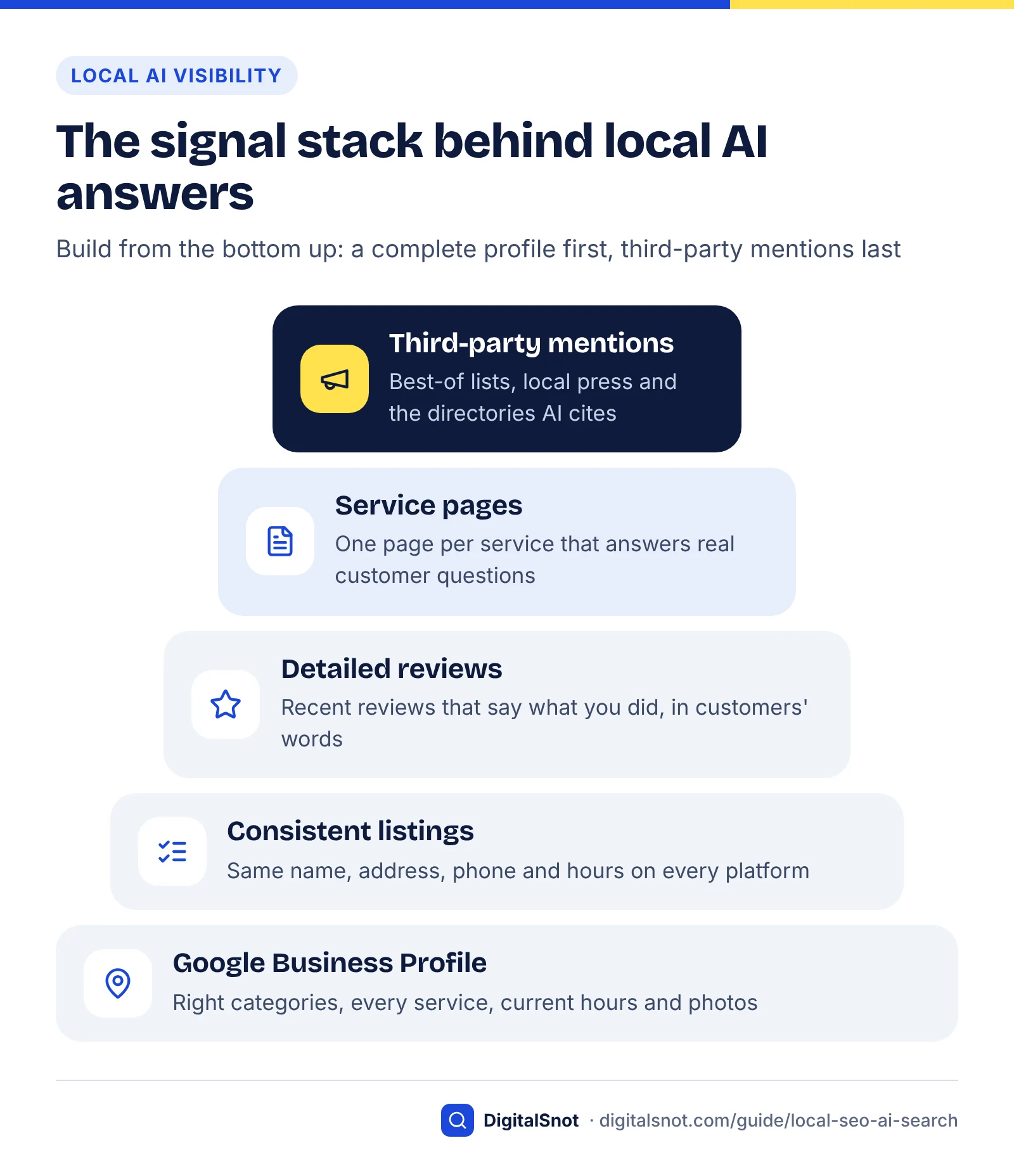
The signals that decide whether AI names a local business are the ones that build trust with people: a complete profile, recent detailed reviews, consistent listings, service pages that answer real questions, and mentions on independent sites. AI answers weight specific written evidence more heavily than a bare star rating.
Business Profile and reviews
For Google's surfaces, the profile is the foundation: BrightLocal found AI Overviews and AI Mode lean heavily on it, and Google's AI guide points local businesses to it. Reviews then work in two ways. Rating and count act as a filter, as SOCi's 4.3-star average for ChatGPT picks suggests, and the text becomes the summary, built from the past year of reviews. A steady flow of new reviews matters more than an old pile.
Our guide to getting more Google reviews covers wording and timing. The free Google Review Link and QR Generator creates a direct review link, QR code and ready-to-send messages from your profile; put the link on receipts and invoice emails.
Listings and consistency
If your website says you open at 8am, your profile says 9am and a directory lists an old phone number, an AI answer may repeat any of them. BrightLocal recommends starting with Google Business Profile, Bing, Apple Maps and Yelp, then industry directories, which AI models strongly preferred in specialised sectors. Microsoft's February 2026 Bing Webmaster Tools announcement points local businesses to Bing Places for Business to keep address, hours and contact details current for AI-generated answers.
Before editing listings one by one, run your key pages through the free AI Answer Consistency Checker, which finds conflicting phone numbers, addresses and figures across your pages and listings. Fix each conflict at its source, starting with your phone number and opening hours.
Third-party mentions
Whitespark's 2026 Local Search Ranking Factors report asked 47 local search experts to score 187 factors and, for the first time, rated each for AI search visibility. Three of the top five AI visibility factors were citation factors, meaning mentions of your business on other sites. One contributing expert added that curated "best of" lists on heavily referenced sites, local magazines and blogs, and forums such as Reddit are disproportionately cited by AI tools. That is opinion, not measurement, but it matches the citation studies.
Build service and location pages that AI can quote
Give each core service its own page that answers customers' questions in plain sentences: what you do, where, for whom, how quickly, what affects the price and how to book. BrightLocal found business websites made up 42% of local AI citations, so your own pages are the largest source you control.
Local map results
What a quotable service page includes
- A first sentence that answers the main question. Example (hypothetical): "We repair gas boilers across north Leeds, usually within 24 hours of your call."
- The areas you serve, named the way customers name them.
- Prices, price ranges or the factors that set the price.
- The questions that used to sit in your profile Q&A.
- Proof: qualifications, registrations, years trading and links to your review profiles.
- Name, address and phone exactly as on your Business Profile.
Our post on service pages versus blog posts explains when a topic needs a service page, and clinics should read local SEO for clinics before writing treatment pages.
Location pages without the spam
Google's AI guide warns that creating separate pages for every query variation, including fan-out queries, mainly to manipulate rankings or AI responses violates its scaled content abuse policy. Query fan-out is the technique AI Mode and AI Overviews use to run several related searches before writing one answer. So skip the hundreds of near-identical "plumber in [town]" pages: build a location page only where you genuinely serve the area, with details only that location has, such as the team, directions, local jobs and local reviews.
Structured data and crawler access
Because Google says no special optimisations are needed for AI features, LocalBusiness markup will not get you into AI answers on its own, but it states your name, address, hours and services without ambiguity. The free Schema Markup Generator writes LocalBusiness JSON-LD from a short form; check every value matches your profile. Our schema markup guide explains which types still earn rich results in 2026.
AI search tools can only quote pages their crawlers can fetch. The free AI Crawler Checker shows, crawler by crawler, whether your robots.txt lets ChatGPT search, Perplexity, Claude, Google and Bing in. If a search crawler is blocked, our guide to deciding which AI crawlers to block shows how to allow search bots while refusing training bots.
Earn the third-party mentions that local AI answers cite
Local AI answers often cite directories, review sites, "best of" lists and local press, so mentions in those places put you in the pool AI picks from. Earn them by being genuinely notable locally; do not manufacture them.
- List the pages AI already cites. Run your test prompts (next section) and note every third-party source cited beside competitors. That is your outreach list.
- Get listed where you belong: industry directories, trade bodies, chambers of commerce and the review platforms your customers use.
- Pitch curated lists. Give the editors of local "best of" lists accurate facts, good photos and a reason to include you.
- Take part in local life. Sponsorships, events and local news stories create genuine mentions.
- Compare with the page AI cites instead. The free AI Citation Gap Checker compares your page with a competitor page that AI cites, factor by factor, showing what it offers that yours lacks, such as a direct answer or specific details.
What not to do
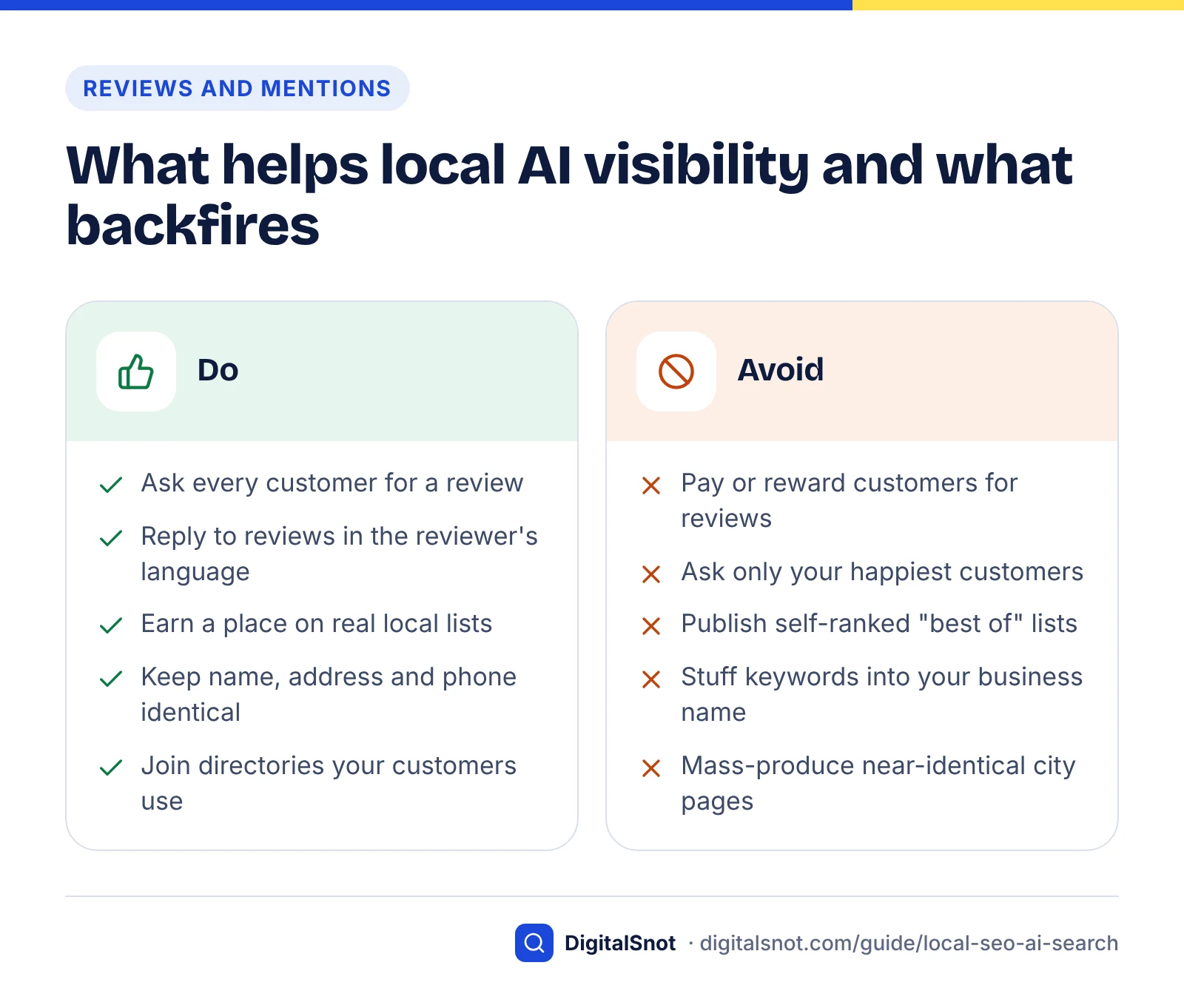
- Do not buy or reward reviews. Google's Maps fake engagement policy prohibits content not based on a real experience, reviews paid for directly or in kind, and posts from multiple accounts at one person's request.
- Do not publish self-ranked "best of" lists. Ranking yourself first on your own site is not a third-party mention, and Google's AI guide lists "pursuing inauthentic mentions" among tactics you can ignore.
- Do not stuff keywords into your business name. It breaks Google's profile guidelines and risks suspension.
- Do not ask only your happiest customers. A balanced stream of genuine reviews gives AI summaries detail and credibility.
Check your AI local visibility without paid tools
Check AI visibility by running the same real customer questions on each surface many times and recording how often you are named, not where. Repeat runs overlapped by only a fifth to a third in BrightLocal's data, so only your mention rate across many runs means something.
- Write 10 prompts customers really use, such as "emergency plumber near me" or "best family dentist in Kothrud", mixing "near me" and named-place versions.
- Control the location. ChatGPT uses an approximate location from your IP address unless you share a precise one, and OpenAI's help page on ChatGPT search suggests adding a city, neighbourhood or postcode when local results look wrong. Test from your service area or name the place.
- Run each prompt three times on AI Mode, Ask Maps (where available) and ChatGPT, in fresh sessions, and repeat the full set every month.
- Record per run whether you were named, the sources cited, competitors named and any wrong fact.
- Report the monthly mention rate per surface: runs where you were named divided by total runs.
How many runs you need: a worked calculation
Method: we applied the standard 95% margin-of-error formula for a proportion, 1.96 × √(p × (1 − p) ÷ n), where n is the number of runs, with p = 0.33 (BrightLocal's AI surfaces named businesses in 32–38% of searches) and p = 0.5 as the worst case. It assumes independent runs, which is optimistic, so read these as minimum margins.
| Runs per surface | Margin at a 33% mention rate | Worst-case margin (50%) |
|---|---|---|
| 5 | ±41 points | ±44 points |
| 10 | ±29 points | ±31 points |
| 20 | ±21 points | ±22 points |
| 30 | ±17 points | ±18 points |
| 50 | ±13 points | ±14 points |
| 100 | ±9 points | ±10 points |
Ten prompts run three times gives 30 runs per surface and a margin of about ±17 points: enough to see a move from rarely named to often named, not to prove a five-point change. Act only on large, repeated shifts.
First-party data to add
- Google Search Console has a generative AI performance report with impressions in AI Overviews and AI Mode by page; our guide to the Search Console AI performance report explains how to read it.
- Bing Webmaster Tools has an AI Performance report, from the same February 2026 announcement, showing how often your pages are cited in Copilot.
India and multi-language local search: Hindi, Ask Maps and AI Mode
India was one of the two launch markets for Ask Maps, and Google's AI features there work in several Indian languages, so Indian businesses should test in the languages their customers use. Ask Maps has worked in English in India since March 2026 and in Hindi since August 2026.
Google's August 2026 India update rolled out Ask Maps in Hindi, added live departure times for buses, metro and trains (its example is ISBT Kashmere Gate in Delhi), and introduced opt-in Personal Intelligence, which can use Gmail bookings for suggestions. In October 2025 Google began rolling out AI Mode in seven more Indian languages: Bengali, Kannada, Malayalam, Marathi, Tamil, Telugu and Urdu, and launched Search Live, AI Mode's voice and camera feature, in English and Hindi.
What this means for an Indian local business
- Test in every language customers use, including Hindi-English mixes.
- Publish key facts in those languages: services, areas, hours and prices, written or checked by a fluent speaker.
- Reply to reviews in the reviewer's language. It reads naturally and shows you serve customers in that language.
- Keep Indian listings consistent. On Justdial, IndiaMART for suppliers, Practo for clinics, or Zomato and Swiggy for restaurants, name, address, phone and hours must match your Business Profile.
We found no published study measuring which Indian directories AI tools cite (checked October 2026), and BrightLocal's citation data covers the US, UK and Australia, not India. Agency blogs that say Justdial or Practo drive AI recommendations show no data. Test instead: run your prompts for your city and category and record which Indian sites are cited. If Justdial pages appear beside competitors, fix your Justdial listing first.
Example (hypothetical): a dental clinic in Kothrud, Pune, runs 10 prompts in English, Hindi and Marathi, such as "Kothrud mein achha dentist", three times each in AI Mode and ChatGPT. Ask Maps gives no answers about the clinic, which fits BrightLocal's finding for some healthcare categories. ChatGPT quotes an old Sunday closing time from a directory, and AI Mode never mentions children's dentistry because that service is missing from the profile. The clinic fixes both, publishes a bilingual page on children's dental care and compares mention rates a month later.
Which fix comes first: a decision table
Start with the fix that matches where you are missing. If you are not in the map pack at all, AI work will not save you; if you are in the pack but missing from AI answers, the gap is usually profile detail, reviews, your website or mentions.
| If this is your situation | Do this first | Why |
|---|---|---|
| Not in the local pack for your main service | Fix Business Profile basics: category, address or service area, verification, reviews | Google's AI surfaces lean on the same profile data, so there is nothing to build on yet |
| In the local pack, missing from AI Mode and AI Overviews | Complete every profile field and service, ask for detailed reviews, add service pages that answer the query | Google's AI reads your profile and review text, and names fewer businesses |
| In Google's AI answers, missing from ChatGPT | Claim Yelp and industry directories where your market uses them; check AI crawlers can reach your site | ChatGPT hardly uses Business Profile and cites websites and directories |
| AI repeats a wrong fact about you | Fix the source: profile first, then website, then directories | Ask Maps has no correction route, so the source is the only lever |
| Named only for "near me" prompts, or only for named-place prompts | Add service areas and the place names customers use to your profile and service pages | Wording changed AI Mode results in the Local SEO Data tests |
| Clinic or regulated category that Ask Maps does not cover | Concentrate on AI Mode, AI Overviews, ChatGPT and health directories | BrightLocal found Ask Maps missing for some healthcare categories (March 2026) |
| Multi-location brand with low AI share | One genuinely local page and a steady review flow per location | SOCi found ChatGPT recommended 1.2% of brand locations |
| Customers search in Hindi or a regional language | Test prompts in those languages and publish key facts in them | Ask Maps answers in Hindi and AI Mode supports several Indian languages |
If two rows apply, work top to bottom, because the earlier rows are prerequisites for the later ones. Whichever row you start on, keep asking for reviews every week, because review text and ratings feed the AI summaries and filters described above.
A 30-day local AI visibility plan
Thirty days is enough to fix the facts AI reads and set a baseline, not to see a final result. Week 1 measures, weeks 2 and 3 fix your profile and website, and week 4 starts the slower work on listings and mentions before rerunning the test.
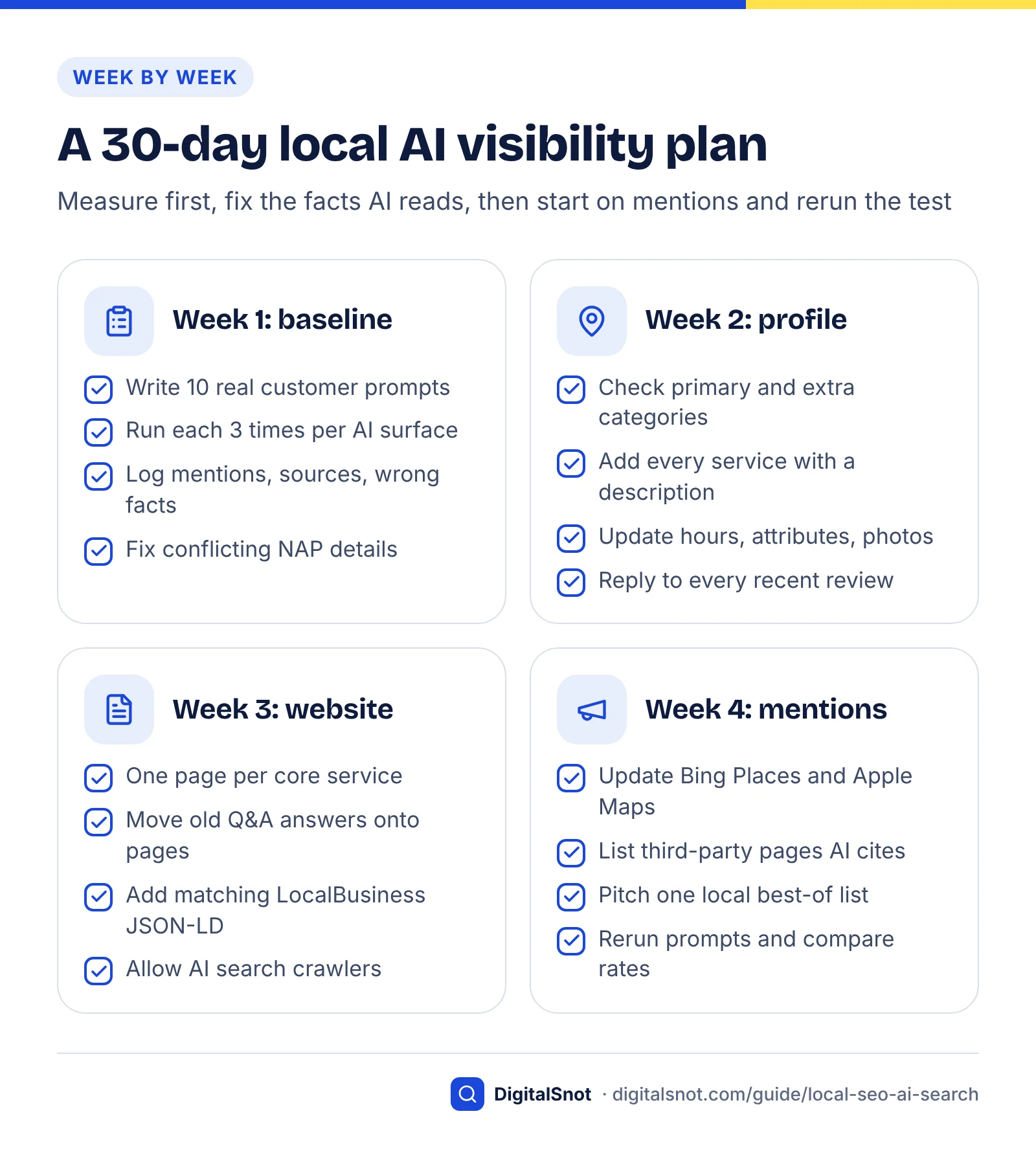
- Week 1, baseline: write 10 customer prompts, run each three times per surface, log mentions, sources and wrong facts, and fix conflicting names, addresses, phone numbers and hours.
- Week 2, profile: confirm categories, add every service with a description, update hours, attributes and photos, and start a weekly review request.
- Week 3, website: give each core service a page that opens with a direct answer, move your old Q&A answers onto those pages, add LocalBusiness JSON-LD that matches your profile and confirm AI search crawlers are allowed.
- Week 4, listings and mentions: update Bing Places, Apple Maps, Yelp where used and your industry or country directories, pitch one local "best of" list, then rerun the prompts and compare mention rates.
After day 30, repeat the test monthly and review service pages each quarter. Factual errors usually clear once the source is fixed and recrawled; mentions build slowly.
If you would rather have this handled for you, our local SEO service covers profiles, reviews, listings and AI visibility tracking. For AI visibility beyond local searches, read our guide to getting cited in AI search, and when you want to talk it through, get in touch.
Free tools in this guide
- Google Review Link & QR Generator Make a QR code and printable card for your Google review link.
- AI Answer Consistency Checker Find brand facts that differ between your pages and listings.
- Schema Markup Generator Create JSON-LD for 10 schema types, with live checks for missing fields.
- AI Crawler Checker See which AI crawlers can read your page, and what they see without JavaScript.
- AI Citation Gap Checker Compare your page with a cited competitor and see the gaps to close.
By the numbers
- of localised searches in which Google Maps named a tracked business, against 32–38% for AI Overviews, ChatGPT and AI Mode (2026)
- 66%
- Source: BrightLocal
- of multi-location brand locations recommended by ChatGPT, against a 35.9% appearance rate in Google's local 3-pack (2026)
- 1.2%
- Source: SOCi
- of local-pack businesses were missing from Google AI Mode for the same search (1,120 searches, May 2026)
- 28.5%
- Source: Local SEO Data via PRWeb
- of US consumers now use AI tools to find local business recommendations, up from 6% in 2025
- 45%
- Source: BrightLocal
Frequently asked questions
How does Google AI Mode choose local businesses?
Google has not published a local ranking formula for AI Mode, but its May 2026 AI guide says Business Profiles help businesses appear in AI responses, and BrightLocal's 2026 study found AI Mode relies heavily on Business Profile data. AI Mode also reads web pages from Google's index and AI summaries of reviews. It names fewer businesses than the map pack, and its picks vary between runs, so profile completeness, review text and clear service pages all matter.
What is Ask Maps in Google Maps?
Ask Maps is a conversational feature in Google Maps, built on Gemini, that answers questions about places by text or voice. Google launched it in March 2026 in the US and India, added Hindi in India in August 2026, and expanded it that month to Australia, Brazil, Canada, Indonesia, Japan, Mexico and more than 150 other countries and territories in English. It draws on profile details, reviews and web content, and can book reservations.
Can I edit or correct what Ask Maps says about my business?
Not directly. According to BrightLocal, Ask Maps generates answers in real time, so there are no stored answers to edit, owners cannot see which questions customers ask, and there is currently no way to report an inaccurate response. The practical fix is to correct the information it draws on: your Business Profile fields, your website and any directory listing that carries the wrong fact, then check the answer again.
Why is my business in the map pack but not in AI Mode?
AI Mode picks from a wider pool and names fewer businesses, so a pack ranking is no guarantee. A June 2026 Local SEO Data study found 28.5% of local-pack businesses missing from AI Mode for the same search, and adding "near me" to some queries changed the results. Complete your profile and service list, ask for detailed reviews, publish service pages that answer the query, and test several phrasings many times.
Does ChatGPT use Google Business Profile for local recommendations?
Very little. BrightLocal's 2026 research found Google Business Profile was 28.5% of all local AI citations but was hardly used by ChatGPT, which leaned on business websites and directories; Yelp appeared as a source in 80% of ChatGPT's local answers in its US, UK and Australian sample. To appear in ChatGPT, keep your website crawlable and accurate, and keep your directory listings consistent.
Do reviews affect whether AI recommends my business?
Yes, in two ways. Ratings and review counts act as a filter: SOCi found locations recommended by ChatGPT averaged 4.3 stars. Review text also becomes the summary, because Google builds AI review summaries from the past year of reviews and refreshes them weekly. Ask every customer for a review, reply to them all, and never pay or reward customers for reviews, which Google's Maps policies prohibit.
Do I need schema markup or llms.txt to appear in local AI answers?
No. Google's May 2026 guide says there are no additional requirements or special optimisations needed for AI Overviews or AI Mode, and lists unnecessary AI text files such as llms.txt among tactics you can ignore. LocalBusiness markup is still worth adding because it states your name, address, hours and services clearly, but it will not get you into AI answers on its own.
Is Ask Maps available in India and in Hindi?
Yes. Ask Maps began rolling out in India in English on Android and iOS in March 2026, alongside the US, and Google rolled it out in Hindi in August 2026. The same update added live transit times and opt-in Personal Intelligence. Separately, AI Mode has worked in Hindi and, since October 2025, in Bengali, Kannada, Malayalam, Marathi, Tamil, Telugu and Urdu.
How can I check if AI tools recommend my business?
Write about 10 prompts that real customers use, mixing "near me" and named-place versions, and run each one three times on AI Mode, Ask Maps and ChatGPT in fresh sessions, repeating the set monthly. Record whether you were named, the sources cited and any wrong facts. Report your mention rate, because answers change between runs; even with 30 runs per surface the margin of error is around 17 percentage points.
How long does it take to show up in local AI answers?
No study gives a reliable timeline. Factual fixes, such as correcting hours or adding a service to your profile, can show up once Google and other platforms process the change. Reviews, third-party mentions and new service pages take longer, because they need to build up and be recrawled. Plan in months, measure mention rates monthly, and judge progress on repeated trends rather than single answers.
Sources
Every figure and claim in this guide comes from the sources below. We checked each one when writing and link to the original so you can read it yourself. Credit belongs to the authors and publishers listed. How we write and check our articles.
-
1
Optimizing your website for generative AI features on Google Search
Google Search Central · Business Profile and AI responses; no special optimisations; fan-out pages and inauthentic mentions (May 2026).
-
2
How Google sources and uses information in local listings
Google Local Listings Help · Profile data sources; AI place, review and topic summaries; review summaries use the past year, updated weekly.
-
3
Study: AI local search data
BrightLocal · 200,085 searches (Sep 2026): Maps 66% vs AI 32–38%; repeat overlap; GBP 28.5% of citations.
-
4
Where to get local citations for AI search
BrightLocal · 1.97M citations: websites 42%, Yelp in 80% of ChatGPT answers, industry directories, where to start.
-
5
In AI-Driven Discovery, Few Brands Are Chosen, Most Disappear
SOCi · 2026 Local Visibility Index: ChatGPT 1.2%, Gemini 11.0%, Perplexity 7.4% vs 3-pack 35.9%; method.
-
6
Local SEO Data Study Finds 28.5% of Local Pack Businesses Are Invisible in Google AI Mode
Local SEO Data via PRWeb · 1,120 searches (May 2026): 28.5% missing from AI Mode, 48% top-three overlap, "near me" effect.
-
7
Half of consumers are asking AI for business recommendations
BrightLocal · 45% use AI for local recommendations (up from 6%); 97% double-check against reviews (2026).
-
8
Ask Maps and Immersive Navigation: New AI features in Google Maps
Google · Ask Maps launch in the US and India (March 2026); insights from people and web content; booking.
-
9
Google Maps' Ask Maps gets more helpful with food ordering
Google · August 2026 expansion to more countries; US-first food ordering, hotels and events.
-
10
A Guide to Google Business Profile Q&A
BrightLocal · Q&A API retired 3 Nov 2025; Ask Maps answers cannot be edited or reported; category gaps (March 2026).
-
11
Introducing AI Performance in Bing Webmaster Tools Public Preview
Microsoft Bing Webmaster Blog · Copilot citation reporting; Bing Places keeps local details current for AI answers (Feb 2026).
-
12
Whitespark's Official 2026 Local Search Ranking Factors Report
Whitespark · 47 experts, 187 factors, first AI visibility scores; citation factors lead; expert notes on lists.
-
13
Fake engagement
Maps User Generated Content Policy Help · Bans reviews not based on real experience, paid reviews and multi-account posting.
-
14
Searching the web with ChatGPT
OpenAI Help Center · Approximate IP-based location for local results; add a city or postcode to correct the area.
-
15
Ask Maps gets more helpful in India
Google India Blog · Ask Maps in Hindi, live transit and opt-in Personal Intelligence in India (August 2026).
-
16
Supercharging Search for India: New Languages in AI Mode & Search Live debuts
Google India Blog · AI Mode in seven more Indian languages; Search Live in English and Hindi (October 2025).


