How ChatGPT recommends businesses (and what you can do about it)
When ChatGPT recommends a business, it usually searches the web first and cites what it finds. Here is how that works and what a small business can do to show up.

On this page (9 sections)
More customers now ask ChatGPT questions like "best physiotherapist near me" or "which accounting software suits a small shop". The answer often recommends a few businesses by name and links to sources. If yours is not among them, it is fair to ask why, and how ChatGPT recommends businesses in the first place.
This post explains, using OpenAI's own documentation, how ChatGPT finds and cites businesses, what it does not tell us, and the practical steps a small business can take. It also shows you how to test where you stand.
Why ChatGPT recommendations matter now
ChatGPT has become a common place to ask for advice, and advice often includes "who should I use?". In Pew Research Center's February 2026 survey of U.S. adults, 44% said they use ChatGPT, up from 34% in 2025. Pew notes its question wording changed in 2026, so the comparison is not exact, and the data is for the United States, not India.
How people use it matters too. A study of ChatGPT consumer messages from May 2024 to June 2025 by OpenAI and Harvard economists, How People Use ChatGPT, classed 49% of messages as "Asking", meaning seeking information or advice to make a decision. Choosing a supplier is exactly that kind of decision.
How ChatGPT finds businesses: search, sources, answer
For questions that need current information, ChatGPT searches the web, reads the results and writes an answer with citations. Recommendations are built from what that search returns, not only from what the model learned in training.
AI assistant answer with citations
1. It turns your question into search queries
OpenAI's help article on searching the web with ChatGPT says that when it uses search partners, ChatGPT generally rewrites the request into one or more targeted queries. It may estimate a general location from the user's IP address, so a "near me" question can become a query that names a city. The IP address itself is not passed to the search providers.
2. It retrieves results from search providers and its own crawler
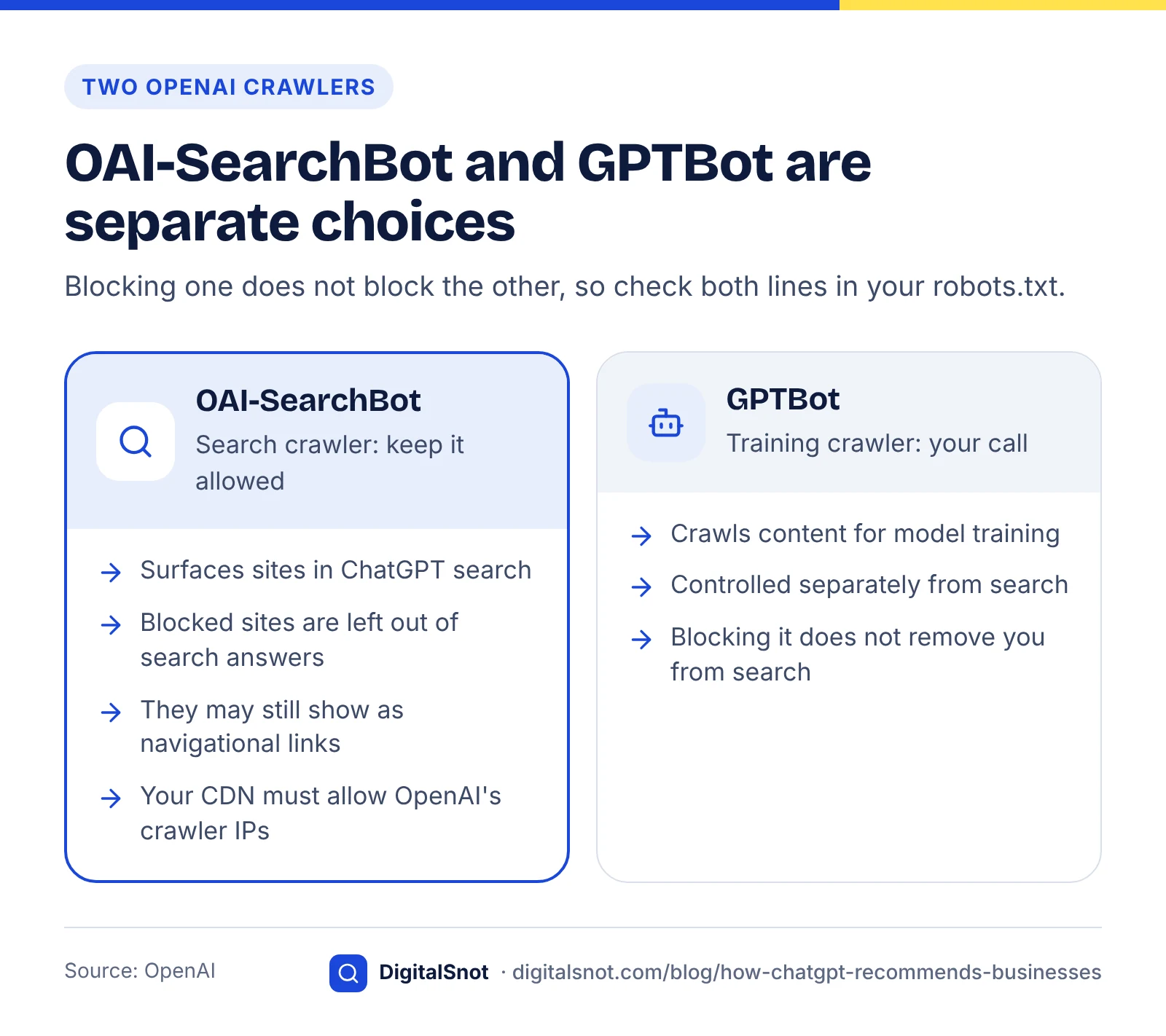
When OpenAI introduced ChatGPT search in October 2024, it said the feature uses third-party search providers as well as content provided directly by partners. Its own crawler matters too. OpenAI's crawler documentation says OAI-SearchBot is used to surface websites in ChatGPT's search features, and that sites which block it will not be shown in ChatGPT search answers, though they can still appear as navigational links. GPTBot, the training crawler, is controlled separately. Our guide on which AI crawlers to block or allow goes through each bot and what blocking it costs.
For business workspaces, OpenAI's Enterprise and Edu search article says disassociated search queries may be shared with Bing. That is one practical reason to make sure Bing can find and index your site, not only Google.
3. It writes an answer and cites sources
Answers that use search can include inline citations and a Sources list. OpenAI also warns that results and citations can be incomplete or wrong, so users are encouraged to check the source. For your business, that means the cited page is often where the customer goes next.
How ChatGPT picks a business to recommend
What we found in OpenAI's documentation
OpenAI documents the mechanics, but not a ranking formula. We read the OpenAI pages cited in this post (the search help article, the crawler overview, the publisher FAQ, the shopping help article and the ChatGPT search launch post) and sorted what they state from what they leave out.
| Question | What OpenAI states | What it does not state |
|---|---|---|
| Can any site appear? | Any public site can appear if OAI-SearchBot is not blocked | How many results are considered per answer |
| How are results ranked? | Multiple factors aimed at relevant, reliable information; placement not guaranteed | The factors or their weights |
| Where do results come from? | Third-party search providers, partner content and OAI-SearchBot | Which provider is used for each query |
| Do reviews count? | For shopping, review summaries are model-generated from reviews on public websites | Whether reviews affect local service recommendations |
| Is it paid? | Product results are selected independently and are not ads | Nothing that lets a business pay for an organic recommendation |
| Can I measure it? | Referrals carry utm_source=chatgpt.com | Impression or citation counts for site owners |
The practical reading: anyone promising a guaranteed ChatGPT recommendation is claiming more than OpenAI itself does. What you can control is whether your site is reachable, and what the wider web says about you.
Why consistency, reviews and mentions matter
Because ChatGPT builds answers from several pages, what it says about you reflects what those pages say. If your website, directory listings and review profiles disagree, the answer may be vague, outdated or about a competitor with a similar name.
Entity consistency
Use the same business name, address, phone number, categories and service descriptions everywhere: your website, Google Business Profile, directories and social profiles. On your site, Google's Organization structured data lets you list your official profiles with the sameAs property, which makes it clearer that they all describe one business.
Reviews
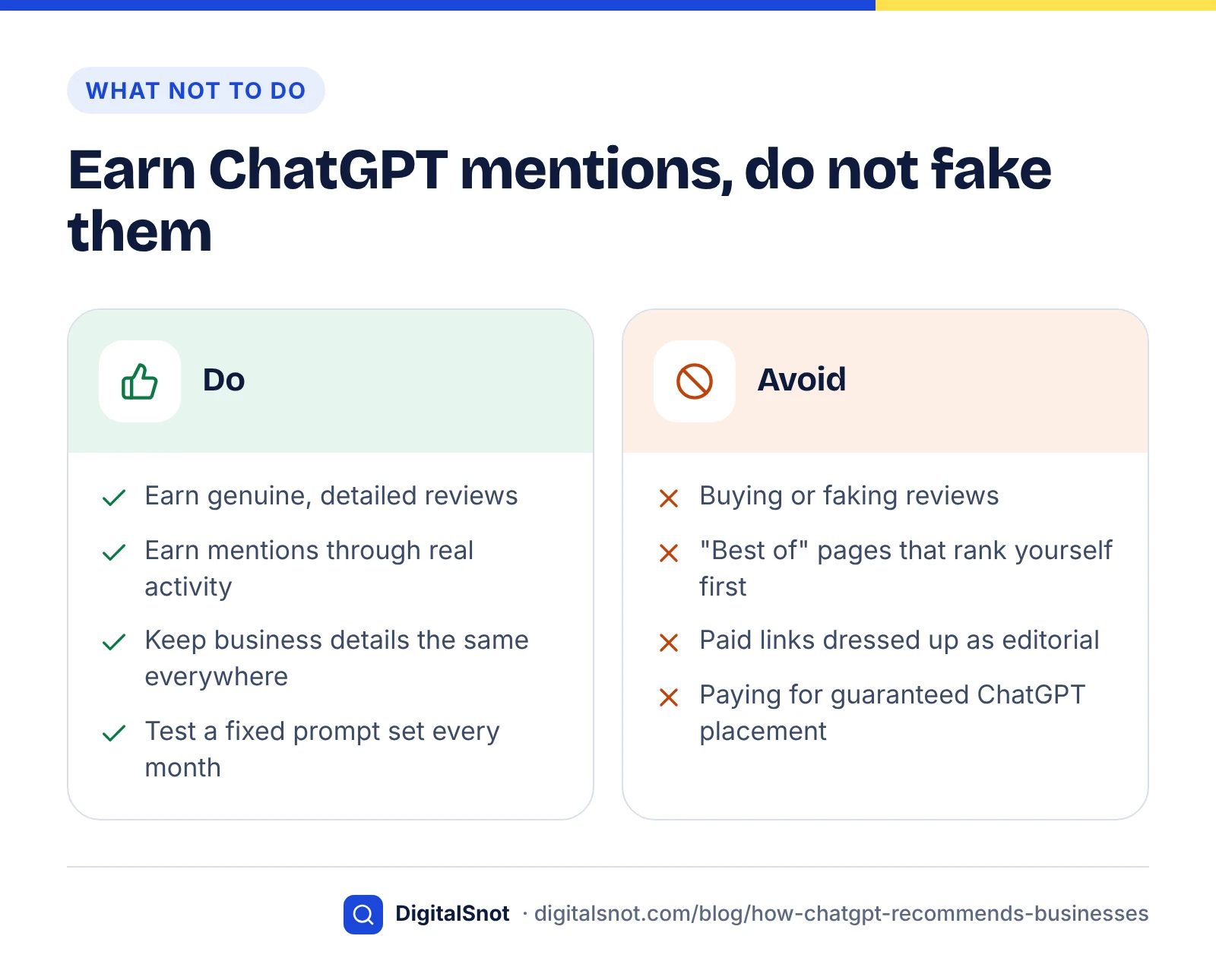
OpenAI's shopping help article says review summaries are built from public websites and that reviews are not verified by OpenAI. OpenAI documents this for products; it does not say how reviews affect local service recommendations. Even so, a steady flow of genuine, detailed reviews on public platforms gives any search-based answer more to work with. Never buy or fake reviews.
Customer reviews
Third-party mentions
A business that appears only on its own website gives a search-based answer little independent evidence. Mentions in local news, industry associations, supplier pages, "best of" lists and community sites give it more pages to retrieve and cite. Earn them through real activity, not paid placements disguised as editorial.
Practical steps for a small business
Most of the work is ordinary SEO done thoroughly, plus a few checks specific to OpenAI. Work through these in order.
- Check robots.txt. Make sure OAI-SearchBot is not blocked. OpenAI's publisher FAQ also says your host or CDN must allow traffic from OpenAI's published search crawler IP addresses. Blocking GPTBot is a separate choice and does not remove you from search. Our free AI Crawler Checker shows, bot by bot, which AI crawlers your robots.txt lets in.
- Make sure you are indexed. Confirm your key pages are crawlable and indexed in Google and Bing. Our technical SEO audit checklist covers the checks.
- Fix your business details. Align your name, address, phone and services across every profile, starting with a complete Google Business Profile.
- Write pages that answer real questions. One clear page per service and location, with prices or price factors, areas served, credentials and FAQs in plain language.
- Ask for reviews consistently. Ask every satisfied customer, on the platforms your customers use, and reply to reviews.
- Earn local and industry mentions. Associations, local press, partner pages and events are all realistic for a small business.
- Measure. Track sessions with utm_source=chatgpt.com in your analytics and run the prompt tests below every month.
For the full method across ChatGPT, Perplexity and Google's AI features, read our guide to getting cited in AI search. If you serve customers in one area, our guide to local SEO for AI search explains how AI Mode, Ask Maps and ChatGPT pick local businesses.
How to test what ChatGPT says about you
Test with a fixed set of prompts, run the same way each month, and record which businesses and sources appear. Answers vary between runs and users, so one screenshot proves little; a repeated set shows a trend.
- Write 10 to 20 prompts across the types below, using the words your customers use.
- Run them in a logged-out or temporary chat where possible, with search on, and note your location setting.
- Record whether you are mentioned, how you are described, and which sources are cited.
- Repeat monthly and compare. Fix the sources that describe you wrongly.
| Prompt type | Example | What to record |
|---|---|---|
| Category + location | "Best physiotherapy clinic in Baner, Pune" | Are you listed? Which sources are cited? |
| Problem-led | "Where can I get treatment for a sports knee injury in Pune?" | Do your service pages appear? |
| Brand check | "What do people say about [your business]?" | Is the description accurate and current? |
| Comparison | "[Your business] vs [competitor]" | Which strengths are mentioned? |
| Detail check | "What are [your business]'s opening hours and address?" | Are the details correct? |
If the cited sources are directories or review sites, that is useful too: it tells you which third-party profiles to fix first.
What not to do
Do not chase shortcuts. Fake reviews, mass-produced "best of" pages that rank yourself first, and paid links dressed up as editorial can mislead users and break platform policies. They also tend to be the first thing a careful answer engine or a sceptical customer sees through.
Be wary of anyone selling guaranteed ChatGPT placement. Our post on how to choose an SEO agency covers the questions to ask.
Next steps
Start with the two checks that take minutes: robots.txt and a brand-check prompt. Then work through the steps above, one each month.
If you would rather have help, our AI search optimisation service covers crawler access, entity consistency and prompt tracking, and you can ask us a question about your business.
Free tools in this article
By the numbers
- of U.S. adults said they use ChatGPT in Pew's February 2026 survey, up from 34% in 2025
- 44%
- Source: Pew Research Center
- of ChatGPT consumer messages were "Asking" (seeking information or advice) in a study of May 2024 to June 2025 data
- 49%
- Source: OpenAI / NBER (Chatterji et al., 2025)
Frequently asked questions
How does ChatGPT decide which businesses to recommend?
For questions that need current information, ChatGPT searches the web. It rewrites the question into targeted queries, retrieves results from third-party search providers, partner content and pages crawled by OAI-SearchBot, then writes an answer with citations. OpenAI says ranking uses multiple factors aimed at relevant, reliable information, but it does not publish the factors and says placement is not guaranteed.
Can I pay to be recommended by ChatGPT?
OpenAI says product results in ChatGPT search are selected independently and are not ads, and its publisher FAQ says placement is not guaranteed. There is no documented way to pay for an organic recommendation. Be cautious of anyone selling guaranteed ChatGPT placement; focus on crawler access, accurate business details, reviews and genuine mentions instead.
What is OAI-SearchBot and should I allow it?
OAI-SearchBot is the OpenAI crawler used to surface websites in ChatGPT search. OpenAI says sites that block it will not be shown in ChatGPT search answers, except possibly as navigational links. If you want to appear, allow it in robots.txt and make sure your host or CDN does not block OpenAI's published crawler IP addresses. GPTBot, the training crawler, is controlled separately.
Does blocking GPTBot stop my business appearing in ChatGPT?
Not according to OpenAI. Its crawler documentation says GPTBot is used for training and OAI-SearchBot for search, and that the two settings are independent. You can block GPTBot to opt out of training while allowing OAI-SearchBot so your pages can still be used in ChatGPT search answers.
Do reviews affect ChatGPT recommendations?
OpenAI documents that, for shopping results, ChatGPT may show review summaries generated from reviews on public websites. It does not say how reviews affect local service recommendations. Genuine, detailed reviews on public platforms still give a search-based answer more evidence about your business, so ask customers consistently and never fake reviews.
How can I track traffic from ChatGPT?
OpenAI says ChatGPT adds utm_source=chatgpt.com to referral links, so you can see these visits in Google Analytics or similar tools. OpenAI does not provide site owners with impression or citation counts, so combine referral data with a fixed monthly set of test prompts that record whether you are mentioned and which sources are cited.
Sources
Every figure and claim in this article comes from the sources below. We checked each one when writing and link to the original so you can read it yourself. Credit belongs to the authors and publishers listed. How we write and check our articles.
-
1
Americans and AI 2026: Chatbots, Smart Devices and Views on Impact
Pew Research Center · February 2026 survey: 44% of U.S. adults use ChatGPT, up from 34%; wording change noted.
-
2
How People Use ChatGPT
OpenAI / NBER (Chatterji, Cunningham, Deming et al.) · 49% of consumer messages classed as Asking (May 2024 to June 2025 sample).
-
3
Searching the web with ChatGPT
OpenAI Help Center · Query rewriting, approximate location, IP not shared, citations and Sources.
-
4
Introducing ChatGPT search
OpenAI · October 2024 launch: third-party search providers and partner content.
-
5
Overview of OpenAI Crawlers
OpenAI · OAI-SearchBot for search, GPTBot for training, independent settings.
-
6
ChatGPT search for Enterprise and Edu
OpenAI Help Center · Disassociated search queries may be shared with Bing.
-
7
Organization structured data
Google Search Central · sameAs property for listing official profiles of an organisation.
-
8
Shopping with ChatGPT Search
OpenAI Help Center · Review summaries from public websites; results not ads; reviews not verified.
-
9
Publishers and Developers - FAQ
OpenAI Help Center · Do not block OAI-SearchBot; CDN IP allowlisting; ranking factors; utm_source=chatgpt.com.