Guide · AI search
How to get cited in AI search: a GEO guide for your business
A practical guide to generative engine optimisation: how ChatGPT, Perplexity, Copilot and Google AI Overviews choose sources, and what you can do to be one of them.

On this page (12 sections)
- 1What generative engine optimisation is
- 2How AI answers choose their sources
- 3What each platform's documentation says: our comparison
- 4Step 1: let the right crawlers in
- 5Step 2: write answer-first content AI can extract
- 6Step 3: add sourced statistics, quotations and citations
- 7Step 4: make your brand a consistent entity
- 8Step 5: earn third-party mentions and reviews
- 9Step 6: keep content fresh and handle llms.txt honestly
- 10How to measure AI search visibility
- 11Your GEO checklist
- 12Sources
When someone asks ChatGPT, Perplexity, Microsoft Copilot or Google's AI Mode for a recommendation, the answer usually comes with a handful of linked sources. Generative engine optimisation (GEO) is the work of making your pages one of those sources, so that you get cited in AI search answers. It is not a separate discipline from SEO so much as SEO with a different finish line: instead of a blue link, the goal is a citation inside a generated answer.
That finish line matters because fewer people click through. In Pew Research Center's 2025 browsing study of 900 US adults, users clicked a traditional result on 8% of visits when an AI summary appeared, against 15% when one did not. Being named in the summary is increasingly where visibility is won.
This guide explains how AI answers pick their sources, what each platform's own documentation says, and a step-by-step method to improve and measure your citations. Everything here is based on primary documentation and published research, linked where used.
What generative engine optimisation is
Generative engine optimisation is the practice of shaping your content and your wider web presence so that AI-powered search tools retrieve it, trust it and cite it in their answers. The term comes from a 2023 research paper, and it now covers any effort aimed at AI Overviews, AI Mode, ChatGPT search, Perplexity and Copilot.
The phrase was coined in "GEO: Generative Engine Optimization" by Pranjal Aggarwal, Vishvak Murahari and colleagues from Princeton, Georgia Tech, the Allen Institute and IIT Delhi. It was posted to arXiv in November 2023 and accepted at KDD 2024. The authors define generative engines as search systems that use large language models to gather and summarise sources into one answer, and they argue that creators have little control over how they appear in them.
You will also see the labels AEO (answer engine optimisation) and LLM visibility. They describe the same goal. What matters more than the label is understanding the mechanism, because most practical advice follows from it.
GEO versus traditional SEO
Traditional SEO aims for a ranked position on a results page. GEO aims for inclusion and prominence within a synthesised answer, where several sources are blended and only some are named. The two overlap heavily: Google states in its AI features and your website documentation that SEO best practices remain relevant for AI features, and that there are no additional requirements to appear in AI Overviews or AI Mode.
So the honest framing is this. A site with weak technical SEO foundations will struggle in AI search for the same reasons it struggles in classic search. GEO adds a layer on top: content shaped for extraction, facts worth quoting, and a brand that the wider web describes consistently.
How AI answers choose their sources
Most AI search answers are built in three steps: the system interprets the question, retrieves candidate pages from a search index, then writes an answer and cites the pages it drew on. If your page is not in the index being searched, it cannot be cited, however good it is.
This retrieval step is often called retrieval-augmented generation. Google's guide to optimising for generative AI features, published in May 2026, says its AI features use techniques like retrieval-augmented generation and query fan-out to highlight content from the Search index, and that they are rooted in Google's core ranking and quality systems. Query fan-out means the system runs several related searches behind the scenes to cover different parts of a question.
How an AI answer picks its sources
Where each engine retrieves from
- Google AI Overviews and AI Mode draw on Google's own Search index. A page must be indexed and eligible to show with a snippet.
- ChatGPT search relies on OpenAI's search crawler, OAI-SearchBot. OpenAI's overview of its crawlers says sites that opt out of OAI-SearchBot will not appear in ChatGPT search answers, though they may still show as navigational links.
- Perplexity uses PerplexityBot, which its crawler documentation describes as designed to surface and link websites in search results.
- Microsoft Copilot grounds answers in the Bing index. Bing's Webmaster Guidelines refer directly to Copilot experiences and grounding results, and warn against blocking Bingbot.
Why some retrieved pages get cited and others do not
Retrieval only gets you into the candidate pool. The model then picks which passages to use. The GEO paper's benchmark gave each query five relevant sources from Google search, then measured how much of the final answer each source contributed. Rewrites that made a source more specific and verifiable, with citations, quotations and statistics, earned it more of the answer. That is the principle behind most of the content advice later in this guide.
What each platform's documentation says: our comparison
The four major platforms agree on one thing: allow their search crawler, and keep your pages indexable. They differ in how training and user-triggered fetches are controlled, and in what reporting they offer site owners.
To build the table below, we read each platform's official crawler and AI-feature documentation in October 2026 and recorded the same five facts for each: the search crawler, the training control, how user-triggered fetches treat robots.txt, how to opt out of AI answers, and what reporting exists. You can repeat this check yourself; the links are in the sources list, and these pages change often.
| Platform | Crawler that decides search inclusion | Training control | User-triggered fetcher | Opting out of AI answers | Site-owner reporting |
|---|---|---|---|---|---|
| Google (AI Overviews, AI Mode) | Googlebot (normal Search crawling) | Google-Extended token; does not affect Search inclusion or ranking | Not a separate factor in Google's AI features guidance | nosnippet, data-nosnippet, max-snippet or noindex; plus a Search generative AI control in Search Console | Search Console: Web totals plus a Generative AI performance report |
| OpenAI (ChatGPT search) | OAI-SearchBot | GPTBot, controlled independently | ChatGPT-User; robots.txt rules may not apply | Disallow OAI-SearchBot; use noindex to stop link and title showing | No dashboard; referrals carry utm_source=chatgpt.com |
| Perplexity | PerplexityBot | Perplexity says it does not build foundation models | Perplexity-User; generally ignores robots.txt | Disallow PerplexityBot (domain, headline and a brief summary may still be indexed) | No dashboard; referrals visible in analytics |
| Microsoft (Copilot, Bing) | Bingbot | No separate AI training token in the Bing guidance we read | Not described | NOINDEX removes from Copilot; NOARCHIVE stops use in Copilot responses; NOCACHE limits to URL, title and snippet | Bing Webmaster Tools AI Performance report (public preview) |
What the comparison tells you
- Search crawlers are the gatekeepers. Every platform ties citation eligibility to its search crawler or index, not to its training crawler.
- Training and search are separate decisions. OpenAI states that each robots.txt setting is independent, so you can allow OAI-SearchBot while disallowing GPTBot. Google says the same of Google-Extended.
- Robots.txt is not a full privacy tool. OpenAI and Perplexity both say their user-triggered fetchers may not follow robots.txt, because a person asked for the page.
- Snippet controls are the real AI levers on Google and Bing. Meta directives such as nosnippet (Google) and NOARCHIVE (Bing) decide whether your text can feed an answer.
- Reporting is uneven. Google and Microsoft now report AI visibility to site owners; OpenAI and Perplexity do not, so you rely on analytics and prompt tests.
Step 1: let the right crawlers in
Allow the search crawlers of every engine you want citations from, and make a separate, deliberate decision about training crawlers. Blocking the wrong user agent is the most common reason a good site is missing from AI answers.
Start by reading your live robots.txt file and your CDN or firewall rules. Many sites block AI bots at the firewall without anyone in marketing knowing. OpenAI's publishers and developers FAQ says sites must not block OAI-SearchBot to appear in ChatGPT summaries and snippets, and OpenAI and Perplexity both publish IP ranges so you can allowlist the genuine bots. For a quick first check, the free AI Crawler Checker reads your robots.txt and shows, crawler by crawler, whether ChatGPT search, Perplexity, Google, Bing and AI training bots may fetch a page.
Search crawlers versus training crawlers
The distinction is simple once laid out:
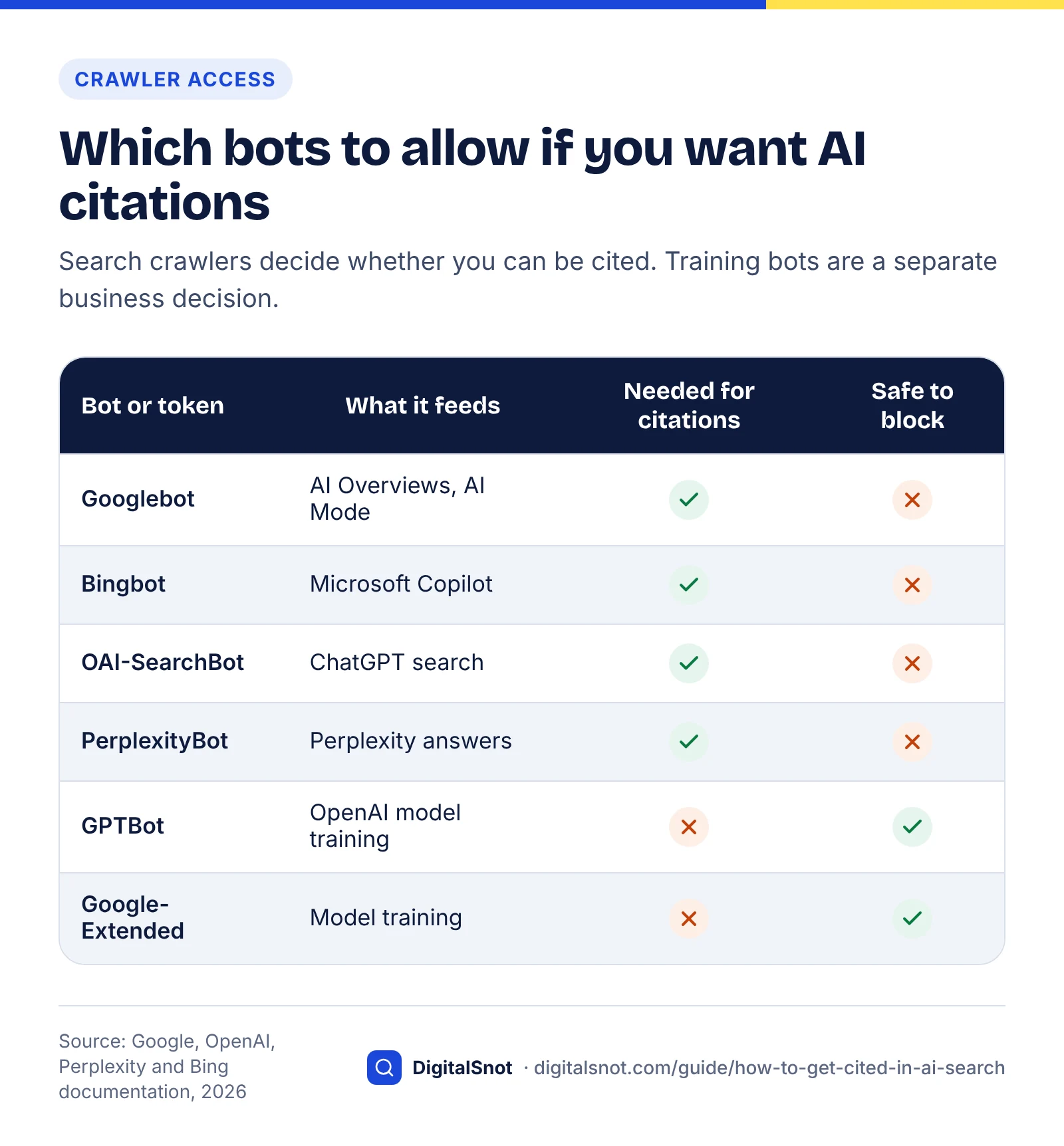
- Search crawlers (Googlebot, Bingbot, OAI-SearchBot, PerplexityBot) index pages so they can be retrieved and cited. Block these and you disappear from that engine's answers.
- Training crawlers and tokens (GPTBot, Google-Extended) govern whether content can be used to train or ground models. Google's common crawlers documentation states that Google-Extended does not affect a site's inclusion in Google Search and is not used as a ranking signal.
A typical configuration for a business that wants AI citations but prefers not to contribute to model training looks like this in robots.txt: allow OAI-SearchBot, PerplexityBot, Googlebot and Bingbot; disallow GPTBot and Google-Extended. Whether to block training is a business decision, not an SEO one. Blocking it does not remove you from ChatGPT search or Google Search. Our guide to blocking AI crawlers without disappearing from AI search lists each bot, what blocking it costs and ready-made robots.txt policies.
Allow time and check the result
OpenAI and Perplexity both say robots.txt changes can take around 24 hours to take effect. Check your server logs afterwards for requests from each user agent, and confirm they come from the published IP ranges rather than a spoofed user-agent string.
Know the opt-out switches
If you need to keep particular content out of AI answers, use the documented controls rather than robots.txt alone. On Google, the nosnippet and data-nosnippet rules stop text being used as direct input to AI Overviews and AI Mode. Google also offers a Search generative AI control in Search Console settings that excludes a site from AI Overviews, AI Mode and generative features in Discover without affecting the rest of Search. On Bing, NOARCHIVE and NOINDEX are the documented levers. Perplexity's help article on robots.txt adds that if you disallow PerplexityBot, your domain, headline and a brief factual summary may still be indexed.
Crawlability problems rarely stop at AI bots. If your logs show crawl errors, redirect chains or JavaScript-only content, work through our technical SEO audit checklist before anything else.
Step 2: write answer-first content AI can extract
Put the direct answer to the question at the top of each page and each section, in one or two plain sentences, then add the detail. Retrieval systems pull passages, and a passage that answers cleanly on its own is easier to use and cite.
Content plan and article outline
Google's May 2026 guide is clear that you do not need to rewrite content "for AI" or break it into tiny chunks, because its systems understand synonyms and can extract the relevant passage from a long page. That is not a licence for vague writing. It means the usual qualities of a good page, written for people, are what get extracted.
A structure that works for people and for retrieval
- Match the question. Use the words people actually ask with as headings where it reads naturally. Our keyword research guide covers how to find those question phrasings.
- Answer in the first sentence. "Yes, you can..." or "The cost depends on three things..." beats a paragraph of scene-setting.
- Back it up straight after. Give the reason, the number or the source in the next two or three sentences.
- Use lists and tables for comparisons and steps. They make relationships explicit, which helps both readers and extraction.
- Use semantic HTML. Google's guide recommends semantic HTML where possible: real headings, lists and tables rather than styled divs.
- State who you are and when it was updated. Bylines and visible dates help readers judge trust and help you keep pages current.
Write non-commodity content
Google's guide puts particular weight on what it calls non-commodity content: material that offers something beyond what every other page says. An AI answer that already has ten pages repeating the same definition has no reason to cite an eleventh. It does have a reason to cite the page with the original comparison, the specific local detail or the worked example.
For a business, non-commodity content usually means your own process explained in detail, specific constraints you know about (regulations, materials, timings), comparison tables you built from primary sources, and clear answers to the awkward questions competitors avoid. The on-page basics still apply, and our on-page SEO checklist covers titles, headings and internal links in detail.
Step 3: add sourced statistics, quotations and citations
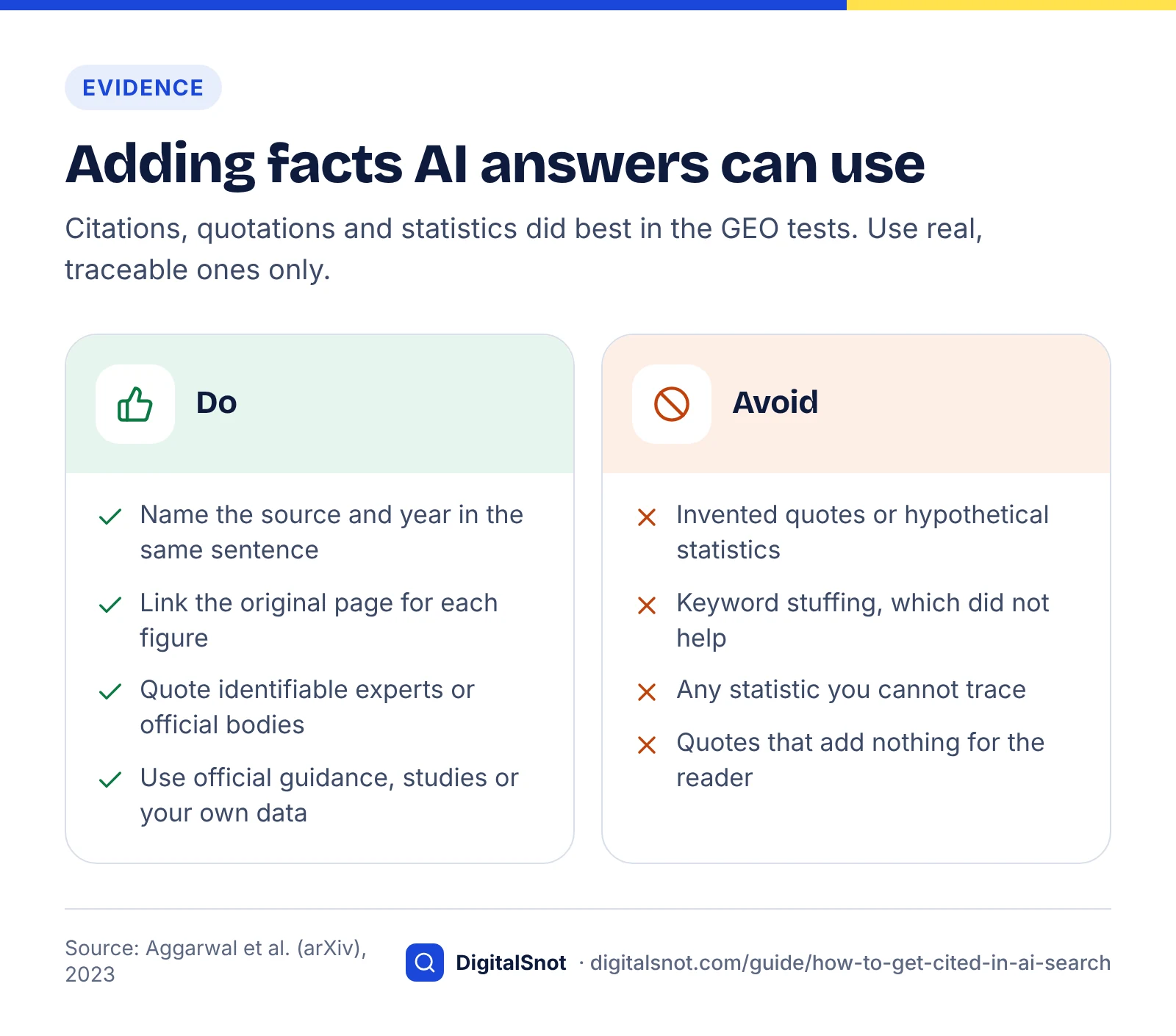
Add specific, verifiable facts to your key pages: statistics with a named source and year, short quotations from identifiable experts or official bodies, and links to the primary sources behind your claims. In the GEO paper's experiments, these were among the edits that most increased a source's visibility in generated answers.
The paper's abstract reports that GEO methods can boost visibility by up to 40% in generative engine responses. The authors tested nine rewriting methods on GEO-bench, a benchmark of 10,000 queries across many domains, including making text more authoritative, more fluent, easier to read, adding technical terms, keyword stuffing, adding citations, adding quotations and adding statistics. Adding citations, quotations and statistics performed best, while keyword stuffing, a classic SEO tactic, did not perform well.
The GEO checklist
What we found when we read the GEO paper's code
The authors published their code in the GEO-optim/GEO repository, so we read the prompts used to generate each method. The instructions for the quotation and statistics methods explicitly allowed the model to add quotes "even though fake and artificial" and statistics "even if hypothetical", and the citation method allowed invented sources that "sound plausible".
That matters for how you apply the findings. The experiment shows that answer engines respond to the presence of specific numbers, quotes and citations. It does not show that fabricated ones are safe to publish, and for a real business they are not: a made-up figure is a trust and legal risk, and it can be checked. The practical lesson is to do the same thing with real, sourced facts.
Other findings worth knowing
- Effects vary by domain. The authors report that method effectiveness differs across subject areas, so test on your own topics rather than assuming one tactic works everywhere.
- Lower-ranked pages gained more. The project's own summary notes that GEO tended to benefit sites ranked lower in conventional search, which is encouraging for smaller businesses.
- It is a lab study. Most results come from the authors' own generative engine built on GPT-3.5, with a smaller test on Perplexity. Treat the numbers as direction, not as a forecast for your site.
How to add evidence without padding
- List the three to five claims on the page that a sceptical reader would question.
- Find a primary source for each: official guidance, a regulator, a published study or your own documented data.
- State the figure with its source and year in the same sentence, and link the source.
- Add a short quote only where an identifiable expert or official body says something your reader needs.
- Remove any statistic you cannot trace to its original page.
If you want help building pages around evidence like this, that is the core of our content SEO work.
Step 4: make your brand a consistent entity
Describe your business the same way everywhere: the same name, address, phone number, short description and category on your website, your structured data and every profile you control. AI systems assemble their picture of a brand from many sources, and conflicting details make you harder to recommend with confidence.
Structured data (JSON-LD) code
Organization structured data and sameAs
Add Organization markup to your home page. Google's Organization structured data documentation says it helps Google understand your organisation's administrative details and disambiguate it in search results. Include your legal name, logo, URL, contact details and address, and use the sameAs property to list your official profiles on social and review sites; Google allows multiple sameAs URLs.
Be realistic about what markup does. Google's AI guide says no special schema is required for generative AI features in Search, while still recommending structured data as part of normal SEO. Markup is a consistency tool, not a citation switch. Our schema markup guide sets out which types still earn a Google feature and what the evidence says about schema and AI answers.
Keep NAP and descriptions aligned
- Write one canonical 25–40 word description of what you do and who for, and reuse it across profiles.
- Keep name, address and phone (NAP) identical across your site, Google Business Profile, Bing Places, directories and social bios.
- Update every profile when something changes, such as a move or a rebrand. Old details linger and get quoted back.
For location-based businesses, much of this overlaps with local SEO, and our Google Business Profile optimisation guide walks through the profile fields that matter. For local questions asked in AI Mode, Ask Maps or AI Overviews, see our guide to local SEO for AI search.
Wikipedia and Wikidata: only where legitimate
Wikipedia and Wikidata are widely used reference sources, which tempts some businesses to create entries for themselves. Wikipedia's conflict of interest guideline strongly discourages editing articles about yourself or your employer, and requires paid editors to disclose who is paying them. If your organisation genuinely meets the notability bar, the right route is to propose changes on the article's talk page and let independent editors decide. If it does not, put the effort into the next step instead.
Step 5: earn third-party mentions and reviews
Get your business mentioned and reviewed on reputable independent sites, because AI answers to "best" and "which" questions often draw on comparison articles, directories and review platforms rather than on your own site.
When an engine fans a question out into several searches, the pages it retrieves are frequently roundups, industry publications, forums and review profiles. If you are absent from those, you are absent from much of the candidate pool. Google's guide specifically lists pursuing inauthentic mentions as something not to do, so this is about earning coverage, not manufacturing it.
Practical ways to earn mentions
- Find the pages AI already cites. Run your target questions (see the prompt test below) and note which third-party pages appear as sources. Those are your outreach list.
- Be useful to those publishers. Offer accurate product details, original data or expert comment for their next update.
- Ask happy customers for reviews on the platforms that matter in your sector, and reply to reviews professionally.
- Join industry bodies and directories that are genuinely used in your sector, and keep those listings consistent with Step 4.
- Publish something others want to reference, such as a clear comparison, a small piece of original research or a useful tool.
None of this is new. It is ordinary reputation and digital PR. The difference is that the payoff now includes being named inside AI answers, not just links and referral traffic.
Step 6: keep content fresh and handle llms.txt honestly
Review and update the pages you want cited on a regular schedule, and tell search engines when they change. Treat llms.txt as an optional experiment: it is a proposal, and Google says it does not use it for Search.
Freshness
Google's AI guidance does not list freshness as a separate requirement, but an answer engine can only quote what its index holds. Out-of-date prices, team pages or opening details get repeated back to customers. Set a review cycle for your most important pages, update facts and dates when something changes, and resubmit the URL.
For Bing, and therefore Copilot, the IndexNow protocol lets you notify participating search engines that a URL was added, updated or deleted, rather than waiting for a recrawl. Notifying one participating engine shares the signal with the others. Submission does not guarantee indexing, but it shortens discovery.
llms.txt: what it is and what it is not
The llms.txt proposal, published by Jeremy Howard in September 2024, suggests placing a Markdown file at /llms.txt that summarises a site and links to its most useful pages for language models. Many documentation sites publish one.
The evidence that answer engines use it is thin. Google's generative AI guide says creating llms.txt or similar AI files is not needed for Search, and a June 2026 update to that guide states such files will neither help nor harm visibility or rankings. We found no official statement from OpenAI, Perplexity or Microsoft confirming that their search products read llms.txt. If you add one, do it because it is cheap and may help agents or developer tools, not as a citation strategy.
How to measure AI search visibility
Measure AI visibility in three ways together: a fixed set of prompts you test on a schedule, referral traffic from AI platforms in your analytics, and the AI reports that Google and Microsoft now provide. No single source gives the full picture.
Monthly results report
A prompt-testing method you can repeat
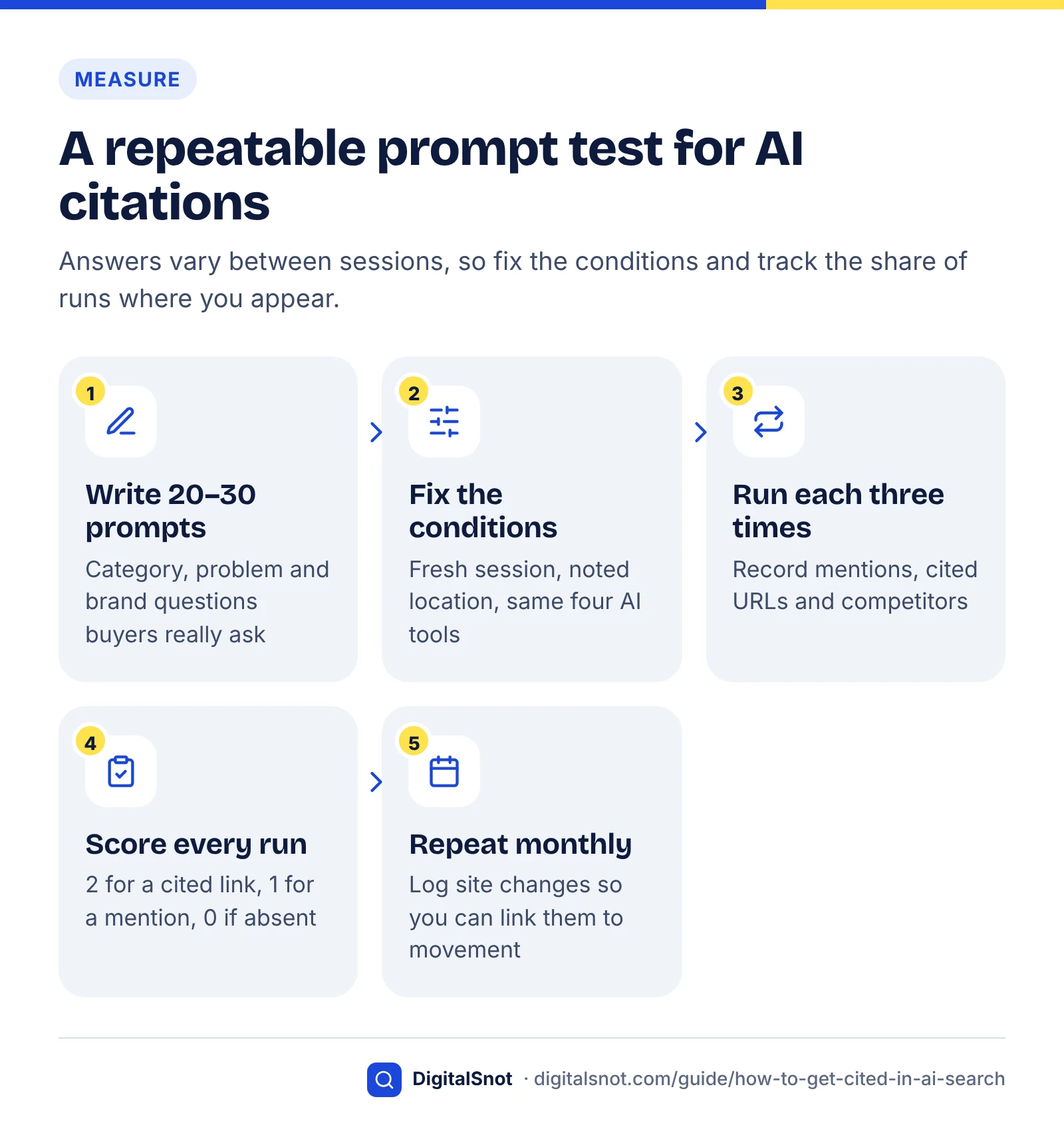
Because answers vary between sessions and users, one-off checks are misleading. This method keeps tests comparable over time:
- Write 20–30 prompts that match real buying and research questions, in three groups: category questions ("best X for Y in Z"), problem questions ("how do I fix..."), and brand questions ("is [brand] good for...").
- Fix the conditions. Use a logged-out or fresh session where possible, note the location, and run each prompt in the same tools each time: Google AI Mode, ChatGPT with search, Perplexity and Copilot.
- Run each prompt three times and record whether your brand is mentioned, whether your site is cited as a source, which URL is cited and which competitors and third-party pages appear.
- Score it simply. For example: 2 points for a cited link to your site, 1 for a brand mention without a link, 0 for absent. Track the share of runs where you score.
- Repeat monthly, and log what you changed on the site in between so you can connect actions to movement.
The third-party pages you record in step 3 double as your outreach list for Step 5.
Referral traffic in analytics
OpenAI's publisher FAQ states that ChatGPT adds utm_source=chatgpt.com to referral URLs, so ChatGPT visits are identifiable in Google Analytics and similar tools. Build a segment or channel group that captures sessions with a source of chatgpt.com, perplexity.ai and copilot.microsoft.com. Expect the numbers to be small: Pew found users clicked a link inside an AI summary on just 1% of visits to pages with one.
Search Console
Google's AI features documentation says traffic from AI Overviews and AI Mode is included in Search Console's Performance report under the Web search type. It is not split out there; Google's help page on impressions, position and clicks explains that all links in an AI Overview share a single position, while AI Mode follows the standard results-page method.
In June 2026 Google announced Search generative AI performance reports. They first rolled out to a subset of sites and, according to Google's help page, became available to all websites on 31 August 2026. The Generative AI performance report shows how often links to your site appeared in AI Overviews and AI Mode, by page, country and device. If you cannot see it, Google says the usual reason is too few impressions in those features. Our guide to reading the generative AI report in Search Console covers what it leaves out and how to pair it with your click data.
Bing Webmaster Tools
Bing's AI Performance report, in public preview, shows how often your pages are cited in Microsoft Copilot and AI-generated summaries in Bing, and the grounding queries the AI used when it retrieved your content. Bing notes that the data is a sample and that a citation does not represent clicks or traffic. It is the closest thing to a citation log any platform offers today.
Your GEO checklist
Work through these in order: access first, then content, then reputation, then measurement. Each row links back to the step that explains it.
| Area | Action | How to check |
|---|---|---|
| Access | Allow Googlebot, Bingbot, OAI-SearchBot and PerplexityBot | robots.txt, firewall rules, server logs |
| Access | Decide separately on GPTBot and Google-Extended | Written policy plus robots.txt |
| Access | Key pages indexed and snippet-eligible | Search Console URL inspection, Bing Webmaster Tools |
| Content | Direct answer in the first one or two sentences of each section | Read the opening lines aloud |
| Content | Non-commodity material: your process, comparisons, specifics | Compare against the top pages already cited |
| Evidence | Real statistics and quotes, each with source and year | Every number links to its original page |
| Entity | Organization markup with sameAs; identical NAP everywhere | Rich Results Test, profile audit |
| Reputation | Earned mentions on pages AI already cites; active reviews | Prompt-test source list |
| Freshness | Scheduled reviews; IndexNow or resubmission after changes | Content calendar, update log |
| Measurement | Monthly prompt test, AI referral segment, Search Console and Bing AI reports | Dashboard with trend lines |
Generative engine optimisation rewards the same fundamentals as good SEO, applied with more care for clarity, evidence and consistency. Start with access, because nothing else matters if the crawlers cannot reach you, then improve the handful of pages that answer your customers' most valuable questions.
If you would rather have this done for you, our AI search optimisation service covers crawler access, content, entity work and citation tracking, and you can see how it fits with our other SEO services. When you are ready to talk it through, get in touch.
Free tools in this guide
By the numbers
- maximum visibility boost in generative engine responses reported for GEO methods (Aggarwal et al., 2023; KDD 2024)
- 40%
- Source: arXiv (Princeton, Georgia Tech et al.)
- of Google searches in Pew's March 2025 browsing study returned an AI summary
- 18%
- Source: Pew Research Center
- of visits ended in a click on a traditional result with an AI summary vs without one (Pew, 2025)
- 8% vs 15%
- Source: Pew Research Center
- of visits to pages with an AI summary included a click on a link inside the summary itself (Pew, 2025)
- 1%
- Source: Pew Research Center
Frequently asked questions
What is generative engine optimisation?
Generative engine optimisation (GEO) is the practice of improving your content and wider web presence so AI search tools such as Google AI Overviews, AI Mode, ChatGPT search, Perplexity and Copilot retrieve and cite your pages in their answers. The term comes from a 2023 research paper by Aggarwal and colleagues, later presented at KDD 2024. In practice it builds on SEO, adding a focus on extractable answers, sourced facts and consistent brand information.
How do I get my business cited by ChatGPT?
Make sure OAI-SearchBot is allowed in your robots.txt and not blocked by your firewall or CDN, because OpenAI says sites that opt out of it will not appear in ChatGPT search answers. Then publish clear, answer-first pages with specific, sourced facts, keep your business details consistent across the web, and earn mentions on the third-party pages ChatGPT already cites for your topic.
Does blocking GPTBot remove me from ChatGPT search?
No. OpenAI documents GPTBot and OAI-SearchBot as separate crawlers with independent robots.txt settings. GPTBot relates to training OpenAI models, while OAI-SearchBot decides whether your pages can appear in ChatGPT search. You can disallow GPTBot and still allow OAI-SearchBot. Changes can take about 24 hours to take effect.
Do I need special markup to appear in Google AI Overviews?
No. Google states there are no additional technical requirements to appear in AI Overviews or AI Mode beyond being indexed and eligible to show with a snippet. Its May 2026 guide also says no special schema.org markup or AI text files are needed. Structured data is still worth using for rich results and for describing your organisation consistently.
Does llms.txt help with AI search visibility?
There is little evidence that it does. llms.txt is a proposal published in September 2024, not an adopted standard. Google says llms.txt files are not needed for Google Search and will neither help nor harm rankings, and we found no official confirmation that OpenAI, Perplexity or Microsoft use it for their search products. Adding one is harmless but should not be your citation strategy.
What did the GEO research paper find?
The GEO paper by Aggarwal et al. tested nine ways of rewriting web content on a benchmark of 10,000 queries. It reports that the best methods boosted visibility in generative engine responses by up to 40%. Adding citations, quotations and statistics worked best, while keyword stuffing did not. Note that the experiments allowed invented quotes and statistics, so apply the lesson with real, verified facts only.
How can I see if AI Overviews are sending me traffic?
Google includes AI Overviews and AI Mode traffic in the Search Console Performance report under the Web search type, but it is not separated there. Google began rolling out a Generative AI performance report in June 2026 that shows how often your links appeared in AI Overviews and AI Mode by page, country and device. If you cannot see it, Google says your site may not have enough impressions yet.
How do I track traffic from ChatGPT and Perplexity in analytics?
Create a segment or custom channel in your analytics tool for sessions with sources such as chatgpt.com, perplexity.ai and copilot.microsoft.com. OpenAI states that ChatGPT adds utm_source=chatgpt.com to referral links, which makes those visits easy to identify. Expect low volumes and combine analytics with regular prompt testing, since many AI answers mention brands without a click.
Is GEO different from SEO?
It overlaps heavily. Google says its AI features are rooted in its core ranking systems and that SEO best practices still apply. GEO shifts the goal from a ranked position to being cited inside a generated answer, which puts more weight on clear answer-first writing, verifiable facts, consistent entity information and third-party mentions. A technically weak site will struggle in both.
How long does it take to get cited in AI search?
Access changes are quick: OpenAI and Perplexity say robots.txt updates take about 24 hours to apply, and Google recrawls can take days to months depending on the page. Content, reputation and entity improvements take longer because engines need to recrawl your pages and the wider web needs to mention you. Track progress monthly with a fixed prompt set rather than expecting overnight results.
Sources
Every figure and claim in this guide comes from the sources below. We checked each one when writing and link to the original so you can read it yourself. Credit belongs to the authors and publishers listed. How we write and check our articles.
-
1
Google users are less likely to click on links when an AI summary appears in the results
Pew Research Center · 2025 browsing study: AI summary frequency (18%) and click rates (8% vs 15%, 1%).
-
2
GEO: Generative Engine Optimization
arXiv (Aggarwal et al., KDD 2024) · Origin of the term GEO; up to 40% visibility boost; GEO-bench and methods tested.
-
3
AI features and your website
Google Search Central · No extra requirements for AI Overviews/AI Mode; snippet controls; Search Console reporting.
-
4
Optimizing your website for generative AI features on Google Search
Google Search Central · RAG and query fan-out; non-commodity content; no chunking, schema or llms.txt needed.
-
5
Overview of OpenAI Crawlers
OpenAI · OAI-SearchBot, GPTBot and ChatGPT-User roles; independent settings; 24-hour propagation.
-
6
Perplexity Crawlers
Perplexity · PerplexityBot vs Perplexity-User, robots.txt behaviour and IP ranges.
-
7
Bing Webmaster Guidelines
Bing Webmaster Tools · Copilot grounding; NOINDEX, NOARCHIVE, NOCACHE; do not block Bingbot.
-
8
Publishers and Developers - FAQ
OpenAI Help Center · Do not block OAI-SearchBot; noindex behaviour; utm_source=chatgpt.com referrals.
-
9
Google's common crawlers
Google for Developers · Google-Extended does not affect Search inclusion or ranking.
-
10
Search generative AI control
Search Console Help · Excluding a site from AI Overviews, AI Mode and Discover generative features.
-
11
How does Perplexity follow robots.txt?
Perplexity Help Center · What may still be indexed when PerplexityBot is disallowed.
-
12
GEO-optim/GEO
GitHub (paper authors) · Method prompts we read: quotes, statistics and citations could be invented in tests.
-
13
Organization structured data
Google Search Central · Organization markup purpose and multiple sameAs URLs.
-
14
Wikipedia:Conflict of interest
Wikipedia · Self-editing strongly discouraged; paid editing must be disclosed.
-
15
IndexNow
IndexNow.org · Notifying participating engines (including Bing) of added, updated or deleted URLs.
-
16
The /llms.txt file
llmstxt.org · The llms.txt proposal by Jeremy Howard, September 2024.
-
17
What are impressions, position, and clicks?
Search Console Help · How AI Overview and AI Mode positions and clicks are counted.
-
18
Introducing Search Generative AI performance reports in Search Console
Google Search Central Blog · June 2026 announcement and phased rollout of the AI reports.
-
19
Generative AI performance report (Search)
Search Console Help · What the report shows and why it may be missing.
-
20
Introducing AI Performance in Bing Webmaster Tools (public preview)
Bing Webmaster Blog · Copilot citation counts, grounding queries and data limitations.