Guide · AI search
Brand mentions for AI visibility: earn citations that count
Mentions now matter more than links for AI answers. Find the sources ChatGPT and AI Overviews cite in your niche, earn a place on them honestly and skip the tactics that backfire.
On this page (12 sections)
- 1Why mentions matter to AI answers: what the studies say
- 2Mention, citation, recommendation: three different wins
- 3Find the sources AI engines cite in your niche
- 4Score every source: a mention-source scorecard
- 5Best-of lists and comparison pages: what helps and what backfires
- 6Reviews, directories and industry associations
- 7Reddit, forums and YouTube: take part without spamming
- 8Digital PR a small business can afford
- 9Measure mention growth and citation quality
- 10What to avoid: tactics that look like manipulation
- 11A 90-day plan for a small business
- 12Sources
Ask ChatGPT, Perplexity or Google's AI Mode for "the best accounting software for freelancers" or "a good wedding photographer in Jaipur", and the answer names a handful of brands. Those names rarely come from the brands' own websites alone. In AI search, they come from brand mentions across the rest of the web: comparison articles, review sites, forum threads, videos and local press.
A brand mention is any reference to your business name on a page you do not control, with or without a link. This guide is for small-business owners and in-house marketers who have read that mentions matter more than backlinks for AI answers and want a plan that is ethical and fits a small budget.
By the end you will be able to find the third-party sources AI engines cite for your buying questions, score them, earn a place on them honestly, measure progress without being fooled by random variation, and recognise the tactics that now backfire. Every study is linked and dated. If you are new to AI search, start with our guide to getting cited in AI search, which covers crawler access and on-page content.
Why mentions matter to AI answers: what the studies say
Mentions matter because AI answers summarise what the web says about a brand, and the largest studies so far find that widely mentioned brands are the ones AI names most. The evidence is correlational and skewed towards big brands, so treat it as a direction, not a formula.
The most quoted study is Ahrefs' 2025 analysis of 75,000 brands in Google AI Overviews. Branded web mentions had the strongest correlation with AI Overview visibility (0.664), followed by branded anchors (0.527) and branded search volume (0.392). Backlinks came in at 0.218. Visibility was also concentrated: brands in the top quartile for web mentions averaged 169 AI Overview mentions, against 14 for the next quartile, and about 26% of brands had none at all.
A follow-up Ahrefs study of 75,000 brands, published in December 2025 and later covered by The Next Web, widened the view to ChatGPT, AI Mode and AI Overviews. YouTube mentions, meaning a brand name in a video's title, transcript or description, had the strongest correlation at about 0.737. Weighting those mentions by views scored slightly lower (about 0.717), and branded web mentions scored 0.66–0.71.
Google's own documentation points the same way. Its guide to optimising for generative AI features, published in May 2026, says these features "can show what's being said about products and services across the web, including in blogs, videos, and forum discussions."
Both Ahrefs analyses are correlations, and Ahrefs itself says improving these metrics will not automatically raise your AI visibility. The honest reading for a small business: famous brands get mentioned a lot and named by AI a lot, and some of that is fame causing both. You cannot buy fame, but you can make sure that when the web discusses your category, the pages AI reads include accurate, independent mentions of you.
Mention, citation, recommendation: three different wins
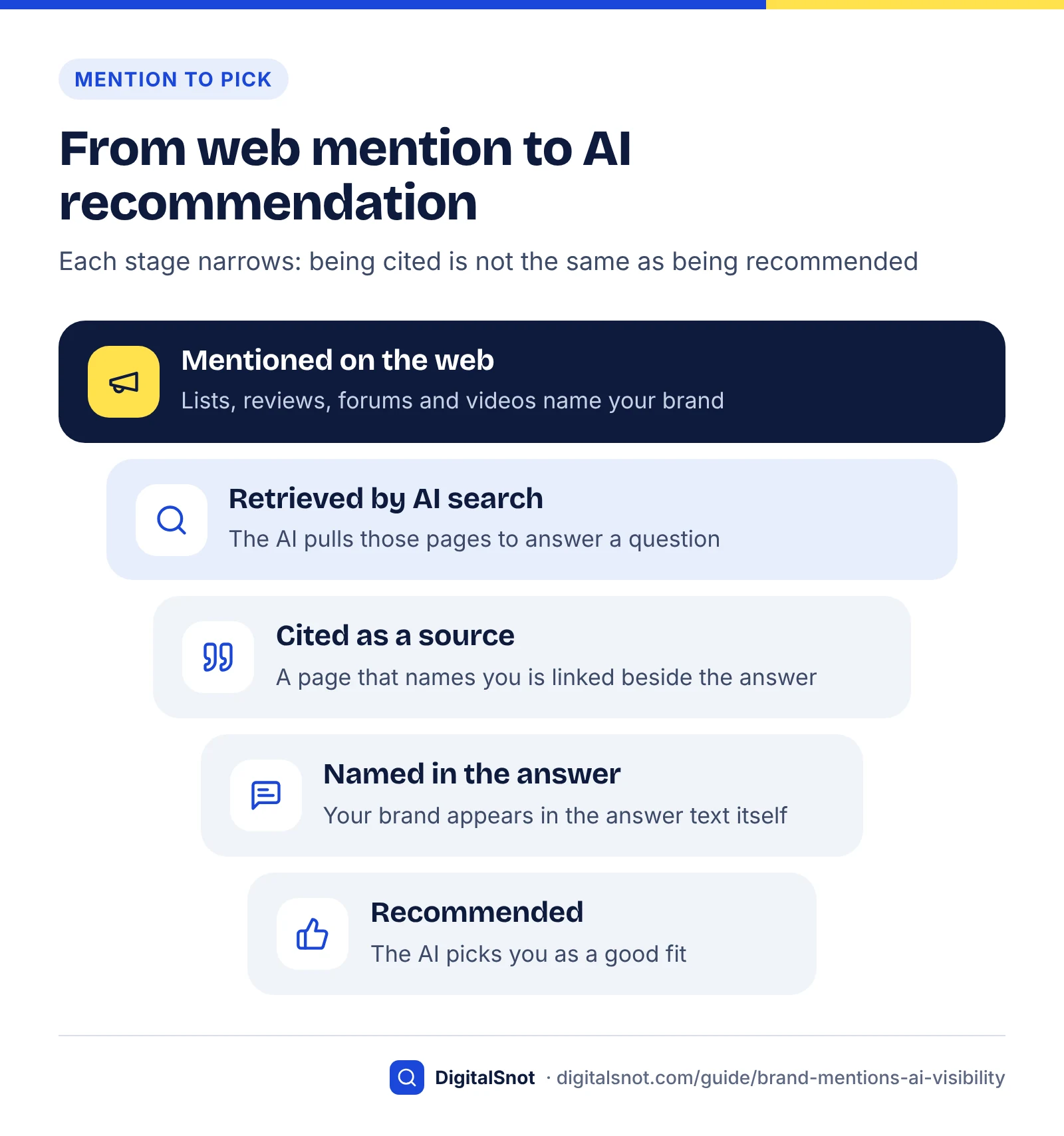
A mention, a citation and a recommendation are different outcomes, and mixing them up wastes effort. A mention is your brand name appearing on a third-party page or in an AI answer. A citation is a linked source shown beside an AI answer. A recommendation is the AI naming you as a good choice for the person's need.
The gap between them can be large. Consultant Lily Ray measured 100 "best B2B software" queries, and PPC Land reported her findings in October 2026. When a brand ranked itself first on its own "best of" page, AI Overviews left that brand out of its recommendation 83% of the time in September, up from 69% in June. In 70% of cases the page helped competitors get recommended while its publisher was left out. She also found AI Overviews citing about 38% fewer vendor-written "best of" pages than in June.
That is one consultant's sample from one vertical and one AI surface, and PPC Land notes that other 2026 data points in different directions. The lesson still holds: being cited is a step, not the goal. The goal is to be recommended, and that usually needs someone other than you saying you are good.
Unlinked mentions still count
An unlinked brand mention is a reference to your business name with no hyperlink. In classic SEO it was mostly a prompt to ask for a link. For AI answers it has value on its own, because language models read the text of a page, not only its links: in the Ahrefs data above, web mentions correlated with AI visibility about three times more strongly than backlinks. If a link would genuinely help the publisher's readers, ask for one politely. If not, the mention itself is the win.
Find the sources AI engines cite in your niche
The fastest way to know which mentions matter is to look at the sources AI tools already cite when people ask your buying questions. Those pages are your shortlist; everything else is guesswork.
Different engines lean on different sources. In Peec AI's March 2026 analysis of 30 million cited sources in US answers from ChatGPT, Google AI Mode, Gemini, Perplexity and AI Overviews, Reddit was the most-cited domain, followed by YouTube and LinkedIn, with Wikipedia and Forbes completing the top five. Review platforms G2 and Yelp were also in the top ten. Google's AI Mode and AI Overviews leaned towards platforms such as Facebook and Yelp, and ChatGPT towards editorial sites such as Forbes and TechRadar. So check each tool your customers use instead of assuming one list fits all.
The source-gap workflow
- Write 10–20 real buying questions. Use the words customers use: "best [service] for [need] in [city]", "[your category] vs [alternative]", "is [competitor] worth it". Sales calls, reviews and your site search are good places to find them. Our explainer on how ChatGPT recommends businesses has more prompt patterns.
- Run each question several times in each tool. Use ChatGPT with search, Google AI Mode, AI Overviews where they appear, Perplexity and Copilot. Answers vary from run to run, so five runs per question per tool is a sensible minimum for a first pass.
- Log every cited source. For each answer, record the URL, the type of page (list, review site, forum thread, video, news, directory, competitor site), which brands it names and whether yours is one of them.
- Count and rank. Sort sources by how many answers cited them. A page cited in a fifth of your answers matters far more than one cited once.
- Mark the gaps. Flag every frequently cited page that names competitors but not you. That is your outreach list.
Two free tools speed this up. The Cited Content Pattern Analyzer compares the pages an AI answer cites and shows what they have in common, which tells you whether lists, reviews or how-to pages are winning for a question. The AI Citation Gap Checker compares your page with a competitor page that AI cites instead of you, factor by factor, which helps when the gap is on your own site rather than off it.
Find the pages AI already trusts
Worked example: a hypothetical source tally
Example: a bookkeeping firm in Manchester writes 12 buying questions and runs each five times in ChatGPT, AI Mode and Perplexity, giving 180 answers. It finds three independent "best bookkeepers in Manchester" articles cited in 54 answers, a long-running Reddit thread about choosing a bookkeeper cited in 31, a local business directory in 12 and its own site in 9. The firm appears on none of the three lists. The priority is clear: the lists first, the thread second, and its own pages last.
Score every source: a mention-source scorecard
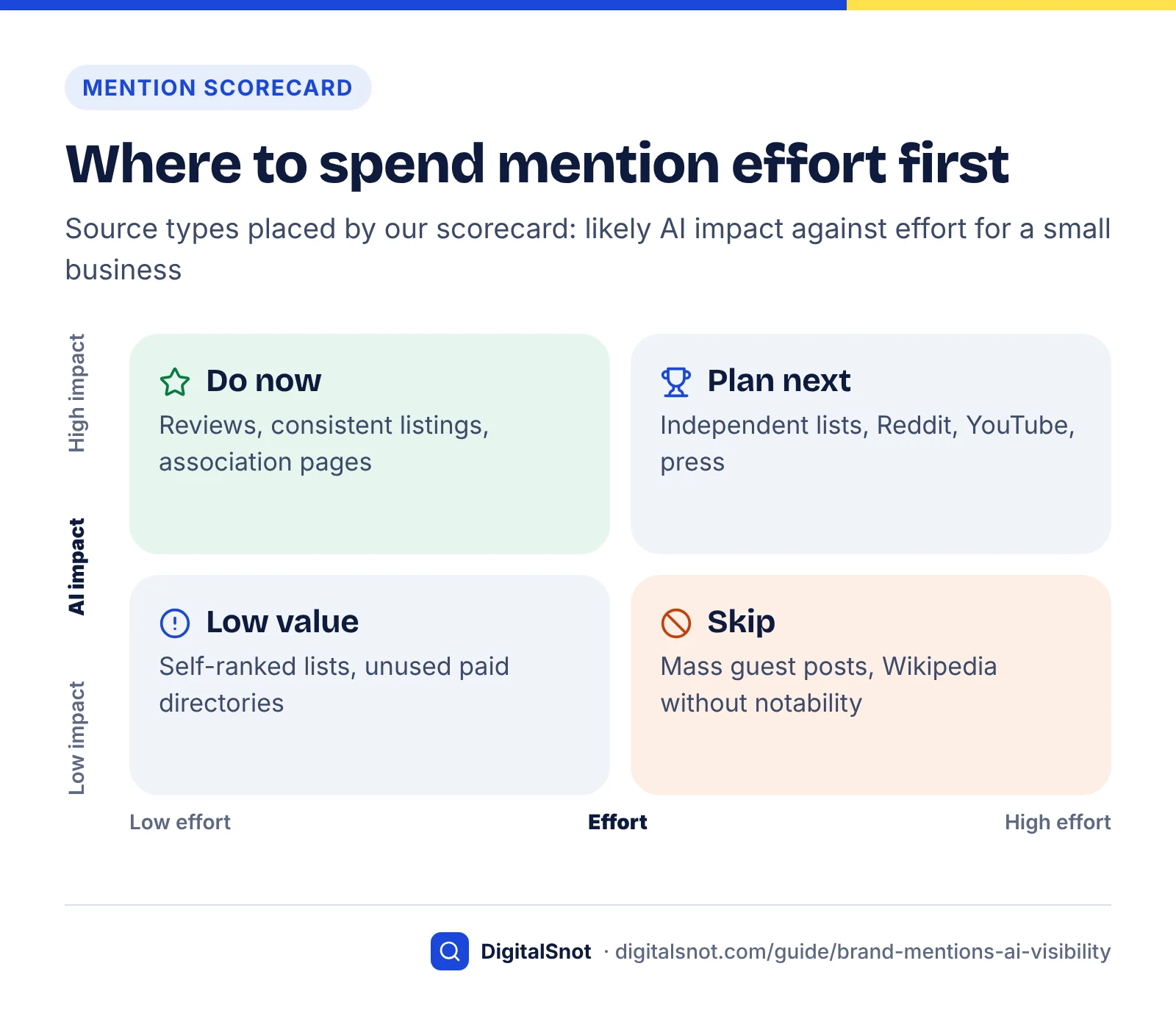
Not every cited source is worth the same effort. Score each one on four criteria and start with the highest totals; it stops you chasing the hardest wins first.
Method: for this guide we rated ten common source types from 1 (low) to 3 (high) on four criteria: relevance to buying questions, independence from the brand, published evidence that AI tools cite that source type (from the studies linked in this guide), and ease for a small business (3 is easiest). The scores are our judgement, not measured data. Re-score them for your niche using your own source tally.
| Source type | Relevance | Independence | AI-use evidence | Ease | Total /12 | Evidence and caution |
|---|---|---|---|---|---|---|
| Review platforms (Google, Yelp, G2, Tripadvisor, sector sites) | 3 | 3 | 3 | 2 | 11 | G2 and Yelp in the top ten cited domains (Peec AI); never buy or gate reviews |
| Independent "best of" lists and comparison articles | 3 | 3 | 3 | 1 | 10 | Most common cited page type in ChatGPT (Ahrefs); paid spots must be disclosed |
| Reddit and niche forums | 3 | 3 | 3 | 1 | 10 | Most-cited domain across engines (Peec AI); community rules apply |
| Industry directories and association member lists | 2 | 2 | 2 | 3 | 9 | Citation factors lead Whitespark's AI factors; skip directories nobody uses |
| YouTube videos (yours and other creators') | 2 | 2 | 3 | 1 | 8 | Strongest correlation in the Ahrefs follow-up; disclose sponsorships |
| Local and trade press | 2 | 3 | 2 | 1 | 8 | ChatGPT leans on editorial sites (Peec AI); "sponsored content" is advertising |
| LinkedIn posts and articles | 2 | 1 | 2 | 3 | 8 | Third most-cited domain (Peec AI), but self-published |
| Partner, supplier and event pages | 2 | 2 | 1 | 3 | 8 | No direct study; easy if facts match your site |
| Wikipedia | 1 | 3 | 3 | 1 | 8 | Top-five cited source; strict notability and conflict-of-interest rules |
| Your own "best of" or comparison page | 3 | 1 | 1 | 3 | 8 | Self-ranked brands usually left out of AI Overviews' picks (Ray, 2026) |
What the scores tell you
- Reviews come first because they are relevant, independent, widely cited and within your power to request from every customer.
- Lists and forums score high but are hard. You cannot place yourself on them; you earn your way on.
- Ease is a trap. Your own list is the easiest source to create and the weakest on independence and evidence.
- Wikipedia is rarely a small-business route. If you are not clearly notable, spend the time elsewhere; our AI citation guide explains Wikipedia's conflict-of-interest guideline.
Decision table: what to do with each gap
| If your source tally shows… | Do this first | Avoid |
|---|---|---|
| Independent lists cite competitors, not you | Pitch the editor with checkable facts (template below) | Paying for a position without a clear "sponsored" label |
| Review sites dominate the citations | Ask every customer for a review on the platform AI cites | Review gating, or rewards tied to positive reviews |
| Reddit or forum threads are cited | Reply once, disclosed and useful, if the thread is open and the rules allow it | New or multiple accounts, planted questions |
| YouTube videos are cited | Publish a video answering that question and say your brand name aloud | Undisclosed paid creator mentions |
| Your site is cited but AI states wrong facts | Fix conflicting details everywhere; add Organization schema with sameAs | Adding more pages that repeat the error |
| AI cites a competitor's self-ranked list | Publish an honest comparison with stated criteria and earn an independent mention | Copying the tactic with yourself at number one |
| Local guides and directories are cited | Complete your profiles; pitch local press and "best of" editors | Buying awards that anyone can pay for |
Best-of lists and comparison pages: what helps and what backfires
Independent "best of" lists help when a credible third party ranks you; lists you write about yourself help far less and can backfire. The 2025–2026 data is consistent in direction, if not in size.
What the evidence says
- Lists are heavily cited. In Ahrefs' December 2025 study of 26,283 source URLs from 750 ChatGPT prompts about software, products and agencies, "best X" blog lists were the most common page type among cited sources, at 43.8%. Recently updated lists were the most prominent, including lists where the publisher ranked its own brand first.
- Your place on the list matters, more on some engines. Peec AI's 2026 study of nearly 200,000 AI responses across eight engines found that first place in frequently cited third-party listicles lifted a brand's mention rate by up to 16.5 percentage points in B2B SaaS and 13.4 in emerging martech. The effect was larger in ChatGPT and Copilot than in AI Overviews and AI Mode, and in US finance the effect on mention count was not statistically significant.
- Self-promotion works mainly when you are already a believable answer. In an Ahrefs experiment run from February to May 2026, 34 self-promotional pages on five domains were tracked across 9,886 answers from ChatGPT, Gemini, Perplexity and Copilot. For a new conference brand, 82% of its new mentions appeared in answers citing one of the pages; for an established product, only 6% did. Being cited was also not the same as being named: AI tools sometimes used a page as a source without mentioning its publisher's brand.
- AI Overviews appear to discount self-ranked lists. Lily Ray's September 2026 sample, covered above, found fewer vendor "best of" pages cited and the self-ranked brand usually left out of the recommendation (checked October 2026).
Ahrefs and Peec AI both sell AI-visibility tools, so read their numbers as direction rather than forecasts. Ahrefs found that self-promotional lists do show up in ChatGPT's sources, but its later experiment found the benefit depended heavily on how well known the brand already was.
How to get onto independent lists
- Take the lists from your source tally that cite competitors but not you.
- Read each one in full. Note the author's criteria, the last update date, and whether it explains how products were chosen or carries affiliate links.
- Check that you genuinely fit. If you are not a credible answer for that list, move on; the Ahrefs experiment suggests forced placements do not stick.
- Send the author a short, factual note with what they need to evaluate you (template below).
- If they add you, keep your facts current. Lists get updated, and outdated facts get repeated by AI.
Subject: Facts for your "best [category]" list
Hi [name], I read your list of [category] options and found the criteria section useful. We make [product], which meets your "[criterion]" test because [one specific, checkable fact]. If it helps your next update, here is a trial login, our pricing page, our reviews on [platform] and a contact for questions. We have not paid for placement and are not asking for a particular position. Thanks for considering it. [Name, role]
Paid placements: only with clear disclosure
Some list publishers sell places. Paying for visibility is advertising; hiding the payment is the problem.
- United States: the FTC's Endorsement Guides FAQ says material connections, including payment and employment, must be disclosed clearly and conspicuously, and agencies that arrange endorsements can be liable too.
- United Kingdom: the CMA's fake reviews guidance (CMA208) bans fake reviews and reviews that conceal an incentive, says incentivised reviews should be prominently labelled as advertising, and bans offering services that submit or commission such reviews.
- India: ASCI's guidelines for influencer advertising require upfront, prominent disclosure of any material connection, such as payment, free products or discounts, even when the review is honest, using labels such as "Ad" or "Sponsored".
- Google: its spam policies treat paid links as link spam unless they carry
rel="sponsored"orrel="nofollow".
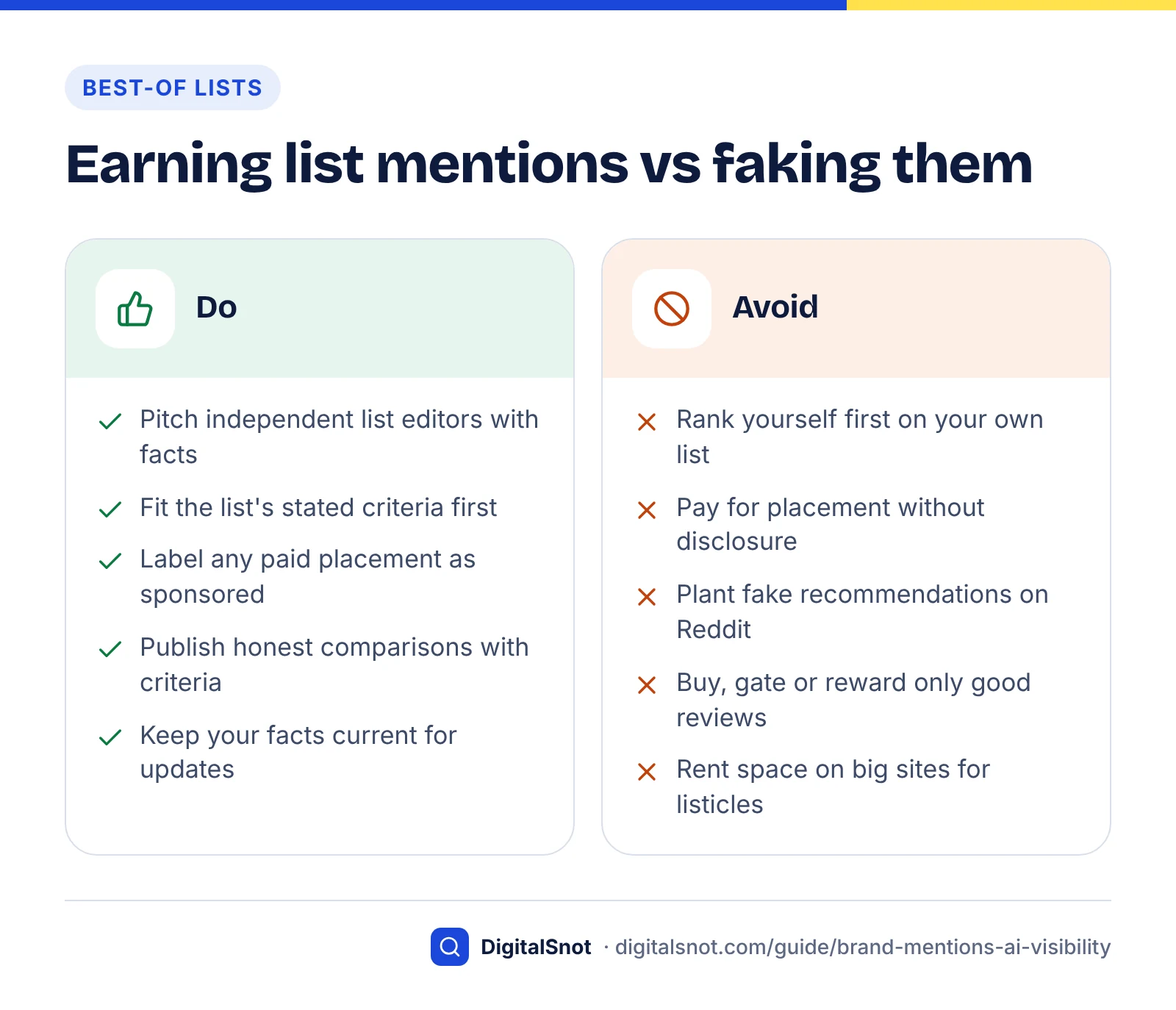
Your own comparison pages are fine when they are honest: state your criteria, include rivals that genuinely beat you for some needs, and say plainly that you are the publisher. That page will rarely win the recommendation on its own, but it gives AI tools and buyers accurate facts to work with.
Reviews, directories and industry associations
Reviews and directory listings are the most controllable mentions you have, and for local businesses they are among the factors experts rate highest for AI visibility. Get these right before chasing press coverage.
Whitespark's 2026 Local Search Ranking Factors survey, in which 47 local search experts scored 187 factors, added an AI search visibility score for the first time. Three of the top five AI visibility factors were citation factors, and one contributor noted that expert-curated lists on heavily referenced sites such as Yelp and Tripadvisor, prominent local magazines and blogs, and forum content on sites like Reddit are disproportionately cited by large language models. It is expert opinion, not measured cause and effect, but it matches the citation studies above.
Reviews
- Ask every customer, not only the happy ones, on the platform AI cites for your category: Google for most local services, G2 for business software, Tripadvisor for hospitality.
- Make it easy. A short link or QR code at the point of service works; our guide to getting more Google reviews covers timing and wording.
- Reply with specifics. A reply that names the service you provided adds accurate detail to a page AI tools can read.
- Never buy reviews or reward only positive ones. In the US, the FTC's Consumer Review Rule, in full effect since 21 October 2024, bans fake reviews and incentives tied to a particular sentiment. In December 2025 the FTC warned 10 companies that violations can bring civil penalties of up to $53,088 each (checked October 2026). The CMA guidance above bans fake and concealed-incentive reviews in the UK.
Directories and associations
Industry directories, chamber of commerce listings and professional association member pages are mentions that are cheap to get and hard to fake. Choose the ones your customers actually use and that appear in your source tally; ignore paid directories nobody visits.
Consistency matters more than volume. If one directory shows an old address or a different phone number, AI answers can repeat it. Run your key pages and listings through the AI Answer Consistency Checker to find conflicting numbers, phone numbers and addresses, then fix each one at the source. Local businesses should also read our guide to local SEO for AI search, which covers the listings Google's AI surfaces rely on.
To tie every profile back to one entity, list them in your Organization structured data with sameAs. The Brand Knowledge Graph Builder maps your services, places, people and profiles and outputs Organization schema you can paste in; our schema markup guide explains what markup can and cannot do in 2026.
Reddit, forums and YouTube: take part without spamming
Reddit and YouTube are among the most-cited domains in AI answers, which makes them tempting to game and easy to get banned from. The approach that lasts is slow: be a useful, identified participant, and make things people want to reference.
Reddit and forums
Reddit's spam policy defines spam as repeated or unsolicited actions, automated or manual, that negatively affect users, communities or Reddit itself, including mass-posting repetitive content for exposure or financial gain. Promotional content is not automatically spam, but each community sets its own limits, many ban self-promotion outright, and moderators decide.
- Start with the threads in your source tally. These are the discussions AI already reads for your questions.
- Read the community rules before posting, and follow them even when competitors do not.
- Post from a real, identifiable account and say who you are: "I run a bookkeeping firm, so I'm biased, but…". The FTC's Endorsement Guides treat an employment relationship as a material connection, so staff praising their employer without saying so is a disclosure problem, not just bad manners.
- Answer the question fully first, and mention your business only where it genuinely answers what was asked.
- Never use extra accounts, buy aged accounts, pay users or plant questions. Coordinated, fake activity is what Reddit's spam rules and moderators exist to stop, and a thread exposing astroturfing is a mention you do not want AI to find.
YouTube
YouTube mentions had the strongest correlation with AI visibility in the Ahrefs follow-up, which counted a mention when the brand appeared in a video's title, transcript or description. That definition is practical: say your brand name out loud in your videos so it lands in the transcript, and use it naturally in titles and descriptions. Opening a channel will not by itself make AI recommend you; the study found a correlation, not a cause.
- Answer one buying question per video, taken from your prompt list. Short, specific videos are easier to match to a question.
- Appear on other people's channels. Podcasts, interviews and trade events filmed for YouTube put your name in someone else's transcript, which is closer to an independent mention.
- Disclose anything you gave a creator. Free products, payment and affiliate deals are material connections under the FTC and ASCI rules above, and ASCI warns that a disclosure buried in a bio or behind a "more" link is likely to be missed.
Mentions vs links for AI answers
Digital PR a small business can afford
Digital PR is the work of earning coverage and mentions on other people's sites by giving them something worth publishing. For a small business it costs time more than money, and the best results come from being specific, local and quick to respond.
- Publish one small original data point each quarter. Anonymised numbers from your own work, such as average turnaround times, the most common customer question or seasonal demand, give journalists and list writers something to cite.
- Offer expert comment. Local papers, trade magazines and podcasts need sources. Reply fast, with a usable quote and your credentials.
- Contribute to industry associations. Speaking slots, committee roles and member spotlights produce mentions on trusted domains.
- Sponsor or host real community events. Event pages, local news and partner sites mention organisers.
- Ask partners and suppliers to list you. "Where to buy", "certified installer" and partner directory pages are easy wins if the facts match your site.
Internal links between pages
A pitch template for expert comment
Subject: Comment on [topic] from a [city] [profession]
Hi [name], I saw your piece on [topic]. If you follow it up, I can comment on [specific angle] from [number] years running a [business type] in [city]. One point your readers may not know: [one specific, checkable fact]. I can reply by [time] and send a photo and credentials. [Name, role, phone]
A weekly time budget
| Time per week | Focus | Realistic output in 90 days |
|---|---|---|
| 1 hour | Reviews and listings | Review requests to every customer; listings consistent everywhere |
| 2–3 hours | Add list outreach and community replies | 5–10 list editors contacted; one or two useful forum replies a week |
| 4–5 hours | Add PR and video | One data point published; a short video for each top buying question |
If you would rather put the effort into pages that others reference, our content SEO service builds the guides, comparisons and data pages that tend to attract mentions.
Measure mention growth and citation quality
Measure AI mentions as a rate across many runs of the same prompts, not as a ranking from one screenshot. AI answers change too much from run to run for a single check to mean anything.
In a 2026 SparkToro study run with Gumshoe, about 600 volunteers ran 12 prompts through ChatGPT, Claude and Google's AI tools, 2,961 runs in all. There was less than a 1-in-100 chance that ChatGPT or Google's AI returned the same list of brands twice in 100 runs, and the order was even less stable. The authors recommend tracking how often a brand appears across many runs rather than its position.
Four numbers to track every month
| Metric | How to calculate it | What it tells you |
|---|---|---|
| Mention rate | Answers naming you ÷ total answers, per prompt and tool | Whether AI links you with the question at all |
| Recommendation rate | Answers recommending you as a top pick ÷ total answers | Whether mentions are turning into recommendations |
| Source coverage | Frequently cited sources that name you ÷ all frequently cited sources | Whether your outreach is closing the gaps |
| Description accuracy | Answers with correct facts about you ÷ answers naming you | Whether AI repeats wrong or outdated details |
Worked example (hypothetical): the bookkeeping firm from earlier is named in 18 of 180 answers in month one, a 10% mention rate. After it joins two of the three lists, a rerun with the same 12 prompts, five runs each in the same three tools, gives 45 of 180, or 25%. Because the test conditions match, a change that size is unlikely to be noise; a difference between two single screenshots tells you nothing.
For description quality, paste an AI answer that mentions you into the AI Citation Quality Scorer. It rates how favourable and specific the mention is, which helps you spot answers that name you but describe you vaguely or wrongly. Look for missing services, outdated facts and lukewarm wording, then trace each one back to the source that said it.
First-party data
Google now reports some AI visibility directly: Search Console's generative AI performance report shows how often your pages appeared in AI Overviews and AI Mode. Our guide to the Search Console AI performance report explains how to read it and what it leaves out. Watch branded searches too, by filtering the Performance report to queries containing your brand name. More people searching for you by name is a reasonable downstream sign that mentions are working, though it has many possible causes.
What to avoid: tactics that look like manipulation
Avoid any tactic whose purpose is to make a mention look independent when it is not. Google's generative AI guide says seeking inauthentic "mentions" across the web "isn't as helpful as it might seem" and lists pursuing inauthentic mentions among the tactics you can ignore for Search. Most of these tactics also break a law or a platform rule.
| Tactic | Why it backfires | Rule it can break |
|---|---|---|
| Ranking yourself first on your own "best of" list | AI Overviews usually left the self-ranked brand out (83% in Ray's 2026 sample), and the page can help competitors | If it poses as an independent review site, the FTC Consumer Review Rule covers company-controlled review sites |
| Paying for list spots or articles without disclosure | Readers and editors lose trust when it surfaces | FTC Endorsement Guides; ASCI guidelines; Google link spam policy unless marked sponsored |
| Buying, faking or gating reviews | Platforms remove them, and unnatural patterns are easy to spot | FTC Consumer Review Rule (up to $53,088 per violation, as stated in December 2025); CMA fake reviews guidance |
| Sock-puppet Reddit posts and planted questions | Moderators remove them, and exposure threads become a mention in their own right | Reddit spam policy; FTC disclosure rules for staff and paid posters |
| Renting a section of a big site to host your listicles | Google can take manual action against the section hosting it | Google site reputation abuse policy |
| Mass-produced guest posts or AI pages that mention you | Thin pages add little evidence and invite spam action | Google scaled content abuse policy |
| Buying "guaranteed AI placement" | AI answers vary run to run, so nobody can promise a place | No rule as such, but a clear sales red flag |
Google's spam policies define site reputation abuse as publishing third-party pages on a site to exploit the host site's ranking signals. Since 30 August 2026, a manual action under this policy no longer affects results for searchers in the European Economic Area, where Google may instead separate the affected section so it ranks on its own; outside the EEA, including the UK and India, the action still applies (checked October 2026). Either way, a paid listicle parked on a big publisher's domain is a short-lived bet.
If an agency offers guaranteed AI recommendations, ask how it would measure them across repeated runs and which of its tactics it would be happy to disclose publicly. Our post on how to choose an SEO agency lists more questions worth asking.
A 90-day plan for a small business
A realistic 90-day plan spends the first month measuring and fixing what you control, the second earning independent mentions, and the third measuring again. Keep the same prompts throughout so the before-and-after comparison means something.
Days 1–30: baseline and foundations
- Write 10–20 buying prompts; run each at least five times per tool; log cited sources and your mention rate.
- Score the cited sources with the scorecard and pick the ten biggest gaps.
- Fix conflicting facts across your site and listings, and add Organization schema with sameAs.
- Start asking every customer for a review on the platform AI cites for your category.
Days 31–60: earn mentions
- Pitch the editors of the lists that cite competitors but not you.
- Reply, disclosed and helpful, in two or three cited forum threads where the rules allow it.
- Publish one short video answering your top buying question.
- Offer one piece of expert comment or one small data point to local or trade press.
Days 61–90: measure and adjust
- Rerun the same prompts the same number of times in the same tools, and compare mention and recommendation rates.
- Check how AI describes you, and fix the source of every wrong fact.
- Drop the source types that produced nothing and put more time into the ones that moved.
Mentions build slowly, so expect the first 90 days to lay the base rather than transform results. If you want help with source-gap research, outreach and citation tracking, that is part of our AI search optimisation service. When you are ready to talk it through, get in touch.
Free tools in this guide
- Cited Content Pattern Analyzer See the formats and patterns of cited pages, and get a content plan.
- AI Citation Gap Checker Compare your page with a cited competitor and see the gaps to close.
- AI Answer Consistency Checker Find brand facts that differ between your pages and listings.
- Brand Knowledge Graph Builder Map your brand entity, find missing links and get the schema.
- AI Citation Quality Scorer Score how strongly pasted AI answers recommend your brand.
By the numbers
- correlation with AI Overview brand visibility for branded web mentions vs backlinks (75,000 brands, 2025)
- 0.664 vs 0.218
- Source: Ahrefs
- of checks in which AI Overviews left a self-ranked brand out of its recommendation (100 B2B software queries, September 2026)
- 83%
- Source: PPC Land (Lily Ray data)
- lift in mention rate for brands ranked first in frequently cited third-party listicles (B2B SaaS, 2026)
- +16.5 pp
- Source: Peec AI
- chance that ChatGPT or Google's AI gives the same list of brands twice in 100 runs (2,961 runs, 2026)
- <1 in 100
- Source: SparkToro
Frequently asked questions
Do brand mentions help you appear in AI answers?
Probably, though the evidence is correlational. Ahrefs' 2025 study of 75,000 brands found branded web mentions correlated with AI Overview visibility at 0.664, against 0.218 for backlinks, and a follow-up found YouTube mentions correlated most strongly across ChatGPT, AI Mode and AI Overviews. The brands studied were mostly established, so mentions may reflect fame as much as cause it. Earning genuine mentions on the sources AI already cites is still the most sensible bet.
What is an unlinked brand mention?
An unlinked brand mention is a reference to your business name on someone else's page with no hyperlink to your site. In classic SEO it was mainly a chance to ask for a link. For AI answers it has value on its own, because AI tools read the text of the page, not only its links. Ask for a link only when it would genuinely help the publisher's readers; otherwise the mention itself is the win.
Should I pay to be included in "best of" lists?
Only if the placement is clearly labelled as paid, and even then expect it to be worth less than an independent mention. The FTC's Endorsement Guides require clear disclosure of material connections such as payment, ASCI's guidelines require the same in India, and Google treats paid links as link spam unless they are marked sponsored or nofollow. An editor choosing you on merit is safer and more persuasive to readers.
Can I publish my own "best tools" list and rank myself first?
You can, but it often backfires in AI answers. In Lily Ray's September 2026 sample of 100 B2B software queries, AI Overviews left the self-ranked brand out of its recommendation 83% of the time, and the page often helped competitors get recommended instead. An honest comparison with stated criteria, where you are clearly the publisher and not automatically first, is more credible and more useful to buyers.
How do I find which sites ChatGPT and AI Overviews cite for my industry?
Write 10 to 20 real buying questions, run each several times in ChatGPT with search, Google AI Mode, AI Overviews, Perplexity and Copilot, and log every cited URL with its page type and the brands it names. Count how often each source appears. The frequently cited pages that name competitors but not you are your outreach list. Repeat monthly, because sources differ between engines and change over time.
Can I use Reddit to get my brand into AI answers?
You can take part, but not as a channel you control. Reddit was the most-cited source across major AI engines in Peec AI's 2026 analysis, which makes astroturfing tempting and risky. Reddit's spam policy targets repeated or unsolicited posting for exposure or gain, and each community sets its own rules on promotion. Use a real account, say who you are, answer fully and mention your business only when it genuinely helps.
Do YouTube videos help AI visibility?
They appear to. In the Ahrefs follow-up study of 75,000 brands, reported in May 2026, YouTube mentions (a brand name in a video's title, transcript or description) had the strongest correlation with AI visibility, about 0.737. Make short videos that answer your customers' buying questions, say your brand name aloud so it appears in the transcript, and appear on other creators' channels, disclosing any free product or payment.
How do I measure brand mentions in AI search?
Track a mention rate rather than a ranking. Run the same prompts the same number of times in the same tools each month and divide the answers that name you by the total. SparkToro's 2026 study found less than a 1-in-100 chance that ChatGPT or Google's AI returns the same brand list twice in 100 runs, so single checks mislead. Add recommendation rate, description accuracy and Search Console's generative AI report.
Are fake or incentivised reviews risky?
Yes. In the US, the FTC's Consumer Review Rule, in full effect since 21 October 2024, bans fake reviews and incentives tied to a particular sentiment, and in December 2025 the FTC warned 10 companies that violations can bring civil penalties of up to $53,088 each. In the UK, the CMA's guidance bans fake reviews and reviews that hide an incentive. Ask every customer for an honest review instead, and make leaving one easy.
What does Google say about brand mentions and AI answers?
Google's May 2026 guide to generative AI features says they can show what is being said about products and services across blogs, videos and forum discussions. It also says seeking inauthentic mentions is not as helpful as it might seem, and lists pursuing inauthentic mentions among tactics you can ignore for Search. In short, real mentions can surface in AI answers, while manufactured ones are not a shortcut.
Sources
Every figure and claim in this guide comes from the sources below. We checked each one when writing and link to the original so you can read it yourself. Credit belongs to the authors and publishers listed. How we write and check our articles.
-
1
An Analysis of AI Overview Brand Visibility Factors (75K Brands Studied)
Ahrefs · 2025 study: web mentions 0.664 vs backlinks 0.218; quartile concentration; 26% of brands with no mentions.
-
2
Top Brand Visibility Factors in ChatGPT, AI Mode, and AI Overviews (75k Brands Studied)
Ahrefs · December 2025 follow-up: YouTube mentions about 0.737, mention impressions about 0.717, branded web mentions 0.66–0.71; correlational.
-
3
YouTube mentions are the single strongest predictor of whether AI will recommend your brand, according to a study of 75,000 companies
The Next Web · Coverage of the Ahrefs follow-up study: YouTube mentions about 0.737.
-
4
Optimizing your website for generative AI features on Google Search
Google Search Central · AI features show what blogs, videos and forums say; inauthentic mentions are not a shortcut.
-
5
Google AI Overviews cut self-ranking listicle citations 38%, Lily Ray finds
PPC Land · Lily Ray data: 38% fewer vendor best-of citations; self-ranked brand omitted 83% of the time (Sept 2026).
-
6
Top domains cited by AI search: Analysis based on 30M sources
Peec AI · March 2026, US answers from five AI surfaces: Reddit, YouTube, LinkedIn, Wikipedia and Forbes top five; differences by engine.
-
7
Do Self-Promotional "Best" Lists Boost ChatGPT Visibility? Study of 26,283 Source URLs
Ahrefs · 4 December 2025: 750 prompts; best-X lists 43.8% of cited page types; recently updated lists most prominent.
-
8
The Listicle Rank Effect: What 200K AI Responses Across 8 AI Engines Reveal About Brand Visibility
Peec AI · 2026: first place in cited third-party listicles lifts mention rate up to 16.5 pp; varies by engine.
-
9
Self-Promotional Content Works—Until It Backfires (AI SEO Experiment)
Ahrefs · Experiment, February–May 2026: 34 pages on five domains, 9,886 answers; new brand 82% vs established 6%.
-
10
FTC's Endorsement Guides: What People Are Asking
Federal Trade Commission · Disclosure of material connections (payment, employment); liability of intermediaries.
-
11
Fake reviews (CMA208)
Competition and Markets Authority · UK ban on fake and concealed-incentive reviews; labelling as advertising; services that commission them.
-
12
Guidelines for Influencer Advertising in Digital Media
Advertising Standards Council of India (ASCI) · India: material connection disclosure, prominence and permitted labels such as Ad and Sponsored.
-
13
Spam policies for Google web search
Google Search Central · Paid links need sponsored or nofollow; site reputation abuse; scaled content abuse.
-
14
Update to the Site Reputation Policy
Google Search Central Blog · From 30 August 2026, site reputation manual actions no longer affect results for users in the EEA.
-
15
Whitespark's Official 2026 Local Search Ranking Factors Report
Whitespark · 47 experts, 187 factors; three of the top five AI visibility factors are citation factors.
-
16
FTC Warns 10 Companies About Possible Violations of the Agency's New Consumer Review Rule
Federal Trade Commission · December 2025 warnings; rule in effect since 21 Oct 2024; penalties up to $53,088 per violation.
-
17
Spam
Reddit Help · Reddit's definition of spam; promotional content and community rules.
-
18
NEW Research: AIs are highly inconsistent when recommending brands or products; marketers should take care when tracking AI visibility
SparkToro · 2026: under 1-in-100 chance of the same brand list twice in 100 runs; track visibility rate.