Margin vs markup: pricing products without losing money
Margin and markup explained with formulas, a markup to margin table and a gift shop example: why mixing them loses money, why GST is not margin, and your break-even.
On this page (9 sections)
Ask two people in the same shop what margin they make on a product and you may get two different numbers, both "right". One is talking about margin, the other about markup. The gap between them is where small shops quietly lose money. This post on margin vs markup shows you the two formulas, a table to convert one into the other, how GST fits in, and how to check that your margin pays your monthly bills. It is general information, not tax or accounting advice: check how to treat GST in your own books with your CA.
Margin and markup: the same profit, two different bases
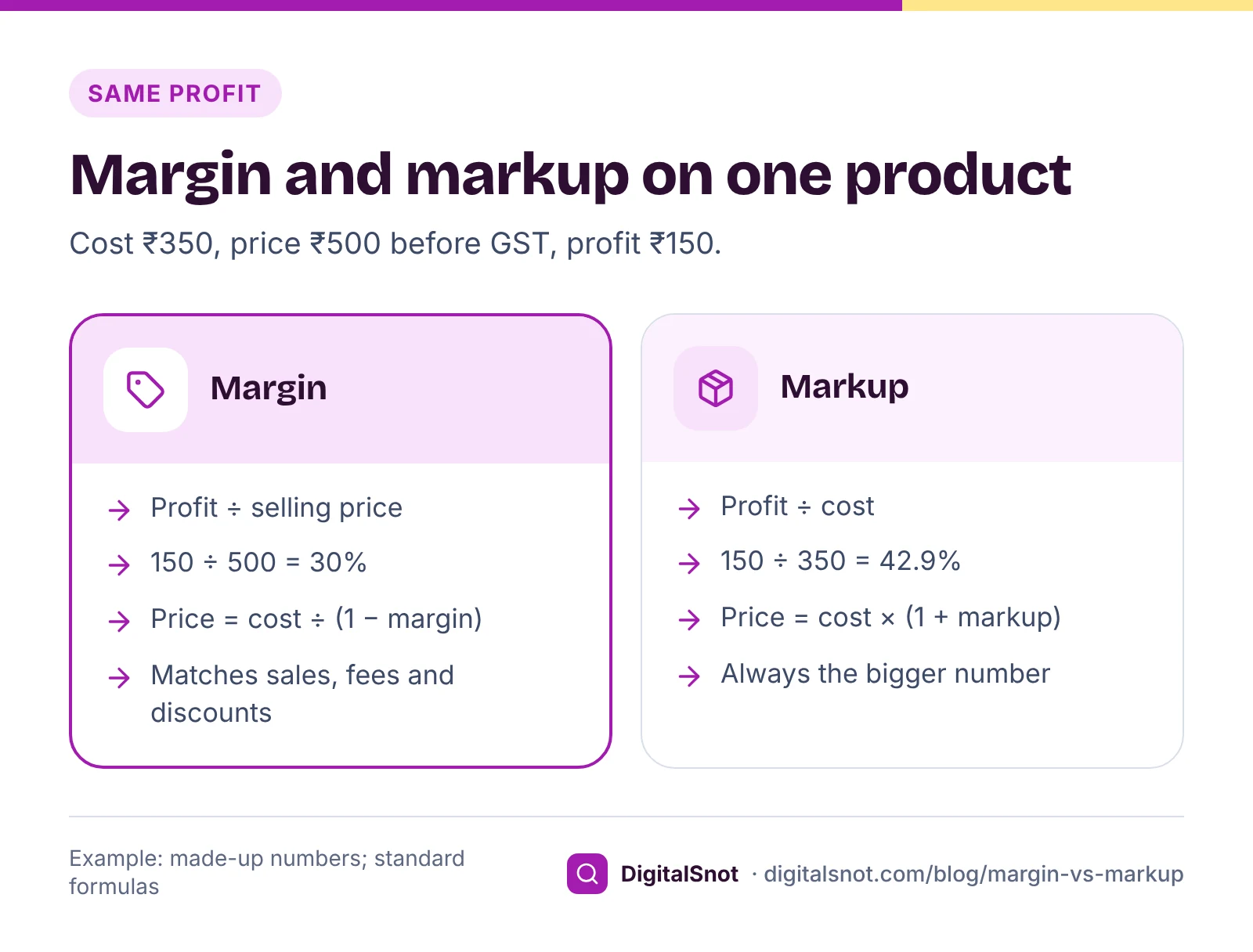
Both start from the same profit on one unit: the selling price before GST minus what the unit cost you.
- Margin = profit ÷ selling price × 100. It tells you how much of each rupee of sales you keep.
- Markup = profit ÷ cost × 100. It tells you how much you added on top of the cost.
A product that costs ₹60 and sells for ₹100 before GST makes ₹40. That is a 40% margin (40 ÷ 100) but a 66.7% markup (40 ÷ 60). A product that costs ₹350 and sells for ₹500 makes ₹150: a 30% margin and a 42.9% markup. For the same product, the markup is always the bigger number, because the cost is smaller than the price.
Two more formulas do most of the pricing work:
- Price for a target margin = cost ÷ (1 − margin). For a 30% margin on a ₹350 cost: 350 ÷ 0.70 = ₹500.
- Price for a target markup = cost × (1 + markup). For a 30% markup on a ₹350 cost: 350 × 1.30 = ₹455.
Converting markup to margin
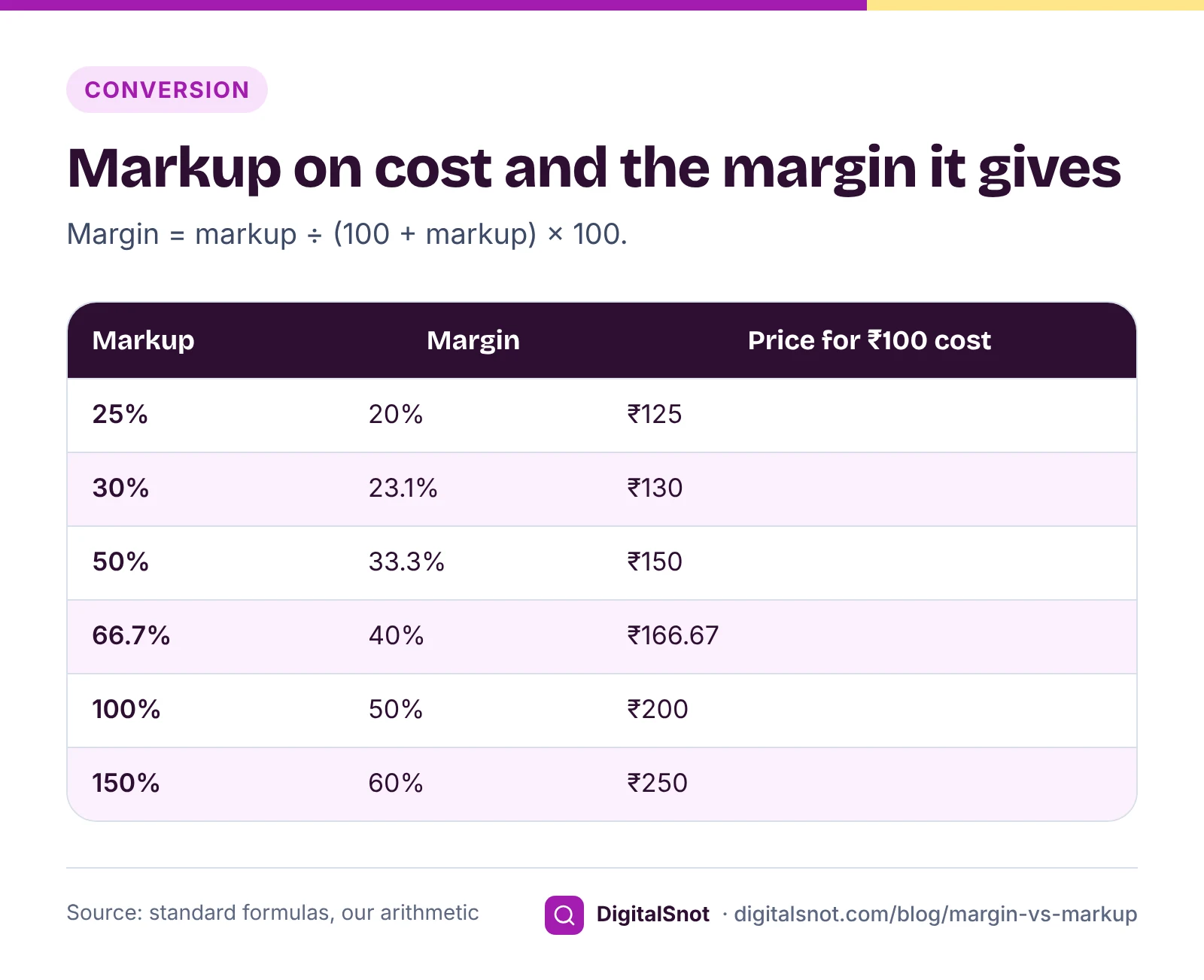
To turn a markup into a margin, divide the markup by 100 plus the markup: margin = markup ÷ (100 + markup) × 100. To go the other way, divide the margin by 100 minus the margin: markup = margin ÷ (100 − margin) × 100. These are standard formulas, and the table below uses them.
| Markup on cost | Margin on price | Price for a ₹100 cost |
|---|---|---|
| 10% | 9.1% | ₹110 |
| 25% | 20% | ₹125 |
| 30% | 23.1% | ₹130 |
| 42.9% | 30% | ₹142.86 |
| 50% | 33.3% | ₹150 |
| 66.7% | 40% | ₹166.67 |
| 100% | 50% | ₹200 |
| 150% | 60% | ₹250 |
Read it both ways. "Keystone" pricing, doubling the cost, is a 100% markup but a 50% margin. A 50% markup is only a 33.3% margin. A margin stays below 100% for anything that costs you money, but a markup can go far above it.
How mixing them up loses money
Lakshmi Gift House is a made-up gift shop in Mylapore, Chennai. Before the festive season, the owner tells her staff she wants a 30% margin on a new brass diya set that costs ₹350 before GST. The staff add 30% to the cost and price it at ₹455 before GST. That is a 30% markup, and only a 23.1% margin.
Say the shop sells 400 sets in the season. At ₹455, each set makes ₹105, so the shop makes ₹42,000. At the ₹500 the owner meant, each set makes ₹150, so the shop would have made ₹60,000. The same work, the same stock and the same customers leave ₹18,000 on the table. A higher price can also change how many sets sell, so treat that figure as arithmetic, not a forecast. The point is that nobody chose the lower margin: it came from a misunderstanding.
The fix is to agree one word in your business. Our suggestion: price and report by margin, because your sales figures, discounts and marketplace fees are all shares of the selling price. Put the cost and the margin you want into our Profit Margin & Markup Calculator. Type any two of cost, price, margin and markup, and it works out the other two, shows margin and markup side by side, and gives a table of prices for margins from 10% to 60%.
GST is not part of your margin
The GST you collect is passed on to the government, so it is not your income and it does not belong in your margin. Since 22 September 2025, after the 56th GST Council meeting, the main rates are 5% and 18%, with a 40% rate for a short list of goods. Whatever your rate, work out the margin on the price before GST.
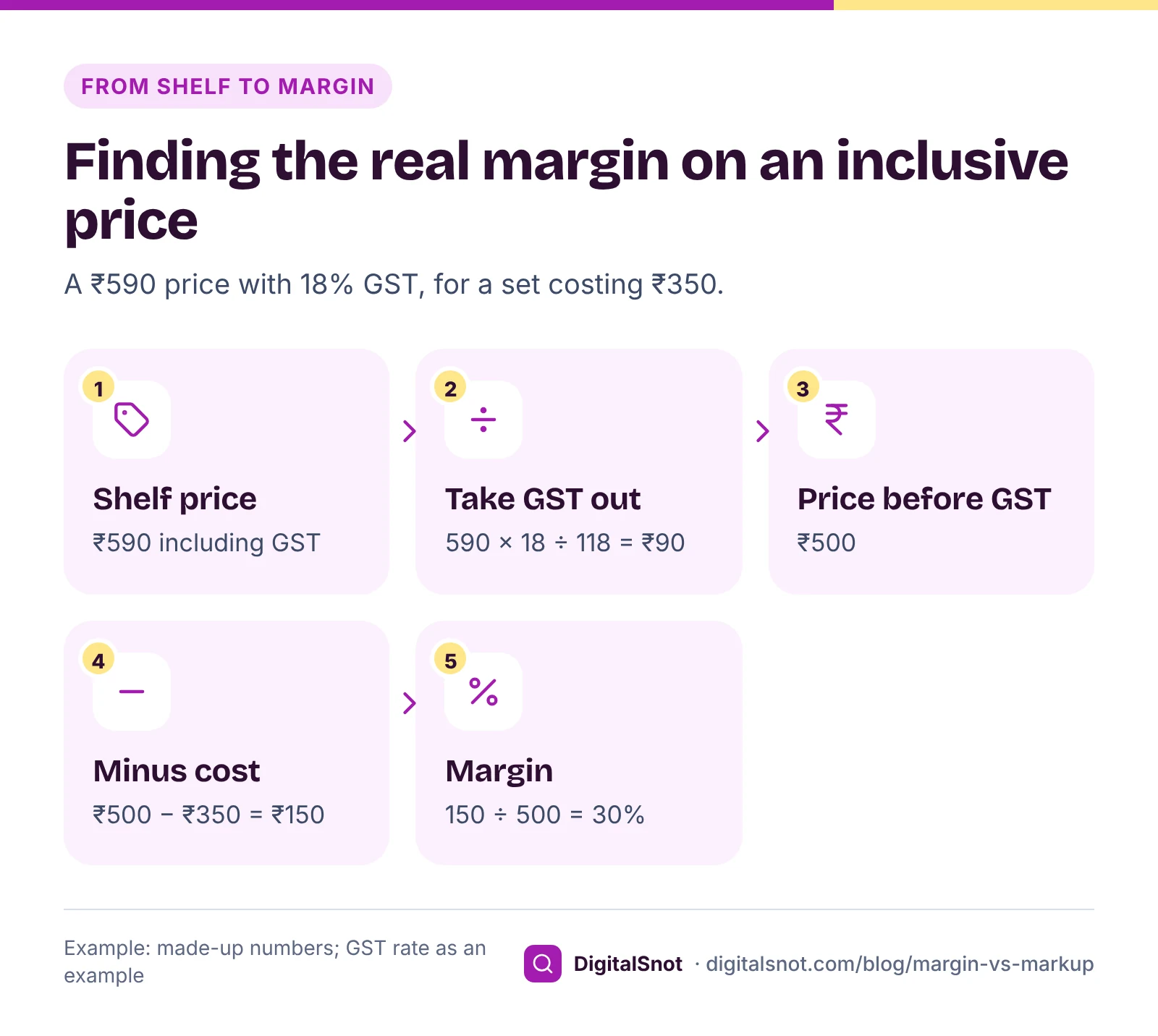
Say Lakshmi Gift House sells the diya set for ₹590 including 18% GST (an example rate). The GST inside is 590 × 18 ÷ 118 = ₹90, so the price before GST is ₹500. The margin is (500 − 350) ÷ 500 = 30%. Use the inclusive price by mistake and you get (590 − 350) ÷ 590 = 40.7%, a margin the shop never makes. Our post on working out GST-inclusive and exclusive prices has the formulas for taking GST out.
Costs need the same care:
- If you are registered and claim input tax credit on what you buy, under the conditions in section 16 of the CGST Act, enter your costs before GST.
- If you are not registered, you cannot claim that GST back, so enter costs as you paid them. You also cannot charge GST: section 32 of the CGST Act says a person who is not registered may not collect any amount as tax.
- A composition seller does not collect GST on its bills either, and prints "composition taxable person, not eligible to collect tax on supplies" under Rule 5. Ask your CA how to treat the GST you pay on purchases.
For packed goods there is a ceiling too. The Legal Metrology (Packaged Commodities) Rules, 2011 have the MRP declared inclusive of all taxes, and rule 18(2) says no one may sell a pre-packed product above it. If your cost rises and the MRP stays the same, your margin shrinks; you cannot add a markup on top of the MRP.
Discounts and fees come straight off the margin
A discount cuts the price but not the cost, so it comes entirely out of your profit. Take 10% off the ₹500 diya set and it sells for ₹450 before GST. The profit falls from ₹150 to ₹100, a third less, and the margin falls from 30% to 22.2%. To make the same ₹60,000 in the season, the shop would need to sell 600 sets instead of 400.
Marketplace fees work the same way. Amazon.in's fees and pricing page describes a referral fee that is a percentage of the sale and varies by category, plus a closing fee and other fees. Flipkart's fees and commission page says its commission varies by category and its fixed fee depends on the selling price. Fees change, so never price from a number you remember: copy the rates from your own rate card. A margin that looks healthy at your shop counter can disappear once fees, shipping, returns and ads are paid. Our SKU Profit Analyzer takes a sheet of your products, one row per SKU and channel, with your own fees and costs, and shows the profit per order for each, the price that breaks even and the price for your target margin. Our post on working out your real profit per order walks through every marketplace cost.
Break-even: does your margin pay the bills?
Margin is earned on each sale; rent and salaries are paid every month whether you sell or not. Break-even is the point where the first covers the second. Break-even units = fixed costs ÷ contribution per unit, where the contribution is the price before GST minus the variable cost of that sale.
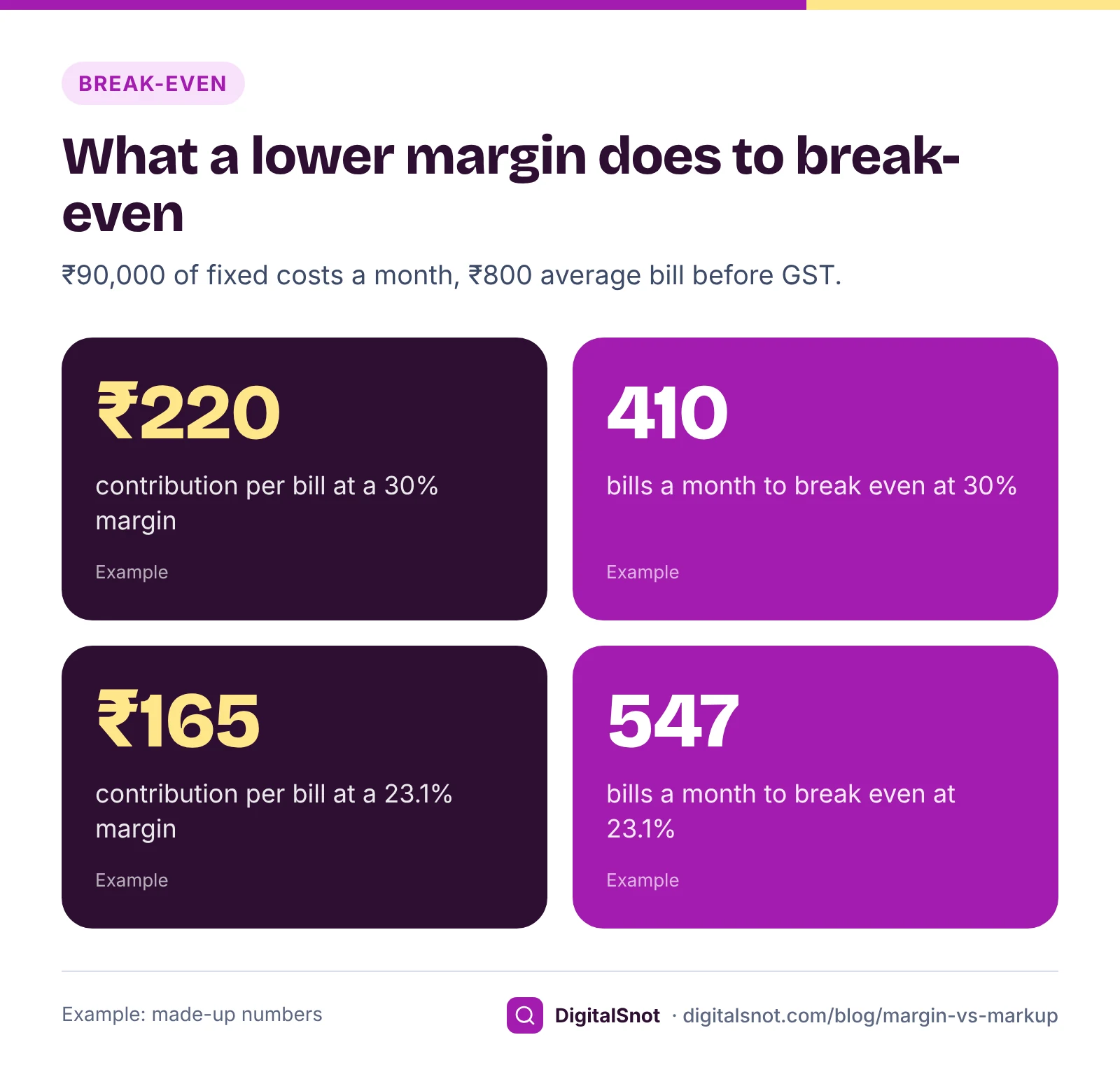
Lakshmi Gift House has fixed costs of ₹90,000 a month: ₹45,000 rent, ₹36,000 for two staff, ₹6,000 electricity and ₹3,000 for billing software and phones. Its average bill is ₹800 before GST. These are made-up numbers.
- At a 30% margin, the stock in an average bill costs ₹560. With ₹20 of packing and payment costs, each bill contributes ₹220. Break-even is 90,000 ÷ 220 = 409.1, so 410 bills a month, or about ₹3.28 lakh of sales.
- At a 23.1% margin, from pricing by markup, the stock costs about ₹615 and each bill contributes about ₹165. Break-even rises to 547 bills a month, about ₹4.38 lakh of sales.
The shop would need about 137 more bills every month just to stand still. Put your own costs into our Break-even Calculator: list your fixed costs a month, your price or average order before GST and your variable cost, and it gives break-even units and sales, the units for a profit you choose, your margin of safety and a chart, with every formula shown.
Mistakes to avoid
- Adding the target margin to the cost. 30% on top of cost is a 23.1% margin.
- Working margin on a price that includes GST. Take the GST out first.
- Entering costs before GST when you cannot claim the credit. Then the GST you pay is a cost.
- Using one markup across every product. Products with high fees, returns or breakage need more.
- Running discounts without redoing the sums. Check how many more units you must sell to make the same profit.
- Forgetting fixed costs. A good margin on each sale can still mean a loss each month if you sell too few.
Your next step
Pick your ten best-selling products. For each, write down the cost, the price before GST and the margin, using the Profit Margin & Markup Calculator's section for many products at once, which can also open a CSV file. Mark any product below the margin you want, then run your monthly fixed costs through the Break-even Calculator. If you sell on marketplaces, add the fees from your rate card in the SKU Profit Analyzer. More tools for pricing and paperwork are on our free tools page, and if you would like a second pair of eyes on your pricing pages, contact us.
Free tools in this article
- Profit Margin & Markup Calculator Any two of cost, price, margin and markup give the rest, with GST and many products at once.
- SKU Profit Analyzer Find the SKUs that lose money after fees, returns, ads and shipping, with the price or fix for each one.
- Break-even Calculator Break-even units and sales from your monthly costs, with target profit, a chart and what-if scenarios.
Frequently asked questions
What is the difference between margin and markup?
Both start from the same profit: the price before GST minus the cost. Margin divides that profit by the selling price; markup divides it by the cost. A product costing ₹350 and selling for ₹500 has a 30% margin and a 42.9% markup.
How do I convert markup to margin?
Divide the markup by 100 plus the markup and multiply by 100. A 25% markup is 25 ÷ 125 × 100 = a 20% margin, and a 100% markup is a 50% margin. To go the other way, divide the margin by 100 minus the margin.
How do I price a product for a 30% margin?
Divide the cost by 0.70. For a ₹350 cost, that is ₹500 before GST. Adding 30% to the cost gives ₹455, which is only a 23.1% margin.
Should I include GST when I work out my margin?
No. Work on the selling price before GST, because the GST you collect goes to the government. Enter costs before GST only if you claim the input tax credit; if you cannot, the GST you pay is part of your cost.
Is a 50% markup the same as a 50% margin?
No. A 50% markup is a 33.3% margin: a ₹100 cost sold at ₹150. A 50% margin needs a 100% markup: a ₹100 cost sold at ₹200.
How does my margin affect my break-even point?
Break-even units are your monthly fixed costs divided by the contribution per unit, the price before GST minus the variable cost. A lower margin means a smaller contribution, so you need more sales each month just to cover your fixed costs.
Sources
Every figure and claim in this article comes from the sources below. We checked each one when writing and link to the original so you can read it yourself. Credit belongs to the authors and publishers listed. How we write and check our articles.
-
1
Recommendations of the 56th meeting of the GST Council
Press Information Bureau · Main GST rates of 5% and 18%, with a special 40% rate for a short list of goods, from 22 September 2025.
-
2
Section 16: Eligibility and conditions for taking input tax credit (CGST Act, 2017)
CBIC · A registered person can claim input tax credit only when the conditions are met.
-
3
Section 32: Prohibition of unauthorised collection of tax (CGST Act, 2017)
CBIC · A person who is not registered may not collect any amount as tax.
-
4
Rule 5: Conditions and restrictions for composition levy (CGST Rules, 2017)
CBIC · Composition sellers print "composition taxable person, not eligible to collect tax on supplies".
-
5
Legal Metrology (Packaged Commodities) Rules, 2011 with all amendments
Department of Consumer Affairs · The MRP is declared inclusive of all taxes; rule 18(2): no sale of a pre-packed product above its retail sale price.
-
6
Fees and pricing
Amazon.in (Sell on Amazon) · The referral fee is a percentage of the sale that varies by category, with a closing fee and other fees.
-
7
Fees and commission
Flipkart Seller Hub · Commission varies by category; the fixed fee depends on the selling price.