MSME delayed payment interest: how to work out what you are owed
When a buyer pays a micro or small supplier late, the MSMED Act adds interest at three times the RBI Bank Rate, compounded monthly. How to work it out and claim it.

On this page (9 sections)
If you supply goods or services as a micro or small business and a buyer keeps you waiting, the law gives you more than a polite reminder. For a delayed payment it gives you interest, at a rate set by the MSMED Act, that no contract can take away. This post explains when a payment becomes late, how MSME delayed payment interest is worked out, with a worked example you can copy, and what to do if the buyer still does not pay. It is general information, not legal or tax advice: check your own claim with a CA or lawyer.
Who the rule protects
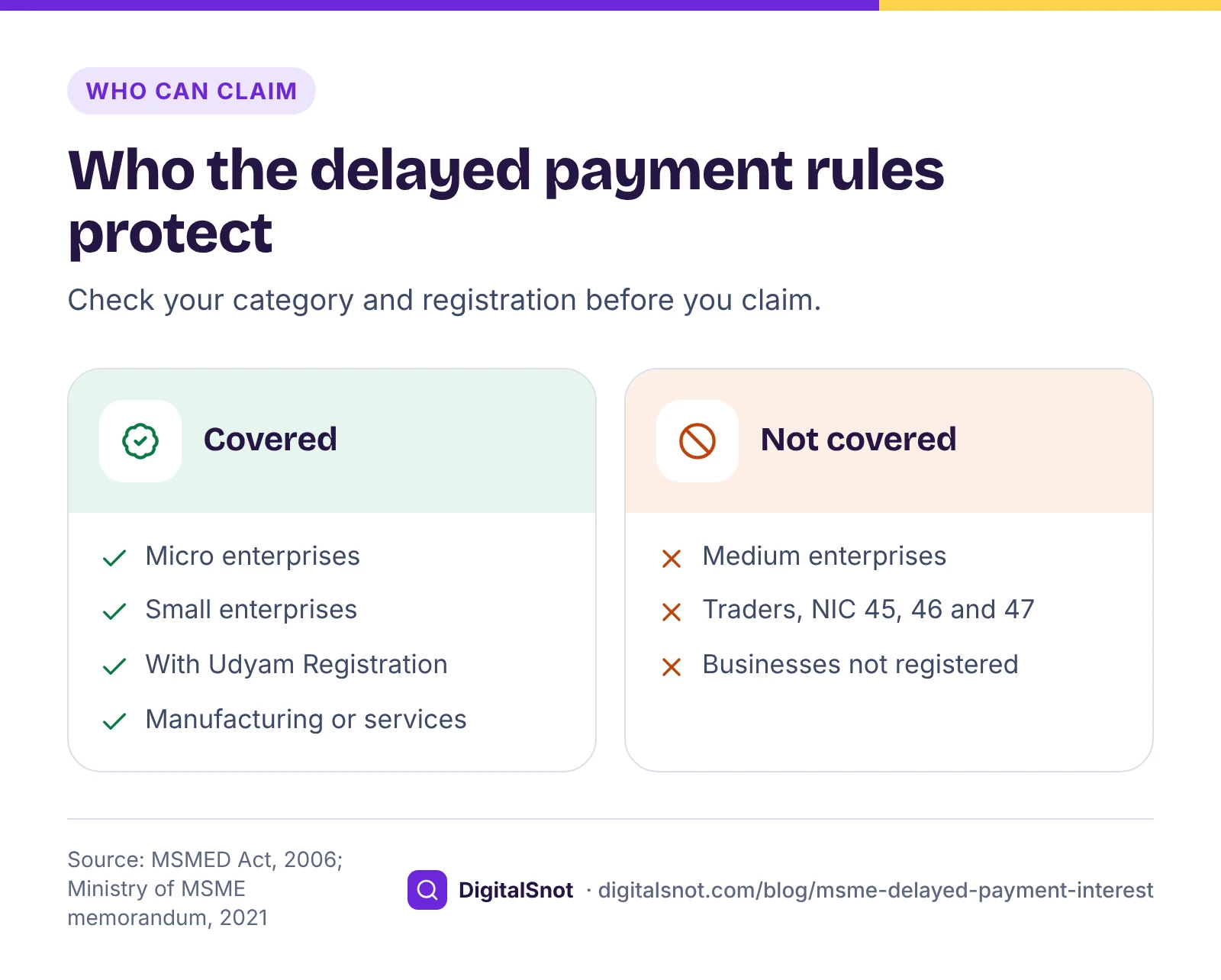
The delayed payment rules are in sections 15 to 24 of the Micro, Small and Medium Enterprises Development Act, 2006. They protect a supplier that is a micro or small enterprise and is registered. Udyam Registration replaced the older memorandum on 1 July 2020, and it is free on the official portal.
Your category depends on two tests, investment in plant and machinery or equipment, and turnover. Under the limits in force from 1 April 2025, a micro enterprise has investment of up to ₹2.5 crore and turnover of up to ₹10 crore, and a small enterprise up to ₹25 crore and ₹100 crore. Crossing either limit moves you up a category. Put your figures into the MSME (Udyam) Category Checker to see where you stand under both tests.
Two groups are left out. Medium enterprises are not covered by these sections. And retail and wholesale traders (NIC codes 45, 46 and 47), who may register on Udyam since a Ministry of MSME memorandum of 2 July 2021, get only priority sector lending from it, not the delayed payment route.
When a payment becomes late
Section 15 sets the deadline. The buyer must pay by the date agreed in writing, and that agreed period can never be more than 45 days from the day of acceptance. If nothing was agreed in writing, the buyer must pay within 15 days of acceptance.
Acceptance is the day the goods were delivered or the service was given. If the buyer objected in writing within 15 days, it is the day you removed the objection. If the buyer raised no objection within 15 days, the goods or service are taken as accepted.
A purchase order that says 60 or 90 days does not stretch the limit. For your claim, the last day to pay is still 45 days after acceptance.
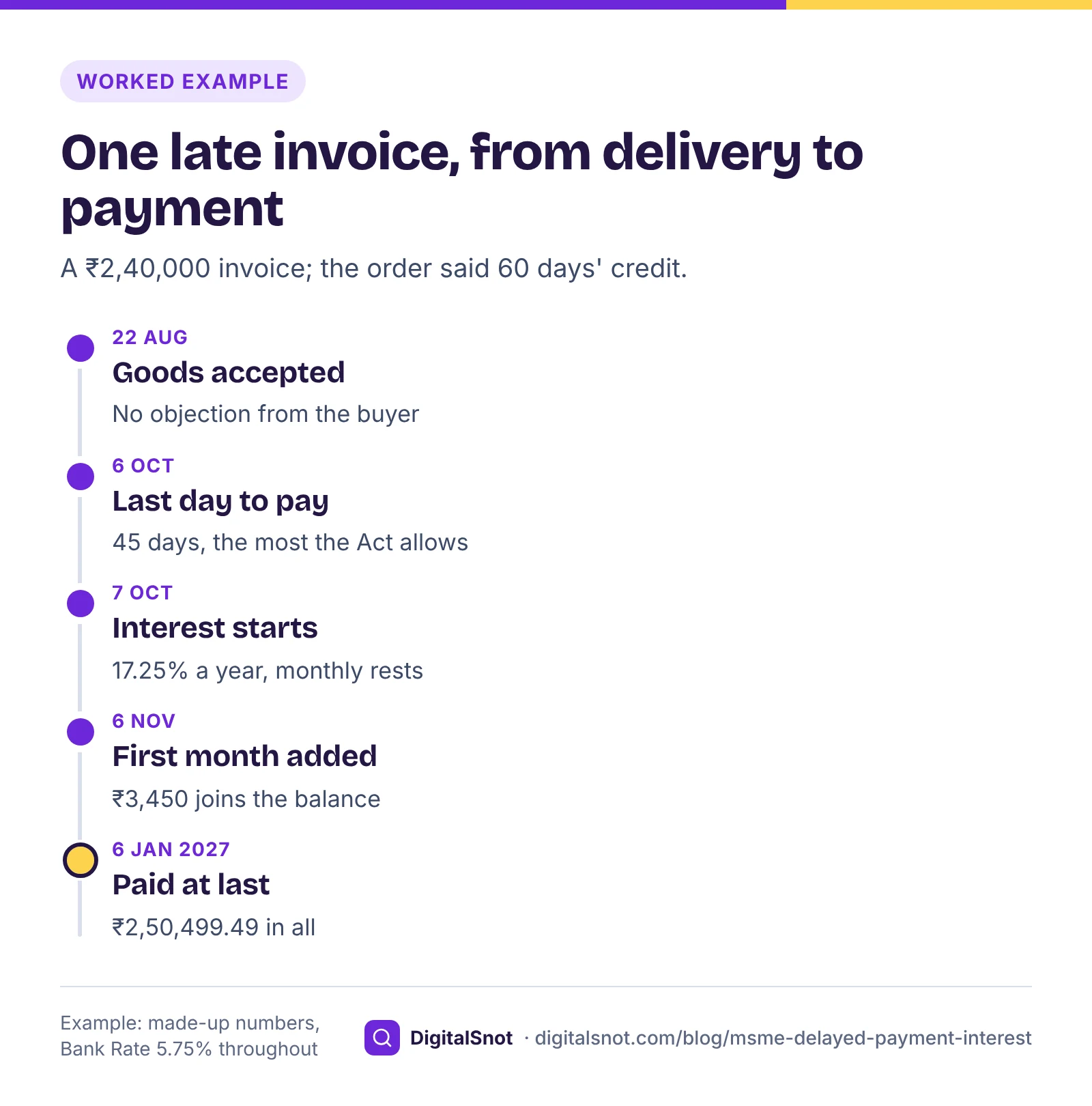
Count from the day after acceptance. Goods accepted on 22 August reach day 45 on 6 October, so interest runs from 7 October. That is how our calculator counts the days; a Council may read the dates slightly differently, so keep your records clear.
How the interest is worked out
Section 16 says a buyer who pays late owes compound interest with monthly rests at three times the Bank Rate notified by the Reserve Bank of India. It applies whatever any agreement between you and the buyer says, so a clause that waives interest or sets a lower rate does not reduce what the Act allows.
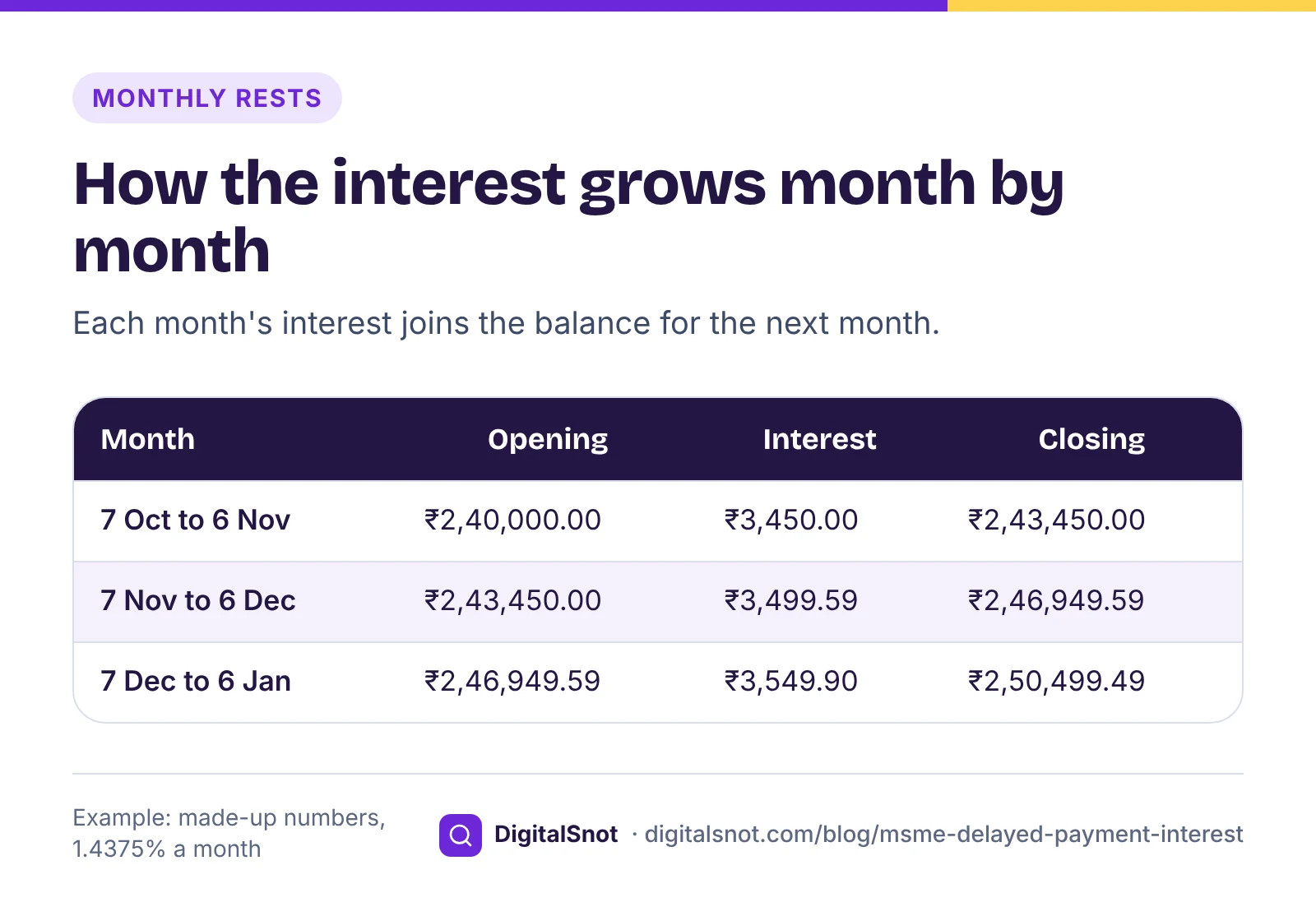
"Monthly rests" means each month's interest is added to the amount owed, so the next month's interest is charged on a larger sum. The RBI raised the Bank Rate from 5.50% to 5.75% in its monetary policy of 7 October 2026. At 5.75%, the Act's rate is 17.25% a year, or 1.4375% a month. To work out one month's interest yourself, multiply the balance by three times the Bank Rate, then divide by 12 and by 100. The Bank Rate changes after RBI policy meetings, so check the current figure on rbi.org.in before you send a claim.
Worked example: Shree Packaging Works, Pune
Shree Packaging Works is a made-up micro manufacturer in Bhosari, Pune, with Udyam Registration. It supplies cartons to a distributor:
- Invoice SPW/26-27/112, dated 20 August 2026, for ₹2,40,000.
- The distributor accepted the goods on 22 August 2026 and raised no objection.
- The purchase order says 60 days' credit, which the Act caps at 45 days.
So the last day to pay is 6 October 2026, and interest runs from 7 October. Suppose the distributor pays nothing until 6 January 2027, and the Bank Rate stays at 5.75%:
- 7 October to 6 November: ₹2,40,000 × 1.4375% = ₹3,450. The balance becomes ₹2,43,450.
- 7 November to 6 December: ₹2,43,450 × 1.4375% = ₹3,499.59. The balance becomes ₹2,46,949.59.
- 7 December to 6 January: ₹2,46,949.59 × 1.4375% = ₹3,549.90. The balance becomes ₹2,50,499.49.
After 92 days the distributor owes ₹10,499.49 of interest, ₹2,50,499.49 in all. Simple interest at 17.25% for the same 92 days would be about ₹10,435. The gap is small over three months, but it grows with every month the bill stays unpaid.
Part payments change the sum. In our calculator, a part payment first reduces the unpaid invoice amount, and interest stops once the invoice amount is paid in full, while interest already added stays owed. That is our method; a Facilitation Council may count part payments differently.
Step by step: claim what you are owed
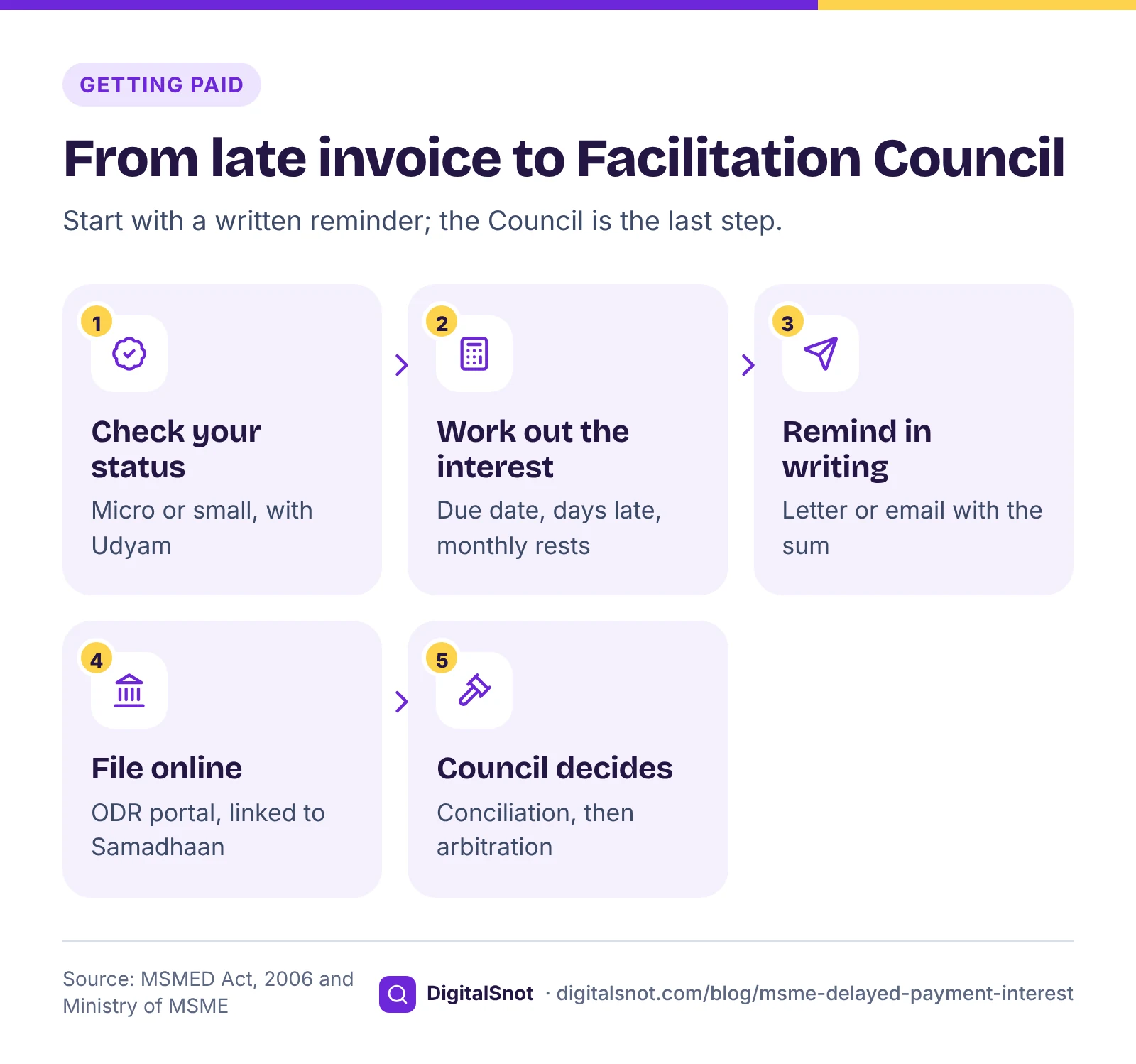
- Check your status. Confirm your category and that your Udyam Registration shows manufacturing or services, not trading.
- List the unpaid invoices. For each, note the invoice date, the acceptance date (from the delivery challan, receipt or email), any credit period agreed in writing, the amount and any part payments.
- Work out the interest. Enter the list in our MSME Delayed Payment Interest Calculator. It gives the last day to pay under section 15, the days late, interest at three times the Bank Rate compounded every month, and a month-by-month table. It also writes a reminder letter and WhatsApp text you can edit, and a CSV file for your accountant. It runs in your browser. It cannot tell whether a buyer's objection was valid, and a Facilitation Council may work the interest out differently, especially if the Bank Rate changed during the delay.
- Remind the buyer in writing. Name each late invoice with its acceptance date, the last day to pay under section 15, the interest to date under section 16, and the date by which you expect payment. Send the letter by email and keep proof that it was sent. If your emails tend to land in spam, read why business emails land in spam first, so the reminder is not lost.
- Record every payment. When money arrives, issue a receipt that shows what was paid and the balance left. Our Payment Receipt Maker does this for part payments, and part payments also go into the calculator.
- File online if the buyer still does not pay. A micro or small supplier can file a delayed payment application through MSME Samadhaan. Since 15 October 2025, new cases are filed on the Ministry of MSME's ODR portal, which is linked to Samadhaan.
The case goes to the Micro and Small Enterprises Facilitation Council of your State. Under section 18, the Council first tries conciliation and then, if that fails, arbitration, and the Act gives it 90 days from the reference to decide.
The process is changing. Parliament passed the MSMED (Amendment) Bill, 2026 in August 2026, with new timelines for resolving delayed payment disputes. Its parts start only from dates the government notifies, so ask your lawyer which rules apply to your case when you file.
Why buyers have a reason to pay on time
Late payment to a micro or small supplier also costs the buyer tax. Under section 43B(h) of the Income-tax Act, 1961, added by the Finance Act, 2023 and in force from assessment year 2024-25, an amount owed to a micro or small enterprise beyond the section 15 time limit is allowed as a deduction only in the year it is actually paid. The Income Tax Department's page on section 43B sets out the clause. The Income-tax Act, 2025, in force from 1 April 2026, keeps this rule in its section 37. And under section 23 of the MSMED Act, the interest itself is not deductible.
That makes a polite line in your reminder fair: paying within the limit protects the buyer's own deduction. Ask your CA how the rule applies to a particular year.
Mistakes that weaken a claim
- No record of acceptance. Keep signed delivery challans, receipts or emails that show the date. Without them, the start date is open to argument.
- Invoices with missing details. A buyer may hold back payment over a faulty bill. Our guide to what a GST invoice must show covers the details.
- The wrong rate. The Act's rate is three times the Bank Rate. Do not use the repo rate, and do not multiply by three twice.
- A trading registration. If your Udyam Registration lists you as a trader, the delayed payment route is closed. Check the activity listed on your certificate.
- Waiving interest by habit. You may choose to ask only for the invoice amount, but decide that on purpose. The Act keeps your right to interest whatever the contract says.
Your next step
Pick your oldest unpaid invoice and put it into the MSME Delayed Payment Interest Calculator with its acceptance date. Send the reminder it drafts, and keep a copy. More free tools for invoices, receipts and GST are on our free tools page.
Free tools in this article
- MSME (Udyam) Category Checker Micro, small or medium under the 2025 Udyam limits, with both tests and how close the next category is.
- MSME Delayed Payment Interest Calculator Interest a buyer owes a micro or small supplier for paying late, with due dates and a reminder letter.
- Payment Receipt Maker Make a receipt for a full payment, part payment or advance, with the balance left, and print it on A4 or A5.
By the numbers
- a year: the late payment interest rate under section 16 of the MSMED Act, three times the RBI Bank Rate of 5.75% as of 7 October 2026
- 17.25%
- Source: Reserve Bank of India
Frequently asked questions
How many days does a buyer have to pay an MSME supplier?
The period agreed in writing, but never more than 45 days from the day of acceptance or deemed acceptance, under section 15 of the MSMED Act, 2006. With no written agreement, the buyer must pay within 15 days of acceptance.
What interest rate applies to late payments to MSMEs?
Compound interest with monthly rests at three times the Bank Rate notified by the RBI, under section 16. With the Bank Rate at 5.75% as of 7 October 2026, that is 17.25% a year, or 1.4375% a month. Check the current Bank Rate on rbi.org.in before you claim.
Can a contract waive the interest on late payment?
No. Section 16 applies whatever any agreement between the buyer and the supplier says, so a clause that waives interest or sets a lower rate does not reduce what the Act allows. The supplier can still choose to ask only for the invoice amount.
Can traders claim interest under the MSMED Act?
No. Retail and wholesale traders (NIC codes 45, 46 and 47) may register on Udyam since July 2021, but only for priority sector lending. The delayed payment route covers micro and small enterprises in manufacturing or services.
Where can I complain if a buyer does not pay?
File a delayed payment application online through MSME Samadhaan; since 15 October 2025, new cases are filed on the Ministry of MSME's ODR portal, which is linked to Samadhaan. The case goes to your State's Facilitation Council for conciliation and then arbitration.
Does late payment to an MSME affect the buyer's income tax?
Yes. Under section 43B(h) of the Income-tax Act, 1961, an amount owed to a micro or small enterprise beyond the section 15 limit is deductible only in the year it is paid. The Income-tax Act, 2025 keeps the rule in section 37; ask your CA how it applies.
Sources
Every figure and claim in this article comes from the sources below. We checked each one when writing and link to the original so you can read it yourself. Credit belongs to the authors and publishers listed. How we write and check our articles.
-
1
The Micro, Small and Medium Enterprises Development Act, 2006
India Code · Sections 15 to 23: the 45-day limit, acceptance, interest at three times the Bank Rate with monthly rests, the Facilitation Council and non-deductible interest
-
2
Monetary Policy Statement, October 2026
Reserve Bank of India · Bank Rate raised to 5.75% on 7 October 2026
-
3
Reserve Bank of India: current rates
Reserve Bank of India · Where to check the current Bank Rate before a claim
-
4
Inclusion of retail and wholesale trade as MSMEs (Office Memorandum, 2 July 2021)
Ministry of MSME · Traders with NIC codes 45, 46 and 47 get priority sector lending only
-
5
Udyam Registration circulars and orders
Ministry of MSME · MSME definition and the revised limits from 1 April 2025
-
6
MSME Samadhaan
Ministry of MSME · Filing delayed payment applications online
-
7
MSME Online Dispute Resolution portal
Ministry of MSME · Portal for new delayed payment cases, linked to Samadhaan
-
8
Empowering MSME ecosystem: a national ODR framework
Press Information Bureau · The ODR portal, launched on 27 June 2025, with conciliation and arbitration before the Council
-
9
The Micro, Small and Medium Enterprises Development (Amendment) Bill, 2026
Press Information Bureau · Amendments passed in August 2026, including timelines for delayed payment disputes
-
10
Section 43B
Income Tax Department · Clause (h): deduction only on payment for sums owed to micro and small enterprises beyond the section 15 limit