AI search optimisation: get your business cited in AI answers
Buyers now ask ChatGPT, Gemini and Perplexity before they search. AI search optimisation makes your website the source those assistants understand, trust and quote.
Get a proposalWhy businesses are missing from AI answers
When an assistant leaves you out, it is usually for one of these reasons.
-
No direct answers
Pages bury the answer under long introductions, so there is nothing clear to quote.
-
Claims without sources
Statements with no evidence, author or date are harder for AI systems to trust.
-
Inconsistent brand details
Different names, services or descriptions across your site and profiles create doubt.
-
Missing structured data
Without schema, machines must guess what your business is and what you offer.
-
Questions left unanswered
Your buyers ask questions your website never addresses, so other sources get cited.
-
AI crawlers blocked
Robots rules or firewalls that stop AI crawlers from reading your pages at all.
What is included
The groundwork that makes your content easy for AI systems to find, understand and quote.
-
Question research
The real questions your buyers ask AI assistants and search engines, grouped by intent.
-
Answer-first rewrites
Key pages restructured so each section opens with a direct, quotable answer.
-
Sources and evidence
Claims backed by named sources, author details and review dates that show expertise.
-
Schema and llms.txt
Organization, Service, FAQ and Person schema, plus an llms.txt file that summarises your site for AI crawlers.
-
Consistent brand profile
Your name, services and details aligned across your site, social profiles and directories.
-
AI visibility tracking
A fixed set of questions checked regularly to see where you are mentioned and cited.
Pages that are easy to quote
AI assistants look for passages that answer a question clearly and can be checked. We restructure your key pages so each section opens with a direct answer, follows with evidence, and ends with practical detail.
The same structure also helps people skim, so it improves the page for every reader.
- Answer-first sections with clear headings
- Definitions written in one or two sentences
- Facts linked to named, original sources
- Author, reviewer and last-reviewed date on the page
How a page becomes an AI citation
See how restructuring a page around clear answers makes it easier for AI assistants to quote.
What is AI search optimisation?
AI search optimisation, often called generative engine optimisation (GEO) or answer engine optimisation (AEO), is the practice of making content easy for AI systems to retrieve, understand and cite. It builds on SEO: AI assistants still rely on pages that are crawlable, well structured and trustworthy.
How is it different from traditional SEO?
Traditional SEO aims for a position in a list of links. AI search optimisation aims to be one of the few sources an assistant uses when it writes an answer. That rewards direct answers, clear definitions, evidence and a brand that is described the same way everywhere.
Who is it for?
- Businesses whose buyers research with ChatGPT, Gemini or Perplexity
- Expert service firms that want to be recommended, not just listed
- Brands that already rank on Google but are missing from AI answers
No one can guarantee that an AI assistant will cite a specific website. What we can do is remove the reasons it would not, and measure the change over time.
Which AI assistants does this cover?
The same groundwork helps across ChatGPT, Google Gemini and AI Overviews, Microsoft Copilot, Perplexity and Claude. Each system retrieves information differently, but they all favour content that is accessible to crawlers, clearly structured, well sourced and consistent with what other trusted sites say about you.
What to expect and when
Some AI systems search the web live and can reflect changes within weeks. Others rely on training data that updates less often. That is why we measure a fixed set of questions every month and report the trend, rather than judging a single answer on a single day.
How it works
-
1
Baseline
We check how AI assistants describe your business today and which sources they use.
-
2
Research
We map the questions your buyers ask and the pages that should answer them.
-
3
Restructure
We rewrite and mark up those pages, and fix inconsistent brand details.
-
4
Track
We re-check the same questions every month and report mentions and citations.
Measured every month
You cannot improve what you do not measure. We keep a fixed set of questions your buyers ask and check them across AI assistants every month. The report shows where you are mentioned, where you are cited as a source, and whether you are described accurately.
These results sit next to your normal search rankings and website enquiries, so you see the full picture.
- Mentions and citations per assistant
- Which sources the answers rely on
- Accuracy of how your business is described
- Changes month by month, with notes on what we did
What you get
Practical changes and clear reporting, not a black box.
-
AI visibility baseline
How assistants describe you today, and which sources they use instead.
-
Question map
The buyer questions that matter, mapped to the pages that should answer them.
-
Rewritten key pages
Answer-first copy with sources, definitions and FAQs.
-
Schema and llms.txt
Structured data and a plain summary file that AI crawlers can read.
-
Brand consistency fixes
One accurate description of your business across your site and profiles.
-
Monthly AI visibility report
Mentions, citations and accuracy, tracked over time.
Plans and prices
Every plan starts with a baseline of how AI assistants describe you today.
-
Starter
A small business with a few key services.
₹15,000 a month
- Baseline for up to 20 buyer questions
- Question map linked to the pages that should answer them
- 2 key pages rewritten answer-first each month
- Schema and llms.txt set up
- Monthly AI visibility report
-
Recommended
Growth
Businesses competing for recommendations in a busy market.
₹30,000 a month
- Up to 50 buyer questions tracked
- 5 pages rewritten or created each month
- Sources and evidence added to key pages
- One consistent brand description across your site and profiles
- Monthly report that compares you with competitors
-
Advanced
Larger sites or several product lines.
From ₹55,000 a month
- Up to 100 buyer questions tracked
- 10 pages rewritten or created each month
- Everything in Growth
- A review call every two weeks
Prices are in Indian rupees and do not include GST. The exact scope, timeline and any minimum term are agreed in writing before work starts.
Not sure which plan fits? Start with a free auditSee how AI assistants describe your business today
We will check a handful of questions your buyers ask and show you which sources the answers use.
Guides and articles on aI search optimisation (GEO)
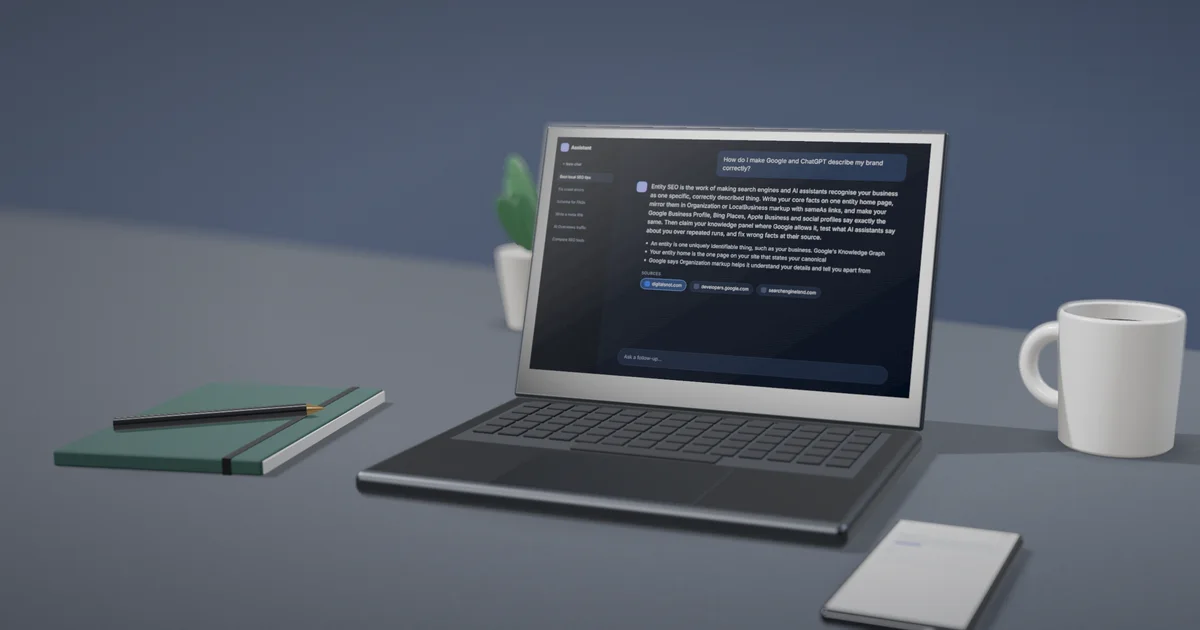
Entity SEO: help Google and AI understand your brand
A step-by-step entity SEO guide: define your brand on one page, mark it up with sameAs, make every listing match, and correct what Google and AI assistants get...
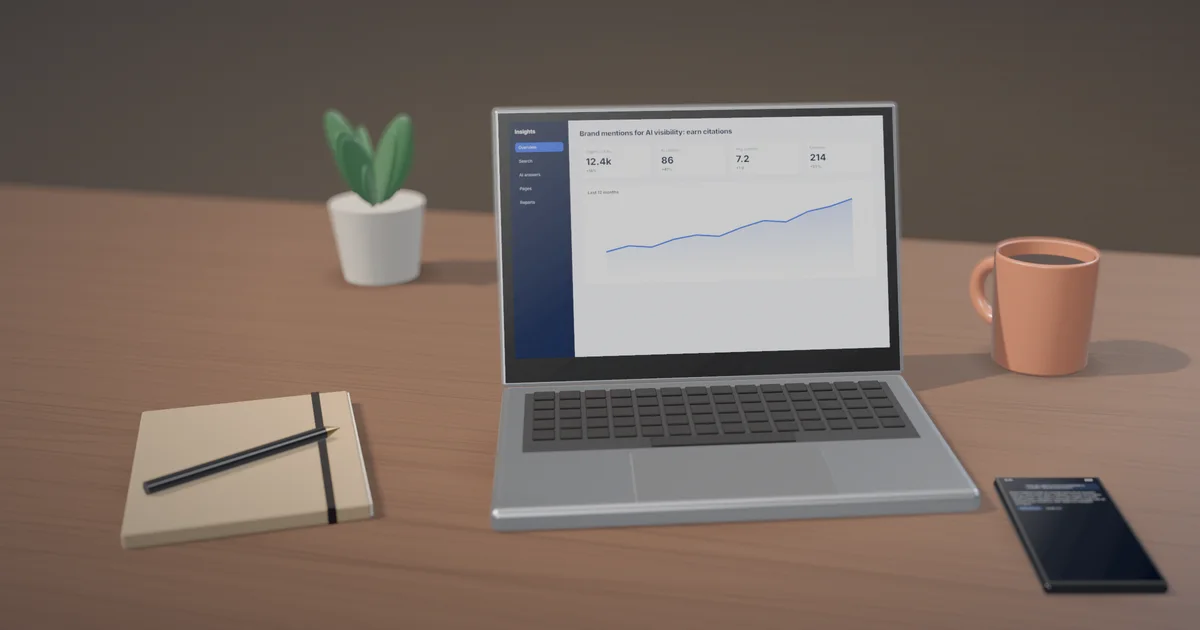
Brand mentions for AI visibility: earn citations that count
Mentions now matter more than links for AI answers. Find the sources ChatGPT and AI Overviews cite in your niche, earn a place on them honestly and skip the tac...

Query fan-out: how AI Mode builds answers and how to be included
How Google's AI Mode splits one question into many searches, what Google says you can ignore, and a free method to map sub-questions and decide between one page...
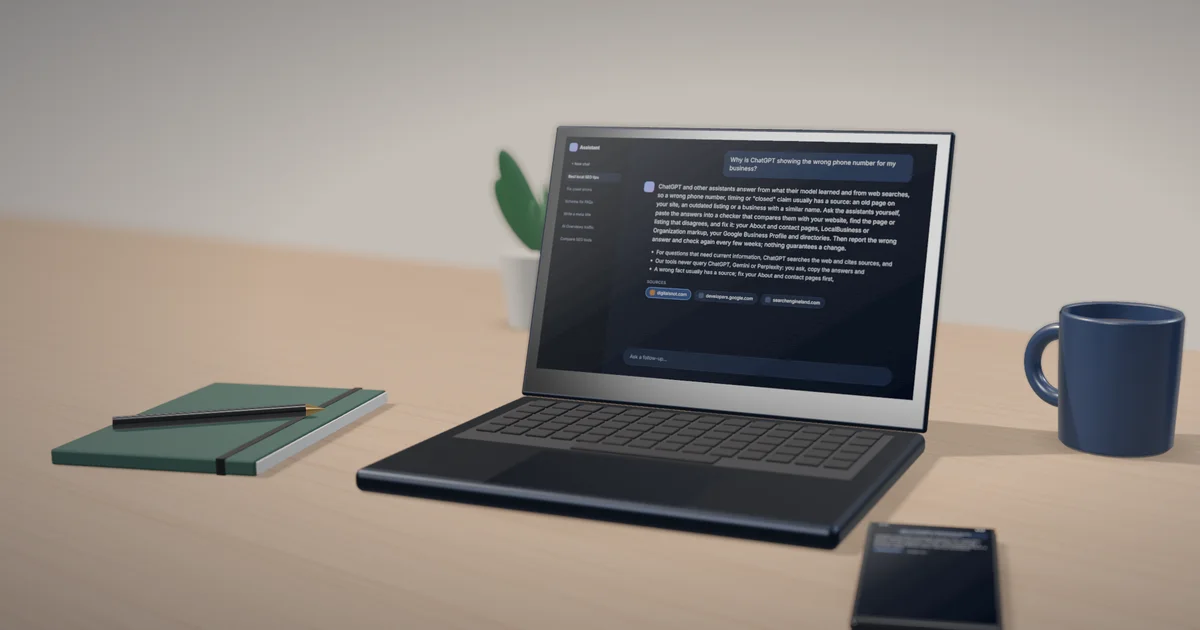
Is ChatGPT giving wrong business facts? How to check and fix the sources
Find out what AI assistants say about your business, compare it with your real phone, hours and prices, and fix the pages and listings those answers are built f...

AI Overviews took my clicks? What to check and what to do
Clicks down but impressions steady? Here is how to tell whether AI Overviews are the cause, using Search Console, and what to change if they are.

How ChatGPT recommends businesses (and what you can do about it)
When ChatGPT recommends a business, it usually searches the web first and cites what it finds. Here is how that works and what a small business can do to show u...
Free tools to start with
All free toolsCheck where you stand before you talk to us. These run on your own pages or the details you type in.
- AI Search Readiness Checker Score a page on what helps ChatGPT, Gemini and AI Overviews cite it.
- AI Crawler Checker See which AI crawlers can read your page, and what they see without JavaScript.
- AI Extractability Checker Score how easily AI answers can quote each section of your page.
- AI Brand Fact Checker Check AI answers about your business against your site: wrong phone, prices, timings or "closed" claims.
- AI Citation Gap Checker Compare your page with a cited competitor and see the gaps to close.
- AI Share of Voice Checker Compare how often AI answers name and recommend you against competitors, prompt by prompt.
Frequently asked questions
What is GEO?
GEO stands for generative engine optimisation: making your content easy for AI assistants such as ChatGPT, Gemini, Perplexity and Google AI Overviews to understand and cite.
Is AI search optimisation different from SEO?
It builds on SEO. Pages still need to be crawlable and trustworthy, but GEO puts more weight on direct answers, evidence, structured data and a consistent brand profile.
Can you guarantee my business will appear in ChatGPT?
No one can guarantee that. AI assistants choose sources themselves. We improve the signals they rely on and track your mentions and citations so you can see progress.
How do you measure results?
We keep a fixed list of buyer questions and check them across AI assistants every month, recording whether you are mentioned, cited and described accurately.
Do I need new content?
Often the fastest gains come from restructuring pages you already have. New content is added where important questions have no good answer on your site.
What is the difference between GEO and AEO?
Answer engine optimisation (AEO) focuses on giving direct answers that search features and assistants can extract. Generative engine optimisation (GEO) is broader: it covers being understood, trusted and cited by AI systems that write answers. In practice the work overlaps a lot.
Should I block AI crawlers?
It depends on your goals. Blocking them can protect content, but it also makes it harder for AI assistants to cite you. Your website settings let you allow or block individual AI crawlers, and we can help you decide.
Does this replace normal SEO?
No. AI assistants often draw on pages that already rank well in search. GEO works best on top of solid technical SEO and useful content.