Guide · AI search
Query fan-out: how AI Mode builds answers and how to be included
How Google's AI Mode splits one question into many searches, what Google says you can ignore, and a free method to map sub-questions and decide between one page or many.

On this page (11 sections)
- 1What query fan-out is, in Google's own words
- 2How other AI search tools split questions: a documentation check
- 3Why fan-out changes which pages get cited
- 4What fan-out does not mean: myths Google has addressed
- 5Map the sub-questions behind a topic with free tools
- 6A worked fan-out map: one question, twelve sub-questions
- 7One page or many? A decision rule
- 8Write passages that answer sub-questions clearly
- 9Check coverage against competitors and AI answers
- 10Measure whether it worked
- 11Sources
Type a long question into Google's AI Mode and it does not run one search. Google says AI Mode and AI Overviews may use a technique called query fan-out: the system breaks your question into subtopics, runs several related searches at the same time and writes one answer from what it finds. That is why a page can be cited for a question it does not rank for, and why the page in position one can be left out.
This guide is for small-business owners, content leads and in-house marketers who keep hearing "query fan-out". By the end you will be able to explain it accurately, tell Google's guidance from the myths, map the sub-questions behind any customer question with free tools, decide whether a sub-question needs its own page, and check whether your changes worked.
What we say about how AI Mode works comes from Google's own documentation, linked where used. Where we go further, we label it as inference. Facts were checked in October 2026.
What query fan-out is, in Google's own words
Query fan-out is a technique in which an AI search system turns one question into a set of related searches, runs them at the same time and builds its answer from the combined results. Google uses the term for both AI Overviews and AI Mode.
Google's guide to optimising for generative AI features, published in May 2026, defines fan-out queries as a set of concurrent, related queries generated by the model to request more information and fetch additional relevant search results. Its example: someone asks how to fix a lawn that is full of weeds, and the fan-out queries might include "best herbicides for lawns", "remove weeds without chemicals" and "how to prevent weeds in lawn".
Google's AI features and your website page says AI Overviews and AI Mode may issue multiple related searches across subtopics and data sources to develop a response. While the answer is being generated, the models identify more supporting pages, so Google can show a wider and more diverse set of links than a classic results page would.
How far it goes
When Google announced AI Mode updates at I/O 2025, it said AI Mode breaks a question into subtopics and issues a multitude of queries simultaneously. Deep Search, the research option in AI Mode, takes the same technique further: Google says it can issue hundreds of searches and produce a fully cited report in minutes.
At I/O 2026 in May, Google said AI Mode had passed one billion monthly users and brought AI Overviews and AI Mode together into one AI Search experience, so a follow-up asked from an AI Overview continues in AI Mode. Google also reports that the average AI Mode query is about three times the length of a traditional search. Longer questions have more parts, and each part is a candidate for its own search.
What Google has not said
Google has not published how many searches a typical question triggers, which data sources it uses for each one, or how it chooses which retrieved pages to cite. Articles that describe those details rely on patent filings or outside tests. Patents show what Google has explored, not what runs in Search today, so treat any precise mechanism, including our own reading of the studies below, as inference.
Who can be included
The entry rules are ordinary. Google says a page must be indexed and eligible to show in Search with a snippet, with no additional technical requirements for AI Overviews or AI Mode. The May 2026 guide adds that your site must not be opted out of Search generative AI features in Search Console. If you are unsure what your robots.txt, CDN or that control allow today, our guide to blocking AI crawlers without leaving AI search covers each switch, and the technical SEO audit checklist covers indexing problems.
How other AI search tools split questions: a documentation check
Google is the only one of the four companies we checked that names "query fan-out" in the documentation we read, but Microsoft, OpenAI and Perplexity all describe answers built from several searches. Only Microsoft gives site owners a partial view of the searches its AI ran.
Method: in October 2026 we read each company's own documentation and help pages for its AI search products and recorded two things: whether it describes splitting one question into several searches, and whether a site owner can see those searches. These pages change often, so repeat the check before relying on it.
| Platform | Describes several searches per question? | What its documentation says | Can site owners see the sub-searches? |
|---|---|---|---|
| Google AI Overviews and AI Mode | Yes, by name | "Query fan-out": multiple related searches across subtopics and data sources. Deep Search can issue hundreds. | No. The Generative AI performance report shows impressions by page, country, device and date, not queries. |
| Microsoft Copilot and Bing | Not by that name in the pages we read | Bing Webmaster Tools reports "grounding queries": the phrases the AI used when it retrieved content it then cited. | Partly. The AI Performance report is sampled and grouped, with no individual prompts or answers. |
| OpenAI (ChatGPT and API) | Yes, for deep research | The deep research model autonomously plans sub-questions and runs web searches. In ChatGPT that process is abstracted away from the user. | No report for site owners. Developers can see the search calls in the API. |
| Perplexity | Yes, for Pro Search | Pro Search runs multiple searches and shows the person how it broke down the question. | Visible to the person asking, not reported to site owners. |
What the comparison tells you
- The behaviour is common, so the method carries over. Mapping sub-questions helps with every engine, not just Google.
- Nobody shows you Google's actual fan-out queries. A tool that lists "the" fan-out queries for your topic is making its own predictions.
- Bing's grounding queries are the best first-party window. They are sampled, but they are real data about what an AI searched for when it used your pages.
Why fan-out changes which pages get cited
Because the AI searches for several sub-questions, the pool of pages it can cite is wider than the top results for the question you track. Studies since 2025 find that many cited pages do not rank in the top 10 for the original query, and that ranking for related questions goes with more citations.
The clearest sign is in Ahrefs' data. In an updated study reported by Search Engine Journal in early 2026, 38% of pages cited in AI Overviews also ranked in the top 10 for the same query, down from 76% in Ahrefs' July 2025 version. Ahrefs says better citation parsing explains part of the drop, and it points to query fan-out as a likely cause: pages that do well across related sub-queries can be cited without ranking for the original question. Google has not confirmed that explanation.
The same question can also surface different pages on different surfaces. Using September 2025 US data, Ahrefs found that AI Mode and AI Overviews cited the same URLs only 13% of the time, though their answers were 86% similar in meaning. That predates the May 2026 merger, but the lesson holds: the answer can stay the same while the sources change.
The evidence, side by side
Method: we collected the published studies that test fan-out or citation overlap directly and recorded the engine, sample, finding and main caveat for each. Two of them point in different directions, which is the useful part.
| Study | Engine | Sample | Finding | Main caveat |
|---|---|---|---|---|
| Ahrefs (2026) | AI Overviews | 863,000 keywords, 4 million cited URLs | 38% of cited pages ranked in the top 10 for the same query, down from 76% in July 2025 | Improved citation parsing explains part of the drop |
| Ahrefs (September 2025 data) | AI Mode vs AI Overviews | 540,000 query pairs | Same URLs cited only 13% of the time; answers 86% similar in meaning | Single runs of each answer, before the 2026 merger |
| Surfer (November 2025) | AI Overviews | 10,000 keywords, 173,902 URLs | Pages also ranking for fan-out queries were 161% more likely to be cited than pages ranking only for the main query | Fan-outs generated with Gemini as a stand-in for the real, invisible ones |
| AirOps with Kevin Indig (April 2026) | ChatGPT | 16,851 queries, 353,799 pages | Top search result cited 58% of the time vs 14% at position 10; pages covering 26–50% of sub-queries beat pages covering all of them | ChatGPT only; data collected from the ChatGPT interface |
| SparkToro (2026) | ChatGPT, Claude, Google AI | 2,961 runs of 12 prompts by 600 volunteers | Less than a 1-in-100 chance of getting the same list of brands twice | Small volunteer study; brand lists, not citations |
Query fan-out in 15 seconds
What we take from it
This is our reading of the studies together, not a finding any one of them states.
- Ranking for the head term is no longer enough. Pages that also rank for neighbouring questions get more chances to be retrieved, which fits both the Surfer correlation and Ahrefs' 38%.
- Covering every sub-question is not the lever. In the AirOps data, the coverage effect shrank to very little once the match between the page and the query was held constant. Clear, closely matched answers and good rankings mattered more.
- Every check is a snapshot. With 13% URL overlap between two Google surfaces and brand lists that rarely repeat, judge trends across many runs, never one answer.
For the wider picture of how AI answers choose sources across engines, including crawler access and reputation, see our guide to getting cited in AI search.
What fan-out does not mean: myths Google has addressed
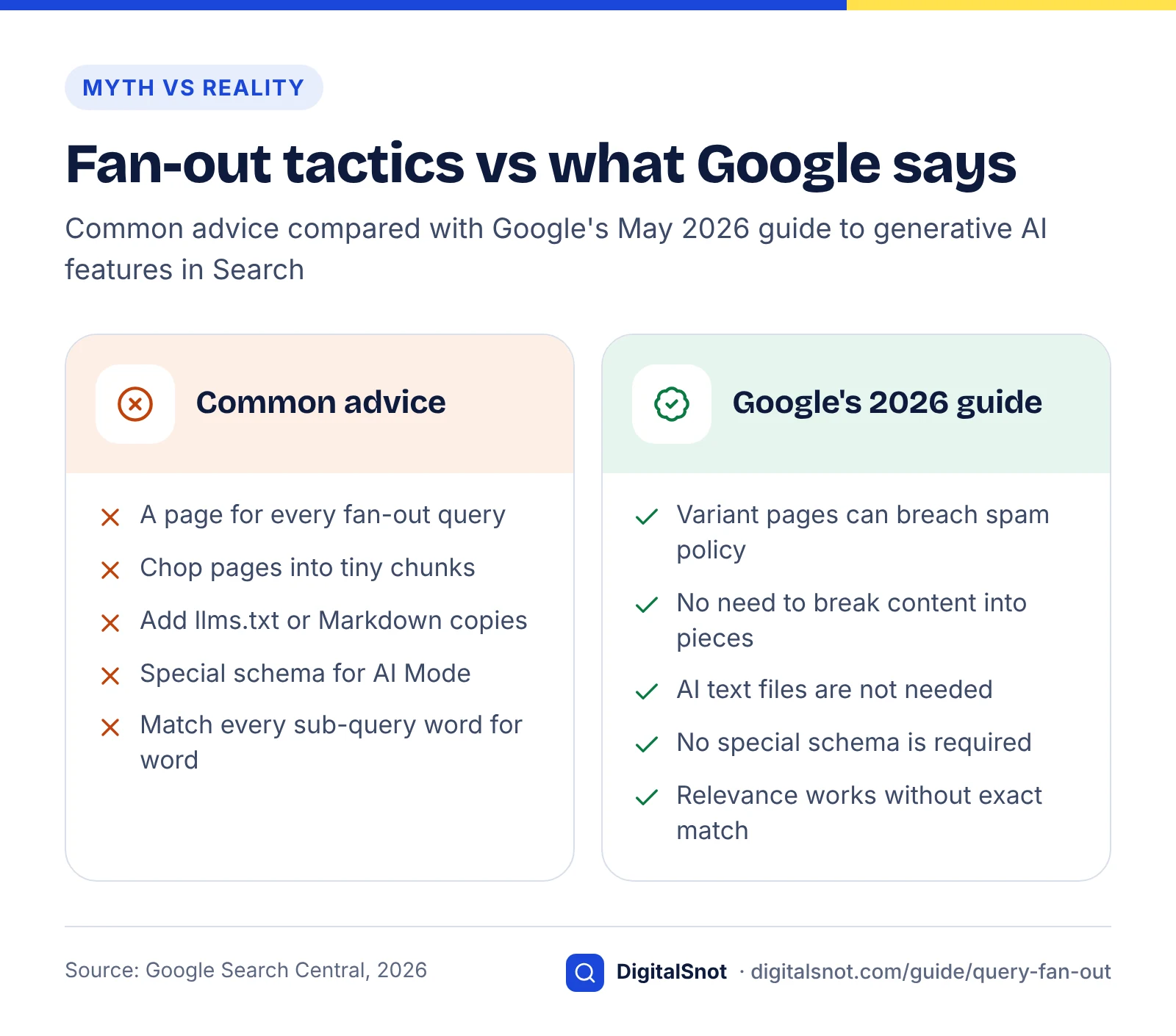
Most fan-out tactics being sold today are covered by Google's May 2026 guide, and several are on its list of things you can ignore. Google's short version is that optimising for generative AI search is "still SEO", because its AI features are rooted in its core ranking and quality systems.
| Myth | What Google's guide says | Do this instead |
|---|---|---|
| Make a page for every fan-out query | Creating separate content for every variation, fan-out queries included, primarily to manipulate rankings or AI responses violates the scaled content abuse policy. More pages do not make a site higher quality. | Cover a topic on one strong page; split only by intent |
| Break pages into tiny chunks for AI | There is no requirement to break content into tiny pieces. "Chunking" is on the list of tactics you can ignore. | Write normal sections with clear headings and direct answers |
| Add llms.txt or Markdown copies | AI text files, special markup and Markdown versions are not needed. A June 2026 update says such files neither help nor harm visibility in Google Search. | Spend the time on the page itself |
| Add special schema for AI Mode | No special schema.org markup is required for generative AI features. Structured data still matters for rich results. | Use markup for what it does (see our schema markup guide) |
| Repeat every sub-query word for word | Google's systems can understand a page's relevance even when there is no exact match between the query and the page. | Use customers' words in headings, then answer |
| Get mentioned anywhere so AI notices you | "Pursuing inauthentic mentions" is listed among the tactics you can ignore. | Earn genuine coverage on pages already cited |
What the sceptics get right
An evidence review by Passionfruit, an SEO agency, accepts that the mechanism is real but argues the tactics built on it are overclaimed. It leans on the AirOps finding that fan-out coverage was nearly irrelevant to citation rates, with retrieval rank and heading-to-query similarity predicting citations better. We agree with the direction: fan-out widens the pool of candidate pages, but it rewards what good SEO always did, answering the real question and the questions around it clearly.
Map the sub-questions behind a topic with free tools
You cannot see Google's real fan-out queries, but you can predict them well enough to plan a page. Start from the full question a customer asks, collect the related questions Google and other engines already show, then sort and trim them into a list of distinct sub-questions.
- Write the customer's question in full. Use the words from sales calls, enquiry emails, reviews and chat logs, not a two-word keyword. AI Mode questions are long, so your starting point should be too.
- Ask AI Mode and note what it covers. Run the question three times in a signed-out or private window and write down the subtopics, headings and cited pages. Subtopics that appear in every run are the ones to cover first.
- Collect Google's own related questions. Note People also ask, related searches and autocomplete suggestions for the question and each of its parts. In Search Console, filter the Performance report with a custom regex such as
^(\S+\s+){6,}\S+$to list queries of seven words or more that already bring you impressions. Google says AI Overviews and AI Mode are reported in the Web search type of that report. - Add Bing's grounding queries if you have them. If Copilot already cites your site, export the grounding queries from Bing Webmaster Tools. They are the nearest thing to real sub-queries any platform shows.
- Sort by intent. Paste up to 50 questions into the free AI Prompt Intent Classifier to separate learning questions from comparing and buying ones. Intent decides where a sub-question goes, so this step matters more than search volume.
- Merge rewordings and trim. "Modular kitchen price" and "cost of a modular kitchen" are one sub-question. Remove anything outside what you sell or know. Our rule of thumb is 8 to 12 distinct sub-questions per main question.
- Check demand where it matters. For the sub-questions that might deserve their own page, check search demand with the methods in our keyword research guide.
From one customer question to a content plan
Third-party fan-out generators can speed up step 2, and Search Engine Land's fan-out guide recommends them for surfacing related questions, paraphrases and follow-ups. Treat their output like your own list: predictions from another model, good enough to plan sections and pages, but not a list of searches Google will run.
A worked fan-out map: one question, twelve sub-questions
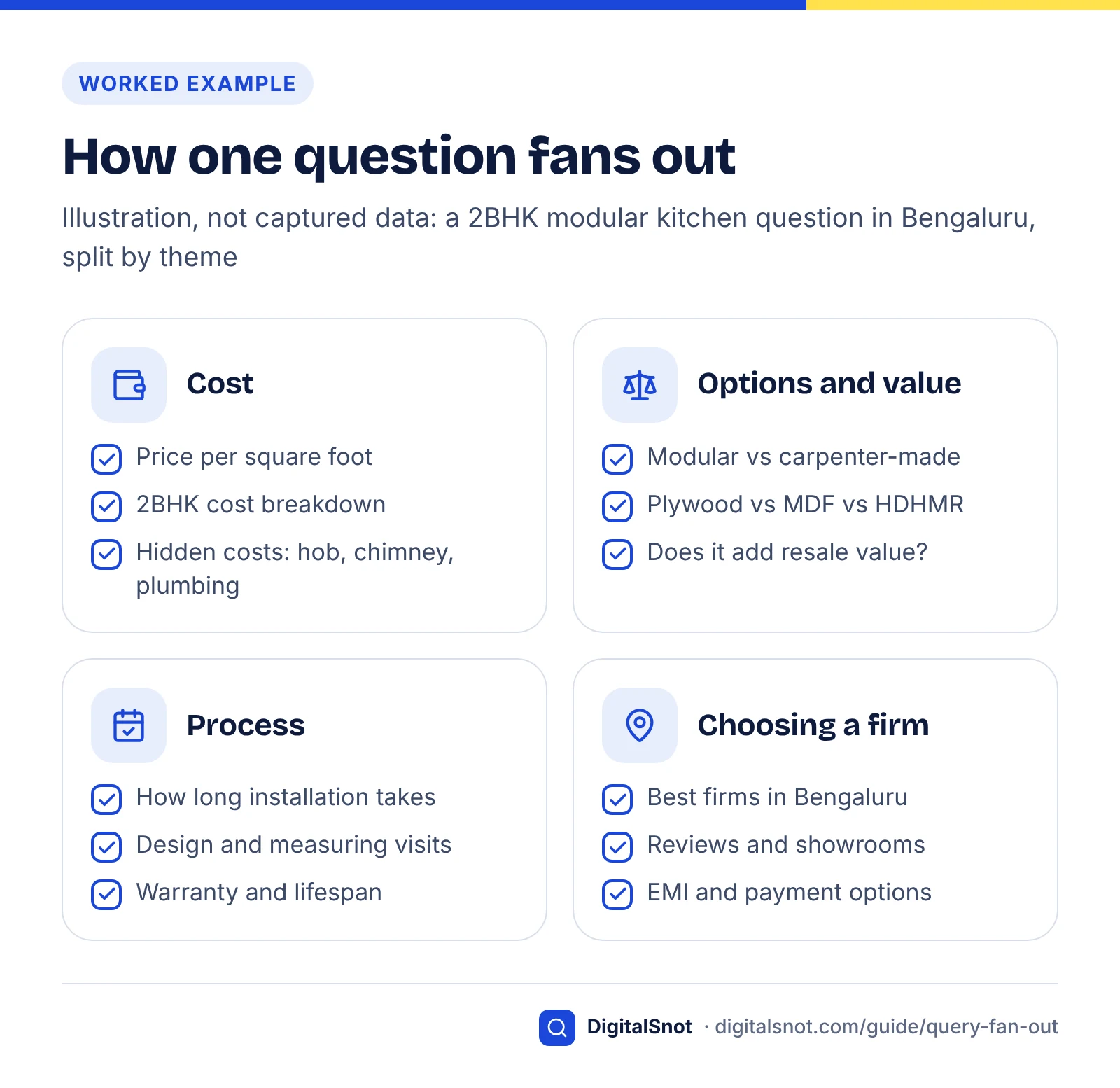
Here is the method applied to one example. The business, the question and the sub-questions are an illustration: they are our prediction of a plausible fan-out, not queries captured from Google.
Example: a modular kitchen firm in Bengaluru wants to be cited for the question "How much does a modular kitchen cost for a 2BHK flat in Bengaluru, and is it worth it over a carpenter-made one?" It is the kind of long, two-part question AI Mode users ask. Working through the steps above gives twelve sub-questions in four groups.
| # | Likely sub-question | Intent | Where it goes | Best format |
|---|---|---|---|---|
| 1 | Modular kitchen price per square foot in Bengaluru | Learn (cost) | Main guide: "What it costs" section | Price table from your own quotes |
| 2 | Cost breakdown for a 2BHK kitchen | Learn (cost) | Main guide, same section | Worked example with line items |
| 3 | Hidden costs: hob, chimney, plumbing, electrical | Learn (cost) | Main guide | Checklist |
| 4 | Modular vs carpenter-made kitchen | Compare | Its own page, linked both ways | Comparison table |
| 5 | Plywood vs MDF vs HDHMR boards | Compare | Main guide; own page only with lots of first-hand detail | Table of pros, cons and best uses |
| 6 | Does a modular kitchen add resale value? | Learn | Leave out unless a reliable source exists | None |
| 7 | How long installation takes | Learn (process) | Main guide | Numbered timeline |
| 8 | Design and measuring visits | Learn (process) | Main guide, same section as 7 | Steps |
| 9 | Warranty and lifespan | Trust | Existing warranty page, linked | Short answer plus link |
| 10 | Best modular kitchen firms in Bengaluru | Choose (local) | Service page, Google Business Profile and reviews | Not a self-ranked "best" list |
| 11 | Reviews and showroom visits | Choose | Service page and Business Profile | Reviews, address, photos |
| 12 | EMI (instalment) and payment options | Buy | Service or pricing page | Short factual answer |
What the map shows
- Half belong on one page. Six share the main question's learning intent and need short answers, so they become sections of one guide.
- One deserves its own page. "Modular vs carpenter-made" is a comparison people search for on its own, so it gets a separate page, linked both ways.
- Three are buying questions. Choosing a firm, reviews and payment options are answered by the service page, the Google Business Profile and reviews. Our guide to local SEO for AI search covers how those sources feed AI answers.
- Two need no new section. Warranty is already covered on an existing page, so the guide links to it. Resale value is a fair question, but the firm cannot back up an answer, so a section would only add guesswork.
Notice what the map does not contain: a page per sub-question. Twelve thin pages would compete with each other and are the pattern Google's guide warns against.
One page or many? A decision rule
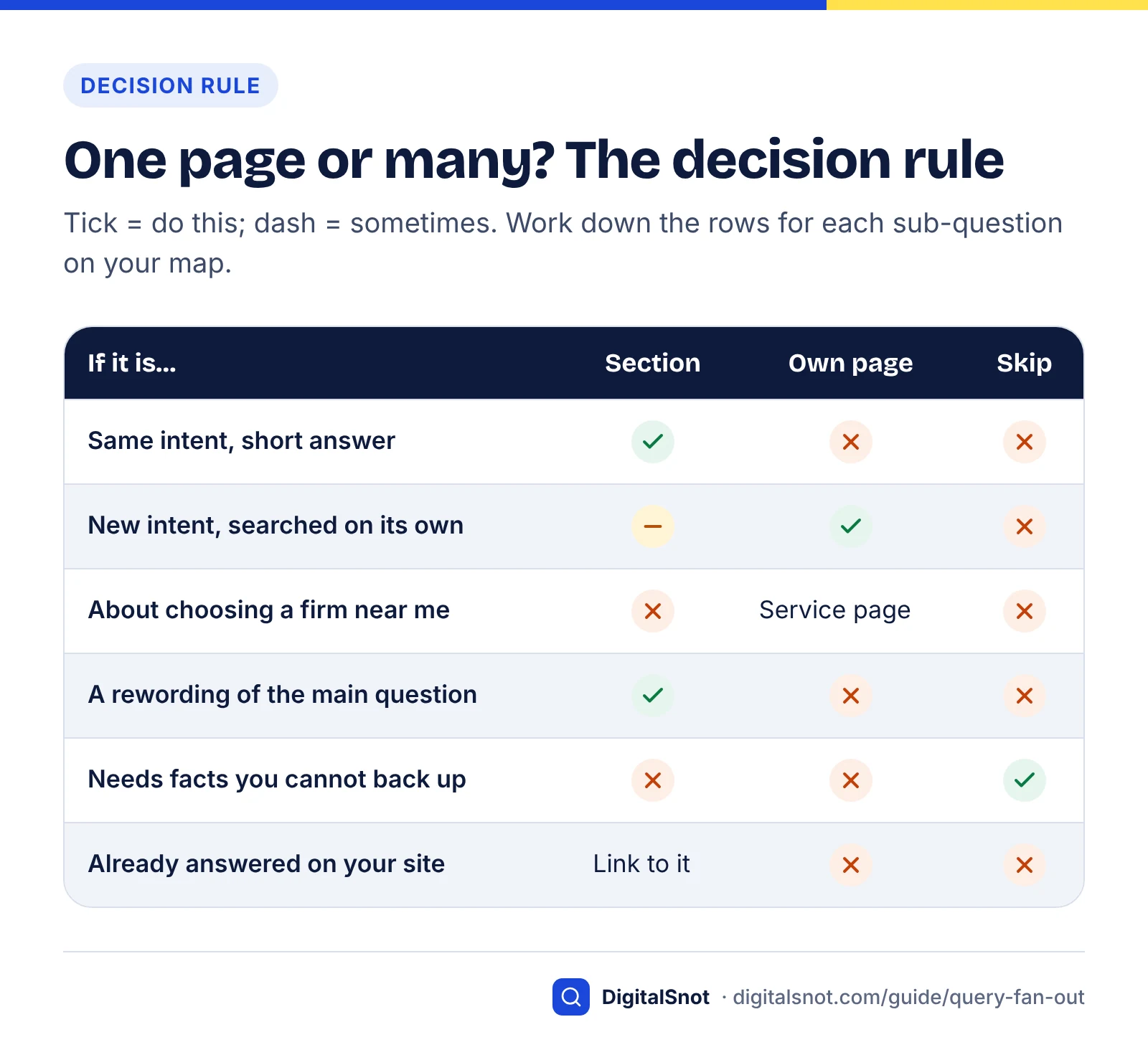
Keep a sub-question on the main page when it shares the main question's intent and can be answered in a paragraph, list or table. Give it its own page only when it has a different intent, people search for it on its own, and you have enough first-hand material to fill a page.
| If the sub-question… | Then | Example from the map |
|---|---|---|
| Shares the main question's intent and can be answered briefly | Answer it in a clearly headed section of the main page | How long installation takes |
| Has a different intent (comparing, choosing, buying) and is searched on its own | Give it its own page and link the two pages to each other | Modular vs carpenter-made kitchen |
| Is about choosing a provider near the searcher | Answer it with a service or location page, your Business Profile and reviews, not a blog post | Best modular kitchen firms in Bengaluru |
| Is a rewording of the main question | Add nothing; Google says its systems understand relevance without an exact match | "Modular kitchen price" vs "cost of a modular kitchen" |
| Needs facts you cannot stand behind | Cite a primary source or leave it out | Does a modular kitchen add resale value? |
| Is already answered by another page on your site | Summarise in a sentence and link to that page instead of writing a second one | Warranty and lifespan |
Why not one giant page?
Covering everything on one page sounds safe, but the evidence does not favour it. In the April 2026 AirOps study of ChatGPT citations, pages covering 26–50% of the fan-out sub-queries were cited more than pages covering all of them, and pages over 5,000 words did worse than pages under 500. That is one engine and one dataset, so treat it as a caution against bloat, not a word limit.
The opposite mistake is fragmentation. Search Engine Land's guide argues that each article in a topic hub should be self-contained, because a page covering one narrow angle is less likely to hold up across the whole fan-out. That is a practitioner view, not Google's, but it matches the rule: split by intent, not by wording. If you already have overlapping pages, our post on service pages versus blog posts explains how to stop them competing.
Write passages that answer sub-questions clearly
Give each sub-question a heading in the words customers use, answer it in the first one or two sentences, then add the evidence. A passage that makes sense when quoted on its own is easier for any AI system to use and easier for any reader to trust.
- Name the sub-question in the heading where it reads naturally: "How long does installation take?" rather than "Timelines".
- Answer first. Put the number, the yes or no, or the recommendation in the opening sentence.
- Make paragraphs stand alone. Repeat the subject instead of "it" or "this", and include the unit, place or condition, so a quoted paragraph still makes sense.
- Use the right format. Tables for comparisons, numbered lists for processes, short paragraphs for explanations.
- Add what only you know. Your own price ranges, timelines, photos and the mistakes customers make. Google's guide calls this non-commodity content, and it is the reason to cite you rather than the next page.
- Keep the page readable. Do not chop it into dozens of tiny sections; Google says chunking is not needed.
Before and after: an example passage
Example, for the kitchen firm above. Weak: "Many factors affect timelines and every project is different, so it is best to speak to us." Strong: "A 2BHK modular kitchen takes [X] working days to install in Bengaluru once the design is signed off. Factory production takes [Y] of those days and fitting takes [Z]." The brackets are placeholders for your real figures. The strong version answers the sub-question, names the conditions and can be quoted on its own.
To check a draft, run it through the free AI Answer Snippet Extractor, which scores every paragraph out of 100 as a quotable snippet. Rewrite the lowest-scoring paragraphs under your sub-question headings first; they usually open with background instead of the answer. Titles and internal links still need the basics in our on-page SEO checklist.
What not to do
- Do not publish near-duplicate pages for rewordings of the same sub-question.
- Do not invent figures to make a passage more quotable. A wrong number in an AI answer gets repeated back to your customers.
- Do not write sections for sub-questions you cannot answer well. Leave them out, as the example firm did with resale value.
Check coverage against competitors and AI answers
Once the page is drafted, compare it with the pages AI answers already cite and with your competitors' sites. You are looking for sub-questions, entities and whole topics that they answer and you do not.
- Re-run your question in AI Mode. Use the same signed-out setup three times and record each cited page. For each cited page, note which of your sub-questions it answers.
- Compare entities. Put your page and a cited competitor page into the free Entity Coverage Checker. It lists the entities each page mentions. A material, fitting or standard you never name often points to a sub-question you missed.
- Find whole missing topics. The Competitor Content Gap Finder reads your sitemap and your competitors' sitemaps and lists topics they cover that you do not. Run each result through the decision rule before writing anything.
- Log it in a coverage grid. One row per sub-question, as in the template below. Review it whenever you update the page.
| Sub-question | Answered on our page? | Answered by cited pages? | Action |
|---|---|---|---|
| Hidden costs | Partly (no plumbing) | Yes, 2 of 3 | Add plumbing and electrical to the checklist |
| Plywood vs MDF vs HDHMR | No | Yes, 3 of 3 | Add a comparison table section |
| Warranty and lifespan | Yes, via link | Yes, 1 of 3 | No change |
| Resale value | No | Yes, 1 of 3 | Leave out unless you find a reliable source |
The rows above are an illustration for the example firm. One limit: a competitor being cited does not prove its coverage is the reason. Rankings, reputation and wording match all play a part, so match their completeness where it helps readers, not their pages.
Measure whether it worked
Track three things before and after each change: AI impressions by page in Search Console, citations and grounding queries in Bing Webmaster Tools, and a repeated sample of AI Mode answers for your main questions. None of them shows Google's fan-out queries, so read them together and look for trends.
Monthly results report
| What to track | Where | How often | What a good result looks like |
|---|---|---|---|
| AI impressions for updated pages | Search Console, Generative AI performance report | Monthly, equal periods before and after | A sustained rise for the pages you changed |
| Citations and grounding queries | Bing Webmaster Tools, AI Performance report | Monthly | New grounding queries matching your new sections |
| Share of runs citing you | AI Mode, signed out, same location | Monthly, several runs per question | A higher share across runs, not one lucky answer |
| Long queries with impressions | Search Console, Performance report (regex filter) | Quarterly | More long, specific queries reaching the page |
Search Console
Google's Generative AI performance report shows how often links to your site appeared in AI Overviews and AI Mode, grouped by page, country, device and date (checked October 2026). It has no query dimension, so compare each updated page over equal periods before and after the change. Our guide to the Search Console AI performance report covers setup and limits. If the report is missing, Google says the usual reasons are too few AI impressions or an opt-out.
Bing Webmaster Tools
Bing's AI Performance report shows how often your pages are cited in Copilot and Bing's AI summaries, and the grounding queries behind those citations. The data is sampled and shows no individual prompts. New grounding queries that match the sub-questions you added suggest the new sections are being used.
A repeated sample of AI answers
Single checks mislead. In its 2026 study, SparkToro found less than a 1-in-100 chance that ChatGPT or Google's AI would give the same list of brands twice when asked the same question 100 times. Run each main question several times on a fixed schedule, record whether your page is cited, and track the share of runs where you appear.
Query fan-out does not change what earns a citation so much as how many chances you get. A page that answers the real question and the questions around it clearly, with facts only you can supply, is retrieved for more of those searches. A page split into a dozen thin variants is not.
If you would like help mapping sub-questions and building pages this way, our content SEO and AI search optimisation services cover it, and you can get in touch to talk it through.
Free tools in this guide
- AI Prompt Intent Classifier Sort AI questions by intent and value, and see the page each needs.
- AI Answer Snippet Extractor Score every paragraph as an AI answer snippet and fix the near misses.
- Entity Coverage Checker Find the brands, tools and concepts competitors cover and you miss.
- Competitor Content Gap Finder Find the topics and formats competitors cover that you do not.
By the numbers
- of pages cited in AI Overviews also ranked in Google's top 10 for the same query, down from 76% in July 2025 (Ahrefs, 2026)
- 38%
- Source: Search Engine Journal
- of the time AI Mode and AI Overviews cited the same URLs for the same query (Ahrefs, September 2025 US data)
- 13%
- Source: Search Engine Journal
- monthly AI Mode users, with AI Mode queries more than doubling every quarter since launch (Google, May 2026)
- 1bn+
- Source: Google Blog
- the length of the average AI Mode query compared with a traditional Search query (Google, 2026)
- 3x
- Source: Google Blog
Frequently asked questions
What is query fan-out?
Query fan-out is a technique in which an AI search system splits one question into several related searches, runs them at the same time and combines the results into one answer. Google says AI Overviews and AI Mode may use it, and defines fan-out queries as concurrent, related queries generated by the model to fetch more relevant results. A question about a weedy lawn, for example, might fan out into searches about herbicides, chemical-free removal and prevention.
Do AI Overviews use query fan-out as well as AI Mode?
Yes. Google's AI features documentation says both AI Overviews and AI Mode may use a query fan-out technique, issuing multiple related searches across subtopics and data sources to develop a response. Since May 2026 the two also work as one AI Search experience, so a follow-up question asked from an AI Overview continues in AI Mode. Deep Search in AI Mode uses the same technique on a larger scale.
Can I see the fan-out queries Google uses for my topic?
No. Google does not publish the fan-out queries behind an answer, and Search Console's Generative AI performance report shows impressions by page, country, device and date, not queries. Tools that list fan-out queries generate their own predictions. The closest first-party data comes from Bing Webmaster Tools, whose AI Performance report shows sampled grounding queries: the phrases Copilot used when it retrieved and cited your content.
Should I create a separate page for each fan-out query?
No. Google's May 2026 guide says creating separate content for every variation of how people might search, fan-out queries included, primarily to manipulate rankings or AI answers violates its scaled content abuse policy. Cover a topic on one strong page, and give a sub-question its own page only when it has a different intent, its own search demand and enough first-hand material to fill a page.
Do I need llms.txt, Markdown files or special schema for AI Mode?
No. Google says you do not need AI text files such as llms.txt, special markup or Markdown versions to appear in Google Search, and a June 2026 update adds that such files neither help nor harm visibility there. No special schema.org markup is needed for generative AI features either, although structured data still matters for rich results. The entry rules are being indexed and eligible to show with a snippet.
How many sub-questions should one page answer?
There is no official number. As a working rule, map 8 to 12 distinct sub-questions for a main question, answer the ones that share its intent on the main page, and move the rest to the right page or leave them out. An April 2026 AirOps study of ChatGPT found that pages covering about a quarter to half of the sub-queries were cited more than pages covering all of them.
Does ranking in the top 10 still matter for AI citations?
It matters, but it is not the whole picture. Ahrefs found that 38% of pages cited in AI Overviews ranked in the top 10 for the same query in early 2026, down from 76% in mid-2025. Surfer's 2025 study linked ranking for related fan-out queries to more citations, and AirOps found ChatGPT cited the top search result 58% of the time, against 14% at position 10.
Does ChatGPT use query fan-out?
OpenAI does not use the term in the documentation we checked, but it describes similar behaviour. Its deep research model autonomously plans sub-questions and runs web searches, and developers can see those search calls in the API, while ChatGPT hides the process from users. Studies of ChatGPT citations, such as the April 2026 AirOps report, analyse its sub-queries using data collected from the ChatGPT interface.
How do I know if my fan-out changes worked?
Compare equal periods before and after the change. Check the Generative AI performance report in Search Console for impressions on the pages you updated, Bing Webmaster Tools for new citations and grounding queries, and a repeated sample of AI Mode answers for your main questions. Answers vary a lot between runs, so record the share of runs where you are cited rather than trusting a single check.
Is query fan-out the same as keyword clustering?
Not quite. Keyword clustering groups the searches people type so you can decide which page targets them. Query fan-out is what the AI system does on its side, generating its own related searches to answer one question. The planning work overlaps: in both cases you group related questions by intent and decide which belong on one page. The difference is that you cannot see fan-out queries, so you predict them.
Sources
Every figure and claim in this guide comes from the sources below. We checked each one when writing and link to the original so you can read it yourself. Credit belongs to the authors and publishers listed. How we write and check our articles.
-
1
Optimizing your website for generative AI features on Google Search
Google Search Central · Fan-out definition and lawn example; variant pages and scaled content abuse; no chunking, AI files or schema.
-
2
AI features and your website
Google Search Central · AI Overviews and AI Mode may use fan-out; wider set of links; eligibility; Web search type reporting.
-
3
AI Mode in Google Search: Updates from Google I/O 2025
Google Blog · AI Mode splits questions into subtopics; Deep Search can issue hundreds of searches.
-
4
Google Search's I/O 2026 updates: AI agents and more
Google Blog · AI Mode passes 1bn monthly users; AI Overviews and AI Mode combined into one AI Search experience.
-
5
How AI Mode is changing and expanding the way people search
Google Blog · Average AI Mode query is about three times the length of a traditional search.
-
6
Generative AI performance report (Search)
Search Console Help · AI impressions by page, country, device and date; why the report may be missing.
-
7
Introducing AI Performance in Bing Webmaster Tools (public preview)
Bing Webmaster Blog · Grounding queries, Copilot citations, sampling and limits of the data.
-
8
Introduction to deep research in the OpenAI API
OpenAI Cookbook · Deep research plans sub-questions and runs web searches; process hidden in ChatGPT, visible in API.
-
9
What is Pro Search?
Perplexity Help Center · Pro Search runs multiple searches and shows how it broke down the question.
-
10
Google AI Overview Citations From Top-Ranking Pages Drop Sharply
Search Engine Journal · Ahrefs: 38% of AI Overview citations in the top 10 vs 76%; fan-out as likely cause; parsing caveat.
-
11
Google AI Mode & AI Overviews Cite Different URLs, Per Ahrefs Report
Search Engine Journal · Ahrefs, September 2025 data: 13% URL overlap; 86% semantic similarity; 540,000 query pairs.
-
12
Ranking for Multiple Fan-Out Queries Dramatically Increases Your Chances of Getting Cited in AIOs (173,902 URLs Studied)
Surfer · 161% citation likelihood and 0.77 correlation; Gemini fan-outs used as a proxy (Nov 2025).
-
13
The Fan-Out Effect: What Happens Between a Query and a Citation
AirOps · ChatGPT study with Kevin Indig: rank vs citation, fan-out coverage, page length (Apr 2026).
-
14
NEW Research: AIs are highly inconsistent when recommending brands or products; marketers should take care when tracking AI visibility
SparkToro · Less than 1-in-100 chance of the same brand list twice; 2,961 runs by 600 volunteers.
-
15
Is Query Fan-Out a Marketing Buzzword or Something Relevant for Your SEO
Passionfruit · Sceptical evidence review: mechanism real, tactical claims overclaimed.
-
16
Query fan-out optimization: How to optimize content for AI search
Search Engine Land · Practitioner view: self-contained hub articles; fan-out generators for related questions.