GST inclusive and exclusive price: how to work out both
The two formulas for adding GST to a price and taking it out, worked examples at 5%, 18% and 40%, CGST and SGST or IGST, rounding on bills, MRP and business quotes.
On this page (11 sections)
- 1Exclusive and inclusive: what the words mean
- 2Formula 1: adding GST to a price before tax
- 3Formula 2: taking GST out of a price that includes it
- 4CGST and SGST, or IGST
- 5Rounding: paise, halves and the round-off line
- 6MRP and prices for consumers
- 7Quoting business buyers
- 8Your margin is on the price before GST
- 9Mistakes to avoid
- 10Your next step
- 11Sources
A price "plus GST" and a "GST inclusive" price can differ by hundreds of rupees on one bill, and mixing them up is one of the commonest pricing slips in a small business. For a GST inclusive and exclusive price, this post gives you the two formulas, worked examples at the current main rates, how the tax splits into CGST and SGST or IGST, how to round on an invoice, and how to show prices to consumers and to business buyers. It is general information, not tax advice: check the GST rate for each product, and your own case, with your CA.
Exclusive and inclusive: what the words mean
An exclusive price is the price before GST. You add GST on top, so the buyer pays more than the number you quoted. An inclusive price already contains the GST. The buyer pays exactly that number, and the GST sits inside it.
The rate depends on what you sell. Since 22 September 2025, after the 56th GST Council meeting, the main GST rates are 5% and 18%, with a special 40% rate for a short list of goods, such as aerated drinks and large cars. Some goods are nil-rated or exempt. Every example below says which rate it uses, but the rates are examples only, not advice on what your products carry.
Formula 1: adding GST to a price before tax
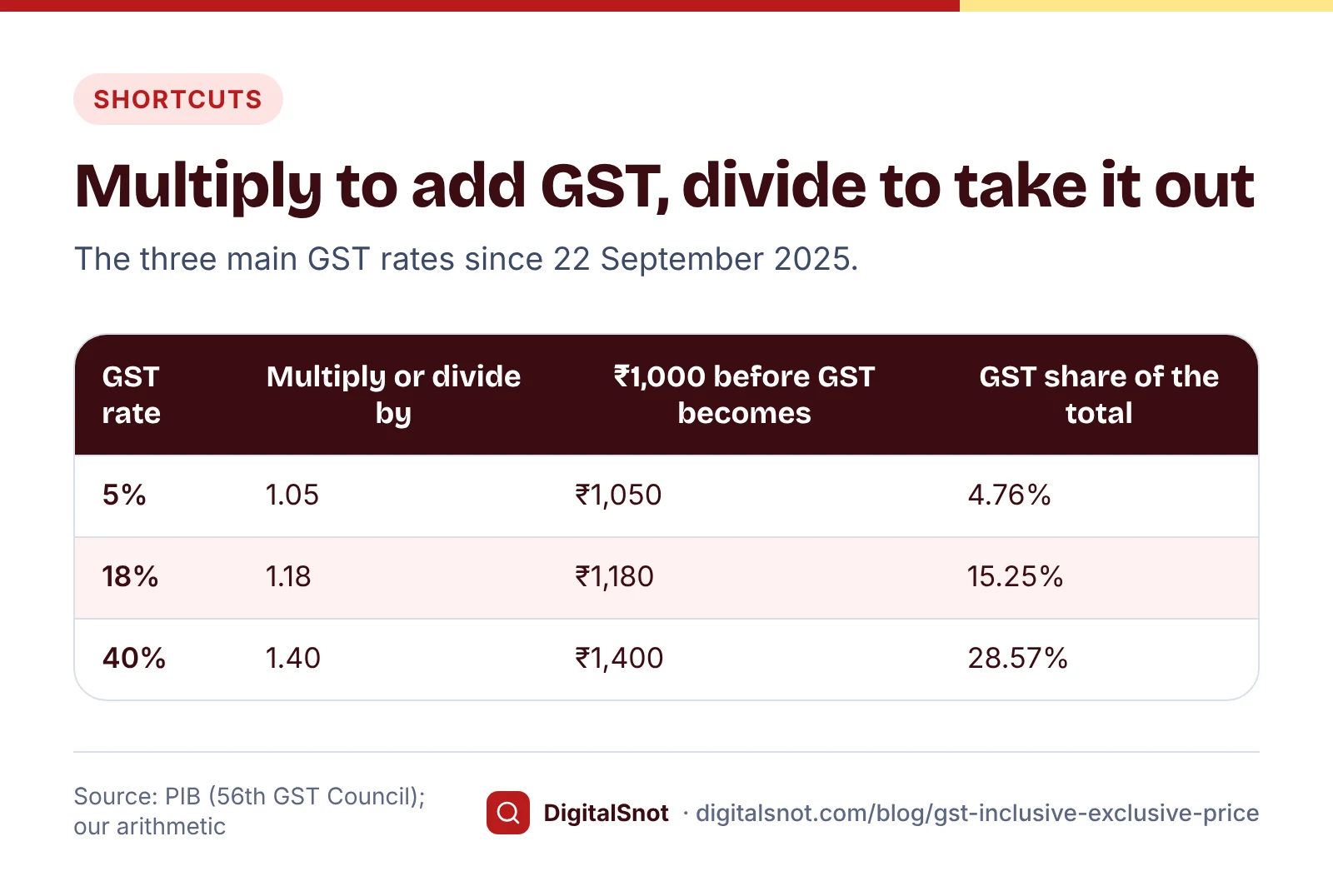
GST = price before GST × rate ÷ 100. The price with GST is the price before GST plus that amount.
- ₹1,000 at 5%: GST ₹50, total ₹1,050.
- ₹1,000 at 18%: GST ₹180, total ₹1,180.
- ₹1,000 at 40%: GST ₹400, total ₹1,400.
The shortcut is to multiply the price before GST by 1.05, 1.18 or 1.40. This is the price you put on a tax invoice as the taxable value, with the GST shown under it.
Formula 2: taking GST out of a price that includes it
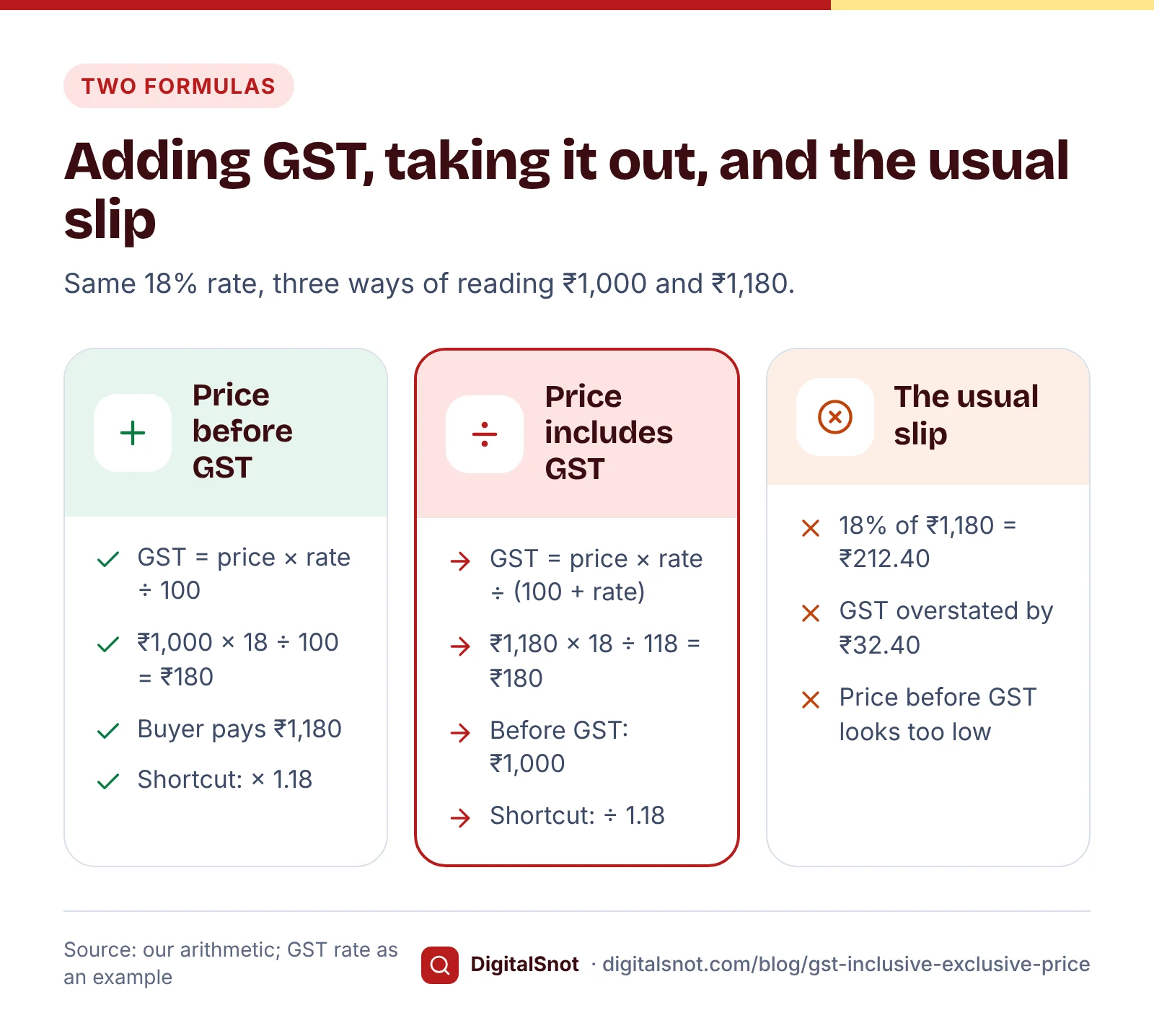
GST = inclusive price × rate ÷ (100 + rate). The price before GST is what is left. So ₹1,180 at 18% holds 1,180 × 18 ÷ 118 = ₹180 of GST, and the price before GST is ₹1,000. A price of ₹525 at 5% holds 525 × 5 ÷ 105 = ₹25 of GST.
The common mistake is to take 18% of the inclusive price. 18% of ₹1,180 is ₹212.40, which would leave ₹967.60 as the price before GST. Add 18% back to ₹967.60 and you get ₹1,141.77, not ₹1,180. GST is a share of the price before GST, not of the final price, so you divide by 100 plus the rate. The shortcut is to divide the inclusive price by 1.05, 1.18 or 1.40 to get the price before GST.
CGST and SGST, or IGST
The total GST is the same either way. What changes is how it is split. Under section 8 of the IGST Act, a supply is within a State when the supplier and the place of supply are in the same State or Union territory. Under section 7, it is between States when they are in different ones. Within one State, charge CGST plus SGST at half the rate each, or CGST plus UTGST in a Union territory such as Chandigarh. Between States, charge IGST at the full rate.
Take Patel Kitchenware, a made-up shop in Navrangpura, Ahmedabad, Gujarat. It sells a set of steel tiffin boxes at ₹2,000 before GST, at 18% in this example:
| Buyer | Tax on ₹2,000 | Total |
|---|---|---|
| Customer at the shop in Ahmedabad | CGST ₹180 + SGST ₹180 | ₹2,360 |
| Registered caterer in Surat, Gujarat | CGST ₹180 + SGST ₹180 | ₹2,360 |
| Registered hotel in Mumbai, Maharashtra | IGST ₹360 | ₹2,360 |
The IGST Act has its own rules for deciding the place of supply, with exceptions, so ask your CA when a sale is not a simple delivery within one State. To split any price or bill this way, put it into our GST Calculator: choose Add GST if your prices are before GST or Remove GST if they include it, pick within one State or between States, and tap the rate. It works line by line for a whole bill, with a total for each rate.
Rounding: paise, halves and the round-off line
Inclusive prices rarely split into round numbers. Patel Kitchenware sells a lunch box at ₹999 including 18% GST to a customer in Ahmedabad. The GST inside is 999 × 18 ÷ 118, about ₹152.39. Our GST Calculator works each half at 9% and rounds it to the paisa, so CGST and SGST stay equal: ₹76.19 each, ₹152.38 in all, leaving ₹846.62 as the price before GST. Sold to a buyer in Mumbai, the same ₹999 holds IGST of ₹152.39 and ₹846.61 before GST. A paisa of difference is normal: it comes from rounding each half separately.
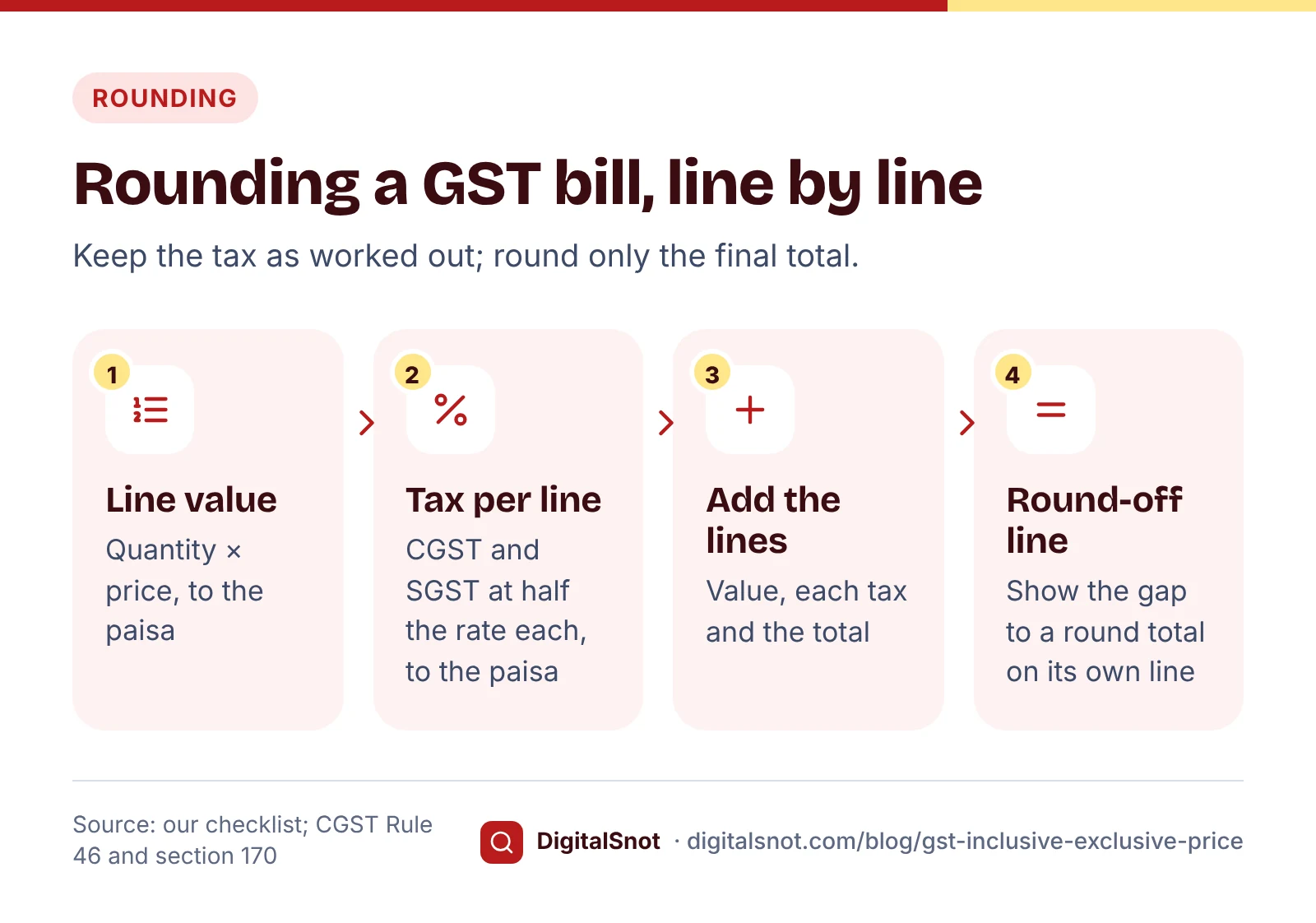
Rule 46 of the CGST Rules asks a tax invoice to show the rate and the amount of each tax. Section 170 of the CGST Act rounds tax, interest and other sums payable under the Act to the nearest rupee, with 50 paise or more going up. On the bill itself, our suggestion is to work each tax amount to the paisa, add up the lines, and show any difference to a round total as a separate round-off line, so the tax amounts stay exactly as worked out.
For example, a bill for 3 tiffin boxes at ₹449 at 18% and 2 pressure pans at ₹1,299.50 at 5%, all before GST, comes to ₹4,318.42 within Gujarat. Rounded, that is ₹4,318.00 with a round-off of −₹0.42. The GST Calculator shows the rounded total and the round-off under its result. Working back from a target works too: its Find the price mode says that a total of ₹1,000 with 18% GST within one State needs ₹847.46 before GST. Agree one method with your CA and use it on every invoice.
MRP and prices for consumers
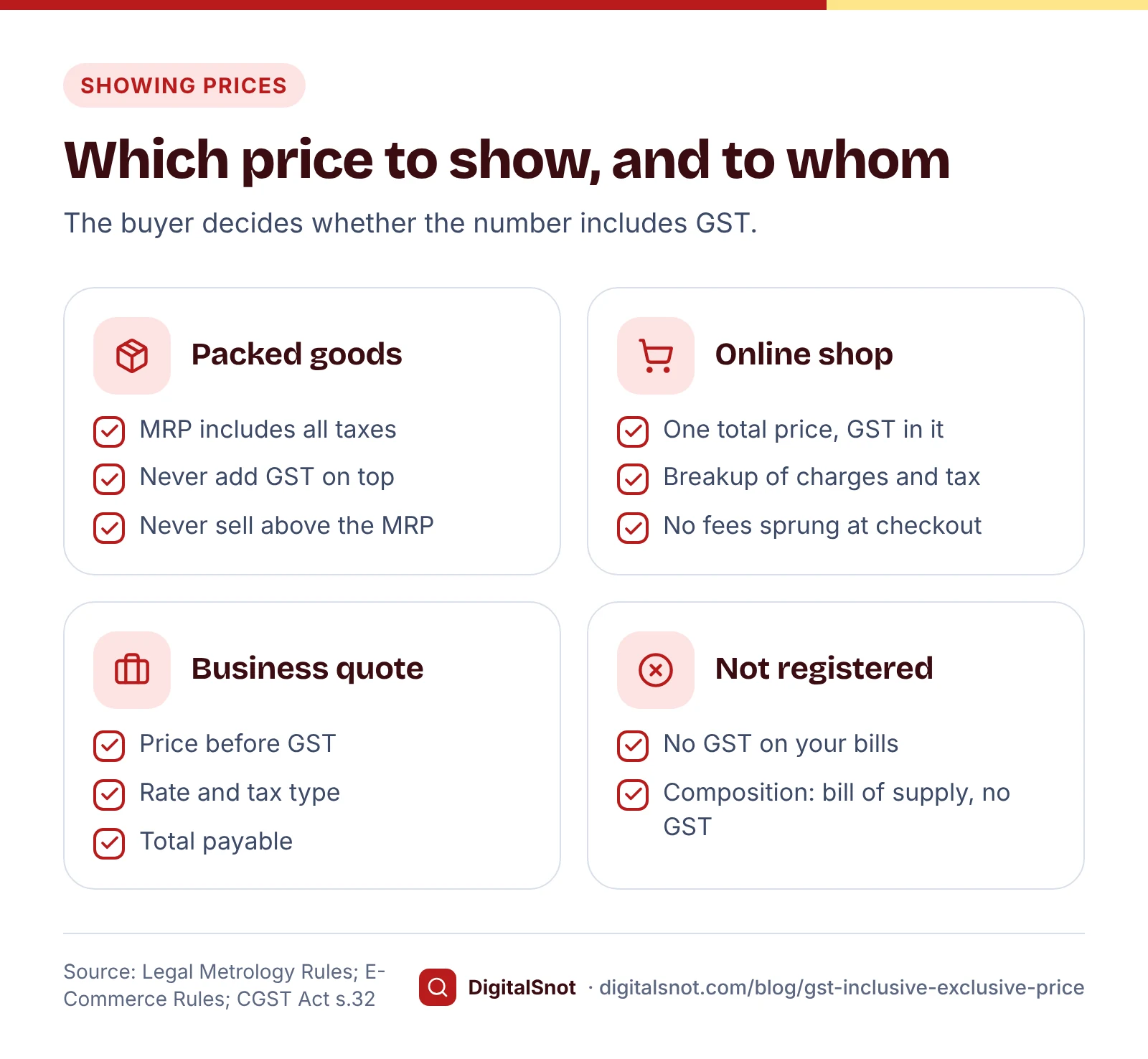
On pre-packed goods, the printed price is already inclusive. The Legal Metrology (Packaged Commodities) Rules, 2011 ask for the retail sale price to be declared as the maximum retail price inclusive of all taxes, and rule 18(2) says no one may sell a pre-packed product above it. So a shop never adds GST on top of an MRP. If a pack has an MRP of ₹236 and GST at 18% (example), selling at the MRP puts ₹36 of GST and ₹200 before GST into your books. Sell it at ₹220 after a discount and the GST inside falls to ₹33.56, with ₹186.44 before GST.
For other goods and services sold to consumers, our suggestion is to show one price that includes GST. A counter or menu price "+ GST" leaves the customer to do sums at the till. Online, the rule is firmer. The Consumer Protection (E-Commerce) Rules, 2020 ask sellers on marketplaces, and shops that sell their own stock online, to show the total price in a single figure, with a breakup of the compulsory and voluntary charges, such as delivery, postage and handling, and the applicable tax. The Central Consumer Protection Authority's dark patterns guidelines also list drip pricing, where parts of the price appear only late in the purchase. Our posts on dark patterns your online shop must avoid and what must be printed on a product package cover both in more detail.
Quoting business buyers
A registered business buyer can usually claim the GST you charge as input tax credit, when the conditions in section 16 of the CGST Act are met, such as holding your tax invoice. So business buyers compare prices before GST, and quotes to them are usually exclusive. Our suggestions for a quote that cannot be misread:
- Write "₹1,000 per set before GST", not just "₹1,000 + GST".
- Add the rate and the tax type: "GST at 18%: IGST ₹7,200 on 40 sets".
- Give the total: "Total payable ₹47,200".
- Show any discount on the quote and on the invoice. Under section 15 of the CGST Act, a discount given before or at the time of supply and recorded on the invoice is not part of the value, so GST is worked out on the price after the discount.
Our GST Invoice and Quotation Generator makes a quotation with each item's value before GST, the GST and the total. It takes discounts off before GST, works out CGST and SGST or IGST from your State and the place of supply, and prints "This is not a tax invoice" on it. When you make the supply, issue the tax invoice; our post on what a GST invoice must show lists what goes on it.
Your margin is on the price before GST
The GST you collect goes to the government, so work out your profit on the price before GST. Patel Kitchenware's ₹999 lunch box brings in ₹846.62, not ₹999. If it costs the shop ₹600 before GST, and the shop claims the input tax credit on its purchases, the profit is ₹246.62: a margin of 29.1%, not the 39.9% you would get by using the inclusive price. Put your own numbers into the Profit Margin & Markup Calculator, choose "Including GST" if your price includes it, and it takes the GST out first.
Mistakes to avoid
- Taking 18% of an inclusive price to find the GST. Divide by 118 and multiply by 18 instead.
- Adding GST on top of an MRP. The MRP already includes all taxes.
- The wrong tax type: IGST on a sale within your State, or CGST and SGST on a sale to another State.
- "+ GST" on a quote with no rate and no total.
- A price before GST on your website, with the tax added only at checkout.
- Charging GST when you are not registered. Section 32 of the CGST Act says a person who is not registered may not collect any amount as tax. A composition seller does not collect it either, and prints "composition taxable person, not eligible to collect tax on supplies" on its bill of supply under Rule 5.
- Rounding each line to the rupee and then the total again, so the tax shown no longer matches the rate.
Your next step
Pick your three best-selling items and work out both prices for each in the GST Calculator: the price before GST for quotes and invoices, and the price including GST for your counter, website and price list. To check an invoice you have already issued, type it into our GST Invoice Checker, which tests that the tax and the total add up. Take questions about your rates or place of supply to your CA, and if you want help with how prices show on your website, contact us.
Free tools in this article
- GST Calculator Add GST to a price or take it out, split into CGST and SGST or IGST, for one item or a whole bill.
- GST Invoice and Quotation Generator Make a GST tax invoice, bill of supply or quotation, check it against Rule 46, and print it or save a PDF.
- Profit Margin & Markup Calculator Any two of cost, price, margin and markup give the rest, with GST and many products at once.
- GST Invoice Checker Check an invoice for missing Rule 46 fields, the invoice number, GSTIN, tax split and totals.
Frequently asked questions
How do I calculate GST from a price that includes it?
Multiply the price by the rate and divide by 100 plus the rate. For ₹1,180 at 18%: 1,180 × 18 ÷ 118 = ₹180 of GST, so the price before GST is ₹1,000. Dividing the price by 1.18 gives the price before GST directly.
Why is 18% of the inclusive price the wrong answer?
Because GST is a share of the price before GST, not of the final price. 18% of ₹1,180 is ₹212.40, which overstates the GST by ₹32.40; the right figure is ₹180.
Can a shop charge GST on top of the MRP?
No. The Legal Metrology (Packaged Commodities) Rules, 2011 have the MRP declared inclusive of all taxes, and rule 18(2) says no one may sell a pre-packed product above it. The GST is inside the MRP.
Should my website show prices with or without GST?
Show consumers the total price including GST. The Consumer Protection (E-Commerce) Rules, 2020 ask for the total price in a single figure with a breakup of the charges and the applicable tax, and the CCPA's dark patterns guidelines list drip pricing.
When do I charge CGST and SGST, and when IGST?
Charge CGST plus SGST at half the rate each when you and the place of supply are in the same State, or CGST plus UTGST in a Union territory. Charge IGST at the full rate when they are in different States. The total GST is the same.
How should I round GST on an invoice?
Our suggestion: work each tax amount to the paisa, keeping CGST and SGST equal, add the lines, and show any difference to a round total as a separate round-off line. Section 170 of the CGST Act rounds tax payable to the nearest rupee; agree your invoice method with your CA.
Sources
Every figure and claim in this article comes from the sources below. We checked each one when writing and link to the original so you can read it yourself. Credit belongs to the authors and publishers listed. How we write and check our articles.
-
1
Recommendations of the 56th meeting of the GST Council
Press Information Bureau · Main GST rates of 5% and 18%, with a special 40% rate for a short list of goods, from 22 September 2025.
-
2
Section 7: Inter-State supply (IGST Act, 2017)
CBIC · Supplier and place of supply in different States or Union territories: a supply between States.
-
3
Section 8: Intra-State supply (IGST Act, 2017)
CBIC · Supplier and place of supply in the same State or Union territory: a supply within the State.
-
4
Rule 46: Tax invoice (CGST Rules, 2017)
CBIC · A tax invoice shows the rate and amount of each tax.
-
5
Section 170: Rounding off of tax, etc. (CGST Act, 2017)
CBIC · Tax and other sums payable under the Act are rounded to the nearest rupee, 50 paise or more going up.
-
6
Section 15: Value of taxable supply (CGST Act, 2017)
CBIC · A discount given before or at the time of supply and recorded on the invoice is not part of the value.
-
7
Section 16: Eligibility and conditions for taking input tax credit (CGST Act, 2017)
CBIC · A registered buyer can claim input tax credit when the conditions are met, such as holding the tax invoice.
-
8
Section 32: Prohibition of unauthorised collection of tax (CGST Act, 2017)
CBIC · A person who is not registered may not collect any amount as tax.
-
9
Rule 5: Conditions and restrictions for composition levy (CGST Rules, 2017)
CBIC · Composition sellers print "composition taxable person, not eligible to collect tax on supplies".
-
10
Legal Metrology (Packaged Commodities) Rules, 2011 with all amendments
Department of Consumer Affairs · The MRP is declared inclusive of all taxes; rule 18(2): no sale of a pre-packed product above its retail sale price.
-
11
Consumer Protection (E-Commerce) Rules, 2020 (Gazette)
Department of Consumer Affairs · Total price in a single figure, with a breakup of compulsory and voluntary charges and the applicable tax.
-
12
CCPA issues Guidelines for Prevention and Regulation of Dark Patterns, 2023
PIB: Central Consumer Protection Authority · Drip pricing is one of the 13 specified dark patterns.

