Product label rules in India: what a package must show (Legal Metrology)
The declarations a pre-packed product must carry under the Legal Metrology rules, how to write each one, what your online listing must show, and the exemptions.

On this page (10 sections)
If you pack your own products, from tea and spices to soaps and candles, the pack has to carry a set of details called declarations. Get one wrong and a Legal Metrology inspector, a marketplace or a buyer can raise it. This post covers these product label rules: it lists every declaration, shows you how to write each one, explains what your online listing must show, and covers the main exemptions.
It follows the Legal Metrology (Packaged Commodities) Rules, 2011 as the Department of Consumer Affairs and PIB summarise them. It is not legal advice: check your own product with your lawyer, your CA or the Legal Metrology office before you print.
Which products the Rules cover
The Rules cover pre-packed goods: products packed before the buyer sees them, in a pack with a set quantity. Most consumer packs sold in shops and online fall in this group. The Department of Consumer Affairs explains the scope on its Legal Metrology overview.
The Rules, with all amendments, do not apply to packages above 25 kg or 25 litres, except cement, fertiliser and agricultural produce in bags above 50 kg, or to goods packed for industrial or institutional buyers. In July 2024 the Department proposed changing this so that bags above 25 kg sold in retail would be covered too. Check whether that change has been notified before you rely on the 25 kg limit.
Other labelling rules can apply on top. Packed food, for example, also has food safety labelling rules. This post covers only Legal Metrology.
If you resell products another brand has packed, that brand prints the label. You still write the listing, though, so check that the declarations on the pack also appear in your listing, and do not sell above the printed MRP.
The declarations every pack needs
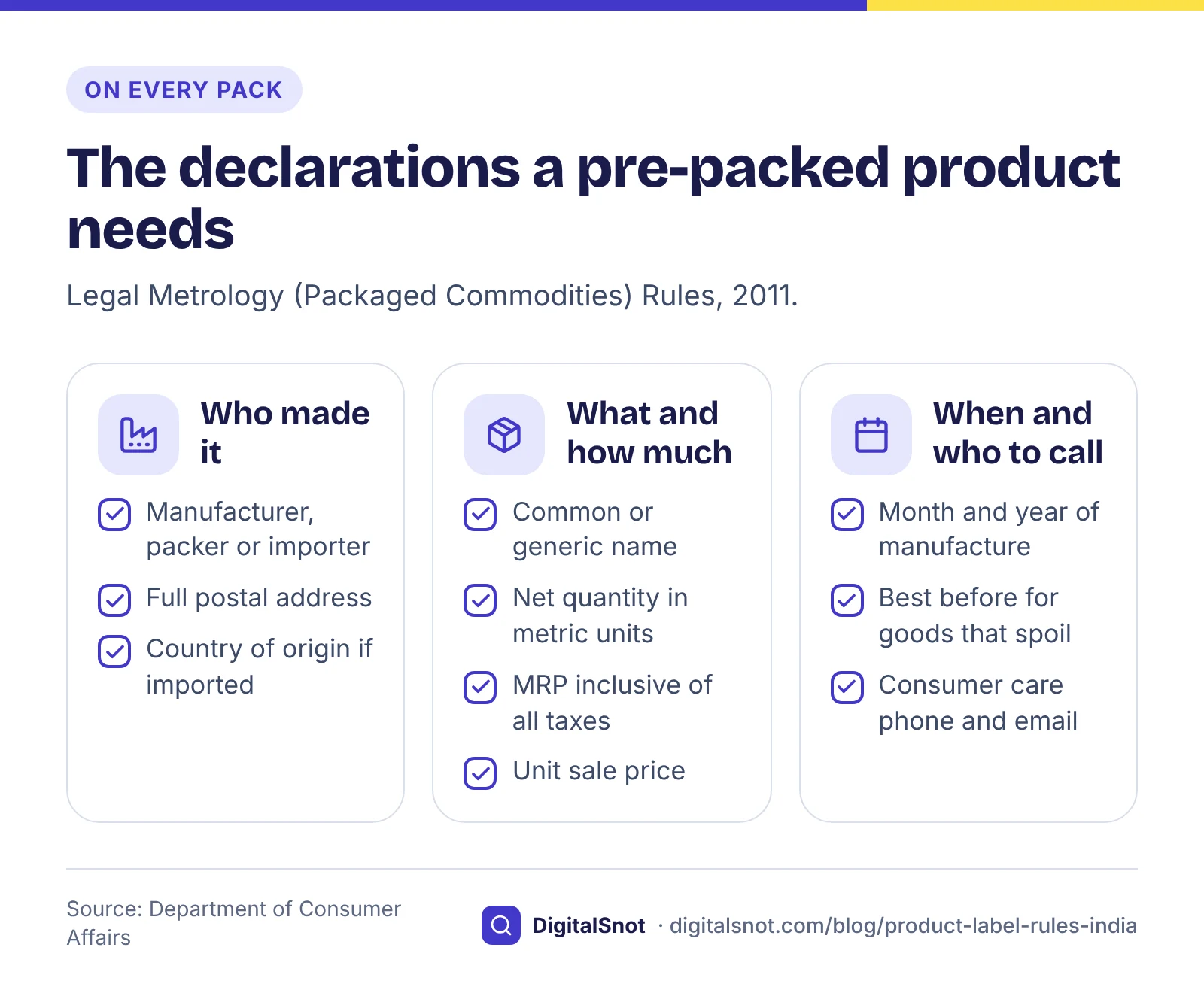
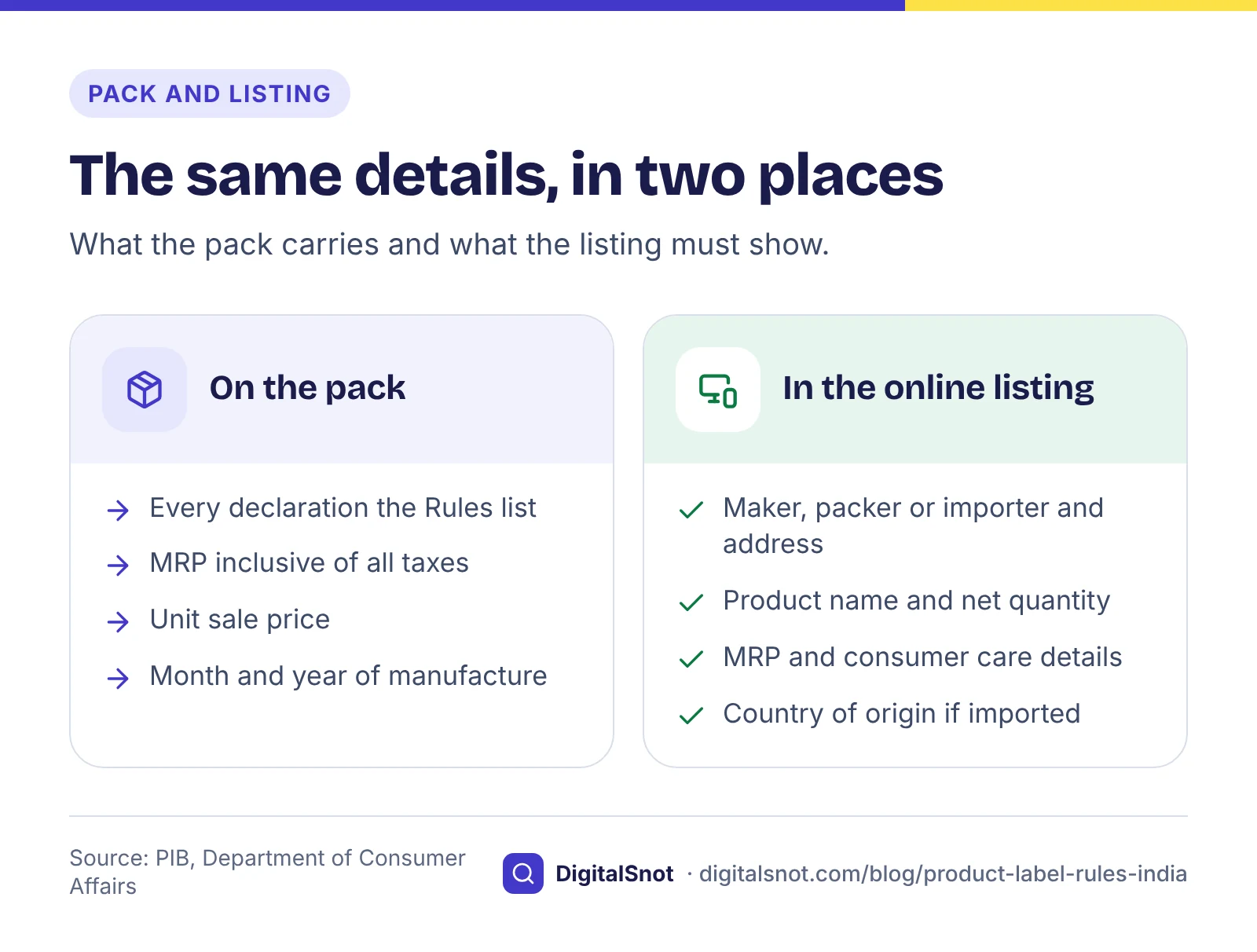
The Rules list these declarations for a pre-packed product:
- Name and address of the manufacturer, packer or importer, with words such as "Manufactured by", "Packed by" or "Imported by".
- Country of origin, for imported goods.
- The common or generic name of the product, such as "Assam tea", not only your brand.
- Net quantity, in standard metric units or as a count.
- Month and year of manufacture.
- Retail sale price, as the MRP in rupees, inclusive of all taxes.
- Unit sale price, the price per unit of measure.
- Best before or use by date, for goods that can become unfit for human consumption after a time.
- Consumer care details: the name, address, telephone number and email, if there is one, of the person or office to contact with a complaint.
How to write each one correctly
Net quantity
Use metric units only: weight for solids, volume for liquids, or length where it applies. The Rules allow no other system of units. Since the 2021 amendment, a count can be written as number, unit, piece, pair or set. Our checklist adds three habits: use the standard symbols g, kg, ml and l ("250 g", not "250 gms"), give one definite figure, and never write "approx." or a range.
MRP
Write it as the maximum retail price in rupees, inclusive of all taxes, for example "MRP ₹450.00 (inclusive of all taxes)". The 2017 amendment says no one may print different MRPs on identical packs, and rule 18(2) says no one may sell a pre-packed product above its MRP.
Unit sale price
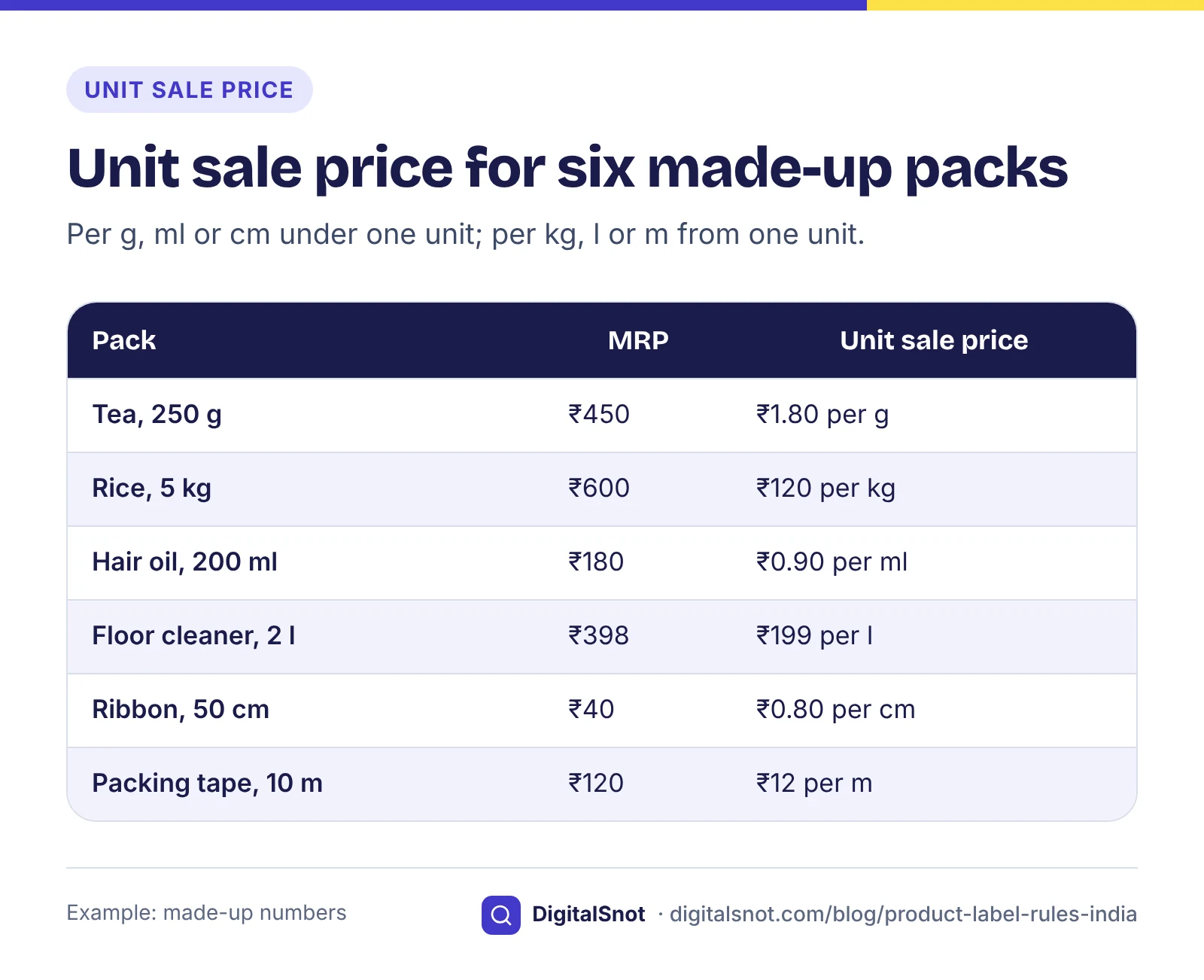
This lets buyers compare packs of different sizes. The Rules give it per gram for packs under 1 kg and per kilogram from 1 kg, and the same way for millilitres and litres and for centimetres and metres. A pack of exactly 1 kg already shows its price per kg, so it needs no separate figure.
Dates and consumer care
Print the month and year of manufacture, such as "08/2026". Add a best before or use by date if the product can spoil. For consumer care, give a working phone number with its code and an email address that someone reads.
A worked example: one tea gift box
Chai Patti Tea Co. in Siliguri is a made-up brand selling a 250 g Assam tea gift box at an MRP of ₹450. Its label could read:
- Assam tea, loose leaf (gift box)
- Net quantity: 250 g
- MRP ₹450.00 (inclusive of all taxes)
- Unit sale price: ₹1.80 per g
- Month and year of manufacture: 08/2026
- Best before: 07/2027
- Manufactured and packed by: Chai Patti Tea Co., [full address with PIN code], Siliguri, West Bengal
- Consumer care: Chai Patti Tea Co., [address], [phone with code], care@chaipatti.example
Type your own label details into the Package Label Checker (Legal Metrology). It says which declarations are there or missing, checks how the net quantity, MRP and unit sale price are written, works out the unit sale price from your MRP and net quantity, and gives you label text for your designer. Each check says whether it comes from the Rules or from our own checklist. It runs in your browser and cannot tell you whether an exemption applies.
What changed, and when
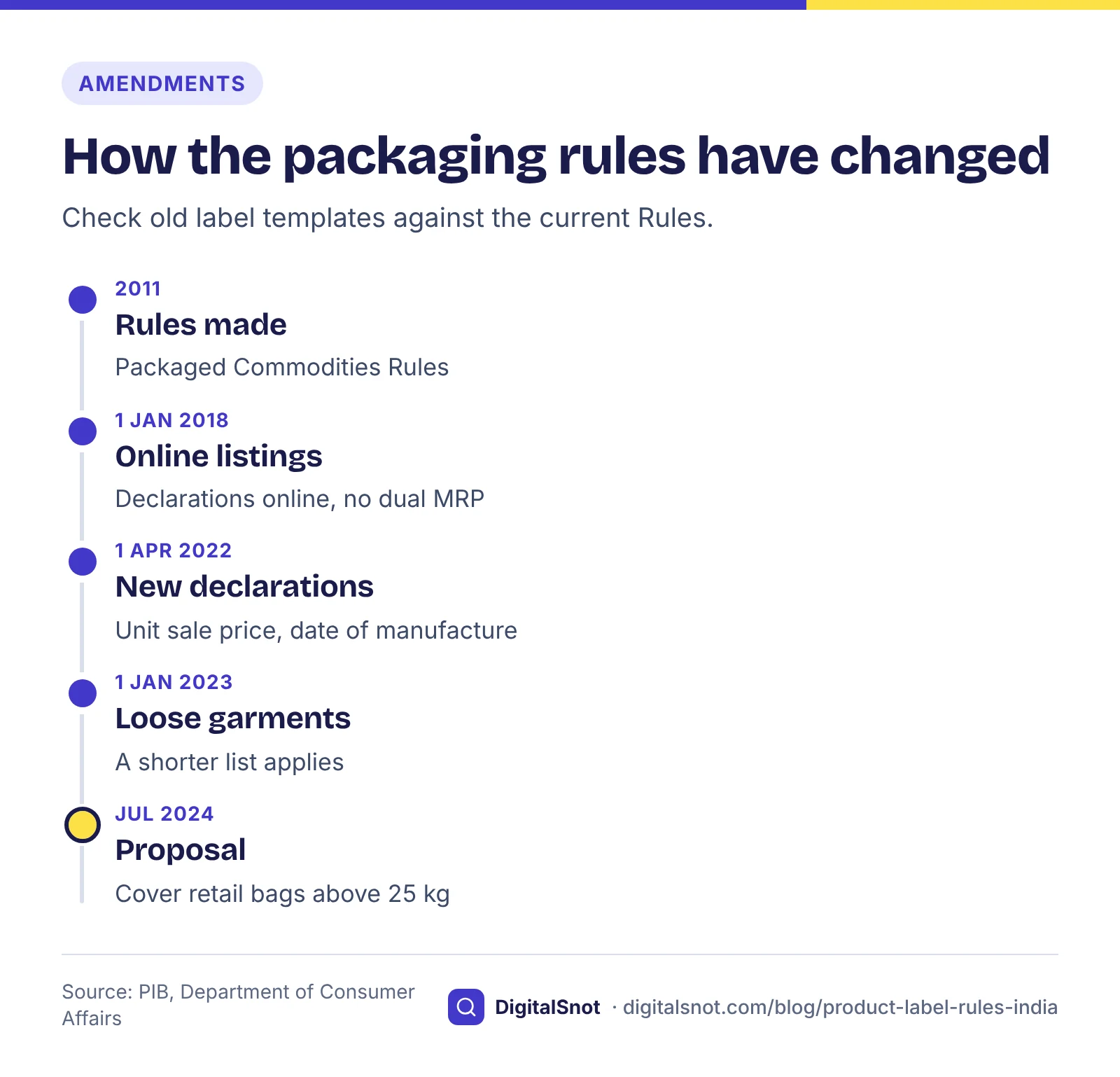
The Rules have been amended several times, so an old label template may be out of date.
- From 1 January 2018: the 2017 amendment (GSR 629(E)) required the declarations on e-commerce listings, banned different MRPs on identical packs and made the letters and numbers larger.
- From 1 April 2022: the 2021 amendment made the month and year of manufacture and the unit sale price compulsory, and removed rule 5, the schedule of standard pack sizes. So you are no longer tied to a list of standard sizes, as long as the net quantity is declared correctly.
- From 1 January 2023: garments and hosiery sold loose or open, where the buyer can inspect them, got a shorter list of declarations.
- July 2024: the Department proposed covering retail bags above 25 kg.
The same details in your online listing
Since 1 January 2018, e-commerce companies have had to make sure the mandatory declarations are shown on the platform. The PIB summary of the 2017 amendment lists the name and address of the manufacturer, packer or importer, the name of the product, the net quantity, the MRP inclusive of all taxes and consumer care details. The Legal Metrology office has also sent notices to e-commerce companies over missing country of origin declarations.
The Consumer Protection (E-Commerce) Rules, 2020 point the same way: sellers must give the details buyers need to decide before they buy, including the country of origin.
In practice, put the declarations in the listing's detail fields, not only on the product photos. A photo of the back of the pack is hard to read on a phone and cannot be searched. On your own shop, showing the same details on every product page is our suggestion; our guide to product page SEO for small online shops covers what else a good product page needs.
While you are editing listings, two more of our tools help. The Marketplace Listing Checker checks your Amazon.in, Flipkart or Meesho title, bullets and photos against what each marketplace tells sellers. For your own website, the Product Page Checker reads a product page's structured data and checks that the price in the markup is shown on the page. Neither checks Legal Metrology declarations; the label checker does that.
Exemptions and grey areas
- Large packs and trade packs. Packs above 25 kg or 25 litres (with the bag exceptions above), and goods for industrial or institutional buyers, are outside the Rules for now.
- Garments sold loose or open. Since 1 January 2023 they need only the maker, marketer, brand owner or importer with the country of origin for imports, a consumer care email and phone, sizes such as S, M or L with measurements in cm or m, and the MRP inclusive of all taxes, as set out in the 2022 amendment.
- Other exemptions. Rule 26 of the Rules lists further cases. Read it for your product rather than relying on a summary.
- Medical devices. A 2025 amendment says the Medical Devices Rules, 2017 decide the size of letters and numbers on their packs.
Mistakes to avoid
- Only the brand name. Say what the product is.
- "Net Wt. 250 gms approx." Write "250 g": one figure with the standard symbol.
- "MRP 450/-". Add the rupee sign and "inclusive of all taxes".
- No unit sale price. Required since 1 April 2022 unless the pack is exactly one unit, such as 1 kg.
- A listing price above the MRP. Check both figures before you raise a price to cover fees.
- Declarations only in the photos. Type them into the listing as well.
Your next step
Take your best-selling pack and type its label into the Package Label Checker today. Fix what is missing before your next print run, then update the listing fields on each marketplace. Our post on working out your real profit per order helps if you are repricing at the same time, and all our free tools for online sellers are on one page. For questions about your own products, ask the Legal Metrology office in your State, and if you want help with your shop's listings and pages, get in touch.
Free tools in this article
- Package Label Checker (Legal Metrology) Check a pack label and its listing for the declarations India's Legal Metrology rules ask for.
- Marketplace Listing Checker (Amazon, Flipkart, Meesho) Check titles, bullets, search terms and product photos against Amazon.in, Flipkart and Meesho rules.
- Product Page Checker Check a product page's Product markup, price, stock, identifiers, shipping, returns and search basics.
By the numbers
- the date from which e-commerce listings must show the declarations the Packaged Commodities Rules require
- 1 Jan 2018
- Source: PIB: Department of Consumer Affairs
- the date from which the unit sale price and the month and year of manufacture are required on pre-packed goods
- 1 Apr 2022
- Source: PIB: Department of Consumer Affairs
Frequently asked questions
What must be printed on a packed product sold in India?
The Legal Metrology (Packaged Commodities) Rules, 2011 ask for the name and address of the manufacturer, packer or importer, the common or generic name, the net quantity, the month and year of manufacture, the MRP inclusive of all taxes, the unit sale price and consumer care details, plus the country of origin for imported goods and a best before or use by date for goods that can become unfit for human consumption.
Do I have to show these details in my online listing?
Yes. Since 1 January 2018, e-commerce platforms must make sure the mandatory declarations are shown: the maker, packer or importer and address, the product name, net quantity, MRP and consumer care details. Imported goods should show the country of origin too. Put them in the listing's detail fields, not only in the photos.
What is the unit sale price?
The price for one unit of measure, printed next to the MRP. The Rules give it per gram for packs under 1 kg and per kilogram from 1 kg, and the same way for millilitres and litres and for centimetres and metres. For example, ₹450 for 250 g is ₹1.80 per g. It has been required since 1 April 2022.
Do I still have to use standard pack sizes?
No. The 2021 amendment, in force from 1 April 2022, removed rule 5 and its schedule of standard pack sizes. You can pack any quantity, as long as you declare the net quantity correctly and show the unit sale price.
Can I sell a packed product above its MRP?
No. Rule 18(2) of the Legal Metrology (Packaged Commodities) Rules, 2011 says no retailer or other person, including the manufacturer, packer or importer, may sell a pre-packed product above its retail sale price. That applies to your online price too.
Which products are exempt from these labelling rules?
The Rules do not cover packs above 25 kg or 25 litres, apart from cement, fertiliser and agricultural produce in bags above 50 kg, or goods for industrial or institutional buyers; a 2024 proposal would bring retail bags above 25 kg in. Garments and hosiery sold loose or open have a shorter list. Rule 26 lists other cases, so check it for your product. This is not legal advice.
Sources
Every figure and claim in this article comes from the sources below. We checked each one when writing and link to the original so you can read it yourself. Credit belongs to the authors and publishers listed. How we write and check our articles.
-
1
Legal Metrology overview
Department of Consumer Affairs · Scope of Legal Metrology and the declarations on pre-packed goods.
-
2
Legal Metrology (Packaged Commodities) Rules, 2011 with all amendments
Department of Consumer Affairs · The declarations, the 25 kg and 25 litre scope, unit sale price bases, rule 18(2) and rule 26.
-
3
Amendments to the Legal Metrology (Packaged Commodities) Rules, 2011 (2017)
PIB: Department of Consumer Affairs · GSR 629(E): e-commerce declarations, no dual MRP and larger letters, in force from 1 January 2018.
-
4
Centre amends the Legal Metrology (Packaged Commodities) Rules 2011 for enhanced protection of consumer rights
PIB: Department of Consumer Affairs · Month and year of manufacture, unit sale price and removal of rule 5, from 1 April 2022.
-
5
Amendment for garments or hosiery sold loose or open
PIB: Department of Consumer Affairs · Shorter list of declarations for garments and hosiery sold loose or open.
-
6
Legal Metrology (Packaged Commodities) (Third Amendment) Rules, 2022 (Gazette)
Department of Consumer Affairs · The garment declarations, in force from 1 January 2023.
-
7
Department of Consumer Affairs proposes amendment in the Packaged Commodities Rules
PIB: Department of Consumer Affairs · July 2024 proposal to cover retail bags above 25 kg.
-
8
Notices to e-commerce companies over country of origin
PIB: Department of Consumer Affairs · Action over missing country of origin declarations online.
-
9
Legal Metrology (Packaged Commodities) Amendment Rules, 2025
PIB: Department of Consumer Affairs · Medical Devices Rules, 2017 decide letter and numeral sizes on medical device packs.
-
10
Consumer Protection (E-Commerce) Rules, 2020 (Gazette)
Department of Consumer Affairs · Sellers must give the details buyers need before buying, including the country of origin.