Dark patterns your online shop must avoid, and what to do instead
The 13 dark patterns in India's 2023 guidelines, what each looks like in a small online shop, the honest alternative, and how to audit your own checkout.
On this page (10 sections)
A dark pattern is a design or wording choice that pushes buyers into something they did not mean to do: buy faster, pay more or share more. India has an official list of dark patterns, and from 1 January 2027 e-commerce entities will also have to audit themselves against it every year. This post explains the rules, shows each of the 13 patterns as it might look in a small online shop, gives the honest alternative, and walks you through a self-audit.
The short descriptions here are ours, in plain words; read the guidelines for the official definitions. This post is not legal advice.
What the rules say, and who they cover
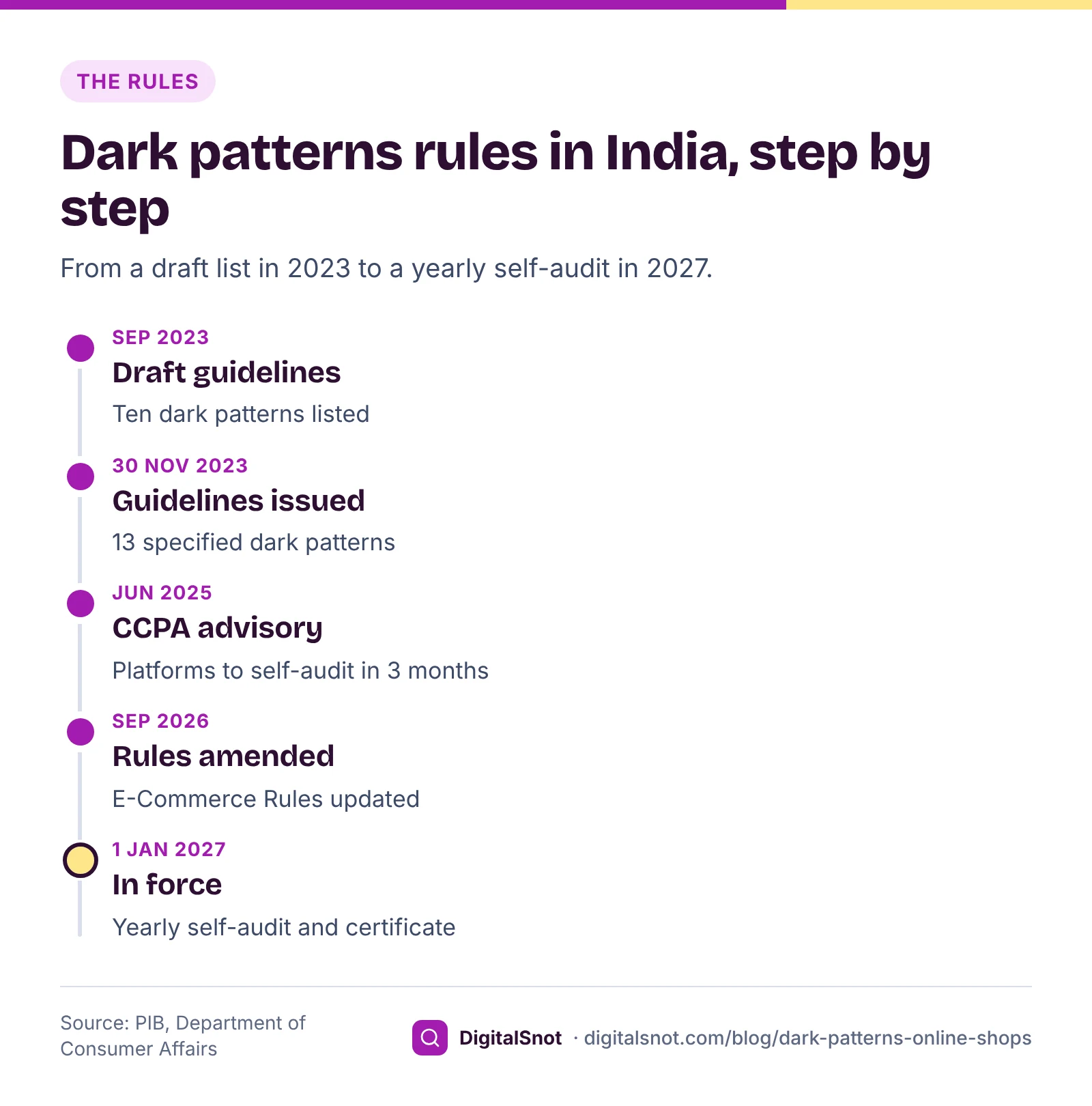
The Central Consumer Protection Authority (CCPA) issued the Guidelines for Prevention and Regulation of Dark Patterns, 2023 on 30 November 2023, under the Consumer Protection Act, 2019. They apply to platforms that systematically offer goods or services in India, to advertisers and to sellers, and they say no one may engage in a dark pattern. So sellers are covered too, whether they sell on their own website or through a marketplace.
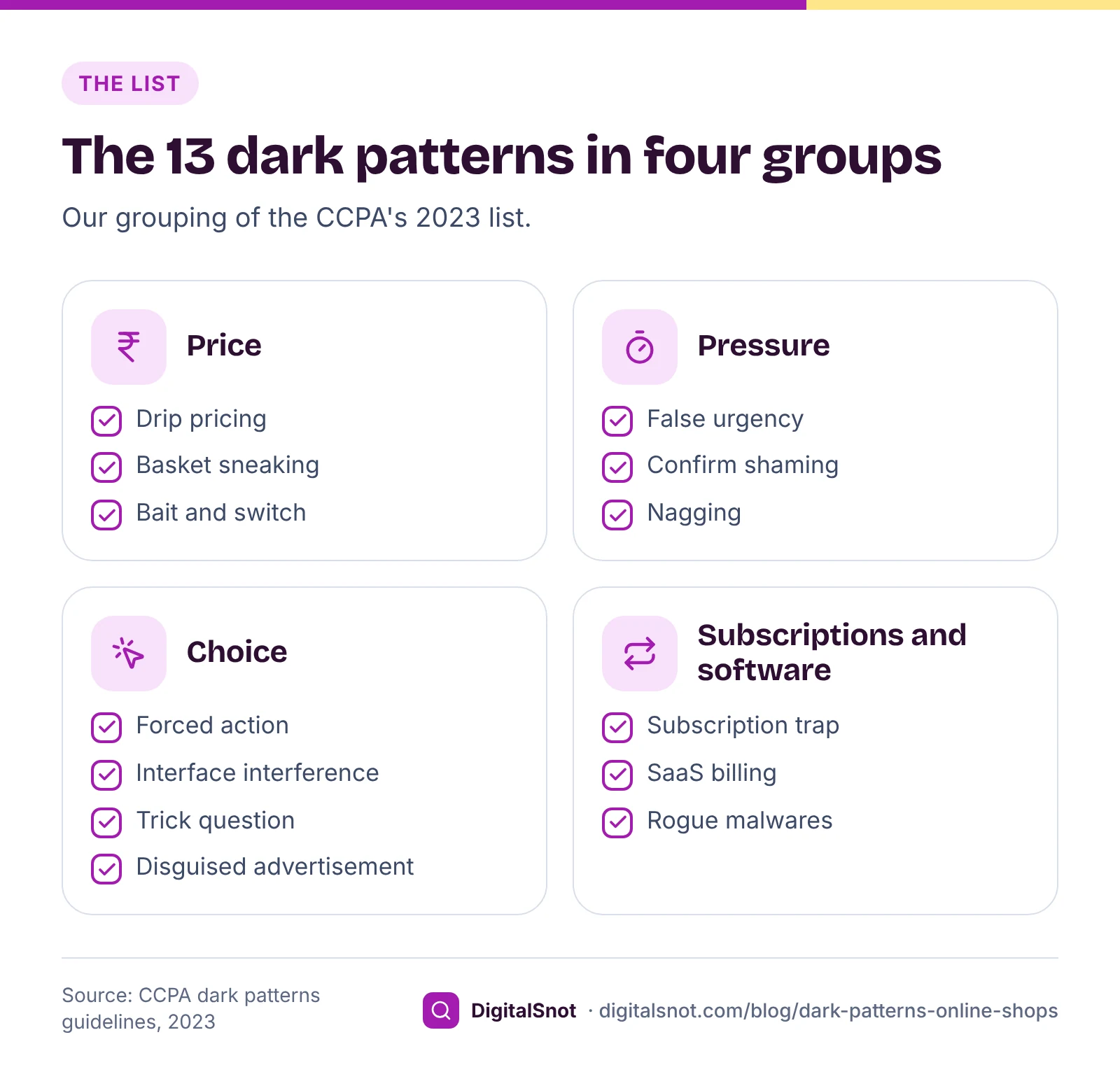
The draft published in September 2023 listed ten patterns. After public comments, the final guidelines added three more: trick question (some releases call it trick wording), SaaS billing and rogue malwares, making 13.
Enforcement has followed. In June 2025 the CCPA advised e-commerce platforms to self-audit for dark patterns within three months, and 26 leading e-commerce platforms later declared that they comply. The CCPA has also fined an online education platform ₹5 lakh after a ₹10 donation was selected automatically at checkout, with emotional messages discouraging buyers from removing it.
In September 2026 the government amended the E-Commerce Rules. From 1 January 2027, e-commerce entities must comply with the 2023 guidelines, undertake a yearly self-audit and prominently display a certificate of compliance. Ask your lawyer how this applies to your shop.
The 13 dark patterns, in plain words
Here is each pattern as it might appear in a small online shop, and the honest version. The examples are ours.
| Pattern | What it can look like | The honest alternative |
|---|---|---|
| False urgency | "Only 2 left" when you have 50; a timer that restarts on every visit | Real stock counts and real end dates |
| Basket sneaking | Gift wrap, insurance or a donation already in the cart | Add-ons left unticked, with their price |
| Confirm shaming | "No thanks, I don't care about my skin" | A plain "No thanks" |
| Forced action | Buyers must sign up or install the app to order | Guest checkout; ask only what the order needs |
| Subscription trap | Cancelling needs a phone call; a free trial needs autopay | A cancel button in the account |
| Interface interference | A bright "Yes" next to a faded, tiny "No"; a close button that opens an offer | Equal buttons; close only closes |
| Bait and switch | An advertised offer that is never available, with a dearer item pushed instead | Honour the offer or say it has sold out |
| Drip pricing | A platform, packing or COD fee that appears only at payment | Every compulsory fee in the first price |
| Disguised advertisement | Paid reviews or sponsored products that look like ordinary content | An "Ad" or "Sponsored" label buyers can see |
| Nagging | The same app or notification pop-up on every page after "no" | Remember the buyer's "no" |
| Trick question | "Untick this box if you do not want to stop receiving offers" | Plain, positive wording and an unticked box |
| SaaS billing | A trial or plan that turns paid or renews with no reminder | A reminder before each charge |
| Rogue malwares | Fake virus warnings or software that tricks people into paying | Never ship software that misleads or harms |
Price tricks: the ones to fix first
Drip pricing, basket sneaking and bait and switch all change what the buyer pays, so fix them first.
- Show the full price early. The Consumer Protection (E-Commerce) Rules, 2020 ask for the total price with a breakup of compulsory and voluntary charges, such as delivery and handling. The Consumer Protection Act, 2019 treats an advertisement that deliberately conceals important information as misleading.
- Never pre-tick a purchase. The E-Commerce Rules say consent to a purchase must come from an explicit and affirmative action, never recorded automatically, including through pre-ticked checkboxes.
- Keep "free" honest. The CCPA's 2022 guidelines on misleading advertisements say something is not free if the buyer pays packing or handling charges for it, or if the price of what they must buy was raised for the offer.
Before a sale, put your MRP, cost and offer into the Discount and Sale Price Calculator. Besides the real discount and your margin, its honest pricing checks look at a price above the MRP, discount and "free" claims, countdowns and fees added at the last step.
Pressure and choice: wording and design
False urgency, confirm shaming and nagging push buyers to decide fast or feel bad. A countdown is fine when the offer really ends then; end it when you said you would. Show a stock count only if it comes from your real stock.
Forced action, interface interference and trick questions take a choice away. Let buyers check out as guests where you can, and ask only for details the order needs. For boxes that sign buyers up to offers, the Digital Personal Data Protection Act, 2023 asks for consent given with a clear affirmative action, so leave them unticked.
For disguised advertisement, the Department of Consumer Affairs asks that a paid or other material connection in an endorsement is disclosed in a way that is "clear, prominent and extremely hard to miss". That covers influencer posts and reviews you paid for or gave free products for.

A worked example: one small checkout
Rangoli Home Decor in Lucknow is a made-up shop selling cushion covers. Here is what its owner found on a walk through her own checkout, and what she changed:
- Product page: a theme app showed "Only 3 left, 14 people are viewing" on every product, whatever the real stock. She turned the app off and now shows stock only when it is truly low.
- Cart: "Gift wrap ₹49" was ticked for every order. She left the box unticked, with the price next to it.
- Payment step: a ₹29 convenience fee appeared only here. She folded it into her product prices instead.
- Exit pop-up: the button to close it read "No, I don't like saving money". It now reads "No thanks", in the same size as the other button.
None of these changes stopped her selling the offer. They only stopped the page from deciding for the buyer.
Your policies count too
A dark pattern can sit in your terms as well as your buttons. A refund policy that says "no refunds under any circumstances" can mislead buyers, because the E-Commerce Rules say a seller cannot refuse to take back goods, or refund them, if they are defective, deficient or spurious. The same Rules bar cancellation charges unless you bear similar charges when you cancel, and ask for a grievance officer who acknowledges complaints within 48 hours and resolves them within one month.
The Return and Refund Policy Builder turns your answers into a policy and checks it against those Rules and our checklist, flagging blanket lines like that one. If you charge for cash on delivery, say so upfront; our post on cutting COD returns shows how to nudge buyers to prepay without dark patterns.
Run your own self-audit
You do not need a big team. Set aside an hour and do this for your own shop:
- Walk through your checkout as a buyer, on a phone, from a product page to the payment step. Screenshot every step.
- Copy the text of each step, or the page's HTML source, into the Dark Pattern Checker for Online Shops. It marks phrases that point to 12 of the 13 patterns (rogue malwares cannot be seen in a page's text) and boxes ticked in advance.
- Tick what the flow does, such as "a fee appears only at the last step" or "adds a donation to the cart by default", because text cannot show colours, timers or what happens after a click.
- Fix the worst first, using the plain explanation and fix next to each flagged item.
- Keep dated notes: the report, your screenshots and what you changed.
The checker uses fixed word lists, not AI, and a match is a reason to look, not proof. A page with no matches can still mislead. It does not issue a certificate.

Mistakes to avoid
- Copying a big platform's checkout. The CCPA has asked large platforms to audit theirs, so a pattern you see elsewhere is not proof that it is allowed.
- Forgetting your theme and apps. Shop themes and apps can add timers, pop-ups and pre-ticked boxes; switch off what you cannot stand behind.
- Checking only the desktop site. Check on a phone too: faded buttons and small print are hardest to read on a small screen.
- Auditing once. New offers, apps and sale banners bring patterns back, so check before every sale.
Your next step
Run the self-audit on your checkout this week, then again before your next sale. If you are also checking your pack labels, read our post on what must be printed on a product package. All our free tools for online sellers work in your browser and never sign in to your shop or seller accounts. If you want a second opinion on your pages, get in touch.
Free tools in this article
- Discount and Sale Price Calculator See what the buyer pays, the real discount on MRP, the GST inside the price and your margin after an offer.
- Return and Refund Policy Builder Turn your return, refund, cancellation and delivery rules into a clear policy, with checks for gaps.
- Dark Pattern Checker for Online Shops Paste your checkout text to spot false urgency, hidden fees, pre-ticked add-ons and other dark patterns.
By the numbers
- dark patterns specified in the Guidelines for Prevention and Regulation of Dark Patterns, 2023, issued on 30 November 2023
- 13
- Source: PIB: Central Consumer Protection Authority
- the date from which the amended E-Commerce Rules ask for a yearly dark patterns self-audit and a displayed certificate of compliance
- 1 Jan 2027
- Source: PIB: Department of Consumer Affairs
Frequently asked questions
What is a dark pattern?
In plain words, a design or wording choice that pushes buyers into something they did not mean to do, such as buying faster, paying more or sharing more. India's Central Consumer Protection Authority issued guidelines on 30 November 2023 that list 13 specified dark patterns, from false urgency and basket sneaking to drip pricing and SaaS billing.
Do the dark patterns guidelines apply to small online shops?
The 2023 guidelines apply to platforms that systematically offer goods or services in India, to advertisers and to sellers, and say no one may engage in a dark pattern. From 1 January 2027 the amended E-Commerce Rules also ask e-commerce entities for a yearly self-audit. Ask your lawyer how they apply to your shop.
Is a countdown timer or "only 2 left" banned?
The guidelines list false urgency: a false sense of urgency or scarcity. A real deadline or a true stock count is fine. A timer that resets on every visit, or a stock number you cannot back up, is the problem. End offers when you said they would end.
Can I add a convenience or packing fee at checkout?
The guidelines list drip pricing, where parts of the price appear only late in the purchase, and the E-Commerce Rules ask for the total price with a breakup of compulsory charges. Show every compulsory fee with the first price the buyer sees, or fold it into the product price.
Can I tick the gift wrap or donation box for the buyer?
No. The guidelines list basket sneaking, and the E-Commerce Rules say consent to a purchase must not be recorded automatically, including through pre-ticked checkboxes. The CCPA has fined a platform over a ₹10 donation selected automatically at checkout. Leave add-on boxes unticked, with the price next to them.
What is the dark patterns self-audit?
From 1 January 2027, the amended Consumer Protection (E-Commerce) Rules ask e-commerce entities to comply with the 2023 guidelines, undertake a yearly self-audit and prominently display a certificate of compliance. Walking through your checkout, checking each step and keeping dated notes is a sensible first pass. This is not legal advice.
Sources
Every figure and claim in this article comes from the sources below. We checked each one when writing and link to the original so you can read it yourself. Credit belongs to the authors and publishers listed. How we write and check our articles.
-
1
CCPA issues Guidelines for Prevention and Regulation of Dark Patterns, 2023
PIB: Central Consumer Protection Authority · Issued 30 November 2023; 13 specified dark patterns; who the guidelines cover.
-
2
The Guidelines for Prevention and Regulation of Dark Patterns, 2023 (Gazette)
Department of Consumer Affairs · Official definitions and illustrations of each pattern.
-
3
Centre seeks public comments on draft guidelines on dark patterns
PIB: Department of Consumer Affairs · The September 2023 draft with ten dark patterns.
-
4
CCPA advisory to e-commerce platforms to self-audit for dark patterns
PIB: Central Consumer Protection Authority · June 2025 advisory: self-audit within three months.
-
5
26 leading e-commerce platforms declare compliance with self-audit
PIB: Department of Consumer Affairs · Platforms' self-declarations of compliance with the 2023 guidelines.
-
6
CCPA acts against dark patterns on digital platforms
PIB: Central Consumer Protection Authority · ₹5 lakh penalty over a ₹10 donation selected automatically at checkout.
-
7
Government amends E-Commerce Rules to strengthen consumer protection
PIB: Department of Consumer Affairs · From 1 January 2027: comply with the guidelines, yearly self-audit and a displayed certificate of compliance.
-
8
Consumer Protection (E-Commerce) Rules, 2020 (Gazette)
Department of Consumer Affairs · No pre-ticked consent, total price breakup, cancellation charges, grievance officer, defective goods.
-
9
Consumer Protection Act, 2019
India Code · Section 2(28): an advertisement that deliberately conceals important information is misleading.
-
10
CCPA guidelines on misleading advertisements, 2022
PIB: Central Consumer Protection Authority · Conditions for calling something free.
-
11
Endorsement guidance
PIB: Department of Consumer Affairs · Disclosures must be clear, prominent and extremely hard to miss.
-
12
Digital Personal Data Protection Act, 2023
MeitY · Section 6(1): consent with a clear affirmative action.