COD RTO: cutting returns that cost you twice
Work out what each undelivered cash on delivery parcel costs you, then confirm orders, find risky PIN codes and nudge buyers to prepay without dark patterns.
On this page (9 sections)
A cash on delivery (COD) parcel that comes back undelivered costs you twice. You pay to send it, you pay to get it back, and you earn nothing. This post shows you how to work out what RTO costs your shop, and five ways to reduce COD RTO: confirming orders before you ship, finding risky PIN codes in your own order history, prepaid nudges that stay honest, better addresses, and reading your return reasons.
The numbers in the example are made up. Use your own from your shop, courier or seller reports. This post is not legal advice.
What one RTO parcel really costs
RTO means return to origin: a parcel that never reached the buyer and went back to you, because the buyer refused it, could not be reached or gave a wrong address. A return is different: the buyer received the parcel and sent it back. Both cost you money, but RTO is the one COD makes worse, because a buyer who has not paid loses nothing by refusing.
Each RTO parcel costs you:
- Forward shipping, already paid when the parcel left.
- Return shipping, if your courier or marketplace charges for the trip back.
- Packaging, which is usually torn or taped over by the time it returns.
- Stock you cannot sell again, such as a crushed box or a food item near its date.
- Stock and cash tied up for the days the parcel is on the road, which you could have sold to someone else.

Take Masala Ghar in Indore, a made-up spice shop. In a month it sends 800 orders worth ₹650 each before GST. 55% are COD. 18% of COD orders come back as RTO, against 3% of prepaid ones. Shipping costs ₹60 out and ₹50 back, packaging ₹15, and 15% of the stock that comes back cannot be sold.
Put those made-up numbers into the COD and RTO Cost Calculator and each RTO parcel costs ₹164. The 90 RTO parcels cost about ₹14,900 a month, and ₹58,500 of sales never happen. An average COD order sent earns ₹204, a prepaid one ₹288. The tool also shows what cutting the COD RTO rate from 18% to 13% would be worth: about ₹9,900 a month in this example.
If you sell on marketplaces too, our post on working out your real profit per order shows how to spread returns and RTO over every order you send.
Confirm COD orders before you ship
The cheapest RTO is the one you never ship. Ask every COD buyer to confirm the order before it leaves. This is our suggestion, not a rule, and it catches orders placed by mistake, by someone testing your checkout, or with a wrong address.
- Send a confirmation as soon as the order comes in, with the product, the amount to pay in cash and the delivery address.
- Ask the buyer to reply YES to confirm or NO to cancel, and say you will ship once they confirm.
- If there is no reply in the time you set, call once.
- Ship confirmed orders. Cancel the rest politely, and tell the buyer they can order again.
The Order Update and COD Confirmation Templates give you this message ready to copy, in English, Hinglish or Hindi, for the WhatsApp Business app, as a WhatsApp Business Platform template, as an SMS or as an email. Nothing is sent for you: you copy the text.
Follow WhatsApp's rules while you do it. The WhatsApp Business Policy says to message only people who gave you their number and agreed to hear from your business. On the WhatsApp Business Platform, a buyer's message opens a 24-hour customer service window; outside it you can send only approved templates. Meta's template categories treat order updates with no offer as utility, and a template that mixes an order update with a promotion as marketing. So keep discounts out of the confirmation.
This is for orders from your own shop. Amazon, Flipkart and Meesho send their own order updates and set their own rules on contacting buyers, so read those first.

Find risky PIN codes in your own orders
RTO is rarely spread evenly. A few PIN codes, areas or couriers often send back far more COD parcels than the rest. Your own order history is the best evidence you have, because it reflects your products, your prices and your buyers.
Export a few months of orders from your shop, marketplace panel or shipping app, with the PIN code, payment method and final delivery status of each. Open it in the COD Pincode Risk Analyzer. It works out the RTO rate of COD and prepaid orders for each PIN code, area and courier, and, with your own product, shipping and return costs, finds the PIN codes where a COD order loses money. Where profit is below zero it suggests prepaid only; where the rate is close to that line, part payment. The export is read in your browser and the buyer details in it are not uploaded.
A rate from a handful of orders can swing a lot, so the tool groups small PIN codes by their first three digits, then their first two. That follows how the Department of Posts numbers PIN codes: the first digit is the region, the first two the sub-region or postal circle, the first three the sorting district, and the last three the delivery post office.
Turn off COD only where your own numbers say it loses money, and check again every few months. A PIN code's rate can change, for example once you start confirming orders there.
Prepaid nudges that are not dark patterns
A buyer who has already paid has every reason to accept the parcel, so it makes sense to nudge buyers towards paying online. The COD and RTO Cost Calculator shows the largest prepaid discount you can give before a prepaid order earns less than a COD one: about ₹88 in the Masala Ghar example, our measure. Offer less than that.
How you ask matters. The Central Consumer Protection Authority's Guidelines for Prevention and Regulation of Dark Patterns, 2023 list 13 dark patterns, and several of them show up in clumsy COD nudges:
- False urgency. A "prepaid offer ends in 10 minutes" timer that resets on every visit.
- Confirm shaming. A COD button that says "No thanks, I like paying more".
- Drip pricing. A COD fee that appears only at the last step.
- Interface interference. A bright "Pay online" button next to a faded, tiny COD link.
The honest version is simple: show the COD fee, if you charge one, on the product page and in the cart, offer a real prepaid discount, and give both options the same size and weight. The Consumer Protection (E-Commerce) Rules, 2020 also ask for the total price with a breakup of compulsory and voluntary charges, such as delivery and handling charges.

Better addresses, fewer failed deliveries
Some RTO parcels are simply undeliverable. Small changes at checkout help, and all of these are our suggestions:
- Ask for the house or flat number, the street and a landmark in separate fields.
- Check that the PIN code has six digits, and that it matches the city the buyer typed.
- Ask for a 10-digit mobile number, and use it in the confirmation message so a typo shows up early.
- Repeat the full address in the confirmation, so the buyer can correct it before you ship.
- Send tracking and out-for-delivery updates, so the buyer expects the courier and keeps cash ready.
Read your return reasons, then fix the biggest one
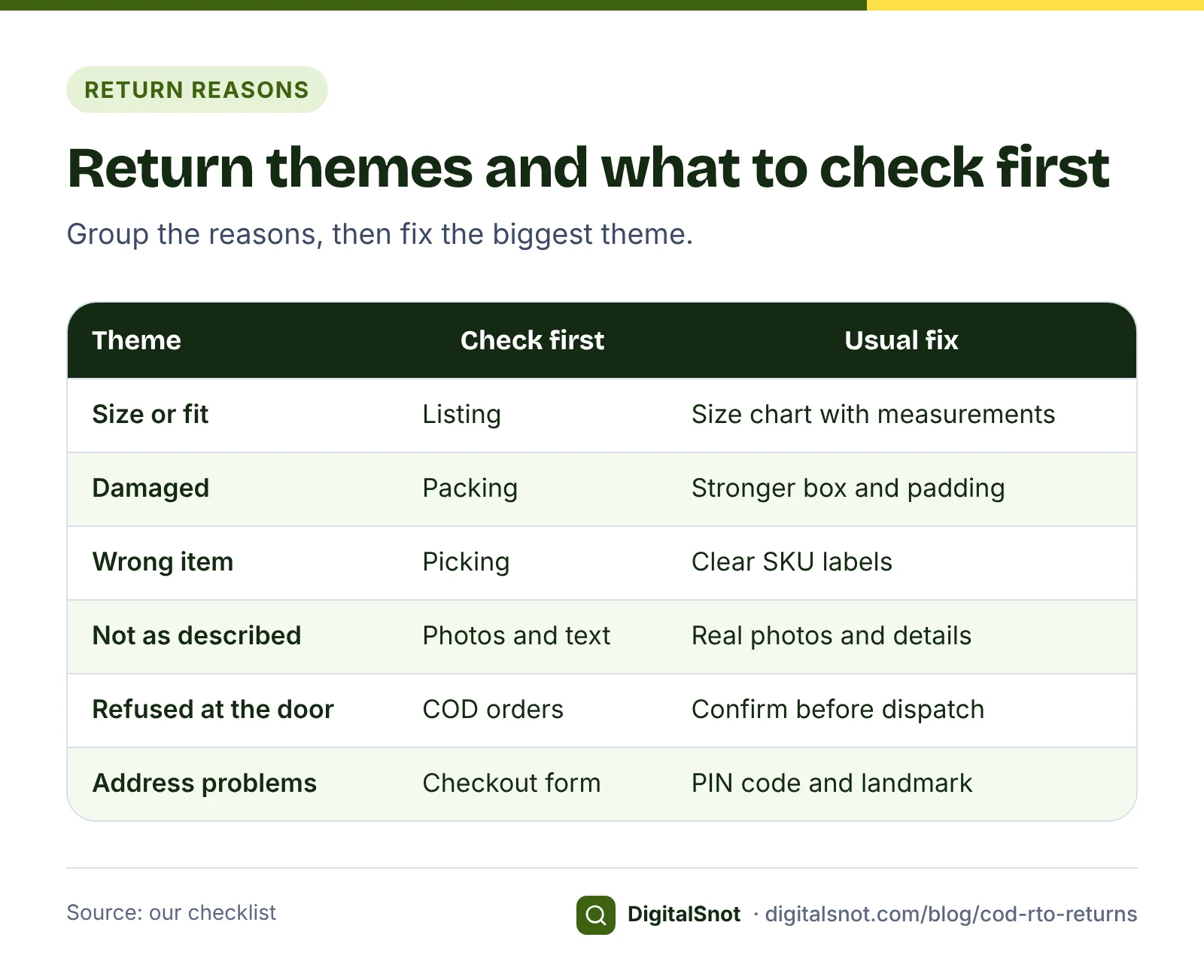
RTO is only half the story. Returns after delivery usually cost you shipping both ways too. The reasons buyers give are messy, but grouped together they point at what to fix.
Open your returns or RTO report in the Returns and RTO Reason Analyzer. It groups reasons into themes such as size or fit, damaged, wrong item, not as described, changed mind, late delivery, refused at the door and address problems, in English and common Hinglish, and shows them by product, by month and RTO by State. Add your orders per product to get return rates. The grouping and the thresholds it flags are our measures, and you can move any reason to another theme.
One rule to keep in mind while you fix things: under the Consumer Protection (E-Commerce) Rules, 2020, a seller cannot refuse to take back goods, or refund them, if they are defective, deficient or spurious. A tighter return policy is not the answer to damage or wrong items; better packing and picking are.
Mistakes to avoid
- Turning off COD everywhere. Some buyers order only with COD. Switch it off only for PIN codes where your own numbers show a loss.
- Judging a PIN code on five orders. Wait for enough orders, or group it with nearby PIN codes.
- A prepaid discount larger than the saving. Work out the limit first.
- Adding an offer to the confirmation message. It turns an order update into marketing.
- Counting returns and RTO together without looking at the reasons. Size returns and refused parcels need different fixes.
Your next step
This week, put last month's numbers into the COD and RTO Cost Calculator to see what RTO costs you, and start sending a confirmation for every COD order. Next month, run your orders export through the pincode tool and your returns report through the reasons tool. You will find all of these in our free tools for online sellers, which work in your browser and never sign in to your seller accounts. If you would like a second pair of eyes on your numbers, get in touch.
Free tools in this article
- COD and RTO Cost Calculator See what COD and returned parcels cost you each month, and the largest prepaid discount you can give.
- Order Update and COD Confirmation Templates Messages for every order step, from COD confirmation to refund, for WhatsApp, SMS or email.
- COD Pincode Risk Analyzer Find the PIN codes where cash on delivery loses money to RTO, and which ones to make prepaid-only.
- Returns and RTO Reason Analyzer Group return and RTO reasons into themes by product, month and state, and see what to fix first.
By the numbers
- the WhatsApp customer service window after a buyer writes to you; outside it, businesses on the WhatsApp Business Platform can send only approved templates
- 24 hours
- Source: Meta for Developers: WhatsApp Business Platform
Frequently asked questions
What is RTO in e-commerce?
RTO means return to origin: a parcel that was not delivered and goes back to the seller, for example because the buyer refused it, could not be reached or gave a wrong address. You pay to send it and usually to bring it back, the sale does not happen, and some stock may not be sellable again.
Why do cash on delivery orders come back more often?
A buyer who has not paid loses nothing by refusing the parcel, so orders placed on impulse, by mistake or with a wrong address are more likely to come back. Compare the RTO rates of your own COD and prepaid orders to see how big the gap is for your shop.
Can I confirm COD orders on WhatsApp?
Yes, if the buyer gave you their number and agreed to hear from your business, as the WhatsApp Business Policy requires. On the WhatsApp Business Platform, outside the 24-hour customer service window you can send only approved templates. Keep offers out of the confirmation, or it becomes a marketing message.
Should I turn off COD for some PIN codes?
Only where your own orders show that COD loses money there, and only after enough orders to trust the rate. For PIN codes close to that line, asking for part of the price online is a gentler option. Check the numbers again every few months.
Is a prepaid discount a dark pattern?
No, a real discount shown clearly is fine. It becomes a problem when it uses a countdown that resets, guilt-trip wording on the COD option, a hidden COD fee that appears only at the end, or a faded COD button. Those match patterns in the CCPA's 2023 dark patterns guidelines.
Can I refuse returns of damaged or wrong items?
No. Under the Consumer Protection (E-Commerce) Rules, 2020, a seller cannot refuse to take back goods, or refund them, if they are defective, deficient or spurious. You can set rules for change-of-mind returns, but say them plainly in your policy. This is not legal advice.
Sources
Every figure and claim in this article comes from the sources below. We checked each one when writing and link to the original so you can read it yourself. Credit belongs to the authors and publishers listed. How we write and check our articles.
-
1
WhatsApp Business Policy
WhatsApp · Message only people who gave their number and agreed to hear from the business; respect requests to stop.
-
2
Send messages: customer service window
Meta for Developers · A 24-hour customer service window; outside it only approved templates can be sent.
-
3
Template categorisation
Meta for Developers · Order updates without offers are utility; templates mixing updates and promotions are marketing.
-
4
PIN code structure
PIB: Department of Posts · What the six digits of a PIN code stand for.
-
5
CCPA issues Guidelines for Prevention and Regulation of Dark Patterns, 2023
PIB: Central Consumer Protection Authority · The 13 specified dark patterns, including false urgency, confirm shaming, interface interference and drip pricing.
-
6
The Guidelines for Prevention and Regulation of Dark Patterns, 2023 (Gazette)
Department of Consumer Affairs · Official text and definitions of each dark pattern.
-
7
Consumer Protection (E-Commerce) Rules, 2020 (Gazette)
Department of Consumer Affairs · Total price with a breakup of charges; sellers may not refuse to take back defective, deficient or spurious goods.