How to choose an SEO agency: 10 questions to ask before you hire
Ten questions to ask any SEO agency before you sign, what a good answer sounds like, the red flags Google itself warns about, and a scorecard to compare agencies.

On this page (10 sections)
- 1Start with what Google says about hiring an SEO
- 2Before you ask: know what you want
- 3The 10 questions to ask an SEO agency
- 4Red flags to walk away from
- 5What we found when we compared Google's list with these 10 questions
- 6A scorecard to compare SEO agencies
- 7Agency, freelancer or in-house?
- 8Questions about AI search
- 9Next steps
- 10Sources
Hiring an SEO agency is a long-term decision. Most providers work on monthly retainers, and changes they make to your site can help or harm it for years. Yet when working out how to choose an SEO agency, many businesses go on price and a confident sales call.
This post gives you 10 questions to ask, what a good answer sounds like, the red flags to watch for and a scorecard to compare agencies side by side. It draws on Google's own guidance on hiring an SEO, which is more practical than most people expect.
Start with what Google says about hiring an SEO
Google publishes a page called "Do you need an SEO?" that lists questions to ask and warning signs to avoid. Read it before any sales call.
Three points from that page shape everything below. First, Google says an SEO can help with things like reviewing your site content or structure, keyword research and SEO training, and that a good time to hire is when you are planning a redesign or a new site. Second, it says no one can guarantee a number one ranking on Google. Third, it reminds you that you are responsible for the actions of any company you hire, so an agency's shortcuts become your problem.
Google also notes that a small local business can often do much of the work itself, starting with its SEO Starter Guide. If you hire anyway, knowing the basics helps you judge the answers you get.
Before you ask: know what you want
Decide the outcome you are buying before you talk to anyone. "More traffic" is not an outcome; "more enquiries for our Pune clinic" or "more online orders in our top category" is.
Write down your main goal, your budget range, who on your side can make website changes, and what you have already tried. If budget is the first question on your mind, our guide to what SEO services cost and what you are paying for explains the pricing models. In Ahrefs' global SEO pricing survey of 439 providers, 78.2% charge a monthly retainer, so plan for an ongoing contract rather than a one-off fee.
Answer-ready page checklist
The 10 questions to ask an SEO agency
Ask every agency the same 10 questions, in writing if you can. Good answers are specific to your site; weak answers are generic or vague.
1. How will you diagnose my site before recommending anything?
A good answer describes a review of your current site and data first: crawling, indexing, Search Console data, content and competitors. A careful agency will usually propose a technical SEO audit or a short discovery phase before a fixed plan. If you are hiring because traffic fell, our guide to diagnosing a drop after a core update shows the checks a sound diagnosis should cover.
2. Can you show me examples of your past work?
This is one of Google's suggested questions. A good answer includes work you can check, such as published content, public case studies with named sources, or samples of audits and reports. A newer agency may show detailed methods and sample deliverables instead, and should say so honestly.
3. Do you follow Google Search Essentials?
Also from Google's list. A good answer is a clear yes plus examples of what they will not do, such as buying links or publishing mass-produced pages. Ask them to explain one recent Google policy in plain words.
4. What results should I expect, and when?
A good answer gives a realistic range and timeline tied to your site's starting point and competition, with early milestones such as fixes shipped and pages published. It does not promise positions or dates for page one.
5. How will you measure success?
A good answer ties reporting to your business goal: enquiries, sales or qualified organic traffic, measured in your own analytics. Rankings can be one input, but a report built only on ranking screenshots is a warning sign.
6. What exactly will you deliver each month?
A good answer is a written list: pages written or updated, fixes shipped, research delivered, meetings and reports. If the answer is "ongoing optimisation" with no detail, you cannot hold anyone to it.
7. How do you earn links and mentions?
A good answer describes creating content or resources other sites want to reference, digital PR, and fixing existing mentions. Google's spam policies list buying or selling links for ranking purposes and excessive link exchanges as link spam, so a fixed number of links per month is a red flag.
8. What is your experience in my industry and my market?
Google suggests asking about experience in your industry and in your country or city. A good answer shows an understanding of how your customers search, local competition and any regulatory limits on what you can claim, for example in health or finance.
9. Will you explain every change you make to my site?
Google suggests asking whether the SEO will share all changes and the reasoning behind them. A good answer is yes, with a change log and a sign-off step for anything that affects how the site works.
10. Who owns the accounts, content and data if we stop working together?
A good answer: you do. Search Console, analytics, Google Business Profile, content and reports should sit in your accounts, with the agency given access. Ask what handover looks like and what the notice period is.
10 questions to ask an SEO agency
Red flags to walk away from
Walk away from any agency that guarantees rankings, claims inside access to Google, or sells links by volume. These are the warning signs Google names directly.
- Guaranteed rankings. Google says no one can guarantee a number one ranking, and warns about SEOs who guarantee rankings only on obscure, long phrases you would get anyway.
- A "special relationship" with Google or "priority submit". Google says there is no priority submit; sites are submitted through tools such as Search Console and sitemaps.
- Link popularity schemes. Google advises avoiding SEOs who talk about link schemes or submitting your site to thousands of search engines.
- Secrecy. Refusing to explain methods or changes, or keeping your logins.
- Lock-in. Long contracts with no exit before results can be measured.
What we found when we compared Google's list with these 10 questions
Google's page covers about half of what you need to ask. We compared its suggested questions with the 10 above and noted where each comes from, so you can see which questions rest on Google's guidance and which we added to fill gaps.
Method: we took each question Google suggests on its "Do you need an SEO?" page, matched it to the closest question in our list, and marked our remaining questions as additions with the reason for adding them.
| Our question | From Google's list? | Why it matters |
|---|---|---|
| 1. Diagnosis first | Added | Stops one-size-fits-all packages |
| 2. Past work | Yes | Evidence instead of claims |
| 3. Search Essentials | Yes | Protects you from penalties |
| 4. Results and timeline | Yes | Sets realistic expectations |
| 5. Measuring success | Yes | Keeps reports tied to revenue |
| 6. Monthly deliverables | Added | Makes a retainer accountable |
| 7. Link building method | Added (based on Google's spam policies) | Links are where most risk sits |
| 8. Industry and market | Yes | Local and sector knowledge |
| 9. Explaining changes | Yes | You stay responsible for your site |
| 10. Ownership and exit | Added | Protects your data and access |
The pattern is clear: Google's list focuses on trust and expertise, while the gaps are commercial. Deliverables, link methods and ownership are where agency relationships tend to go wrong, so they deserve as much attention as the questions Google suggests.
A scorecard to compare SEO agencies
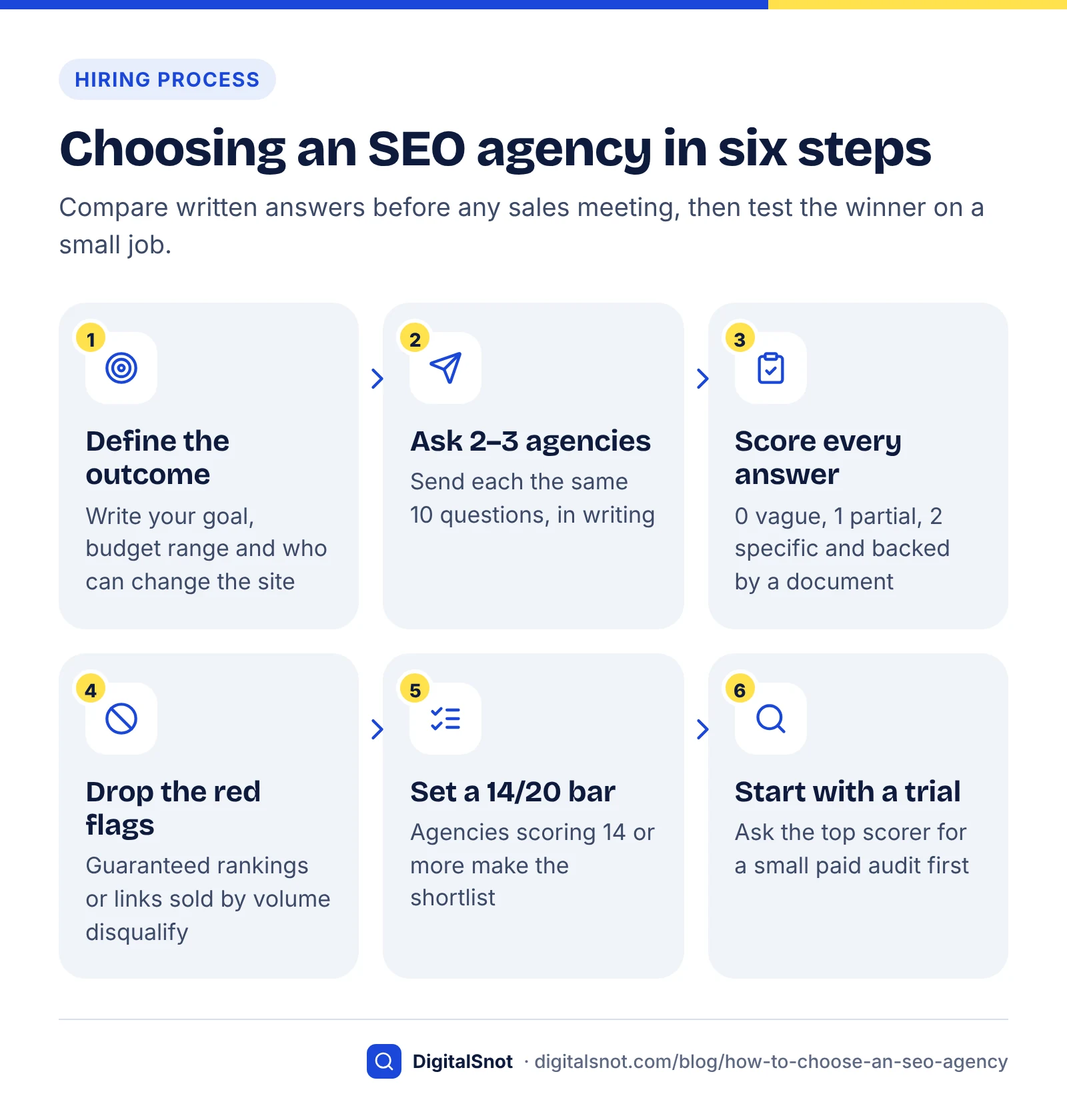
Score each agency from 0 to 2 on every question and compare totals. Use 0 for a vague or missing answer, 1 for a partial answer, and 2 for a specific answer backed by a document or example.
| Question | Agency A | Agency B | Agency C |
|---|---|---|---|
| 1. Diagnosis first | 0–2 | 0–2 | 0–2 |
| 2. Past work you can check | 0–2 | 0–2 | 0–2 |
| 3. Follows Search Essentials | 0–2 | 0–2 | 0–2 |
| 4. Realistic results and timeline | 0–2 | 0–2 | 0–2 |
| 5. Success tied to business goals | 0–2 | 0–2 | 0–2 |
| 6. Written monthly deliverables | 0–2 | 0–2 | 0–2 |
| 7. Safe link and mention method | 0–2 | 0–2 | 0–2 |
| 8. Industry and market experience | 0–2 | 0–2 | 0–2 |
| 9. Explains every change | 0–2 | 0–2 | 0–2 |
| 10. You own accounts and data | 0–2 | 0–2 | 0–2 |
| Total (out of 20) |
Two rules make the scorecard useful. Any answer that guarantees rankings or sells links by volume disqualifies the agency, whatever its total. And a score of 14 or more is a reasonable bar for a shortlist.
Monthly results report
Agency, freelancer or in-house?
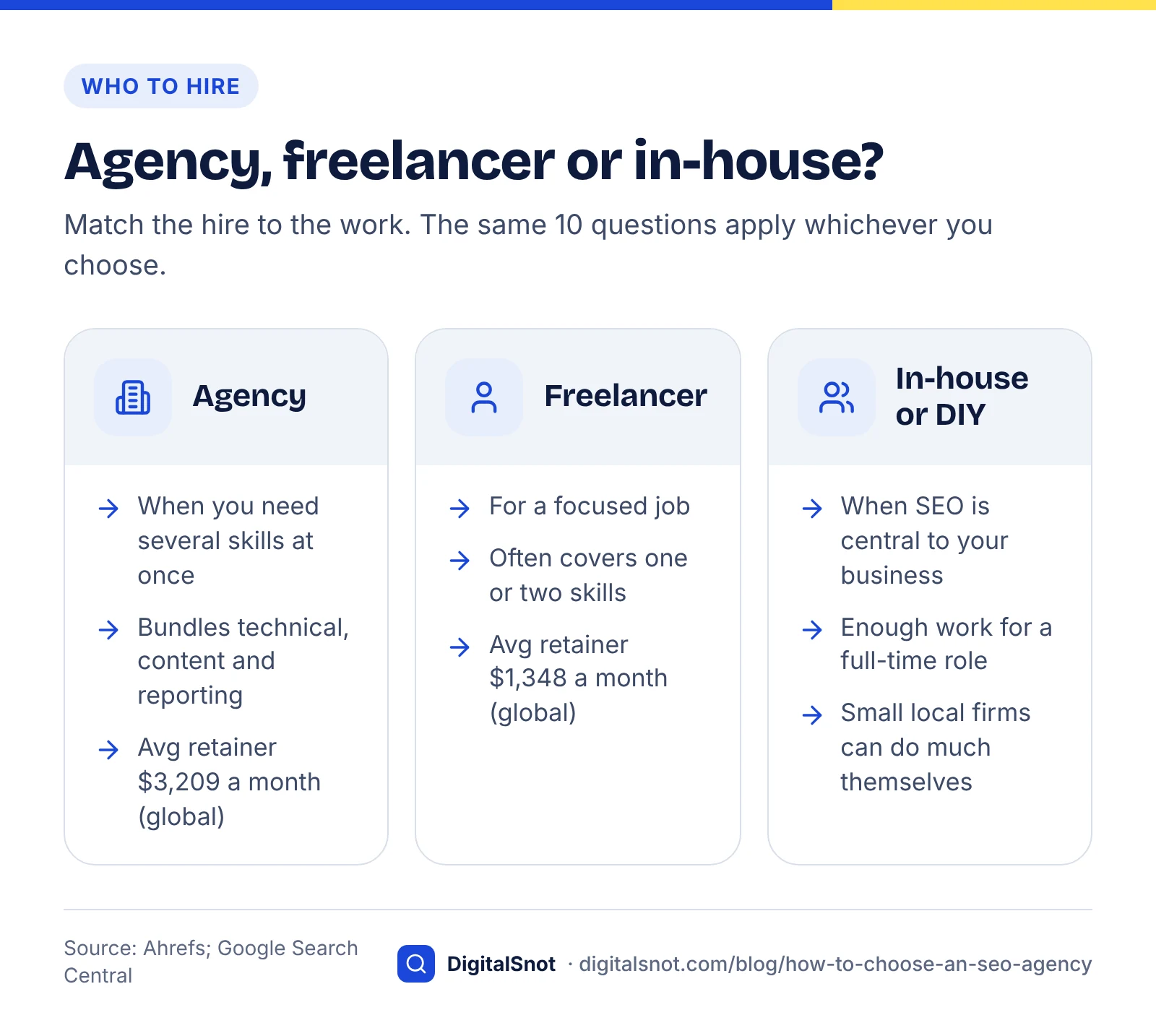
Choose an agency when you need several skills at once, a freelancer for a focused job, and in-house help when SEO is central to your business and you can keep someone busy full time.
Ahrefs' survey reports an average monthly retainer of $3,209 for agencies and $1,348 for freelancers. That is a global, self-reported average, not an Indian benchmark, but the gap reflects a real difference: agencies usually bundle technical, content and reporting skills, while a freelancer often covers one or two. The same 10 questions apply to both.
Questions about AI search
Ask how the agency handles visibility in AI answers such as ChatGPT, Perplexity and Google's AI Overviews. A good answer starts with the same basics, crawlable and indexed pages, clear content and consistent business details, and avoids promising placement in AI answers.
Our explainer on how ChatGPT recommends businesses covers what is known, and our guide to getting cited in AI search goes further.
Next steps
Shortlist two or three agencies, send each the 10 questions, and score the written answers before any meeting. Ask the best scorer for a small paid audit or trial before a long retainer.
If you want to see how we would answer these questions, look at our technical SEO service and content SEO service, or send us your questions and we will reply in writing.
By the numbers
Frequently asked questions
What should I ask an SEO agency before hiring?
Ask how they will diagnose your site, examples of past work, whether they follow Google Search Essentials, what results to expect and when, how they measure success, what they deliver monthly, how they earn links, their industry and market experience, whether they explain every change, and who owns your accounts and data. Several of these come directly from Google's hiring guidance.
Can an SEO agency guarantee rankings?
No. Google states that no one can guarantee a number one ranking on Google. It also warns about SEOs who guarantee rankings only on obscure, long phrases that would rank anyway, and about anyone claiming a special relationship with Google or a priority submission service. Treat any ranking guarantee as a reason to walk away.
How long before an SEO agency shows results?
It depends on your starting point, competition and how quickly changes are implemented. Early progress should be visible as work completed, such as fixes shipped and pages published. A good agency gives a realistic range for your situation and agrees milestones, rather than promising page-one positions by a date.
Should I hire an SEO agency or a freelancer?
An agency suits you when you need several skills, such as technical fixes, content and reporting, under one contract. A freelancer suits a focused job, like an audit or a set of pages. In Ahrefs' global survey, agencies reported higher average retainers than freelancers. Ask both the same questions and compare written answers.
Who should own my Google Search Console and analytics accounts?
You should. Create Search Console, analytics and Google Business Profile accounts under your own business login and give the agency access. That way you keep your data, history and control if the relationship ends. An agency that insists on owning these accounts is a red flag.
Is it risky to hire an SEO agency that sells backlink packages?
Yes. Google's spam policies list buying or selling links for ranking purposes as link spam, and Google says you are responsible for the actions of any company you hire. A package promising a fixed number of links each month usually relies on links created to manipulate rankings, which can harm your site.
Sources
Every figure and claim in this article comes from the sources below. We checked each one when writing and link to the original so you can read it yourself. Credit belongs to the authors and publishers listed. How we write and check our articles.
-
1
Do You Need an SEO? Tips for Hiring an SEO
Google Search Central · Questions to ask, what an SEO can do, no guaranteed ranking, red flags, owner responsibility.
-
2
SEO Starter Guide: The Basics
Google Search Central · Google's recommended starting point for doing SEO yourself.
-
3
SEO Pricing: How Much Does SEO Cost? 439 People Polled
Ahrefs · Global survey: 78.2% charge retainers; average agency vs freelancer retainers.
-
4
Spam Policies for Google Web Search
Google Search Central · Link spam examples, including buying links for ranking and excessive link exchanges.