How long does SEO take? What happens in the first 90 days
SEO is measured in months, not days. Here is what Google itself says about timing, and a realistic plan for the first 90 days.

On this page (9 sections)
- 1The short answer: months, with early signals in weeks
- 2What Google says about timing: a side-by-side
- 3Five factors that decide your timeline
- 4A typical 90-day SEO plan
- 5What moves first, and what takes longer
- 6What to measure in the first 90 days
- 7Red flags when someone promises fast results
- 8How to make SEO work faster
- 9Sources
"How long does SEO take?" is usually the first question a business owner asks, and the honest answer is months, not days. This post explains what Google itself says about timing, the factors that make your timeline shorter or longer, and what a sensible first 90 days look like.
The plan below is a typical sequence of work, not a promise. Nobody can guarantee rankings, and Google says so directly.
The short answer: months, with early signals in weeks
Most sites need several months before SEO work turns into steady traffic, but you should see early signals, such as more pages indexed and more impressions, within the first few weeks.
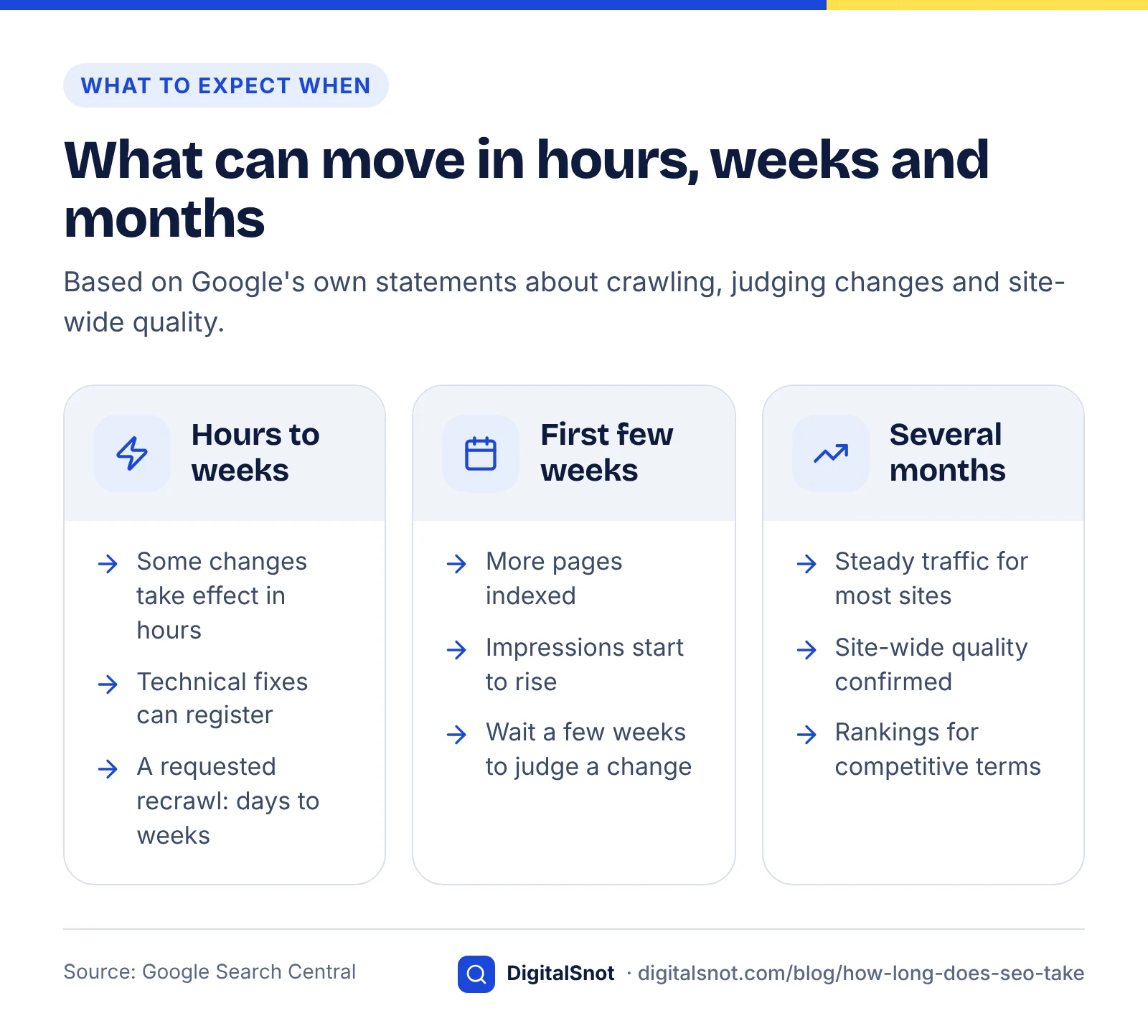
Google's SEO Starter Guide says some changes "might take effect in a few hours, others could take several months", and that you will likely want to wait a few weeks to judge whether a change helped. Its core updates documentation adds that while some changes show up in days, it can take several months for Google's systems to confirm that a site as a whole is producing helpful, reliable content. If you are recovering from a drop after a core update rather than starting out, our core update recovery guide covers how to diagnose it and what to fix.
So the realistic framing is this: technical fixes can register within days or weeks, content needs time to be crawled, indexed and tested, and trust across a whole site builds over months.
What Google says about timing: a side-by-side
Google does not publish a single SEO timeline, but several of its own pages describe how long different steps take. We read the relevant Google documentation and put the statements side by side. You can repeat this by searching Search Central for "weeks" and "months" and noting each claim with its page.
| Step | What Google says | Source |
|---|---|---|
| Recrawling a URL you asked about | Crawling can take anywhere from a few days to a few weeks | Ask Google to recrawl your URLs |
| Requesting indexing | A request does not guarantee the page will be indexed, and repeat requests do not speed it up | URL Inspection tool help |
| Judging a single change | Some changes take hours, others several months; wait a few weeks before assessing | SEO Starter Guide |
| Site-wide quality improvements | Can take several months for systems to learn and confirm | Google Search's core updates |
| Hiring help | Ask what results to expect and in what timeframe; no one can guarantee a #1 ranking | Do you need an SEO? |
Two things stand out. Google consistently talks in weeks for crawling and in months for overall quality. And it never promises an outcome, which is why any honest SEO plan avoids guarantees.
Five factors that decide your timeline
Your timeline depends mainly on where your site starts and how hard your market is. These five factors explain most of the difference between a site that moves in three months and one that takes a year.
1. Site age and history
An established domain with existing links and indexed pages usually responds faster than a brand-new site. Ahrefs' study of how long it takes to rank also notes that most pages in Google's top 10 are several years old. A new site has to earn that history.
2. Competition
Ranking for a long, specific phrase in one city is far quicker than ranking for a broad national term. Good keyword research lets you target winnable searches first while you build authority for harder ones.
3. Crawling and indexing speed
Google cannot rank a page it has not crawled and indexed. Blocked sections, broken internal links, missing sitemaps or slow servers all add delay. Fixing these is usually the fastest lever you have, which is why most plans start with a technical SEO audit.
4. Content quality and depth
Thin or duplicated pages rarely rank, however long you wait. Pages that answer the searcher's question clearly, with real expertise, give Google a reason to show them.
5. How quickly changes get made
Recommendations only help once they are live, and Google can only reassess a page after it has recrawled the changed version. If developer time or approvals are slow, the timeline stretches accordingly.
Search result citing the client
A typical 90-day SEO plan
A sensible first 90 days moves from foundations to content to measurement. The table shows a common order of work; your own plan should be adjusted to what the audit finds.
| Period | Main work | What you should see |
|---|---|---|
| Days 1–30 | Set up Search Console and analytics, run a technical audit, fix crawl blocks, broken links, redirects and sitemaps, agree target keywords | Clean index coverage, fewer errors, a prioritised fix list |
| Days 31–60 | Improve titles, headings and internal links on key pages, fix templates, start publishing or rewriting priority content | More pages indexed, impressions starting to rise |
| Days 61–90 | Publish more content, strengthen internal linking, review Search Console queries, refine pages that get impressions but few clicks | Rankings appearing for long-tail queries, first organic clicks on new pages |
Notice what is missing from the right-hand column: guaranteed rankings, leads or revenue targets. Those can come within 90 days for some sites, but they depend on the factors above and are not something anyone can promise.
Days 1–30: foundations
Verify the site in Search Console, submit an XML sitemap and check the Page indexing report for excluded pages. Fix anything that stops Google reaching important URLs before you write a single new page. This is the core of technical SEO work. For a quick first pass, our free Website SEO Audit crawls up to 50 pages and lists the issues it finds.
Days 31–60: key pages
Start with the pages closest to revenue: service pages, category pages and location pages. Work through titles, headings, copy and internal links using an on-page SEO checklist, then move to new content.
Days 61–90: content and refinement
By now, Search Console should show which queries trigger impressions. Use that data to improve pages that sit on page two and to plan the next batch of articles through a content SEO process.
Technical audit scorecard
What moves first, and what takes longer
Indexing and impressions move first; clicks, competitive rankings and leads follow. Knowing this order stops you judging the work on the wrong metric too early.
The first 90 days of SEO
- Indexing. Once crawl issues are fixed, more of your pages appear as indexed in Search Console.
- Impressions. Indexed pages start appearing in results, often in low positions at first.
- Long-tail rankings. Specific, lower-competition queries tend to rank before broad ones.
- Clicks. As positions improve, impressions turn into visits.
- Leads and sales. These depend on traffic volume and on how well the page converts.
Ahrefs' data supports a patient view. In its analysis of URLs first seen in September 2023, only 1.74% of newly published pages reached the top 10 within a year. Among pages that did make the top 10, 40.82% got there within their first month, which suggests that pages which are going to rank often show it early. If a page has had no impressions after a few months, it usually needs rework rather than more waiting.
What to measure in the first 90 days
Measure leading indicators in Google Search Console, not just traffic and leads. These show whether the work is heading in the right direction long before revenue does.
- Indexed pages: the Page indexing report shows how many of your URLs are indexed and why others are not.
- Impressions: the Performance report shows how often your pages appear in results. A rising trend is the earliest sign of progress.
- Queries: new queries appearing for your key pages show Google is testing them for more searches.
- Average position for target pages: watch the trend, not daily swings.
- Single URLs: the URL Inspection tool confirms whether a specific page is indexed and lets you request indexing.
When you request a recrawl, Google's recrawl guidance says crawling can take from a few days to a few weeks, and that asking again for the same URL will not make it faster. Submit, then check back.
Monthly results report
Red flags when someone promises fast results
Be cautious of anyone who promises page-one rankings in a fixed number of days. Google's "Do you need an SEO?" page states that no one can guarantee a #1 ranking on Google, and it suggests asking any SEO what results they expect and in what timeframe.
A good answer explains the plan, the order of work, the metrics you will see first and the assumptions behind them. Our guide on how to choose an SEO agency covers more questions to ask, and if budget is part of the decision, see what drives SEO costs in India.
How to make SEO work faster
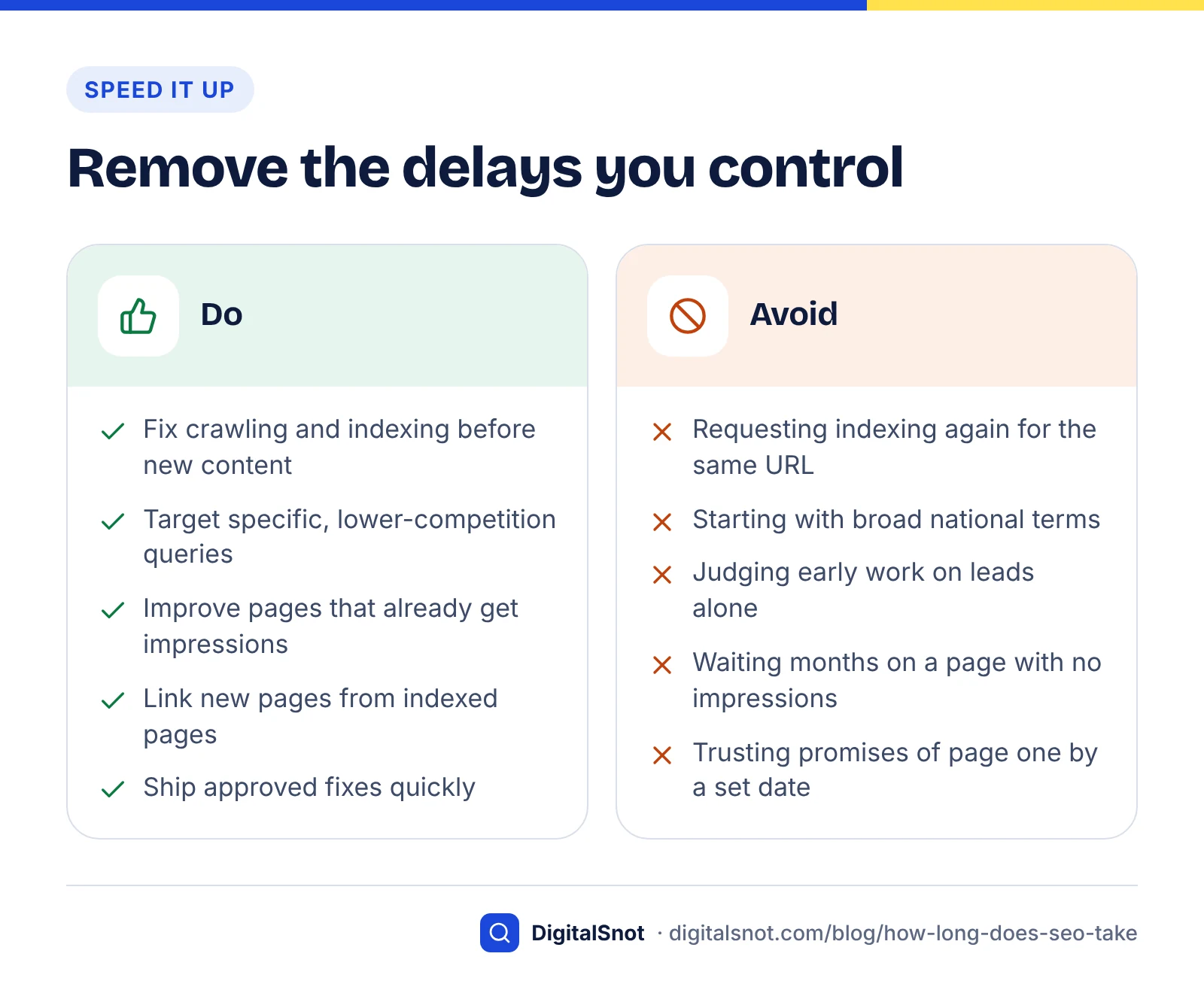
You cannot force Google to rank you sooner, but you can remove the delays that are under your control.
- Fix crawling and indexing problems before creating new content.
- Target specific, lower-competition queries first, then broaden.
- Improve existing pages that already get impressions; they are closer to page one than new pages.
- Link new pages from relevant, already-indexed pages so Google finds them quickly.
- Get developer and content approvals moving quickly, because unshipped fixes have no effect.
If you want a plan built around your own site and market, you can talk to us about a 90-day roadmap.
Free tools in this article
By the numbers
- of newly published pages reached Google's top 10 within a year (Ahrefs sample of 1 million URLs first seen in September 2023)
- 1.74%
- Source: Ahrefs
- of pages that did reach the top 10 got there within their first month (Ahrefs, 2023 data)
- 40.82%
- Source: Ahrefs
- is how long Google says crawling can take after you ask it to recrawl a URL
- Days to weeks
- Source: Google Search Central
Frequently asked questions
How long does SEO take to show results?
Most sites need several months before SEO turns into steady traffic. Google says some changes take effect in a few hours and others take several months, and suggests waiting a few weeks before judging a change. Early signals such as more indexed pages and rising impressions in Search Console usually appear well before clicks and leads.
Can SEO work in 30 days?
Some things can improve within 30 days, especially technical fixes that let Google crawl and index pages it was missing. You may see more pages indexed and more impressions. Competitive rankings and lead growth usually take longer, and anyone promising guaranteed page-one rankings in 30 days is making a claim Google says no one can guarantee.
Why is my new website not ranking yet?
New sites have no history, few links and often few indexed pages. Check Search Console to confirm your pages are indexed, fix any crawl blocks, and target specific lower-competition queries first. Ahrefs found only a small share of newly published pages reach the top 10 within a year, so patience and steady improvement matter.
What should I measure in the first three months of SEO?
Focus on leading indicators in Google Search Console: the number of indexed pages, total impressions, the number of queries your pages appear for, and the average position of your priority pages. Track trends week to week rather than daily swings. Traffic and leads are lagging indicators that follow once these move.
Does requesting indexing in Search Console speed things up?
Requesting indexing tells Google about a page, but Google says it does not guarantee indexing and that repeat requests for the same URL will not speed it up. Crawling can take from a few days to a few weeks. For many URLs, submit an XML sitemap instead of requesting each page individually.
Is it worth continuing SEO if nothing happens after 90 days?
Look at the leading indicators before deciding. If indexed pages and impressions are rising, the work is moving in the right direction and rankings often follow. If nothing has changed at all, review whether fixes were actually implemented, whether target keywords are realistic for your site, and whether the content answers searchers better than competing pages.
Sources
Every figure and claim in this article comes from the sources below. We checked each one when writing and link to the original so you can read it yourself. Credit belongs to the authors and publishers listed. How we write and check our articles.
-
1
SEO Starter Guide: The Basics
Google Search Central · Changes can take hours or several months; wait a few weeks to assess.
-
2
Google Search's core updates
Google Search Central · Site-wide improvements can take several months for systems to confirm.
-
3
How long does it take to rank in Google? (A study by Ahrefs)
Ahrefs · 1.74% of new pages in top 10 within a year; 40.82% of top-10 pages ranked within a month.
-
4
URL Inspection tool
Google Search Console Help · Checking index status of single URLs and requesting indexing.
-
5
Ask Google to recrawl your URLs
Google Search Central · Crawling can take a few days to a few weeks; repeat requests do not help.
-
6
Do you need an SEO?
Google Search Central · No one can guarantee a #1 ranking; ask about expected results and timeframe.