How much do SEO services cost in India? What you are paying for
SEO pricing in India varies widely because the work varies widely. Here is how the pricing models work, what drives cost and how to spot a proposal that will cost you more later.

On this page (9 sections)
- 1Why SEO prices vary so much
- 2The four common SEO pricing models
- 3What drives the cost of SEO
- 4Red flags that make cheap SEO expensive
- 5Our framework: how to compare SEO proposals
- 6A hypothetical example: two quotes, same label
- 7How to get more from any SEO budget
- 8Choosing who to work with
- 9Sources
SEO services cost in India varies widely: ask five providers for a quote and you may get five very different numbers. That is not always a sign that someone is overcharging. SEO is a bundle of different jobs, and two quotes with the same label can cover completely different work.
This post explains how SEO is priced, what pushes the cost up or down, which offers to avoid, and how to compare proposals so you know what you are actually buying. We do not quote our own prices here, and we only use figures from a survey we could check.
Why SEO prices vary so much
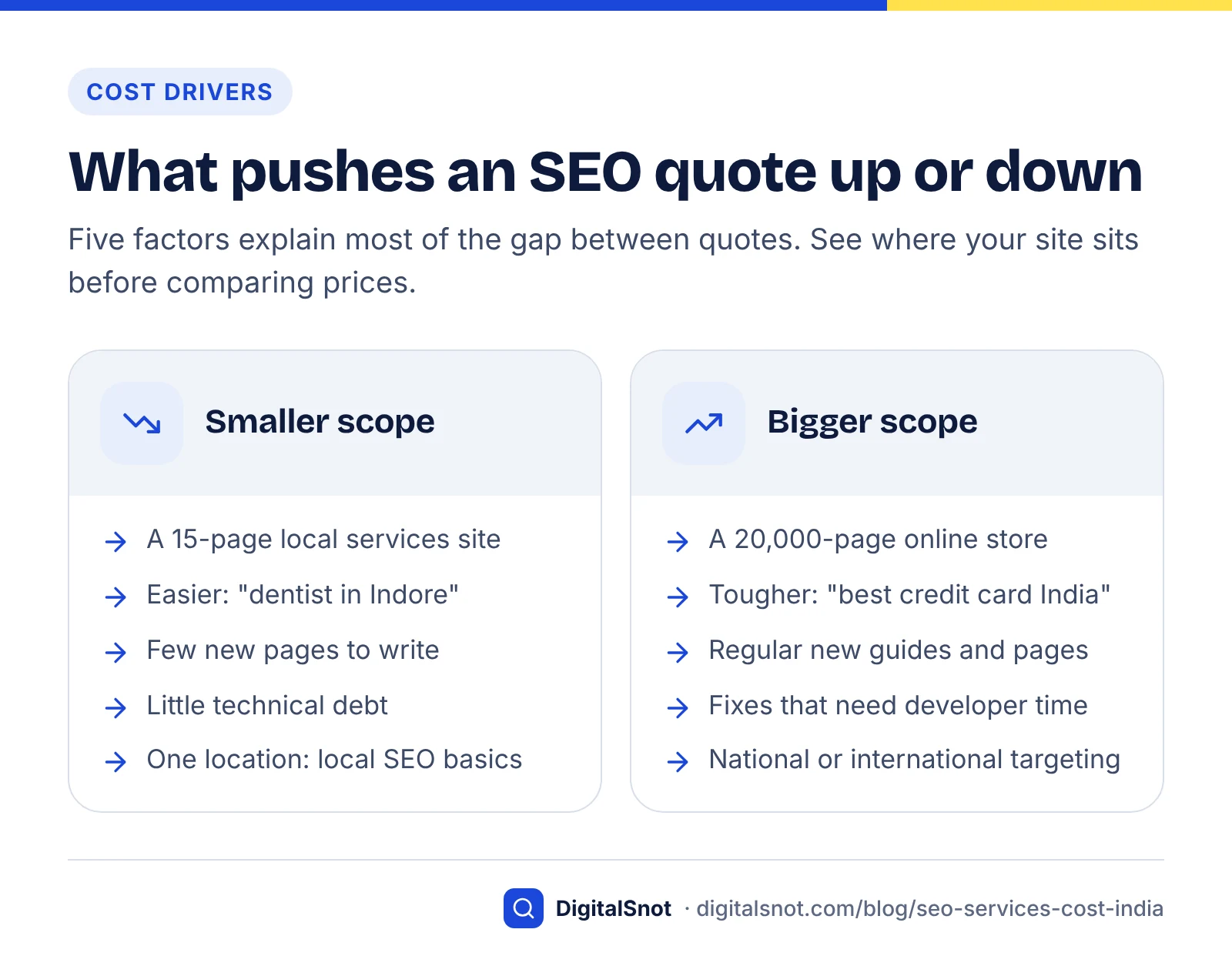
SEO prices vary because the scope varies. A 15-page local services site and a 20,000-page online store both "need SEO", but the work, tools and hours involved are not comparable.
Most SEO work falls into four buckets: technical fixes (crawling, indexing, speed, structured data), on-page work (titles, headings, internal links), content (planning and writing pages that answer real searches) and authority (earning mentions and links from other sites). A cheap package usually covers a thin slice of one bucket. A larger retainer may cover all four. Before comparing numbers, find out which buckets each quote includes.
The four common SEO pricing models
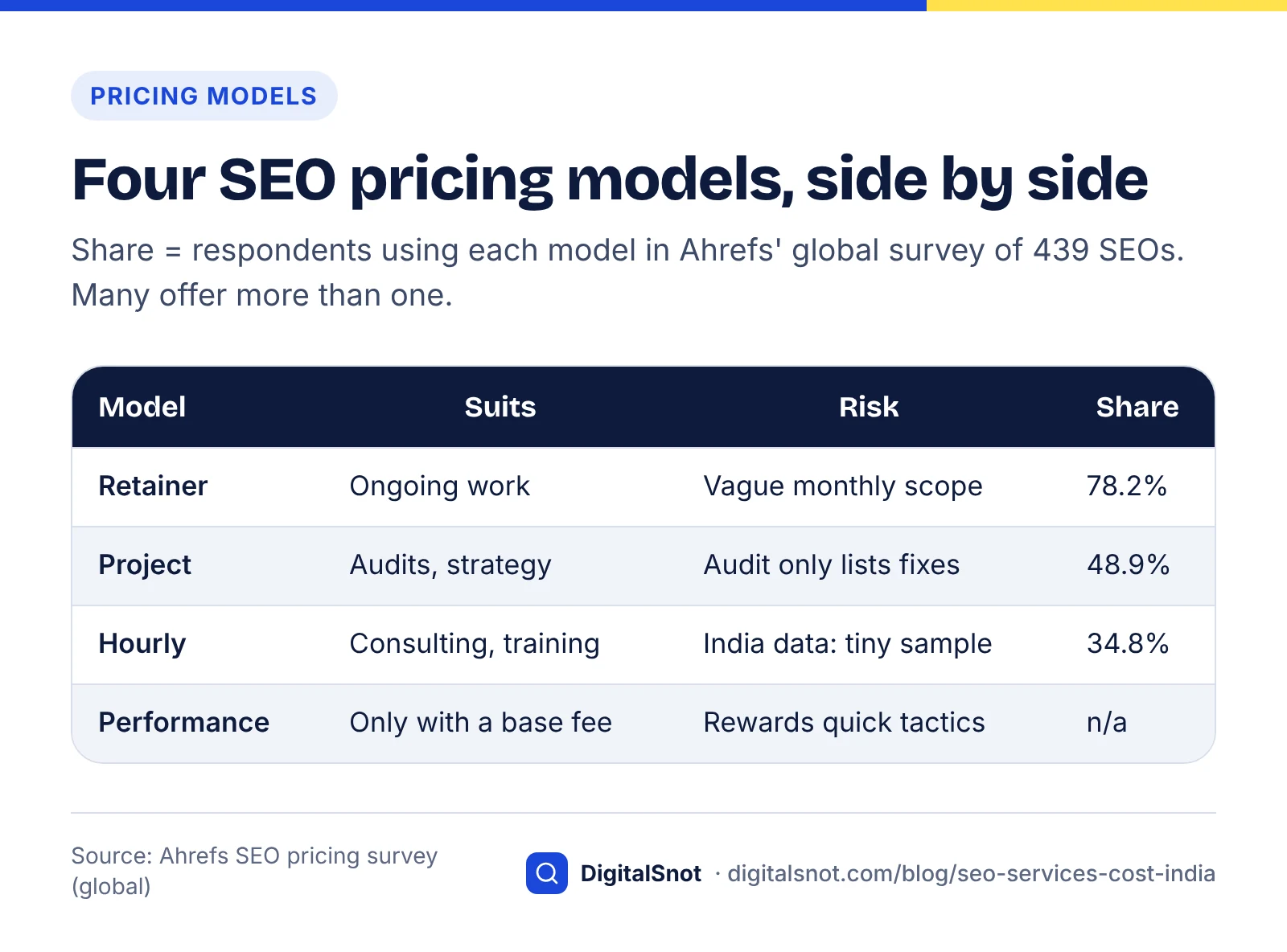
Most providers price SEO as a monthly retainer, a fixed project, an hourly rate or a performance deal. Many offer more than one.
The most useful public data on this comes from Ahrefs' SEO pricing survey, which polled 439 SEO providers worldwide. It is a global, self-reported sample, not an Indian market study, and the article we checked in October 2026 does not state the year the responses were collected. Treat its numbers as a rough picture of how the industry prices, not as an Indian price list.
Monthly retainer
You pay a fixed amount each month for an agreed set of ongoing work. In the Ahrefs survey, 78.2% of respondents charge a monthly retainer, which makes it the most common model. Retainers suit SEO because results build over months and the work does not stop once a site is "fixed". The risk is vagueness: a retainer without a written list of monthly deliverables is hard to hold anyone to.
Project or audit fee
You pay once for a defined piece of work, such as a technical SEO audit, a site migration plan or a keyword and content strategy. Ahrefs found 48.9% of respondents use per-project fees. Projects are easier to compare because the output is concrete. The catch is that an audit only tells you what to fix; someone still has to fix it.
Hourly
You pay for time, usually for consulting, training or ad hoc help. In the Ahrefs survey, 34.8% bill hourly and the average rate across all respondents was $111 an hour. The survey also reports that 85.7% of India-based respondents charge $30 an hour or less. Those percentages (85.7% and 14.3%) suggest only a handful of India-based providers answered, so read that figure as a hint, not a benchmark.
Performance-based
You pay only when a target is hit, such as a ranking position or a traffic level. It sounds low-risk, but it shifts the incentives. The provider is rewarded for moving a number quickly, and the fastest ways to do that, such as bought links, are often the ones Google penalises. Rankings for obscure phrases are also easy to "achieve" and worth little. If you agree to a performance element, tie it to business outcomes you can verify yourself, such as qualified leads from organic search, and keep a base fee for the actual work.
Monthly results report
What drives the cost of SEO
Five factors explain most of the difference between quotes: site size, competition, content volume, technical debt, and whether you target a city or a country.
- Site size. More pages means more to crawl, more templates to check and more internal links to plan. Large catalogues need sampling and template-level fixes rather than page-by-page work.
- Competition. Ranking for "dentist in Indore" takes less effort than ranking for "best credit card India". In competitive markets you need more and better content and more genuine authority.
- Content volume. Writing is often the largest single cost. A plan that calls for new guides, service pages and regular updates needs research, writing and editing time. This is where content SEO budgets usually go.
- Technical debt. A site with slow templates, duplicate URLs, broken redirects or blocked pages needs developer time before content work pays off. If your developers have to make the changes, include their time in the real cost.
- Local versus national. A single-location business can get far with local SEO: a well-kept Google Business Profile, reviews and accurate location pages. National or international targeting needs a broader content and authority plan.
Two smaller factors also matter: reporting depth (a monthly dashboard versus a written analysis with recommendations) and who does the implementation (the agency, your team, or both).
Red flags that make cheap SEO expensive
The clearest red flags are guaranteed rankings, a "special relationship" with Google, and packages that promise a fixed number of backlinks for a small fee.
Google's own page on hiring an SEO says no one can guarantee a number one ranking on Google, and warns against SEOs who claim a special relationship with Google or offer "priority submit". It also tells site owners to avoid SEOs who talk about link popularity schemes or submitting your site to thousands of search engines, and reminds you that you are responsible for the actions of any company you hire.
Cheap link packages are the most common trap. Google's spam policies define link spam as links created mainly to manipulate rankings, and list buying or selling links for ranking purposes, excessive link exchanges and automated link-building programs as examples. Paid links for advertising are allowed only when they are marked with rel="sponsored" or rel="nofollow". A package of "100 high-DA backlinks" is, in practice, a package of links that exist to manipulate rankings. If a past link package may already have hurt your site, our guide to diagnosing a Google traffic drop covers recovering from spam policy problems and manual actions.
Internal links between pages
Other warning signs:
- No written list of deliverables, only "we will do SEO".
- Reports full of ranking positions for phrases nobody searches.
- The agency wants to own your Google Search Console, analytics or Google Business Profile accounts.
- Long lock-in contracts with no exit clause before results are measurable.
Our framework: how to compare SEO proposals
Compare proposals on what you will receive each month, not on the headline fee. We built the scoring table below from the pricing models and red flags above; score each proposal from 0 to 2 on every row and compare totals.
The method is simple enough to repeat: list every proposal in a column, fill each cell with a 0 (missing or vague), 1 (mentioned but unclear) or 2 (specific and written down), then discuss the gaps with each provider before you decide.
| What to check | 2 points if the proposal... | Red flag |
|---|---|---|
| Scope | Names which of technical, on-page, content and authority work is included | "Complete SEO" with no breakdown |
| Deliverables | Lists monthly outputs (pages written, fixes shipped, reports) | Only hours or "activities" |
| Starting point | Begins with an audit or review of your current site and data | Same package for every client |
| Link building method | Explains how mentions and links are earned | A fixed number of links per month |
| Measurement | Ties goals to leads, sales or qualified traffic | Rankings-only reports |
| Ownership | You own all accounts, content and data | Agency holds your logins |
| Contract terms | Clear notice period and handover | Long lock-in, no exit clause |
| Guarantees | Sets realistic expectations and a timeline | Guaranteed rankings |
A proposal that scores 12 or more out of 16 is usually worth a conversation, whatever its price. Anything with a "guaranteed rankings" red flag should be dropped, however well it scores elsewhere.
A hypothetical example: two quotes, same label
Imagine two quotes for a 40-page clinic website, both called a "monthly SEO package". Quote A costs less and promises 50 backlinks and 20 keywords tracked. Quote B costs more and lists an initial audit, fixes to page titles and internal links, two new service pages a month and a monthly written report on enquiries from organic search.
On our scorecard, Quote A loses points for its link method, rankings-only reporting and missing deliverables. Quote B scores well on scope, deliverables and measurement. The lower monthly fee is not the cheaper option if the links break Google's spam policies and the work has to be undone later.
How to get more from any SEO budget
You get more from any budget by fixing the basics yourself, choosing a clear priority and asking for a scope that matches it.
- Set up Google Search Console and your analytics under your own account before you hire anyone.
- Decide the one outcome that matters most this year: more local calls, more product sales or more enquiries for a service.
- Do the basic on-page work yourself using our on-page SEO checklist, so the paid budget goes on harder work.
- Ask for a short paid audit or trial project before signing a long retainer.
- Review results every quarter against the outcome you chose, not against ranking screenshots.
What you pay for in SEO
Choosing who to work with
Price is one input; method and fit matter more. Once you have shortlisted providers whose proposals score well, use our list of questions to ask before you hire an SEO agency to test how they work.
If you would like a proposal written against the scorecard above, you can see the SEO services we offer or get in touch with a short description of your site and goals.
By the numbers
- of SEO providers in Ahrefs' global survey of 439 SEOs charge a monthly retainer (not India-specific)
- 78.2%
- Source: Ahrefs
- average hourly SEO rate across all respondents in Ahrefs' global pricing survey (not India-specific)
- $111
- Source: Ahrefs
- of India-based respondents in the same Ahrefs survey charge $30 an hour or less (a very small subgroup)
- 85.7%
- Source: Ahrefs
Frequently asked questions
How much do SEO services cost in India?
There is no standard price. Cost depends on the pricing model and the scope: site size, competition, content volume, technical debt and whether you target one city or the whole country. The only large public pricing survey we could verify, from Ahrefs, polled 439 providers worldwide and is not India-specific, so use it as a rough guide and compare proposals on deliverables rather than headline fees.
Is a monthly SEO retainer better than a one-off project?
They do different jobs. A project, such as a technical audit or migration plan, gives you a defined output you can compare easily. A retainer pays for ongoing work, which suits SEO because content, fixes and authority build over months. Many businesses start with a paid audit, then move to a retainer once they know what needs doing and who will implement it.
Is performance-based SEO a good idea?
It can be risky. Paying only for rankings or traffic rewards whatever moves the number fastest, and the quickest tactics, such as bought links, break Google's spam policies. Rankings for obscure phrases are also easy to hit and worth little. If you want a performance element, keep a base fee for the work and tie any bonus to verified business outcomes, such as qualified leads.
Why are some SEO packages in India so cheap?
Very cheap packages usually cover a small slice of the work, such as a few directory listings, automated reports or a fixed number of backlinks. Google lists buying links for ranking purposes as link spam, so link-heavy packages can harm a site. Check exactly what is delivered each month and how links are earned before comparing price.
Can an SEO agency guarantee first-page rankings?
No. Google states that no one can guarantee a number one ranking on Google, and it warns against SEOs who claim a special relationship with Google or offer priority submission. A reliable provider will set expectations, explain its method and agree how progress will be measured, but it will not promise specific positions.
What should an SEO proposal include?
A good proposal names which areas are covered (technical, on-page, content and authority), lists monthly deliverables, starts with a review of your current site, explains how links are earned, ties goals to leads or sales, confirms you own all accounts and data, and states notice periods. Missing items are worth raising before you sign.
Sources
Every figure and claim in this article comes from the sources below. We checked each one when writing and link to the original so you can read it yourself. Credit belongs to the authors and publishers listed. How we write and check our articles.
-
1
SEO Pricing: How Much Does SEO Cost? 439 People Polled
Ahrefs · Global survey of 439 SEOs: share using each pricing model, $111 average hourly, India-based rates.
-
2
Do You Need an SEO? Tips for Hiring an SEO
Google Search Central · No guaranteed number one ranking; no special relationship or priority submit; link scheme warnings.
-
3
Spam Policies for Google Web Search
Google Search Central · Definition and examples of link spam, including buying or selling links for ranking purposes.