Guide · Keyword research and content
Google core update recovery: diagnose a drop and what to fix
Lost Google traffic in 2026? A step-by-step way to prove whether a core or spam update caused it, measure it the way Google recommends, and fix the right pages.
On this page (12 sections)
- 1Confirm what happened: the 2025–2026 update timeline
- 2The overlap map: when something else looks like an update
- 3Rule out non-update causes in 20 minutes
- 4The diagnosis tree: match your drop to a cause
- 5Core update or spam update? How the patterns differ
- 6Measure the drop with Google's one-week comparison
- 7Find the losing pages and queries, branded vs non-branded
- 8When AI Overviews took the clicks, not your rankings
- 9What to improve after a core update: a page-level checklist
- 10Recovering from spam policy problems and manual actions
- 11How long recovery takes and what to tell stakeholders
- 12Sources
A Google core update is a broad change to how Google's ranking systems assess content across the web. Google runs several a year, and each one moves some pages up and others down. When your traffic falls in the same fortnight, it is tempting to blame the update and start rewriting pages. That is often the wrong first move for Google core update recovery.
Many drops that land in an update window have another cause: a broken analytics tag, a stray noindex, a CDN rule blocking Googlebot, seasonal demand, AI Overviews answering the question, or a Search Console reporting error. Google's own guide to debugging Search traffic drops treats algorithmic updates as one cause among several, alongside technical issues, security issues, spam problems, site moves and shifts in what people search for.
Who this is for: small-business owners and in-house marketers who lost Google traffic in 2026, around the March or May core updates or the June, August or September spam updates. What you will be able to do: confirm whether an update is the likely cause, measure the drop the way Google recommends, find the pages that lost, and choose the right fix, including changing nothing yet. One honest warning: recovery from a core update is not guaranteed, and it often waits for the next core update.
Confirm what happened: the 2025–2026 update timeline
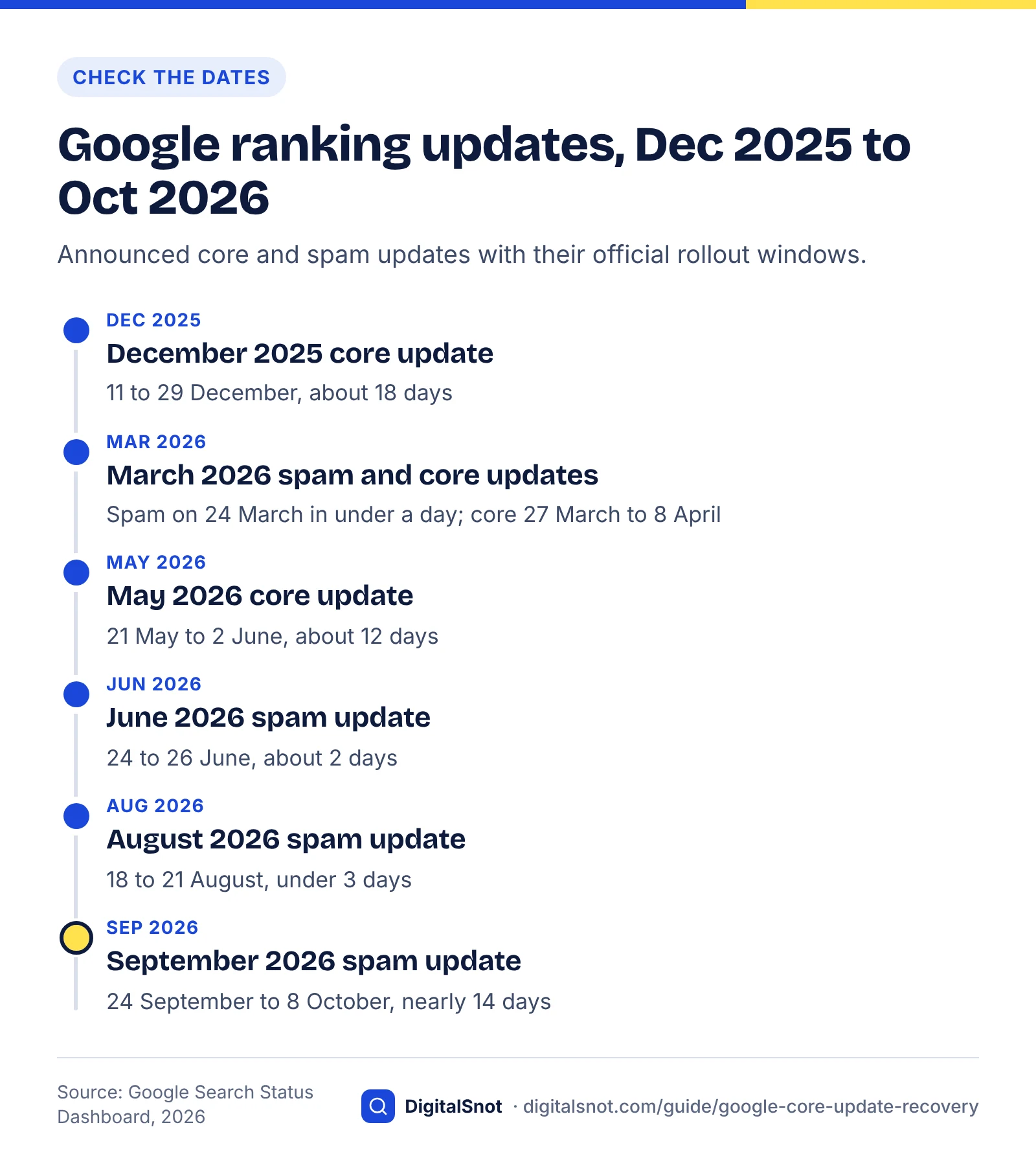
Start with the official dates. Google's Search Status Dashboard records when each announced ranking update started and finished, and it is the only source that settles whether your drop sits inside a rollout window.
The table lists every ranking incident on the dashboard from March 2025 to mid-October 2026 (checked 14 October 2026). Durations are as the dashboard reports them, rounded where it shows fractions of a day.
| Update | Type | Started | Finished | Rollout length |
|---|---|---|---|---|
| March 2025 core update | Core | 13 Mar 2025 | 27 Mar 2025 | 13 days 21 hours |
| June 2025 core update | Core | 30 Jun 2025 | 17 Jul 2025 | 16 days 18 hours |
| August 2025 spam update | Spam | 26 Aug 2025 | 22 Sep 2025 | 26 days 15 hours |
| December 2025 core update | Core | 11 Dec 2025 | 29 Dec 2025 | 18 days 2 hours |
| February 2026 Discover update | Discover | 5 Feb 2026 | Late Feb 2026 | About 22 days |
| March 2026 spam update | Spam | 24 Mar 2026 | Within a day | Under 20 hours |
| March 2026 core update | Core | 27 Mar 2026 | 8 Apr 2026 | About 12 days |
| May 2026 core update | Core | 21 May 2026 | 2 Jun 2026 | 11 days 21 hours |
| June 2026 spam update | Spam | 24 Jun 2026 | 26 Jun 2026 | About 2 days |
| August 2026 spam update | Spam | 18 Aug 2026 | 21 Aug 2026 | About 2.7 days |
| September 2026 spam update | Spam | 24 Sep 2026 | 8 Oct 2026 | 13 days 16 hours |
What the timeline tells you
- Gaps between core updates ranged from under two months to about five and a half. Counting from start dates, they were about 3.5, 5.5, 3.5 and under 2 months. As of 14 October 2026 there has been no core update since May.
- Most 2026 spam updates were short. March, June and August each took under three days. September's ran for nearly 14, so its effects could land anywhere between 24 September and 8 October.
- Two entries need special handling. The February 2026 update affected Discover, not web search. The March 2026 spam and core updates ran three days apart, so the shape of your drop has to tell them apart.
Not every ranking change gets a dashboard entry. Google's core updates documentation says it keeps updating its algorithms between the announced updates, including smaller core updates.
The overlap map: when something else looks like an update
Several 2026 update windows coincided with Search Console reporting errors or platform changes that can draw the same chart as an update hit. Check these before you conclude anything.
Method: we took every ranking incident on the Search Status Dashboard from March 2025 to 14 October 2026 and lined it up against the dated entries on Search Console's data anomalies page and the platform changes Google and Cloudflare announced in the same period. You can repeat the check by putting your own drop date next to both pages.
| When | Update nearby | Other event | What it can look like |
|---|---|---|---|
| April 2026 | March 2026 core update (27 Mar to 8 Apr) | Search Console misreported impressions from 13 May 2025 to 27 April 2026; the fix lowered reported impressions. Clicks were unaffected; CTR and position were affected. | Impressions fall and CTR "improves" while clicks hold |
| From 7 May 2026 | Before the May 2026 core update | FAQ rich results stopped appearing (a real change, not a logging error). Discover logging errors on 7–8 and 21 May. | FAQ impressions vanish and Discover dips while rankings hold |
| 24 June 2026 | June 2026 spam update | Discover logging error | A one-day Discover dip that reads like a spam hit |
| 13–21 August 2026 | August 2026 spam update | Generative AI report impressions under-logged 13–17 August (later restored); Discover logging error on 13 August | AI impressions or Discover dip just before the update |
| 30 August 2026 | After the August spam update | Site reputation abuse manual actions stop affecting results for users in the European Economic Area (EEA) | Demoted third-party sections reappear in EEA countries only |
| 15 Sep to 8 Oct 2026 | September 2026 spam update | Cloudflare's Block settings now also stop Googlebot, Applebot and Bingbot | Pages drop out because the CDN blocked Google, mid-rollout |
The April 2026 correction matters most because it distorts any comparison that spans it. The data anomalies page says clicks were not affected, so trust clicks first. If clicks held through April 2026 and only impressions fell, you are looking at a reporting fix, not a lost ranking.
The FAQ change is a similar trap: it removed a search appearance, not your position. Our schema markup guide covers which structured data still earns a visible result.
Rule out non-update causes in 20 minutes
Before you treat a drop as an update hit, spend 20 minutes on the causes that are faster to confirm and fix. Each check has a clear yes or no answer.
- Is the drop in Search Console as well as analytics? If Search Console clicks are steady, the problem is measurement: a removed tag, a consent change or a broken filter.
- Did anything ship on the drop date? A redesign, CMS update, plugin, hosting move or URL change. A drop that starts on a release date, outside any rollout window, is usually technical. Google notes that after a site move, a medium-sized site can take a few weeks to settle.
- Can Google still crawl and index the pages? Check the Page indexing and Crawl stats reports and run URL Inspection on your three biggest losers. Google points out that a misplaced noindex produces a slower drop, because traffic falls only as each page is recrawled.
- Is a firewall or CDN blocking Googlebot? Since 15 September 2026, choosing Block for a crawler category in Cloudflare also stops Googlebot, Applebot and Bingbot, search included, according to Cloudflare's announcement; its Disallow AI Training setting keeps search crawling. Our guide to blocking AI crawlers without losing search explains the difference.
- Are there security or manual action notices? Check both reports in Search Console. A notice changes the whole plan.
- Is it seasonal? Compare the same weeks last year. Google suggests using the full 16 months of Search Console data and checking Google Trends for a market-wide fall in interest.
- Is Search Console itself wrong? Check the data anomalies page for your dates.
Five causes of a traffic drop that aren't updates
Free tools that speed this up
Search Console is the source of truth for indexing, but a fresh crawl shows what changed. The free Website SEO Audit crawls up to 50 pages like a search engine, starting from your sitemap and robots.txt, and returns a health score and issue list; look for anything that appeared around the drop date. If a URL vanished, the Robots.txt Tester shows whether Googlebot may fetch it and which line decides. After a migration, the Redirect Checker lists every hop and status code across the http, https and www versions.
Fix any fault before anything else, then request indexing for key URLs. For a complete sweep, use our technical SEO audit checklist.
The diagnosis tree: match your drop to a cause
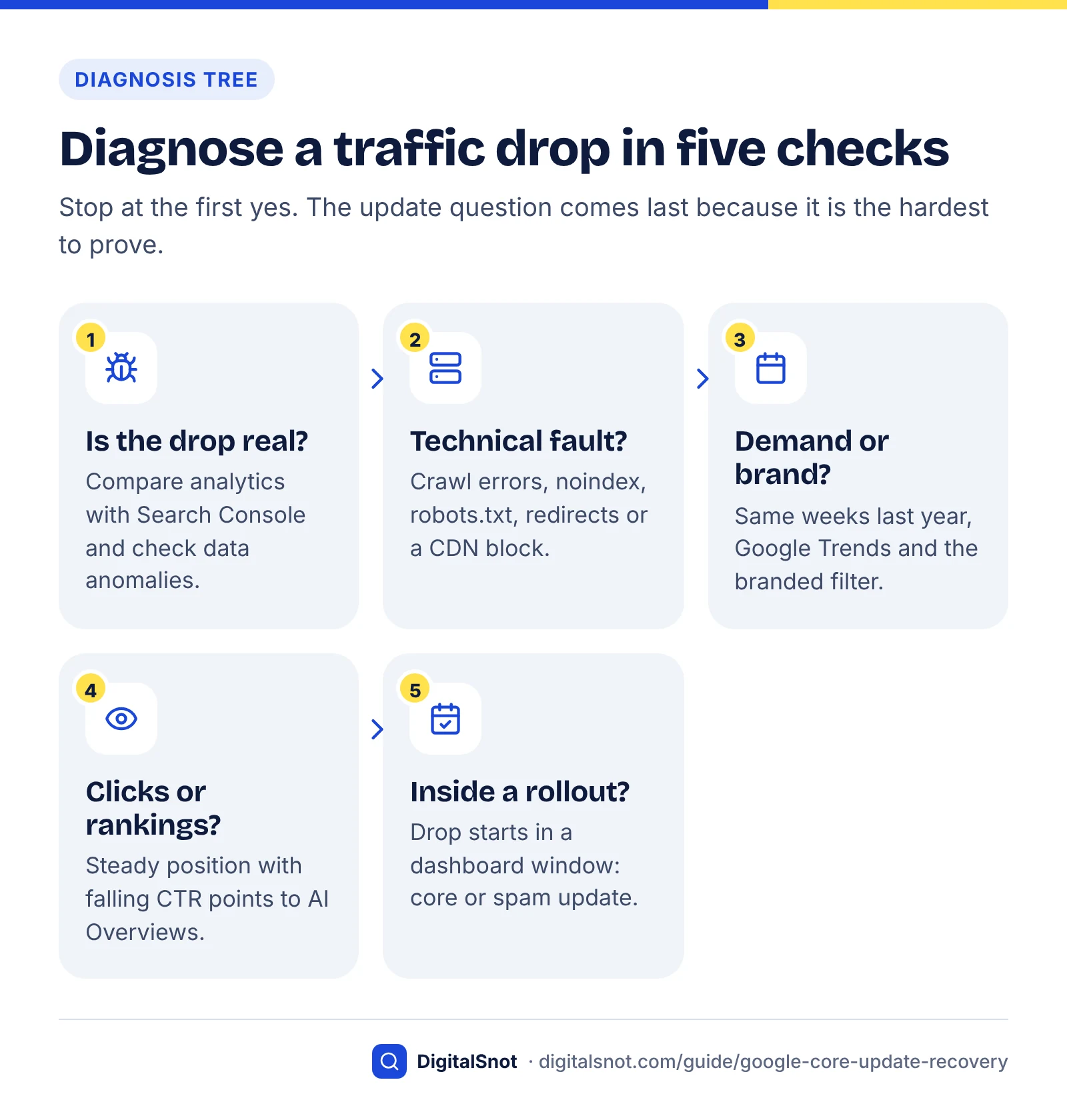
Work through these questions in order and stop at the first "yes". The early questions are quick and point to causes you can fix this week; the update question comes last because it is the hardest to prove.
Method: we built this tree from the cause categories in Google's debugging guide and core updates documentation, then added the 2026-specific checks those documents do not sequence: reporting anomalies, branded demand and AI Overviews. It is a structured way to reason, not an automatic verdict.
- Do Search Console clicks fall as well as analytics sessions? If not, it is tracking. Nothing to recover in Search.
- Does the drop match a data anomalies entry, with clicks holding while impressions fall? Reporting change: annotate the chart and compare clicks only.
- Do losing pages show indexing, crawl, robots.txt or server errors, or did the drop start on a release date? Technical fault: fix, test, request reindexing.
- Is there a manual action or security issue? Follow the spam and manual actions steps below.
- Did the same weeks last year dip similarly, or did impressions fall while position held? Demand changed. Plan around the cycle.
- Is the loss mainly in branded queries? Fewer people are searching for your name: a marketing, PR or reputation issue, not rankings.
- Did position hold while CTR fell, mainly on informational queries? Clicks are going to AI Overviews or other results-page features.
- Did the drop start inside a rollout window, with positions falling across many queries? During a core update, it is a quality or relevance reassessment. During a spam update, audit against the spam policies.
- Still no match? Check which competitors gained your lost queries, allow for smaller unannounced updates, and keep measuring weekly.
Decision table: what to do for each cause
| If you see this | It is probably | Do this | Don't do this |
|---|---|---|---|
| Search Console clicks steady, analytics down | Tracking fault | Check the tag, consent mode and filters | Rewrite content |
| Impressions down, clicks steady, dates match a data anomaly | Reporting change | Annotate and compare clicks only | Report it as a ranking loss |
| Pages missing from the index or errors in Page indexing | Technical fault | Fix, test, request indexing | Wait for the next core update |
| Manual action notice in Search Console | Spam policy breach found by a reviewer | Fix every affected page, then request reconsideration | Resubmit before a decision arrives |
| Same dip last year, position steady | Seasonality | Compare year on year and plan ahead | Change pages that already rank well |
| Branded clicks down, non-branded steady | Lower brand demand | Review PR, reviews and campaigns | Blame an algorithm |
| Position steady, CTR down on informational queries | AI Overviews or other results-page features | Improve snippets, favour queries that still send clicks, track AI visibility | Expect a ranking fix to bring clicks back |
| Positions fall across many queries inside a core update window | Core update reassessment | Wait a week after it ends, compare, then improve the losing pages for people | Make quick fixes during the rollout |
| Sharp fall on certain pages or sections inside a spam update window | Spam update | Audit against the spam policies and remove violations | Delete or disavow at random |
Core update or spam update? How the patterns differ
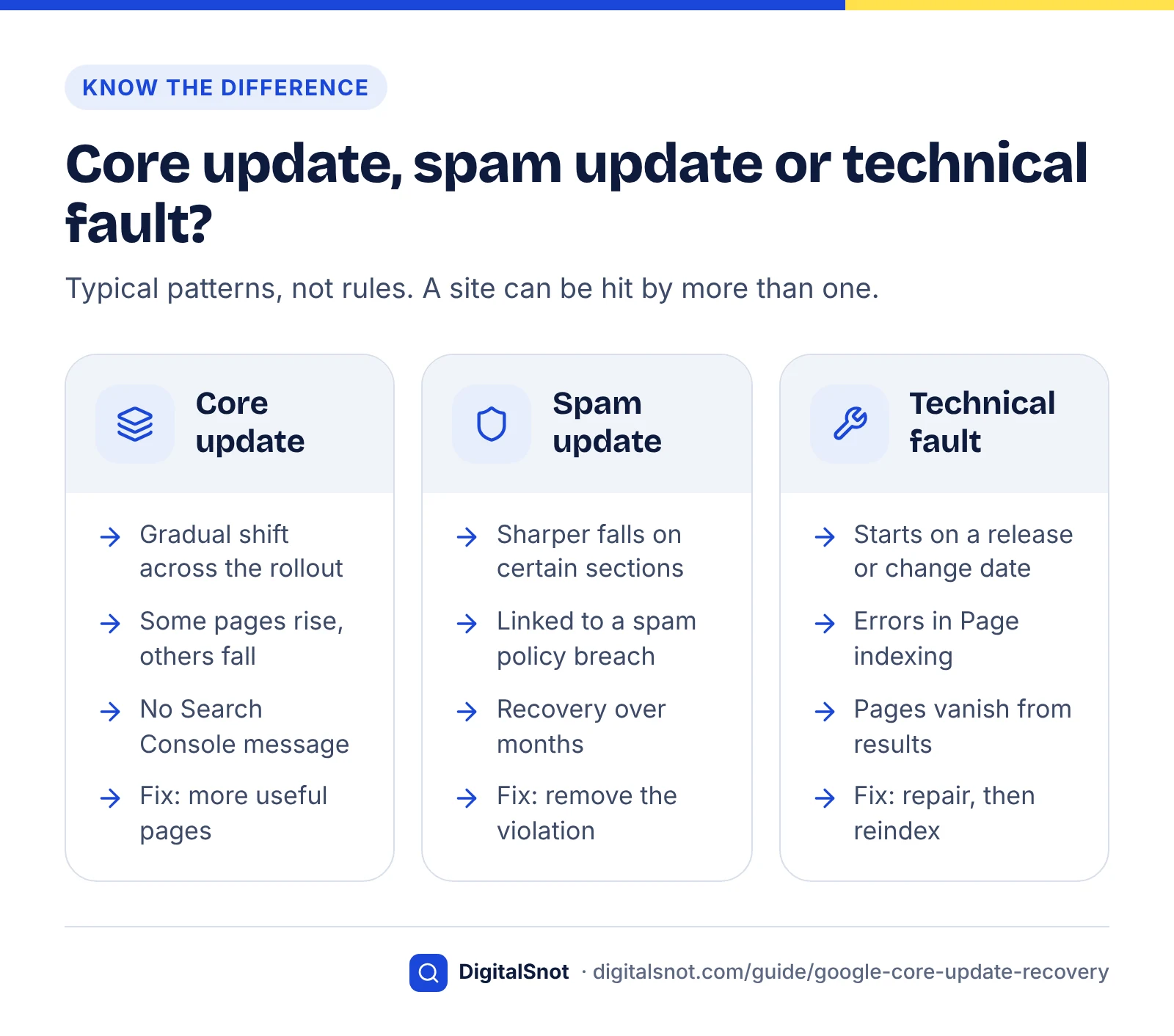
A core update reassesses how helpful and relevant your pages are compared with everything else on the web. A spam update targets practices that break Google's spam policies. The fix for one does nothing for the other, so tell them apart before you act.
Google draws the line itself. Its Q&A on Search updates explains that a change after a non-spam update does not mean you have a spam problem, while a change after a spam update may mean its systems found spam or stopped counting spammy links that had been helping. For core updates, the documentation sizes the response to the drop. For a small fall, such as position 2 to 4: "There's no need to take drastic action." A large fall, such as position 4 to 29, calls for a deeper assessment of your content.
| Signal | Core update | Spam update |
|---|---|---|
| Typical shape | Gradual shifts across the rollout; some pages rise, others fall | Sharper falls concentrated on the pages or sections involved |
| Search Console message | None | None for algorithmic demotion; manual actions are reported separately |
| Who is affected | Any site, including ones that broke no rules | Sites using the practice, or benefiting from links now ignored |
| What helps | More useful pages, judged across the site | Removing the violation, then waiting for re-evaluation |
| Google's stated timing | A few days to several months; may wait for the next core update | "Over a period of months"; lost link value may not return |
These are typical patterns, not rules, and a site can be hit by both. When updates overlap, as in March 2026, read the shape: a cliff on 24–25 March fits the spam update, while a slide building from 27 March fits the core update.
Measure the drop with Google's one-week comparison
Google's core updates documentation recommends waiting at least a full week after an update finishes, then comparing that week with the week before the rollout began. Measuring mid-rollout mixes before and after, and rankings can keep moving until the update completes.
In Google's words, "try comparing this week with a week before the core update started rolling out". In Search Console:
- Get the dates from the dashboard. For the May 2026 core update: 21 May to 2 June.
- Wait a full week after the finish. For May 2026, the earliest clean "after" week was 9–15 June. For the September 2026 spam update, which finished on 8 October, it is 15–21 October 2026.
- Pick the "before" week: the seven days before the start, so 14–20 May or 17–23 September.
- Compare. In the Performance report, choose Date, then Compare, and enter both ranges. Start with Web, then check Image, Video and News separately, as Google suggests.
- Read clicks first, then position. Clicks show the business impact, position shows whether rankings moved, and impressions and CTR explain the gap.
- Size the drop for the whole site, then for your top 20 pages and top 50 queries.
- Export both weeks. Search Console keeps only 16 months of data.
Google's one-week rule after a core update
Worked example (hypothetical)
Example: a physiotherapy clinic in Leeds compares 9–15 June 2026 with 14–20 May 2026. Total clicks fell from 1,240 to 890, a 28% drop, or 350 clicks a week.
- Its sciatica exercises guide fell from position 3.1 to 7.8, and its clicks from 520 to 260: 260 of the 350 lost clicks, or 74%.
- Its sports massage page held position (2.4 to 2.5) and impressions (4,000 to 4,100), but CTR fell from 6.0% to 4.1%, so clicks fell from 240 to about 170.
- Everything else, including branded searches, moved from 480 to 460.
The diagnosis: most of the loss is one page whose ranking fell during the core update, so content work starts there. The service page lost clicks without losing position, which points to a results-page change instead. And a fall from third to eighth behaves more like Google's "large drop" example than its small one, because clicks concentrate at the top.
Find the losing pages and queries, branded vs non-branded
Site-wide totals hide the story. Recovery work starts with a list of the pages and queries that lost clicks, sorted by size of loss, each labelled with the pattern it shows.
Separate branded from non-branded first
Search Console's branded queries filter, which Google introduced in November 2025, splits Performance data into branded and non-branded queries. Google says an internal, AI-assisted system does the split rather than a keyword list, so it catches misspellings, though some queries may be misclassified. It works only for top-level properties with enough queries and impressions, not URL-path or subdomain properties. Without it, a regex query filter on your brand name and misspellings is the fallback.
Branded searches usually still find your own site first, so a core update rarely explains a branded drop. If branded clicks fell and non-branded held, fewer people are searching for you; if non-branded fell and branded held, an update or AI Overviews is the likelier cause.
The loss-pattern worksheet
Export the Pages and Queries tabs for both weeks and add one row per page that lost meaningful clicks: clicks, position and CTR before and after, then a pattern label and an action. Method: the five patterns come from how the four Search Console metrics move together; we defined them for this guide so each label points to one next step.
| Pattern | Signature in Search Console | Most likely cause | First action |
|---|---|---|---|
| A. Rank slide | Position worse by several places; impressions and clicks down | Core update reassessment or a stronger competing page | Compare your page with the pages now above it and improve it for the searcher |
| B. Click squeeze | Position steady; impressions steady or up; CTR down | AI Overviews or other results-page features | Search the query yourself; improve title and snippet; track AI visibility |
| C. Vanished | Impressions close to zero | Indexing fault, noindex, crawler block, manual action or spam demotion | URL Inspection, Manual actions report, robots.txt test |
| D. Demand dip | Impressions down; position and CTR steady | Seasonality or falling interest | Compare year on year and with Google Trends |
| E. Brand dip | Losses concentrated in branded queries | Lower brand demand or reputation problems | Review PR, reviews and campaigns, not page content |
In the clinic example, the sciatica guide is pattern A and the sports massage page is pattern B. Once rows are labelled, the plan mostly writes itself: pattern C pages go to whoever fixes technical issues today, pattern A pages join the content queue in order of clicks lost, and pattern B pages get snippet and AI-visibility work.
When AI Overviews took the clicks, not your rankings
If your positions held but clicks fell, the most likely cause in 2025–2026 is that the results page now answers the question before anyone reaches your link. That is not a penalty, and no core update fix will reverse it.
The research points the same way. In Pew Research Center's 2025 study of 900 US adults' browsing in March 2025, users clicked a traditional result on 8% of visits when an AI summary appeared, against 15% when one did not. Ahrefs' updated analysis of December 2025 data found an AI Overview correlated with a 58% lower average click-through rate for the top-ranking page on informational keywords, up from 34.5% in its first study. Both are correlations from specific samples, not forecasts for your site.
How to confirm it on your site
- Search your pattern B queries yourself, logged out, in the country you target, and note which show an AI Overview.
- Remember that Search Console counts AI Overviews and AI Mode traffic inside the Web search type, as Google's AI features documentation explains, not as a separate line.
- Open the Generative AI performance report, available to all websites since 31 August 2026. It shows how often links to your site appeared in AI Overviews and AI Mode, by page, country, device and date. It counts impressions, not clicks (checked October 2026).
- If a page's AI impressions rose while its web clicks fell, your content is shown inside the answer, but fewer people need to click.
Our guide to the Search Console AI performance report walks through the report, and our post on AI Overviews and your traffic covers the wider click trend.
What you can do about it
- Keep the page worth citing. Being quoted in the answer still earns visibility, even without the click.
- Write titles and descriptions for the click that remains. People who click past an AI Overview tend to want depth, a tool, a price or a provider; say plainly that the page has it.
- Shift effort to queries that still send clicks: commercial, local and comparison searches.
- If you used to appear in AI answers and stopped, the free AI Citation Loss Analyzer works through the usual causes. Treat its output as a checklist to verify, not a verdict.
What to improve after a core update: a page-level checklist
If the diagnosis points to a core update, improve the pages that lost for the people searching, not for the algorithm. Google's core updates documentation directs site owners to an honest self-assessment of whether the site delivers helpful, reliable, people-first content, ideally with input from people who are not connected to the site.
The questions come from Google's guidance on creating helpful, reliable, people-first content. One sums up the standard: "Does the content provide original information, reporting, research, or analysis?" The same page asks who made the content, how and why, and treats "why" as the most important: content should exist mainly to help people, not to attract search visits.
Answer-ready page checklist
| Check | How to test it | If it fails |
|---|---|---|
| Does it answer the query better than the pages that now outrank it? | Read the top three results for the lost query beside yours | Add what they cover and you don't; cut what doesn't serve the searcher |
| Does the format match what the searcher wants? | Are the winners guides, product pages, local results or tools? | Change the format, or aim the page at a query it does fit |
| Is there something only you could have written? | Look for first-hand detail, original data, worked examples, photos of real work | Add your own process, numbers and examples; cite primary sources |
| Is it accurate and current? | Check facts, prices, dates and any years mentioned | Update the substance, not just the date |
| Is it clear who wrote it and why they know? | Byline, author page, qualifications, contact details | Add a real byline and a proper about page |
| Is the rest of the site pulling it down? | Thin, duplicated or outdated pages in the same section | Improve, merge with a redirect, or retire pages nobody needs |
Tools that help with the checklist
The free AI Content Freshness Checker reads every freshness signal on a page, including visible dates, structured data dates, stale year references and sitemap lastmod, so you catch a title that still says "2024" or dates that contradict each other. Use it to find what needs a genuine update, never to bump dates. For format mismatches, our post on service pages versus blog posts explains how to tell which kind of page a query wants.
What not to do
- Don't change pages mid-rollout, or rewrite pages that still perform well. Google recommends against changing content that is already performing well.
- Don't chase quick fixes like stripping sections or padding word counts because of a rumour. Google favours changes that serve users over the long term.
- Don't mass-produce replacement pages with AI. Google's spam policies treat many pages made mainly to manipulate rankings as scaled content abuse, whether automation, people or both made them.
- Don't buy links. Link schemes break the same policies, and value removed by a link spam update does not come back.
If you want a second pair of eyes on the content work, that is the focus of our content SEO service.
Recovering from spam policy problems and manual actions
Spam problems come in two forms: algorithmic demotion by Google's spam systems, which produces no Search Console message, and manual actions, which a human reviewer applies and Search Console reports. Both are fixed by removing the violation, but only a manual action has a request process.
If a spam update hit you
- Check your site honestly against each spam policy. For small businesses, read scaled content abuse, expired domain abuse, site reputation abuse (third-party pages published to exploit a host site's ranking signals) and link spam closely.
- Fix every instance, not just the worst pages.
- Wait. Google's spam updates documentation says changes may help if its automated systems learn "over a period of months" that the site complies. After a link spam update, changes might not help, because the benefit those links gave is gone.
If you have a manual action
- Note the policy and the pages or sections the Manual actions report names.
- Fix the issue on every affected page.
- Submit a reconsideration request explaining what was wrong, what you changed and the evidence.
- Wait. Google's Manual actions report help page says most reviews take several days or weeks, link-related requests can take longer, and you should not resubmit while a request is pending.
The August 2026 change for site reputation abuse in the EEA
On 28 August 2026, Google announced a change to how it enforces its site reputation policy in the European Economic Area, following discussions with the European Commission. From 30 August 2026, a site reputation abuse manual action no longer affects search results for users in the EEA. Instead, Google may separate the affected section in its systems so it ranks on its own over time. Outside the EEA, the action still applies to the affected part of the site.
Two practical points follow. The UK and India are not in the EEA, so an action still demotes the affected section for searchers there. And site owners are still notified in Search Console, can still request reconsideration, and if eligible can then take a dispute to mediation. If a demoted coupon or partner section reappeared in Germany after 30 August but stayed down in the UK, this is why.
How long recovery takes and what to tell stakeholders
Recovery time depends on the cause. Technical fixes can show within days, while core update recovery usually takes months and is not guaranteed. Google's core updates documentation says some changes take effect in a few days while others take several months, and that if you have seen no effect after a few months, that "could mean waiting until the next core update."
| Cause | When to expect movement | Basis |
|---|---|---|
| Tracking or reporting issue | Immediately; nothing was lost in Search | Your own data and the data anomalies page |
| Technical fault | After the fix and recrawl; site moves can take a few weeks | Google's debugging guide |
| Seasonality | When demand returns | Year-on-year data |
| AI Overviews click loss | Possibly never in full; adapt the strategy | Pew (2025), Ahrefs (December 2025 data) |
| Core update | A few days to several months; often at the next core update | Google's core updates documentation |
| Spam update (algorithmic) | "Over a period of months" after you comply | Google's spam updates documentation |
| Manual action | After a successful review (several days or weeks), then recrawling | Search Console Help |
Because Google also ships smaller core updates between the announced ones, improvements can show earlier. Going by the 2025–2026 gaps, the next announced core update could be weeks or months away; nobody outside Google knows.
What to tell your boss or client
Stakeholders need a short, honest note, not a promise. Five parts cover it:
- What happened: "Clicks from Google fell 28% between 14–20 May and 9–15 June 2026."
- The likely cause and the evidence: "The fall began during the May 2026 core update. Tracking, indexing and seasonality are ruled out, and 74% of the loss is one guide that slipped from position 3 to 8."
- What we are doing: "Improving the three pages that lost most, in order, and rewriting the snippet on the service page."
- What we are not doing: "No site-wide rewrites, no deleting pages on a hunch, no link buying."
- When we will know: "We will compare monthly. Google says recovery can take several months and may only show at the next core update, so we won't judge the work on a single week."
For how this fits into regular reporting, see what to look for in a monthly SEO report, and for realistic timescales in general, read how long SEO takes.
Most traffic drops have a cause you can find in an afternoon, and many have nothing to do with a core update. When an update really is the cause, the work is slower and less certain: improve the pages that lost, keep measuring, and give it until at least the next core update. Our technical SEO service covers the crawl and indexing side, and you can talk to us about your drop.
Free tools in this guide
- Website SEO Audit Crawl up to 50 pages and get a health score, every issue and a 30-day plan.
- Robots.txt Tester Test a URL against robots.txt and see which rule blocks or allows it.
- Redirect Checker Trace 301/302 redirects, chains and loops to the final URL.
- AI Citation Loss Analyzer Find the likely reason AI answers stopped citing a page.
- AI Content Freshness Checker Check dates, old years and outdated statistics, with fresh blocks to add.
By the numbers
- end of the September 2026 spam update, which started on 24 September and ran about 13 days 16 hours
- 8 Oct 2026
- Source: Google Search Status Dashboard
- start of a Search Console logging error that misreported impressions, CTR and position until 27 April 2026; clicks were unaffected
- 13 May 2025
- Source: Search Console Help
- lower average click-through rate for the top-ranking page when an AI Overview appears (Ahrefs, December 2025 data)
- 58%
- Source: Ahrefs
- of Google visits ended in a result click with an AI summary vs without one (Pew, March 2025 browsing data)
- 8% vs 15%
- Source: Pew Research Center
Frequently asked questions
How long does it take to recover from a Google core update?
There is no fixed time, and recovery is not guaranteed. Google says some changes take effect within a few days, while it can take several months for its systems to confirm a site has improved. If nothing has changed after a few months, Google says that could mean waiting until the next core update. In 2025 and 2026, announced core updates arrived between about two and six months apart.
Should I change my site while a core update is rolling out?
No. Wait until the rollout finishes, which the Search Status Dashboard confirms, then wait at least a full week before analysing Search Console data. Rankings can keep moving until the update completes, so changes made mid-rollout are based on incomplete data. Google also recommends avoiding changes to content that is already performing well, and says small drops, such as position 2 to 4, need no drastic action.
How do I know if a core update caused my traffic drop?
Check three things. First, the drop should start inside a rollout window on Google's Search Status Dashboard. Second, you should have ruled out tracking faults, technical errors, crawler blocks, seasonality and Search Console reporting errors. Third, average position should have fallen across many queries, not just clicks. If position held while clicks fell, AI Overviews or other results-page features are the more likely cause.
What is the difference between a core update and a spam update?
A core update reassesses how helpful and relevant content is across the web, so sites can drop without breaking any rules. A spam update targets practices that break Google's spam policies, such as scaled content abuse or link spam. Core update losses call for better content. Spam update losses call for removing the violation, after which Google says systems learn over a period of months that the site complies.
Can I recover before the next core update?
Sometimes. Google says it makes smaller core updates between the announced ones, so improvements can show earlier. But it also says that if you see no effect after a few months, that could mean waiting until the next core update. Plan for months, measure monthly, and avoid judging the work on a single week of data.
When can I measure the impact of the September 2026 spam update?
From 15 October 2026. The update ran from 24 September to 8 October 2026, according to Google's Search Status Dashboard. Following Google's one-week rule, compare 15 to 21 October with 17 to 23 September, the week before the rollout began. Also check whether a CDN or firewall rule changed in September, because Cloudflare's Block settings started stopping Googlebot from 15 September 2026.
Why did my Search Console impressions drop in April 2026 when clicks did not?
Most likely because Google corrected a logging error. Search Console's data anomalies page says impressions were not reported accurately from 13 May 2025 to 27 April 2026, and the fix lowered reported impressions. Only impressions, CTR and average position were affected; clicks were not. If clicks held steady, the April fall is a reporting change rather than a ranking loss from the March 2026 core update.
Do AI Overviews cause traffic drops that look like core update losses?
Yes. When an AI Overview answers a query, fewer people click, even if your ranking is unchanged. Pew found users clicked a result on 8% of visits with an AI summary against 15% without one in March 2025 data. Ahrefs found a 58% lower click-through rate for the top result when an AI Overview appeared, in December 2025 data. Steady position with falling CTR is the signature.
Should I delete pages that lost traffic after a core update?
Not by default. A page that lost rankings may need improving, not removing, and deleting pages on the strength of a rumour is the kind of quick fix Google advises against. Retire or merge a page only when it is genuinely thin, duplicated or out of date and nobody needs it, and redirect it to the best related page when one exists.
Will I get a message in Search Console if a spam update demoted my site?
No. Algorithmic demotions from spam updates do not produce a Search Console message. Only manual actions, applied by a human reviewer, appear in the Manual actions report. A manual action can be appealed with a reconsideration request once you have fixed the problem; Google says most reviews take several days or weeks, and link-related requests can take longer.
Sources
Every figure and claim in this guide comes from the sources below. We checked each one when writing and link to the original so you can read it yourself. Credit belongs to the authors and publishers listed. How we write and check our articles.
-
1
Debugging drops in Google Search traffic
Google Search Central · Causes of traffic drops, noindex slow drops, 16 months of data, Google Trends, site moves.
-
2
History (Google Search Status Dashboard)
Google Search Status Dashboard · Start dates and rollout lengths of every 2025–2026 core, spam and Discover update.
-
3
Google Search's core updates and your website
Google Search Central · One-week wait and comparison, small vs large drops, self-assessment, recovery timing.
-
4
Data anomalies in Search Console
Search Console Help · Impressions logging error May 2025 to April 2026, 2026 Discover and AI report errors, FAQ change.
-
5
Have it both ways: stay discoverable in search while disallowing AI training
Cloudflare Blog · From 15 Sep 2026, Block settings also stop Googlebot, Applebot and Bingbot.
-
6
A Q&A on Google Search updates
Google Search Central Blog · Changes after non-spam updates are not spam issues; what a spam update change can mean.
-
7
Introducing the branded queries filter in Search Console
Google Search Central Blog · How the branded filter classifies queries, eligibility and misclassification caveat.
-
8
Google users are less likely to click on links when an AI summary appears in the results
Pew Research Center · 2025 study: result clicks on 8% of visits with an AI summary vs 15% without.
-
9
Update: AI Overviews Reduce Clicks by 58%
Ahrefs · 58% lower top-result CTR with an AI Overview (December 2025 data), up from 34.5%.
-
10
AI features and your website
Google Search Central · AI Overviews and AI Mode traffic is reported within the Web search type.
-
11
Generative AI performance report (Search)
Search Console Help · Available to all sites from 31 Aug 2026; AI impressions by page, country, device, date.
-
12
Creating helpful, reliable, people-first content
Google Search Central · Self-assessment questions and the Who, How and Why framework.
-
13
Spam policies for Google web search
Google Search Central · Scaled content abuse, expired domain abuse, site reputation abuse and link spam.
-
14
Google Search spam updates
Google Search Central · Recovery over a period of months; link spam updates may not allow improvement.
-
15
Manual actions report
Search Console Help · Reconsideration reviews take several days or weeks; do not resubmit while pending.
-
16
Update to the Site Reputation Policy
Google Search Central Blog · 28 Aug 2026: site reputation manual actions no longer affect EEA results from 30 Aug.