Guide · Keyword research and content
E-E-A-T (EEAT) for small businesses: how to show experience and trust
Told to "improve E-E-A-T" after a ranking drop? What Google actually says, plus a page-by-page audit to prove real experience, expertise and trust on a small business site.

On this page (11 sections)
- 1What E-E-A-T is, and what it is not
- 2Who, how and why: Google's self-assessment questions
- 3Trust first: the pages every business needs
- 4Show first-hand experience honestly
- 5Author and business profiles that prove expertise
- 6Reviews, accreditations and third-party proof
- 7YMYL businesses: extra care for health, money and legal topics
- 8A page-by-page trust audit for small business sites
- 9What to fix first: a decision table
- 10E-E-A-T myths and mistakes to avoid
- 11Sources
If your rankings dropped and someone told you to "improve your E-E-A-T", you were probably left wondering what to change. E-E-A-T, often written EEAT, stands for experience, expertise, authoritativeness and trust. It is a set of ideas from Google's quality rater guidelines that describes what reliable content looks like. It is not a score you can raise, and it is not a setting in Search Console.
Google is explicit about this. Its guidance on creating helpful, reliable, people-first content says: "While E-E-A-T itself isn't a specific ranking factor, using a mix of factors that can identify content with good E-E-A-T is useful." So the job is not to add signals for an algorithm. It is to make your site prove, to a sceptical visitor, that a real, competent and accountable business stands behind it.
Who this is for: small-business owners and in-house marketers, especially service businesses such as clinics, trades, accountants, solicitors and agencies. What you will be able to do: explain what Google does and does not claim about E-E-A-T, audit your site page by page, decide what to fix first, and show real experience without inventing case studies. If you have not yet confirmed what caused your drop, start with our guide to diagnosing a core update drop. E-E-A-T work will not repair a technical fault or a tracking error.
What E-E-A-T is, and what it is not
E-E-A-T is Google's shorthand for the qualities its human quality raters look for when they judge whether a page can be relied on. It describes what Google's ranking systems are trying to reward. It is not a ranking factor, a metric or a checklist that Google scores.
The framework comes from Google's Search Quality Rater Guidelines, the manual for the people Google uses to evaluate its search results. The latest edition we could confirm is dated 11 September 2025 (checked October 2026). It frames each part of E-E-A-T as something a rater considers:
- Experience is first-hand or life experience of the topic. Raters are asked to "Consider the extent to which the content creator has the necessary first-hand or life experience for the topic."
- Expertise is the knowledge or skill the topic needs, such as a qualified electrician explaining wiring or an accountant explaining a tax deadline.
- Authoritativeness is reputation as a source. Raters consider whether "the content creator or the website is known as a go-to source for the topic".
- Trust sits at the centre of the other three. Raters "Consider the extent to which the page is accurate, honest, safe, and reliable."
Experience is the newest part. Google added it in December 2022 (E-A-T gets an extra E for Experience), giving actual use of a product as an example. For a small business this is the most useful part: you have experience of your own customers, jobs and local conditions that no content farm can copy.
What Google says E-E-A-T is not
Three statements from Google clear up most of the confusion. First, it is not a ranking factor: Google's SEO Starter Guide lists the idea that E-E-A-T is a ranking factor among the things not to focus on, and answers "No, it's not." Second, raters do not set rankings: Google's overview of its rater guidelines says raters' ratings don't directly affect how a page appears in Search. Third, there is no single system to satisfy: when Google folded its helpful content system into core ranking in the March 2024 core update, it said "there's no longer one signal or system used to do this".
| What you may hear | What Google's documentation says | What it means for you |
|---|---|---|
| "Google gives every site an E-E-A-T score" | E-E-A-T itself isn't a specific ranking factor; systems use a mix of factors | Ignore tools that promise to raise an E-E-A-T score |
| "Quality raters marked your site down" | Ratings don't directly influence ranking; they help Google test its systems | A drop is algorithmic, so look at your pages, not at raters |
| "Add an author bio and you will rank" | Google encourages accurate bylines where readers expect them | Bios help readers judge you; they are not a ranking switch |
| "Every page must show all four" | Trust matters most; content doesn't have to show every quality | Lead with what is true for you: a trade shows experience, a solicitor expertise |
| "E-E-A-T is only for big publishers" | The rater guidelines say thin reputation information on small sites is not a sign of low quality | Small sites are judged on what their pages show, so show it |
| "It matters equally on every topic" | Google gives even more weight to it on health, money and safety topics | YMYL businesses need the most proof |
The helpful content guidance sums up the priority: "Of these aspects, trust is most important. The others contribute to trust, but content doesn't necessarily have to demonstrate all of them." Everything that follows in this guide is a way of making trust visible.
Who, how and why: Google's self-assessment questions
Google's helpful content guidance gives three questions to test any page: who created it, how it was created and why it exists. Answer them visibly on the page and you cover most of what E-E-A-T asks of a small business.
Who created the content
Google's "Who" questions are: "Is it self-evident to your visitors who authored your content?", "Do pages carry a byline, where one might be expected?" and "Do bylines lead to further information about the author or authors involved, giving background about them and the areas they write about?" The guidance adds: "We strongly encourage adding accurate authorship information".
On a business site, "who" applies to more than blog posts. Someone booking a service wants to know who will turn up, who will treat them or who will handle their money. Name the owner, name the people who do the work, and link each name to a short profile.
How the content was created
The "How" section uses product reviews as its example. Readers trust a review more when they understand how many products were tested, what the results were and how the tests were run, "all accompanied by evidence of the work involved, such as photographs". The same section asks whether the use of automation or AI is self-evident to visitors, through disclosures or in other ways.
For a service business, "how" means your process. Explain how you assess, quote, carry out and check a job, and show the evidence: photos of your own work, the equipment you use and the standards you follow.
Why the content was created
Google calls "Why" "perhaps the most important question to answer about your content". The right answer is that the page exists mainly to help people, not mainly to attract search visits. A simple test: would a customer who came to your site directly find this page useful? Pages written only to target a keyword, such as near-identical pages for every suburb you serve, fail that test.
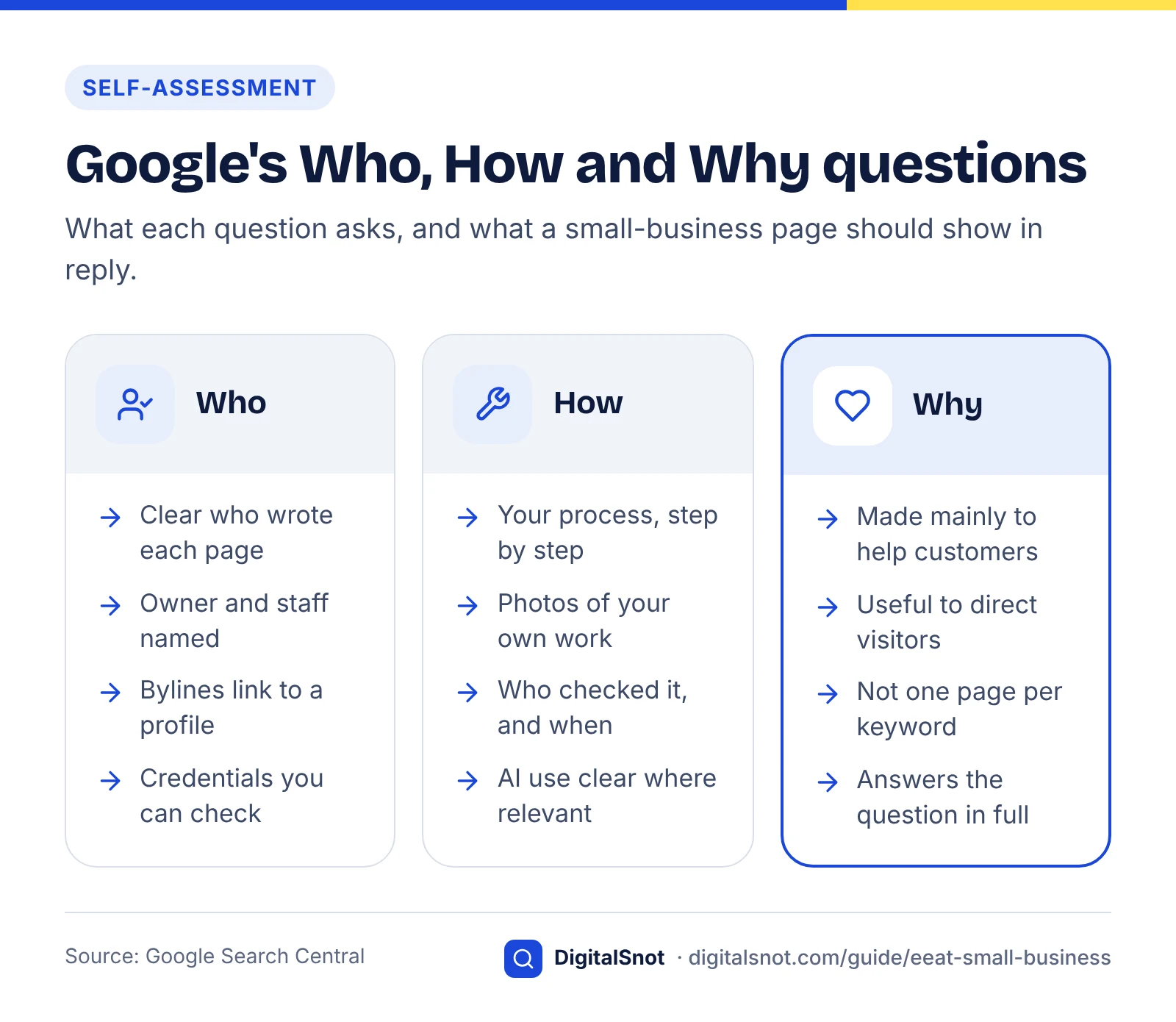
The audit later in this guide turns each of these questions into a specific element on a specific page, so you can check them one by one.
Trust first: the pages every business needs
Start with trust, because Google ranks it above the other three qualities and because missing basics can sink an otherwise good site. Every small-business site needs a clear about page, complete contact details and policies a customer can find in one click.
The rater guidelines are blunt about the worst case. They list a complete lack of information about who is responsible for a website and its content, on YMYL pages or other pages that need trust, as a reason for the Lowest rating. Sites that take payments or collect personal data are expected to give extensive contact information, and for online shops raters look for payment, exchange and returns policies, often found under "customer service".
The same document has good news for small firms: many small, local businesses have little or no reputation information online, and raters are told not to treat that as a sign of low quality. When reputation information is thin, they rely more on what the website itself shows. In other words, a small business is judged largely on what its own pages show, so leave nothing out.
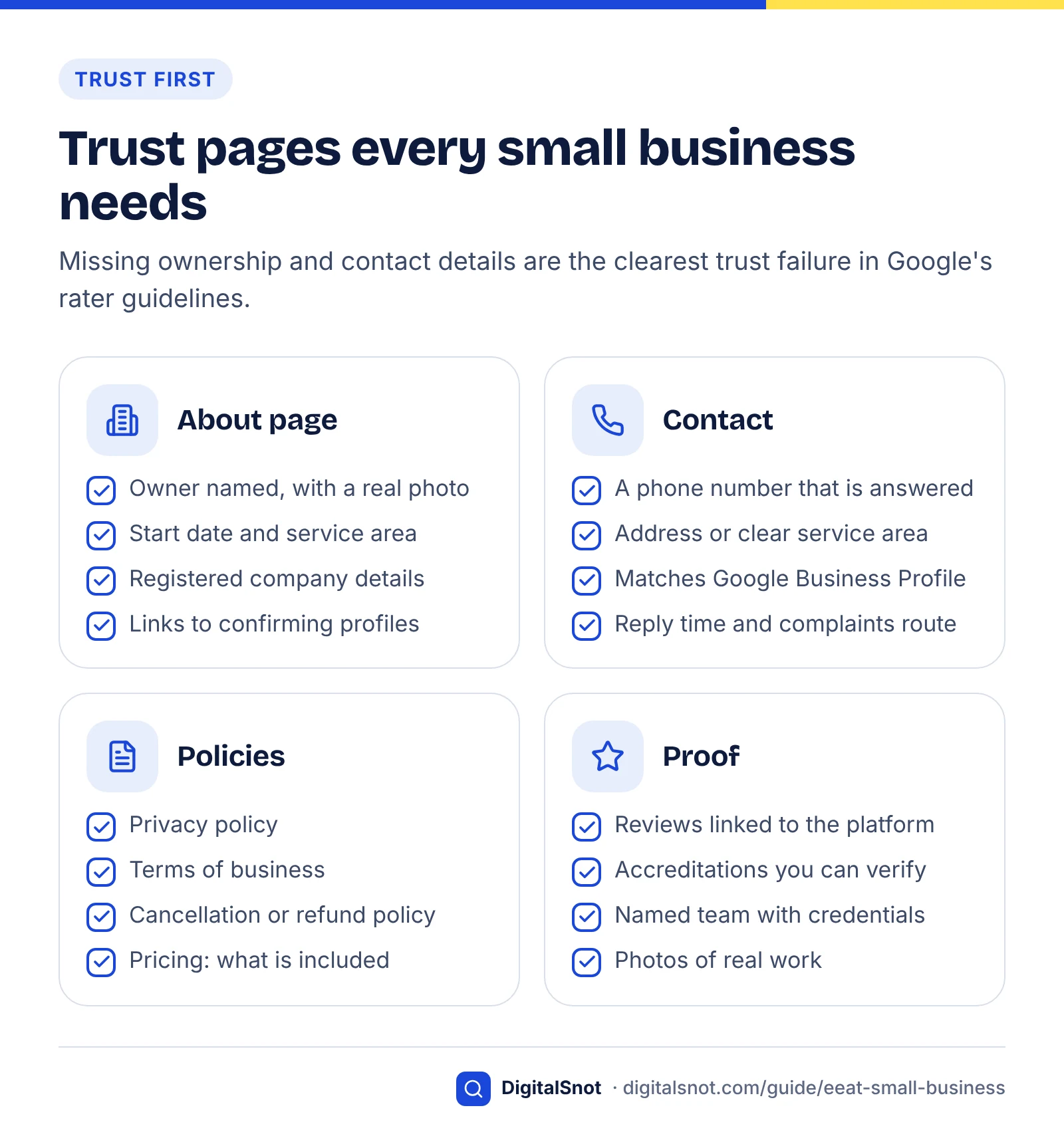
About, contact and policies
- About page: name the owner or partners with a real photo, say when the business started and where it works, and give registered details such as company number, VAT or GST number and professional registration.
- Contact page: give a phone number that is answered, an email address, and a street address or clear service area. Say how quickly you reply and how complaints are handled.
- Policies: publish a privacy policy, terms of business and your cancellation, refund or returns policy. Date them and link them from the footer. If you quote prices, explain what is included.
Your name, address and phone number should match your Google Business Profile and directory listings exactly. Conflicting details are a trust problem for people and for AI assistants alike. The free AI Answer Consistency Checker compares your pages and listings and flags mismatched phone numbers, addresses and figures; fix each conflict at the source. The page-level basics, such as titles, headings and internal links, are in our on-page SEO checklist.
Show first-hand experience honestly
Experience is the part of E-E-A-T a small business can win most easily, because you do the work every day. Show it with evidence a visitor can see, such as your own photos, your own process and your own numbers, and never with invented stories.
Google's May 2026 guide to optimising for generative AI features makes the same case for AI Overviews and AI Mode. It contrasts commodity content, built on common knowledge, with non-commodity content that "provides unique expert or experienced takes that go beyond common knowledge". Its example contrasts a first-hand review, which offers a perspective based on personal experience, with a summary that only restates information available elsewhere.
In our reading, that advice suits small businesses well: build content on what you know first-hand from your own work, not on summaries of what others have already written.
Service proof without invented case studies
Many small businesses cannot publish case studies because of confidentiality, or have never collected them. You can still prove experience honestly:
- Your process in detail. The steps, checks and timings, and why you do them in that order. Competitors rarely write this down.
- Photos you took. Real jobs, premises, equipment and team, with permission where customers or their property can be identified. Stock photos presented as your own work are a quiet form of deception.
- Numbers from your own records. A line such as "we serviced 140 boilers last winter" is only worth writing if your job log shows it.
- Problems you see often. The questions customers ask and the local conditions, such as old housing stock, hard water or monsoon damp, that change the job.
- Clearly labelled examples. A worked example marked "Example" or "typical job" is honest. A made-up customer story presented as real is not.
Put this evidence on service pages first, because that is where people decide whether to contact you. Our post on service pages versus blog posts sets out which content belongs where. To check whether a service page covers the specifics an expert would mention, run it and a strong competitor's page through the free Entity Coverage Checker, which lists the named things each page covers, such as materials, standards and places. Treat gaps as prompts to add your own knowledge, not as words to paste in.
Author and business profiles that prove expertise
Expertise is proved by naming the people behind your content and services and linking each name to a profile with credentials a visitor can check. A short, accurate profile beats a long list of adjectives.
An author box template
Use this structure under articles and on team pages. Every line should be something a visitor could verify.
- Name and role: "[Full name], [job title] at [business]".
- Relevant experience: "[Number] years [doing the specific work], mainly [types of job or customer]". Use only years you can show.
- Qualifications and registrations: "[Qualification], [awarding body]; registered with [regulator], number [registration number]", linked to the public register where one exists.
- What they write about: "Writes about [topics], based on [their day-to-day work]".
- Links: a professional profile, the register entry, and an author page on your site that lists their articles.
- Review line for advice content: "Reviewed by [name, qualification] on [date]".
Example (hypothetical): "Priya, senior physiotherapist at a two-clinician practice in Pune. Eleven years treating sports and back injuries. Bachelor's and master's degrees in physiotherapy; registration number linked to the state council's register. Writes about recovery after common injuries, based on the cases she treats each week."
What not to put in a profile
Fabricating creator profiles, for example with AI-generated headshots, made-up names or false credentials, to make content look expert-written is deception, and Google's rater guidelines treat deceptive pages as untrustworthy. Do not invent a "medical reviewer", round up years of experience, or give the byline to an AI tool or a generic "Admin" account. If you draft with AI help, the named author should check every fact, add the first-hand detail only they know, and take responsibility for the page.
Mark up authors and the business
Structured data helps search engines connect names to people and businesses; it does not create expertise. Google's Article structured data documentation asks you to include every author shown on the page, put only the person's name in author.name, and point author.url to a page that uniquely identifies the author, such as a bio page; Google can also use sameAs. For the business, Organization markup with sameAs links ties your site to your official profiles.
Our schema markup guide covers both types, and the free Brand Knowledge Graph Builder maps your services, places, people and profiles and outputs Organization JSON-LD you can check before adding it. No schema type marks a page as "E-E-A-T compliant": markup should only describe what the visible page already shows.
Reviews, accreditations and third-party proof
Third-party proof is what other people say about you: reviews, accreditations, memberships and mentions on independent sites. It supports authoritativeness and trust because you cannot fully control it, which is exactly why visitors, raters and AI assistants give it weight.
Customers check it closely. BrightLocal's Local Consumer Review Survey 2026, a survey of 1,002 US adults, found that 74% of consumers look for reviews written in the last three months, 32% look for reviews from the last two weeks, and 31% will only use a business rated 4.5 stars or more, up from 17% the year before. A steady flow of recent reviews matters more than a burst.
Ask for reviews the right way
Ask every customer soon after the job, not only the ones you expect to be happy, and send a direct link: the free Google Review Link and QR Generator builds a review link, a QR code and ready-to-send messages from your Business Profile. Reply to reviews, including critical ones, and show them on your site with a link to the platform so visitors can confirm they are real. Our post on how to get more Google reviews has wording and timing ideas, and our Google Business Profile optimisation guide covers the profile around them.
What platforms and regulators forbid
- Google Maps: Google's Maps content policies, including the fake engagement policy, bar offering money, discounts or free goods or services for reviews, discouraging negative reviews or selectively asking for positive ones, and asking staff to collect a set number of reviews. Asking for reviews without incentives is allowed.
- United States: the FTC's Consumer Review Rule, in force since 21 October 2024, covers fake and bought reviews, incentives conditioned on positive sentiment, undisclosed insider reviews and review suppression. In December 2025 the FTC warned 10 companies that violations can bring civil penalties of up to $53,088 each.
- United Kingdom: fake reviews, concealed incentivised reviews and misleading presentation of reviews have been banned since 6 April 2025. The CMA's fake reviews guidance says businesses that publish reviews must take reasonable and proportionate steps to prevent and remove fake ones, and that suppressing genuine negative reviews can break the law.
UK law allows incentivised reviews if the incentive is disclosed, but Google's policy does not allow incentives for Google reviews at all. Where rules differ, follow the stricter one. The same honesty applies to accreditations: show memberships and awards only with a link to the issuing body's register or directory, because a badge with no link proves little.
Why this matters for AI answers
BrightLocal also found that 45% of consumers used AI tools for local business recommendations in the past year, up from 6% in 2025. Assistants build those recommendations from what they can find: your site, your listings, your reviews and other people's pages about you. Consistent facts and genuine third-party proof give them something accurate to repeat.
To see how an assistant describes you now, paste its answer into the free AI Citation Quality Scorer, which rates how favourable and specific the mention is. Vague mentions usually point back to thin proof on your own pages. Our guide to getting cited in AI search covers the wider method.
Three trust fixes for a small business website
YMYL businesses: extra care for health, money and legal topics
If your business gives advice or services that affect people's health, finances, safety or legal position, Google holds your pages to a higher standard. Its helpful content guidance says "our systems give even more weight to content that aligns with strong E-E-A-T" on these "Your Money or Your Life" topics, known as YMYL.
The September 2025 edition of the rater guidelines updated the YMYL definitions and added examples involving AI Overviews, according to Search Engine Land's report. In practice, YMYL means three things: named, qualified people; credentials anyone can check; and advice pages that are dated and reviewed.
| Sector | Who to name | What to show, and how to prove it | Content cautions |
|---|---|---|---|
| Clinics and health (dentists, physiotherapists, doctors, therapists) | The treating clinicians, plus a clinical reviewer for health articles | Qualifications and registration with the relevant council, linked to its public register where one exists | Reviewer and date on every health page; no promised outcomes; say when to see a doctor |
| Investment advisers (India) | The principal officer and advisers | SEBI's FAQ for registered investment advisers says an adviser must display prominently on its website its registered name, registration type, number and validity, full address and phone, principal officer's contact details and SEBI office address | Show fees clearly; separate general education from personal advice |
| Accountants and tax advisers | The qualified partners or staff | Professional body membership, linked to the body's member directory | Date tax content and update it after every budget |
| Solicitors (England and Wales) | The solicitor responsible for each service | SRA number and the SRA digital badge, which has been mandatory on firm websites since 25 November 2019 | Say which jurisdiction the content covers; never imply a guaranteed result |
| Safety-critical trades (gas, electrical) | The engineer who does the work | Registration with the relevant safety scheme, linked to its public checker | Be careful with DIY instructions for work that should be done by a registered professional |
Clinics have extra local considerations, such as condition pages, practitioner profiles and patient privacy, which our post on local SEO for clinics covers in more detail.
A YMYL decision flow
For any page that gives advice someone could act on with their health, money or legal position, work through these questions in order:
- Is a named, qualified person responsible for it? If not, add one, or narrow the page to general information and say so.
- Can a visitor check that person's credentials? If not, link the register entry or membership directory.
- Is the page dated and reviewed? If not, add "Reviewed by [name] on [date]" and set a review schedule.
- Does it say when personal advice is needed? If not, add a clear line on when to book an appointment or consultation.
- Does any claim promise an outcome? If so, remove it or replace it with what typically happens and why results vary.
A page-by-page trust audit for small business sites
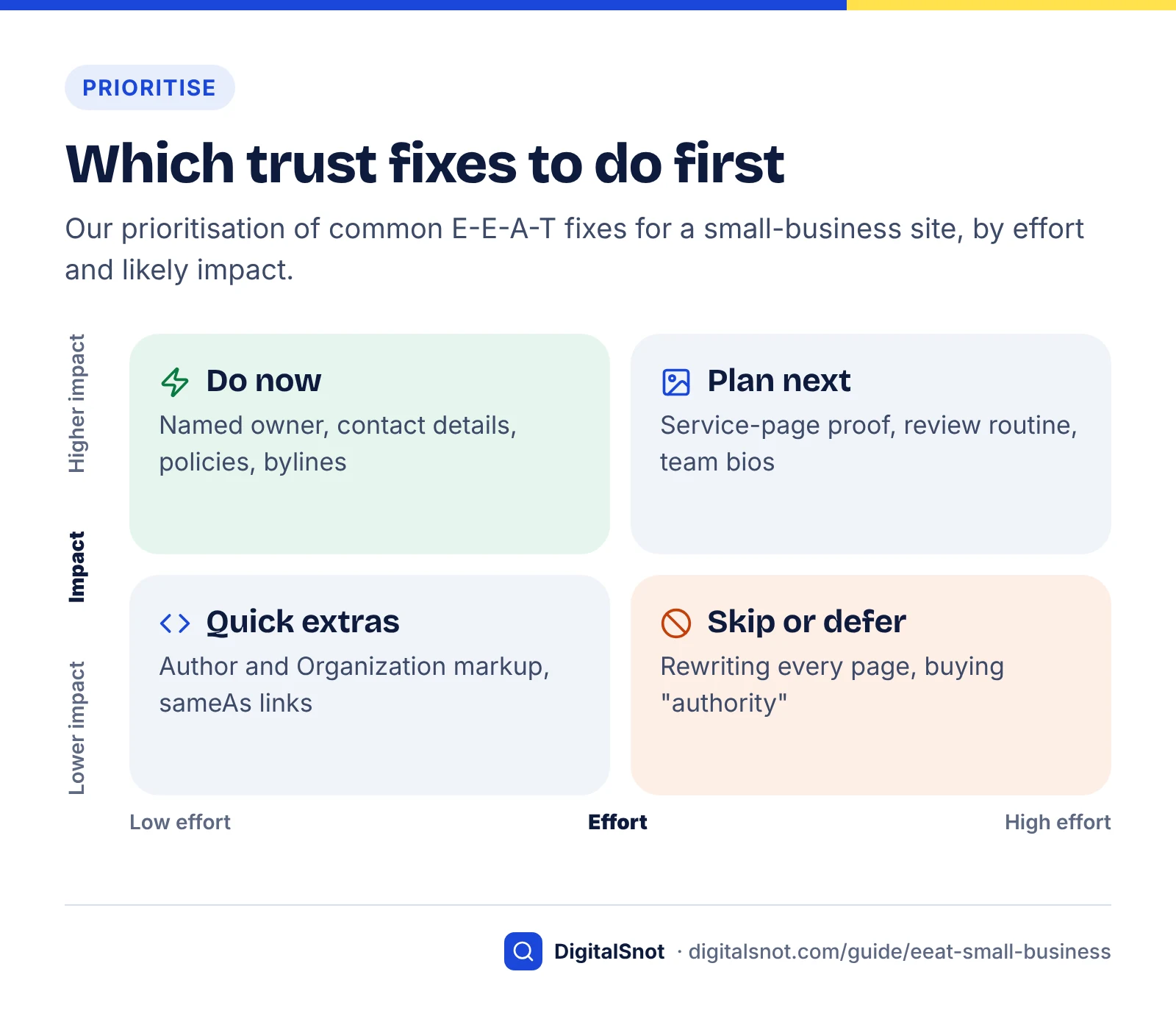
The fastest way to improve E-E-A-T is to audit each page type against a fixed list and fix the gaps a visitor would notice first. The table below is that list: what to add to each page, and how to prove it.
How we built it: we took the Who, How and Why questions from Google's helpful content guidance and the trust items the September 2025 rater guidelines ask raters to check (who is responsible for the site, contact and customer service information, reputation, and the creator's experience and expertise). We then mapped each one to the page on a typical small-business site where a visitor would look for it. The rows and the scoring scale are our own framework, not Google's, and you can repeat the audit with a simple spreadsheet.
| Page | What to add | How to prove it | Main quality |
|---|---|---|---|
| Home page | Business name, what you do, where, and links to about and contact | Same name and details as your Google Business Profile | Trust |
| About page | Named owners, start date, service area, who does the work | Real photos, company or professional registration, linked profiles | Trust, experience |
| Contact page | Phone, email, address or service area, reply time, complaints route | Details match every listing; the phone is answered | Trust |
| Service pages | What is included, process steps, who does it, time taken, risks | Photos of real jobs, numbers from your own records | Experience, expertise |
| Team and author pages | Name, role, experience, qualifications, topics covered | Register numbers linked to the register, professional profiles | Expertise |
| Articles and guides | Byline, date, reviewer for advice content, sources | Byline links to an author page; sources linked in the text | Expertise, trust |
| Reviews and testimonials | Recent reviews, your replies, a link to the platform | Hosted or linked on an independent platform; not filtered | Trust, authoritativeness |
| Accreditations | Memberships, certifications, awards | Links to the issuing body's register or directory | Authoritativeness |
| Policies | Privacy, terms, cancellation, refunds or returns | Dated, linked in the footer, written in plain language | Trust |
| Pricing | Prices or price ranges, what is included, what changes the price | A labelled worked example of a typical quote | Trust |
| Portfolio or work examples | Real jobs, with what was done and why | Your own photos and dates, shared with customer permission | Experience |
| Off-site profiles | Google Business Profile, key directories, social profiles | Consistent facts; Organization markup with sameAs links | Authoritativeness, trust |
Score it: claimed versus provable
Score each row 0, 1 or 2:
- 0, missing: the element is not on the site.
- 1, claimed: it is there, but visitors have to take your word for it, such as "fully qualified team" or "hundreds of happy customers".
- 2, provable: a visitor can check it, such as a named person, a register link, a photo of your own work, or reviews on an independent platform.
Twelve rows give a maximum of 24. The total matters less than the pattern. Fix zeros on trust pages first, then raise ones to twos on the pages that bring in enquiries. The step from 1 to 2 is the point of the whole audit: E-E-A-T is easy to claim and harder to prove, and only proof changes a sceptical reader's mind.
Worked example (hypothetical)
Example: a two-physiotherapist clinic in Pune has a 15-page site. It ranks for its own name but lost visibility for searches like "back pain physiotherapy Pune" during a core update. This scenario is invented to show the method. Its audit scored 6 out of 24, and these were the five changes it made, in order:
| Row | Before | After | What changed |
|---|---|---|---|
| About page, team pages | 0, 0 | 2, 2 | Both physiotherapists named, with photos, qualifications and registration numbers linked to the register |
| Contact page, policies | 1, 0 | 2, 2 | Full address matching the Business Profile; cancellation and privacy policies added to the footer |
| Articles and guides | 0 | 2 | Bylines and "reviewed on" dates added; two generic articles merged into a fuller one |
| Service pages | 1 | 2 | Assessment process, session length and a typical treatment plan described, with photos of the actual clinic |
| Reviews | 1 | 2 | Pasted testimonials replaced by a link to the Google profile and a review request after discharge |
The other five rows (home page, accreditations, pricing, portfolio and off-site profiles) scored 3 between them and were left for a second pass, so the new score is 17 out of 24. None of this guarantees the clinic's rankings return. What it does is remove the reasons a cautious patient, or a rater, would doubt the clinic, and it gives Google's systems more of the evidence they look for.
What to fix first: a decision table
If you have limited time, choose your first fix from your situation rather than from a generic checklist. Start at the top and use the first row that applies to you.
| If this is true | Do this first | Why |
|---|---|---|
| The site does not name the owner or give a full address and phone number | Rewrite the about and contact pages | Missing responsibility information is the clearest Lowest-rating trigger in the rater guidelines for pages that need trust |
| You work in health, money, legal or safety | Name qualified people, link their registrations, date and review advice pages | Google gives even more weight to strong E-E-A-T on YMYL topics |
| Service pages read like your competitors' pages | Add your process, photos of real work and local specifics | First-hand detail is the non-commodity content Google's 2026 AI guide asks for |
| You have few reviews, or none from the last three months | Set up a steady, policy-compliant review request routine | 74% of consumers look for reviews from the last three months |
| Articles have no byline, or the byline says "Admin" | Add bylines linked to author pages | These are Google's own "Who" questions |
| AI assistants describe your business wrongly | Fix conflicting facts on your site and listings | Assistants repeat what they find; conflicts make you harder to describe accurately |
| All of the above is in place and rankings still fell in an update window | Stop adding trust elements and diagnose the drop properly | E-E-A-T is not a single factor; relevance, competition or a technical fault may be the cause |
The last row matters most. Adding author boxes to a site that already shows who it is will not fix a problem that lies elsewhere, so compare the pages that lost with the pages that now outrank them.
E-E-A-T myths and mistakes to avoid
Most E-E-A-T mistakes come from treating it as a checklist for an algorithm instead of proof for a person. These are the ones to avoid:
- Buying "authority". Authoritativeness is a reputation other people give you. Directory blasts and paid listicle slots do not make you a go-to source.
- Bios full of adjectives. "Award-winning, passionate, leading experts" proves nothing. One checkable qualification beats five superlatives.
- The same author box under every page. A long template repeated across service pages adds length, not proof. Keep the full profile on one author page and link to it.
- "E-E-A-T schema" plugins. No markup creates experience or trust.
- Expecting a quick rebound. E-E-A-T improvements make a site more trustworthy; they do not guarantee recovery after an update.
E-E-A-T is not a ranking factor: what it means
Keep it current
Trust signals go stale. Every quarter, re-score the audit table, update team pages when people join or leave, check that review requests are still going out, and review dated advice pages on YMYL topics. Change a page's date only when you change its content.
E-E-A-T rewards what good small businesses already have: real people, real work and real customers. The task is to make that visible and checkable on every page that matters. If you would like help turning your expertise into pages that prove it, that is the core of our content SEO service, and you can contact us to talk it through.
Free tools in this guide
- AI Answer Consistency Checker Find brand facts that differ between your pages and listings.
- Entity Coverage Checker Find the brands, tools and concepts competitors cover and you miss.
- Brand Knowledge Graph Builder Map your brand entity, find missing links and get the schema.
- Google Review Link & QR Generator Make a QR code and printable card for your Google review link.
- AI Citation Quality Scorer Score how strongly pasted AI answers recommend your brand.
By the numbers
- date of the latest Search Quality Rater Guidelines edition we could confirm, the document that defines E-E-A-T (checked October 2026)
- 11 Sep 2025
- Source: Google
- of consumers look for reviews written in the last three months (BrightLocal survey of 1,002 US adults, 2026)
- 74%
- Source: BrightLocal
- of consumers used AI tools to find local business recommendations in the past year, up from 6% in 2025 (BrightLocal, 2026)
- 45%
- Source: BrightLocal
- maximum US civil penalty per violation of the FTC Consumer Review Rule, cited in warning letters sent in December 2025
- $53,088
- Source: Federal Trade Commission
Frequently asked questions
Is E-E-A-T a ranking factor?
No. Google's helpful content guidance says E-E-A-T itself isn't a specific ranking factor, and its SEO Starter Guide lists the idea among common misconceptions. Google's systems use a mix of signals that tend to identify content with good experience, expertise, authoritativeness and trust, and they give these more weight on health, money and safety topics. There is no E-E-A-T score to raise, so focus on proving each quality to visitors.
What does E-E-A-T stand for?
E-E-A-T stands for experience, expertise, authoritativeness and trust. It comes from Google's Search Quality Rater Guidelines, the manual Google's human evaluators use to judge search results; the current edition is dated 11 September 2025. Google added the first E, experience, in December 2022. Trust sits at the centre, and the guidelines describe it as how accurate, honest, safe and reliable a page is.
How can a small business show experience on its website?
Show first-hand evidence of the work you actually do. Describe your process step by step, use photos of your own jobs, premises and team, quote numbers only from your own records, and explain the problems you see most often. Label worked examples as examples and never invent customer stories. Put this proof on service pages first, because that is where people decide whether to contact you.
Do author bios help SEO?
Author bios help readers judge whether to trust a page, which is what Google's systems try to reward, but they are not a ranking switch. Google's helpful content guidance encourages accurate bylines where readers expect them, linked to more information about the author. A useful bio names the person, their role, relevant experience and checkable qualifications. Google treats fabricated authors and false credentials as deception.
Do I need schema markup for E-E-A-T?
No markup creates E-E-A-T. Article markup with accurate author details and Organization markup with sameAs links help search engines connect your content to real people and to your business profiles, so they are worth adding. But trust and expertise are judged from what the page shows. Markup should only describe visible content; it cannot stand in for named people, clear policies or evidence of real work.
What is YMYL and does it apply to my business?
YMYL stands for Your Money or Your Life: topics that could significantly affect people's health, financial stability or safety, or the welfare of society. Clinics, financial advisers, accountants, solicitors and safety-critical trades usually fall into it. Google says its systems give even more weight to strong E-E-A-T on these topics, so name qualified people, link their registrations, and date and review every advice page.
Can I use AI to write content and still show good E-E-A-T?
Yes, if a real expert stays responsible for it. Google's guidance asks whether the use of automation or AI is self-evident to visitors, and it treats fabricated creator profiles as deception. Have the named author check every fact, add the first-hand detail an AI tool cannot know, and keep the byline on the person who takes responsibility. Never give the byline to an AI tool or an invented persona.
Will improving E-E-A-T fix a ranking drop after a core update?
Not necessarily. E-E-A-T is not a single factor, so adding author boxes or trust badges will not reverse a drop on its own. First confirm the cause: check whether the drop matches an update window and rule out technical, tracking and seasonal causes. If the update is the cause, improve the pages that lost for the people who use them. Recovery is not guaranteed.
Are reviews part of E-E-A-T?
Reviews shape how trustworthy and reputable a business appears. The rater guidelines ask raters to consider reputation, and customers rely on reviews heavily: BrightLocal's 2026 survey found 74% of consumers look for reviews from the last three months. Ask every customer for a review without incentives or filtering, reply to reviews, and link to them on your site so visitors can check they are real.
What should an about page include for E-E-A-T?
An about page should say who owns and runs the business, with names and real photos, when it started, where it works and what it does. Add registered details such as company or professional registration numbers, links to profiles that confirm them, and the qualifications of the people who do the work. The rater guidelines treat a complete lack of information about who runs a site as a serious trust failure.
Sources
Every figure and claim in this guide comes from the sources below. We checked each one when writing and link to the original so you can read it yourself. Credit belongs to the authors and publishers listed. How we write and check our articles.
-
1
Creating helpful, reliable, people-first content
Google Search Central · E-E-A-T not a specific ranking factor; trust most important; Who, How, Why; YMYL weighting; automation and AI disclosure.
-
2
Search Quality Rater Guidelines (General Guidelines, 11 September 2025)
Google · E-E-A-T definitions, trust at the centre, deceptive pages untrustworthy, Lowest rating for missing responsibility info, small-site reputation.
-
3
Our latest update to the quality rater guidelines: E-A-T gets an extra E for Experience
Google Search Central Blog · Experience added to E-A-T on 15 December 2022.
-
4
SEO Starter Guide: The Basics
Google Search Central · Lists the idea that E-E-A-T is a ranking factor among things not to focus on.
-
5
An overview of our rater guidelines for Search
Google · Rater ratings do not directly affect how pages appear in Search.
-
6
What web creators should know about our March 2024 core update and new spam policies
Google Search Central Blog · Helpful content system became part of core ranking; no single signal or system.
-
7
Optimizing your website for generative AI features on Google Search
Google Search Central · May 2026 guide: commodity versus non-commodity content; first-hand review example.
-
8
Article (Article, NewsArticle, BlogPosting) structured data
Google Search Central · Author markup best practices: all authors, name only, author.url, sameAs.
-
9
Local Consumer Review Survey 2026
BrightLocal · 74% seek reviews from last three months; 32% last two weeks; 31% need 4.5 stars (1,002 US adults).
-
10
Fake engagement
Maps User Generated Content Policy Help · No incentives for reviews and no review gating; Maps content policies also bar asking staff for a set number of reviews.
-
11
FTC Warns 10 Companies About Possible Violations of the Agency's New Consumer Review Rule
Federal Trade Commission · December 2025 warning letters; Consumer Review Rule scope; penalties up to $53,088 per violation.
-
12
Fake reviews (CMA208)
Competition and Markets Authority · UK ban from 6 April 2025; publishers' duty of reasonable steps; suppression of negative reviews.
-
13
Half of consumers are asking AI for business recommendations
BrightLocal · 45% used AI tools for local business recommendations in the past year, up from 6% in 2025.
-
14
Google updates search quality raters guidelines adding AI Overview examples & YMYL definitions
Search Engine Land · September 2025 update: YMYL definitions and AI Overview examples.
-
15
FAQs - SEBI Registered Investment Advisers
Securities and Exchange Board of India · Details an investment adviser must display prominently on its website.
-
16
SRA digital badge
Solicitors Regulation Authority · Badge mandatory on regulated firms' websites since 25 November 2019.