Guide · Keyword research and content
Topical authority: plan content clusters for Google and AI
What Google has actually said about topical authority, plus a cluster worksheet, a "worth writing" test and linking rules that avoid thin pages and scaled content risk.

On this page (12 sections)
- 1What topical authority means, and what it is not
- 2What Google has actually said about topical authority
- 3Pick a narrow topic you can own
- 4Map the cluster: core page, supporting pages and questions
- 5The cluster planning worksheet, with a worked example
- 6Avoid thin pages, cannibalisation and scaled content risk
- 7Link the cluster together
- 8Publishing order and cadence for a small team
- 9Show expertise across the cluster
- 10Measure cluster performance
- 11Where to start this week
- 12Sources
Most advice on topical authority starts with a spreadsheet of 200 keywords and ends with a plan to publish all of them. That is the quickest way to build a large, thin site, and it can also breach Google's scaled content abuse policy. This guide takes the opposite approach: pick a topic narrow enough to cover properly, write only the pages that earn their place, and link them so readers and search engines can see the whole picture.
It is written for small-business owners, content leads and in-house marketers planning a blog, guide hub or resource section. By the end you will be able to separate what Google has actually said about topical authority from SEO folklore, choose a topic you can own, map a cluster with a worksheet, decide whether each page is worth writing, link the pages together, plan a 12-week publishing order and measure the result. Statements about Google's guidance were checked in October 2026 and are linked where used.
What topical authority means, and what it is not
Topical authority is an SEO term for how far search engines and people treat a site as a dependable, go-to source on a specific subject, because it covers that subject thoroughly, accurately and from real experience. It describes an outcome. It is not a metric Google reports.
Three related terms come up in every guide on the subject:
- A content cluster (or topic cluster) is a group of pages on one subject: a core page that covers the topic broadly and several supporting pages that each answer one distinct question in depth, all linked together.
- A pillar page is another name for the core page. It gives the overview and links out to every supporting page. This guide calls it the core page.
- A topical map is a planning document that lists the sub-topics and questions within a subject and shows how they relate. It is a plan, not a publishing quota.
Topical authority is not a number. There is no topical authority score in Search Console. Scores with "authority" in their name in SEO tools are each vendor's own estimate, built from its own crawl data. They can help you compare sites, but they are not Google's view of your site, and raising them is not the goal.
The useful way to think about it is from the reader's side. A site has topical authority on a subject when someone who arrives with any reasonable question about it finds a clear, trustworthy answer, written by people who plainly do the work, and an obvious next step. Search visibility tends to follow from that, not the other way round.
What Google has actually said about topical authority
Google has not published a "topical authority" ranking factor for ordinary websites. It has described a topic authority system for news, said it uses site-wide signals alongside page-level ones, and asked site owners whether their site is focused and recognised as an authority on its topic. It has also said, more than once, that mass-producing pages to win rankings is spam.
Method: in October 2026 we read the Google Search Central pages and blog posts in the table below, recorded what each says about topic-level or site-level evaluation, and separated what Google states from what SEOs often infer. You can repeat the check; every source is linked.
| Google source | What it says | What it means for a cluster plan |
|---|---|---|
| Understanding news topic authority (May 2023) | A system that helps surface expert sources for news queries. Its signals include how notable a publication is for a topic or location, how often its original reporting is cited by others, and its reputation. | It applies to news. Its signals are still a useful mirror for any site: depth on one topic, original work that others reference, and a track record. |
| Creating helpful, reliable, people-first content | Self-assessment questions ask whether someone researching your site would see it as "well-trusted or widely-recognized as an authority on its topic", and whether your site has "a primary purpose or focus". | Focus is an explicit self-check. A clear subject is part of what Google asks you to judge your own site on. |
| Same page, "search engine-first" warnings | Flags "producing lots of content on many different topics in hopes that some of it might perform well in search results", and entering a niche without real expertise mainly for search traffic. | Breadth for traffic's sake is named as a warning sign. Build clusters only on topics you have real experience in. |
| A guide to Google Search ranking systems | Ranking systems work at the page level, and site-wide signals and classifiers are also used. Good site-wide signals do not mean all content from a site will always rank highly. | A strong cluster can help the whole site, but each page still has to earn its place on its own. |
| March 2024 core update and new spam policies | Introduced the scaled content abuse policy, which applies whether content is produced through automation, human effort or a combination. | Hiring writers to churn out pages is not a loophole. Volume without value is the problem, whoever writes it. |
| Optimizing your website for generative AI features (May 2026) | Defines query fan-out. Says separate pages for every query variation, made mainly to manipulate rankings or AI responses, violate the scaled content abuse policy. Recommends non-commodity content. | Cover sub-questions in fewer, deeper pages. Never build a page per wording. |
| Guidance on using generative AI content (updated 1 October 2026) | Tells site owners to fact-check and review AI-generated content manually before publishing, including meta descriptions, structured data and image alt text. | AI can help draft a cluster, but every page needs a knowledgeable person to check it. |
Search Engine Journal's report dates the AI content change to 1 October 2026 and notes that the previous version asked for accuracy without calling for a manual fact-check.
What the comparison tells you
- Focus is real, but it is not a score. Google asks about focus and topical recognition, and it uses site-wide signals. None of these documents says that publishing a certain number of pages on a topic builds authority.
- The news system rewards being cited, not being big. Original reporting that others reference is one of its named signals. The closest equivalent for a business site is original material, such as your own process, photos or data, that others in your field link to or mention. That is our inference, not a Google statement.
- Volume is the risk. The spam policies, the March 2024 announcement, the May 2026 AI guide and the AI content guidance all warn against large numbers of low-value pages, whoever or whatever writes them.
- Each page still stands alone. Site-wide signals do not carry weak pages. Ten strong pages beat fifty thin ones.
Topical authority in 15 seconds
What the 2024 leak does and does not show
In May 2024, internal Google Search API documentation became public. iPullRank's analysis of the leaked documents reported attributes named siteFocusScore, which denotes how much a site is focused on a specific topic, and siteRadius, which measures how far page embeddings deviate from the site embedding. iPullRank's reading is that Google compares page embeddings with the site embedding to see how off-topic a page is.
Google responded that the documentation lacks context, cautioning against inaccurate assumptions based on out-of-context, outdated or incomplete information. The documents do not say how any attribute is weighted or whether it is still used. Read them as consistent with Google's public questions about focus, not as a formula to optimise against.
Pick a narrow topic you can own
Choose a topic narrow enough that a small team can cover its important questions well within a few months, and close enough to what you sell that the visitors it attracts can become customers. A practical test: if you cannot list the ten questions customers ask most about it from memory, it is either too broad or not really your topic.
Four tests for a topic
- Revenue link. The topic sits next to a service or product you sell. A firm that repairs sash windows should build around sash windows, not around "home improvement".
- First-hand experience. You do this work and can show it: photos, process, judgement and numbers from your own jobs. Google's helpful content guidance specifically flags entering a niche without real expertise.
- Coverable scope. You can answer the main questions properly in a manageable number of pages and keep them accurate afterwards.
- Winnable results. Search the main questions yourself in Google and in an AI assistant, and look at who answers them today.

Broad or narrow: a quick decision flow
- If the topic spans several unrelated services (windows, doors and roofing, say), then split it and start with the service that brings the most profitable work.
- If the top results for your main questions are dominated by national publishers, then narrow by audience (period homes, landlords), by place or by a specific problem.
- If you cannot name ten genuine customer questions, then the topic is too narrow or not one customers think in; widen it by one level.
- If you have no first-hand experience of the topic, then do not build a cluster on it, however good the keyword numbers look.
Example (hypothetical): a five-person firm in York that repairs and draught-proofs timber sash windows. "Home improvement" is hopeless and "windows" is still too broad. "Sash window repair", with an angle on period homes, is a topic it can cover completely and that leads directly to paid work. This example runs through the rest of the guide.
Map the cluster: core page, supporting pages and questions
A cluster map lists the questions customers have about the topic, groups them by intent and decides where each one gets answered: on the core page, on its own supporting page, on the service page or nowhere. Start from real questions, not from a keyword-tool export.
Step 1: decide what the core page is
If most people searching the topic want to hire someone, the service page is the hub. If most want to understand the problem first, write a guide as the core page and link it prominently to the service page. Our post on choosing between a service page and a blog post explains the difference and how to stop the two competing.
Step 2: collect real questions
- Questions customers ask on the phone, by email and during visits. Ask whoever answers the phone to note them for a month.
- Queries already reaching your site, from the Performance report in Google Search Console.
- "People also ask" boxes and related searches in Google for your main topic.
- The follow-up questions AI assistants suggest when you ask them about the topic.
- Topics competitors cover. The free Competitor Content Gap Finder reads your sitemap and competitors' sitemaps and lists topics they have pages on and you do not. Treat the output as candidates to test, not pages to copy.
Our keyword research guide explains how to check demand for the questions you collect and how to read search intent from the results page.
Step 3: sort questions by intent
Group the questions by what the person wants to do next: learn, compare or buy. You can paste up to 50 questions into the free AI Prompt Intent Classifier for a first sort by intent, from information to ready to buy, then correct it by hand, because you know your customers better than any classifier does. Questions with the same intent and the same answer belong on the same page, however differently they are worded.
Step 4: use fan-out as a completeness check
Google says AI Overviews and AI Mode may issue multiple related searches across subtopics and data sources to build a response, a technique it calls query fan-out (AI features and your website). For a question like "should I repair or replace my sash windows?", the related searches plausibly include cost, energy efficiency, lifespan and disruption. Our inference: a cluster that answers those sub-questions clearly gives Google's systems more of your pages to draw on. It does not mean one page per sub-question, and Google's May 2026 guide says the opposite.
Step 5: check entity coverage
An entity is a distinct, named thing: a part, material, process, standard, organisation or place. Thorough answers on a topic tend to mention the same core entities. For sash windows they include sash cords, pulleys, weights, parting beads, staff beads, meeting rails and putty. Run your core page and a strong competitor page through the free Entity Coverage Checker to list the entities each one mentions. A missing entity is a prompt to check whether you have left out something readers need, not an instruction to stuff in terms.
Build a content cluster from one service
The cluster planning worksheet, with a worked example
The worksheet turns your question list into a page plan. Each candidate page gets a row, a score out of 10 and a decision, so the team can say no to most ideas for a stated reason. This is the original framework in this guide.
Method: each candidate is scored 0, 1 or 2 on five criteria. The criteria come from Google's people-first questions (focus, expertise, value beyond what others say), its scaled content warnings and plain business sense. The weights are deliberately equal so the score is easy to explain and argue about in a meeting.
The five "worth writing" criteria
| Criterion | 2 points | 1 point | 0 points |
|---|---|---|---|
| Business link | Leads directly to a paid service or product | Indirect: builds trust before a purchase | No plausible link to what you sell |
| Distinct intent | Answers a question no other page on your site answers | Overlaps partly with another page | Same intent as an existing or planned page |
| Evidence of demand | Seen in two or more sources: customers, Search Console, People also ask, AI follow-ups | Seen in one source | A guess |
| First-hand input | You can add photos, data, process detail or judgement nobody else has | Some original detail | Only what other pages already say |
| Accuracy upkeep | Facts are stable, or you will review them on a schedule | Needs checking a few times a year | Fast-changing facts you cannot maintain |
The decision rule:
- 8 to 10: write it as its own supporting page.
- 5 to 7: answer it as a section of the core page or another page, or schedule it for later if it scores 2 on distinct intent.
- 0 to 4: skip it.
- Veto: a candidate that scores 0 on distinct intent never becomes its own page, whatever its total. Merge it into the page that already serves that intent.
Worked example: the York sash window firm (hypothetical)
The core page, a sash window repair guide linked to the service page, is not scored: it is the topic. Here are ten candidate supporting pages, scored in the order business link, distinct intent, demand, first-hand input and accuracy upkeep.
| Candidate page | Intent | Scores | Total | Decision |
|---|---|---|---|---|
| Should you repair or replace sash windows? | Compare | 2, 2, 2, 2, 2 | 10 | Own page, write first |
| How to draught-proof sash windows | Learn, then hire | 2, 2, 2, 2, 2 | 10 | Own page |
| Signs your sash cords need replacing | Learn | 1, 2, 2, 2, 2 | 9 | Own page |
| What affects the cost of sash window repair | Compare | 2, 2, 2, 1, 1 | 8 | Own page: explain cost factors, review twice a year |
| Slim double glazing in existing sashes | Learn | 2, 2, 1, 2, 1 | 8 | Own page |
| How to paint sash windows yourself | Learn (DIY) | 0, 2, 2, 1, 2 | 7 | Write later; link to the repair service |
| A history of the sash window | Learn | 0, 2, 1, 1, 2 | 6 | Short section on the core page |
| Sash windows versus casement windows | Learn | 0, 1, 1, 0, 2 | 4 | Skip |
| Town pages for Harrogate, Leeds and Selby with the same text | Buy | 2, 0, 1, 0, 2 | 5 (veto) | No separate pages; list the service area on the service page |
| Separate "restoration" and "renovation" pages | Buy | 2, 0, 2, 0, 2 | 6 (veto) | Merge into the service page: same intent, different wording |
Ten ideas produce five supporting pages, two sections or later pieces, and three ideas that are skipped or merged. That is the point: the plan gets smaller, and every page left has a reason to exist that you could explain to a customer.

Columns for your own worksheet
- Candidate page, written as the question in the customer's words.
- Intent: learn, compare or buy.
- Where it is answered: core page, supporting page, service page, a section, or skip.
- The five scores and the total.
- Unique input: the photo, data, example or opinion only you can add.
- Links out: the core page, the service page and any sibling the reader will need next.
- Links in: which existing pages should link to it once it is live.
- Owner, draft date and next review date.
Avoid thin pages, cannibalisation and scaled content risk
A cluster goes wrong in three ways: pages with nothing new to say, several pages competing for the same intent, and pages made in bulk to catch keyword variations. The worksheet's distinct-intent veto and first-hand input score exist to stop all three before anything is written.
Scaled content abuse: where clusters cross the line
Google's spam policies define scaled content abuse as when many pages are generated for the primary purpose of manipulating search rankings and not helping users. The examples include using generative AI or similar tools to generate many pages without adding value for users, and stitching or combining content from different web pages without adding value. Google's May 2026 guide to generative AI features applies the same policy to separate pages for every query variation, fan-out queries included, when they are made mainly to manipulate rankings or AI responses.
So a topical map that turns every keyword in a tool export into a page is a risk, however well each page is written. The safe pattern is fewer pages, each with a distinct intent and something original in it.
Cannibalisation is rarer than it looks
Ranking with two pages for one keyword is not automatically a problem. In a 2024 Ahrefs study of multiple rankings, Ahrefs found about 9,700 keywords where its own site ranked with more than one page. When it reviewed a sample of 80 by hand, only one needed action. Most were what the study calls keyword diversification, such as a blog article and a tool page both ranking because they serve different searchers. For "seo case studies", by contrast, Ahrefs built a single pillar page and ranked better with it than it ever had with several pages.
Use this decision table when two pages in a cluster seem to overlap:
| If you see this | It usually means | Do this |
|---|---|---|
| Two pages answer the same question for the same reader | Cannibalisation | Merge into the stronger page, 301-redirect the other, update internal links |
| Two pages rank for one query but serve different intents, such as a guide and a service page | Diversification | Keep both; make each page's purpose obvious in its title and opening; link between them |
| The ranking URL keeps swapping between two pages | Search engines cannot tell which page fits the query | Choose the primary page, then sharpen the other's focus or merge it |
| A new page is planned for another wording of an existing topic | Same intent, different words | Cover the wording on the existing page; do not create the new one |
| A page has no first-hand input and no impressions after a fair trial | Thin content | Add original material, fold it into another page, or remove it |
What not to do
- Do not make town pages by swapping place names into the same text. A town page needs real local work, photos and specifics to justify itself. If you serve several towns, our local SEO service covers how to show that without duplicate pages.
- Do not publish AI drafts until someone who knows the subject has checked every fact, including titles, meta descriptions and image alt text.
- Do not expand into a neighbouring topic just because a tool shows search volume for it.
If a past burst of mass publishing has already cost you traffic, our guide to recovering from a Google core update explains how to assess the damage and decide what to improve, merge or remove.
Link the cluster together
Link the core page to every supporting page, link each supporting page back to the core page, and add links between sibling pages only where a reader is likely to want the other page next. Every link should be an ordinary HTML link with descriptive anchor text.
Google's link best practices say Google can only reliably crawl a link that is an HTML a element with an href attribute, and that every page you care about should have a link from at least one other page on your site. The same page asks for anchor text that tells people and Google what the linked page is about.
| Link | Purpose | Example anchor (sash window cluster) |
|---|---|---|
| Core page to each supporting page | Lets readers and crawlers reach every page from the hub | "how to tell if your sash cords need replacing" |
| Supporting page back to the core page | Gives context and shows where the page sits in the topic | "our full guide to sash window repair" |
| Supporting page to the service page | The next step for readers ready to buy | "book a sash window survey" |
| Sibling to sibling | Only where the reader needs the other answer next | From draught-proofing to "slim double glazing in existing sashes" |
| Service page to the core page | Helps buyers who want to understand the work first | "what sash window repair involves" |
| Navigation and breadcrumbs | Shows the hierarchy on every page | Home, Guides, Sash windows |
Resist linking every page to every other page. A cluster of six pages where each links to all the others tells the reader nothing about which page matters or what to read next. Link where the sentence naturally calls for it.
Folders and URLs
Putting a cluster in its own folder, such as /sash-windows/, keeps it tidy and makes it easy to measure. Google's SEO Starter Guide says how you organise content may affect crawling and indexing once a site has more than a few thousand URLs, because folders can help Google learn how often different sections change. On a small site, choose whatever is easiest to manage. Do not move existing pages just to create a folder: changed URLs need redirects and carry their own risk.
After each page goes live, crawl the site to catch orphan pages (pages with no internal links pointing to them) and broken links. Our technical SEO audit checklist walks through the crawl and what to fix first.
Publishing order and cadence for a small team
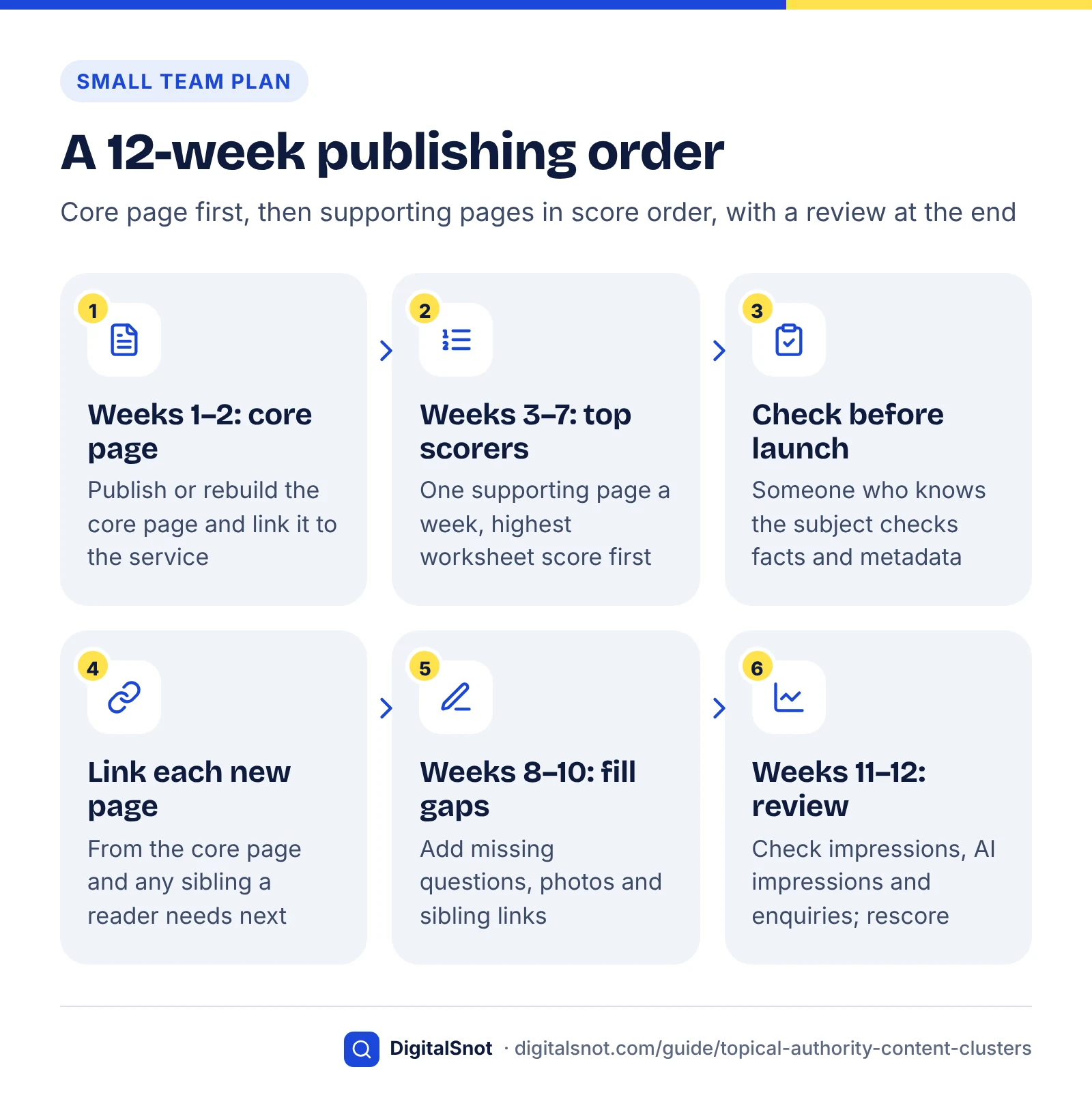
Publish the core page first, then the supporting pages in score order, at a pace you can sustain with proper checks. For a team of one or two people, one well-made supporting page a week is a strong pace and one a fortnight is fine. Consistency matters more than speed, and speed never justifies skipping the fact-check.
A 12-week plan for the worked example
| Weeks | Publish or do | Why |
|---|---|---|
| 1–2 | Publish or rebuild the core page; link it to and from the service page | Every later page needs a hub to link to |
| 3–7 | One supporting page a week in score order: repair or replace (10), draught-proofing (10), sash cords (9), cost factors (8), slim double glazing (8) | The pages closest to a purchase, with the most first-hand material, go first |
| 8–10 | Fill gaps: update core page sections, add sibling links, add photos; painting guide if there is capacity | The first pages show which questions are still missing |
| 11–12 | Review Search Console, AI impressions and enquiries; rescore the worksheet | Decide what the next quarter adds, merges or drops |
Why the core page goes first
Publishing the hub first means each new supporting page joins a structure on the day it goes live. Each time a supporting page is published, add a short summary of its answer and a link to it on the core page, so the hub always reflects the whole cluster.
When to widen the cluster
Widen only when the main questions are answered, the supporting pages are getting impressions and you have new first-hand material. Start the adjacent topic as its own small cluster (for the sash window firm, perhaps timber door repair) and link the two only where a reader would move between them.
Expect months rather than weeks before a new cluster shows its full effect. Our post on how long SEO takes sets out what usually moves first and what takes longer.
Show expertise across the cluster
Every page in the cluster should make it obvious who wrote it, why they know, and what first-hand evidence backs it up. Google's May 2026 guide recommends non-commodity content: material that offers value beyond common knowledge. Its example contrasts a first-hand review, which gives a unique perspective, with a summary that restates information already available elsewhere.
Practical signals of expertise
- Name a real author: the person who does the work, with a short author page about their experience.
- Show your own work: photos of your jobs, before and after, and your process step by step.
- Give judgement, not only facts: say when you would repair rather than replace, and why. Competitors and AI summaries cannot copy judgement.
- Keep facts consistent: the same terms, process and service details on every page in the cluster.
- Date updates and review on schedule: the accuracy upkeep score shows which pages need the most frequent checks.
- Check AI-assisted drafts line by line, metadata included, as Google's guidance now asks.
Before each page goes live, run it through the free On-Page SEO Checker with its target question to catch weak titles, heading problems and canonical errors. Our on-page SEO checklist explains what each item means and how to fix it.
Earn references from others
Google's news system weighs how often a publication's original reporting is cited by other outlets. The equivalent for a small business, in our reading, is original material that suppliers, trade bodies, local press and other specialists want to reference: a clear explanation of a process, a set of photos, a small piece of data from your own jobs. That kind of reference also matters for AI answers. Our guide to getting cited in AI search explains how AI assistants choose the sources they name.
Measure cluster performance
Measure the cluster as a group, not page by page: impressions, clicks and queries across all its URLs, appearances in AI features, and the enquiries that start on cluster pages. Review it every quarter and treat pages that stay flat as candidates to improve, merge or remove.
| What to measure | Where | What progress looks like |
|---|---|---|
| Impressions and clicks for cluster URLs | Search Console Performance report, filtered by page using the cluster's folder or URL pattern | Impressions rise first, clicks follow |
| Spread of queries | The Queries tab for the same page filter; Query groups in Search Console Insights where available | More distinct queries over time, across more sub-topics |
| AI feature impressions | Search Console Generative AI performance report, Pages view | Cluster pages appearing in AI Overviews and AI Mode |
| Coverage | Your worksheet | A rising share of mapped questions answered well |
| Enquiries | Analytics conversions by landing page, plus asking new customers what they read | Enquiries that mention cluster topics |
| Internal links | A site crawl | No orphans; every supporting page linked from the core page |
Two Search Console features worth knowing
Query groups, introduced in October 2025, cluster similar queries in Search Console Insights so you see main interest areas instead of a long list of individual queries. Google says the groups are computed using AI, may change over time and do not affect ranking. They are only available to properties with a large volume of queries, so many small sites will not see them yet.
The Generative AI performance report shows how many times links to your site were shown in AI Overviews and AI Mode, and its Pages view lets you check cluster URLs. Google says it rolled out to all websites on 31 August 2026 (checked October 2026), though it may not appear for a site with too few impressions. Our guide to the Search Console AI performance report explains how to read it.
A simple coverage score
Coverage score = questions on your map that are answered well ÷ all questions on your map × 100. "Answered well" means a direct answer in the first sentence or two, first-hand detail and a working link to the next step. Example: the sash window firm maps 20 questions and answers 14 of them well, giving 70%. Raise the score by improving sections and adding pages that pass the worksheet, never by adding questions you have no intention of answering.
The quarterly review
- If a page has impressions but few clicks, then improve its title and opening so the answer is clearer in search results.
- If a page has no impressions after three to six months and scored low on first-hand input, then add original material, merge it or remove it.
- If customers raise new questions, then add them to the worksheet and score them like any other idea.
When you report on the cluster, report it as a unit alongside the rest of your SEO work. Our post on what a monthly SEO report should include shows how to keep that report useful.
Where to start this week
Start with the topic and the question list; everything else follows from them. In order:
- Pick one narrow topic tied to a service you sell and know first-hand.
- Collect real customer questions from at least three sources and group them by intent.
- Score every idea on the worksheet; plan only those at 8 or more as their own pages, and merge the vetoes.
- Publish the core page, then one supporting page at a time, linked in and fact-checked, and review the cluster as a group each quarter.
Topical authority is what a focused, honest, well-organised set of pages looks like from the outside. Build fewer pages, make each one the best answer you can give, and let the structure show readers and search engines that you cover the subject properly.
If you would like help planning or writing a cluster around your services, that is the core of our content SEO service. When you are ready to talk it through, get in touch.
Free tools in this guide
- Competitor Content Gap Finder Find the topics and formats competitors cover that you do not.
- AI Prompt Intent Classifier Sort AI questions by intent and value, and see the page each needs.
- Entity Coverage Checker Find the brands, tools and concepts competitors cover and you miss.
- On-Page SEO Checker Check titles, headings, images, links, schema and indexing for any page.
By the numbers
- sampled keywords where Ahrefs ranked with more than one page actually needed action; most pages served different intents (2024)
- 1 in 80
- Source: Ahrefs
- Google explained its news topic authority system: notability on a topic, original reporting others cite, and reputation
- May 2023
- Source: Google Search Central Blog
- Google added its scaled content abuse policy, covering pages made by automation, by people or by both
- Mar 2024
- Source: Google Search Central Blog
- Search Console's Generative AI performance report, with AI Overviews and AI Mode impressions by page, reached all sites
- 31 Aug 2026
- Source: Search Console Help
Frequently asked questions
What is topical authority in SEO?
Topical authority is the degree to which search engines and people treat a site as a dependable source on one subject, because it covers that subject thoroughly, accurately and from real experience. It is an SEO concept, not a metric Google publishes. Google does ask site owners whether their site has a primary purpose or focus and whether people would see it as an authority on its topic, and it uses site-wide signals alongside page-level ones.
Is topical authority a Google ranking factor?
Not as a named factor for ordinary websites. The Google system that carries the name, explained in May 2023, is for news queries and looks at notability on a topic, original reporting that others cite, and reputation. Google does say its ranking systems use site-wide signals and classifiers as well as page-level signals, and its helpful content questions ask about focus and recognised authority. So focus matters, but there is no score you can raise.
How many pages do I need to build topical authority?
There is no number. Google has not published one, and its spam policies warn against producing many pages to manipulate rankings. Give a question its own page only when it has a distinct intent, evidence of demand, a link to your business and something first-hand in it. In this guide's worked example, ten page ideas produced five supporting pages, two sections or later pieces, and three ideas that were skipped or merged.
What is the difference between a pillar page and a cluster page?
A pillar page, also called a core page or hub, covers a topic broadly and links to every page in the cluster. A cluster page, or supporting page, answers one specific question within that topic in depth and links back to the pillar. For a service business, the pillar can be the service page itself when most searchers want to hire someone, or a guide linked to the service page when most want to learn first.
Can content clusters cause keyword cannibalisation?
They can if two pages target the same intent, but ranking with two pages is not always a problem. A 2024 Ahrefs study found about 9,700 keywords where its site ranked with more than one page, and only one of 80 sampled cases needed action, because most pages served different intents. Merge pages that answer the same question for the same reader, and keep pages that serve different needs, such as a guide and a service page.
Is it safe to use AI to write cluster content?
Google's guidance says generative AI can help with research and with structuring original content, but generating many pages without adding value may breach its scaled content abuse policy. Since 1 October 2026 it also tells site owners to fact-check and review AI output manually before publishing, including meta descriptions, structured data and image alt text. Use AI to assist, then add first-hand material and have a knowledgeable person check every page.
How long does it take to build topical authority?
Expect months rather than weeks. Pages need to be crawled, indexed and compared with competing pages, and a small team can usually publish only one well-checked supporting page a week or a fortnight. Plan a 12-week first phase: the core page first, then the highest-scoring supporting pages, then a review using Search Console and enquiries. Judge early progress by impressions and the spread of queries across the cluster.
Do content clusters help with AI Overviews and AI Mode?
They can help indirectly. Google says AI Overviews and AI Mode may run multiple related searches across subtopics to build an answer, so a site that answers those sub-questions clearly has more pages that could be drawn on. Google also says no special files or markup are needed, and that making pages for every query variation to influence AI answers violates its spam policy. Clear, crawlable, well-linked pages are what count.
Should a content cluster live in its own subfolder?
It helps with organisation and measurement but is not required. Google's SEO Starter Guide says folder structure can affect crawling and indexing on sites with more than a few thousand URLs, because folders help Google learn how often different sections change. On a small site, choose what is easiest to manage, and avoid moving existing pages into a new folder just for tidiness, because changed URLs need redirects.
What is a topical map and do I need one?
A topical map is a planning document listing the sub-topics and questions within a subject and how they relate. It is useful as a plan but risky as a publishing quota, because maps that turn every keyword variation into a page can drift into scaled content. Use the map to find questions, then score each one for business link, distinct intent, demand, first-hand input and accuracy upkeep before it becomes a page.
Sources
Every figure and claim in this guide comes from the sources below. We checked each one when writing and link to the original so you can read it yourself. Credit belongs to the authors and publishers listed. How we write and check our articles.
-
1
Understanding news topic authority
Google Search Central Blog · May 2023: news topic authority signals (notability, original reporting cited by others, reputation).
-
2
Creating helpful, reliable, people-first content
Google Search Central · Self-assessment questions on recognised authority, primary focus and search engine-first content.
-
3
A guide to Google Search ranking systems
Google Search Central · Page-level systems plus site-wide signals and classifiers; good site-wide signals are no guarantee.
-
4
What web creators should know about our March 2024 core update and new spam policies
Google Search Central Blog · Scaled content abuse policy launch; applies to automation, human effort or both.
-
5
Optimizing your website for generative AI features on Google Search
Google Search Central · May 2026: fan-out definition, variant pages as scaled content abuse, non-commodity content.
-
6
Google Search's guidance on using generative AI content on your website
Google Search Central · Manual fact-checking of AI output and metadata; AI for research and structure; scaled content warning.
-
7
Google Tells Sites To Fact-Check AI Content Before Publishing
Search Engine Journal · Date (1 October 2026) and scope of the fact-checking change to Google's AI content guidance.
-
8
Secrets from the Google Algorithm Leak: Search's Internal Engineering Documentation and What it Means
iPullRank · May 2024 leak analysis: siteFocusScore and siteRadius descriptions; page vs site embeddings.
-
9
Google responds to leak: Documentation lacks context
Search Engine Land · Google's caution against assumptions from out-of-context, outdated or incomplete information.
-
10
AI features and your website
Google Search Central · AI Overviews and AI Mode may issue multiple related searches across subtopics and data sources.
-
11
Spam policies for Google web search
Google Search Central · Definition and examples of scaled content abuse.
-
12
Keyword Diversification: Cannibalization's Good Twin (SEO Study)
Ahrefs · February 2024: 9,700 multiple-ranking keywords; 1 of 80 sampled needed action; pillar vs diversification.
-
13
Link best practices for Google
Google Search Central · Crawlable a href links; every important page linked from another page; descriptive anchor text.
-
14
SEO Starter Guide: The Basics
Google Search Central · Folder organisation can affect crawling on sites with more than a few thousand URLs.
-
15
Introducing Query groups in Search Console Insights
Google Search Central Blog · October 2025: AI-computed query groups; no ranking effect; large-volume properties only.
-
16
Generative AI performance report (Search)
Search Console Help · AI Overviews and AI Mode impressions by page; rolled out to all sites on 31 August 2026.