Guide · Keyword research and content
Writing AI content without breaking Google's spam policies
What Google's 2026 spam policies and AI-content guidance actually say, with a human-in-the-loop workflow for drafting with ChatGPT, Claude or Gemini safely.

On this page (12 sections)
- 1What Google says about AI-generated content in 2026
- 2Six Google documents side by side: our comparison
- 3Scaled content abuse: where the line is
- 4Site reputation abuse and expired domains
- 5Non-commodity content: what AI cannot add for you
- 6A safe AI-assisted writing workflow
- 7Fact-checking text, titles, metadata, schema and alt text
- 8Disclosure, bylines and who is responsible
- 9Should you publish it? A decision table
- 10Signs of a spam problem and what to do
- 11The publish gate: a value-add checklist
- 12Sources
If you draft blog posts, service pages or product copy with ChatGPT, Claude or Gemini, you have probably read two opposite claims: that Google does not care how content is made, and that AI content is penalised and hurts your SEO. Neither is accurate. Google's documents treat AI as a tool, judge each page by its purpose and value, and since 1 October 2026 explicitly ask you to fact-check AI output by hand before it goes live.
This guide sets out what Google's spam policies and AI-content guidance actually say, quoted and dated, and turns them into a workflow a small team can run. It is written for small-business owners, in-house marketers and freelance writers who use AI to save time and want to keep their sites safe.
By the end you will be able to:
- tell an acceptable AI-assisted page from one that risks Google's scaled content abuse or site reputation abuse policies;
- run a human-in-the-loop workflow where AI does the legwork and a named person checks everything that matters;
- fact-check the parts of a page people forget: the title, meta description, structured data and image alt text;
- decide how to disclose AI use and who signs off each page; and
- spot the warning signs of a spam problem and know what to do next.
What Google says about AI-generated content in 2026
Google does not penalise content for being written with AI. It acts against content that breaks its spam policies, and its ranking systems favour pages that are helpful and reliable, whoever or whatever wrote the first draft.
That position dates back to Google's February 2023 Search Central post on AI-generated content, which carries the heading "Rewarding high-quality content, however it is produced". It states: "Appropriate use of AI or automation is not against our guidelines." The same post draws the line at using automation, including AI, to generate content with the primary purpose of manipulating search rankings, which it calls a violation of Google's spam policies. AI content gets no special advantage either way.
The current rules live in Google's guidance on using generative AI content on your website. It says generative AI "can be particularly useful when researching a topic, and to add structure to original content". It also warns: "Using generative AI tools or other similar tools to generate many pages without adding value for users may violate Google's spam policy on scaled content abuse."
The 1 October 2026 change: manual fact-checking
On 1 October 2026 Google added three sentences to the "Focus on accuracy, quality, and relevance" section of that page, as Search Engine Journal reported. The new text explains that generative models "don't retrieve facts, but predict a likely sequence of words based on their training data", so their output may contain inaccuracies, also known as hallucinations. It then says: "It is critical to manually factcheck and review all AI-generated content for accuracy and trustworthiness before publishing."
The review is not limited to the article body. Google names metadata too: "title elements, meta description elements, structured data, and alternate texts for images", because all of these can appear in Search results. Search Engine Journal notes that the previous version of the page asked for accuracy but had no manual fact-check instruction (checked October 2026).
What the quality rater guidelines add
Google's Search Quality Rater Guidelines (September 2025 edition) show how Google's human evaluators are told to judge AI use. They say: "The use of Generative AI tools alone does not determine the level of effort or Page Quality rating." But raters must give the Lowest rating when all or almost all of a page's main content is copied, paraphrased, embedded, auto- or AI-generated, or reposted with little to no effort, originality or added value, even if the page credits another source.
Rater scores evaluate Google's systems rather than ranking individual pages, but they are the clearest public description of what those systems are built to reward.
Six Google documents side by side: our comparison
Every Google document on this topic agrees on the core rule: the tool does not matter, but the purpose and value of the result do. They differ in what else they cover, so read them together.
Method: we took the current version of each document (checked October 2026) and recorded what it says on the same four questions. "Not covered" means the document does not address that question. You can repeat the check yourself; every document is linked in the sources list.
| Google document (version) | Is using AI allowed? | What crosses the line | Fact-checking | Disclosure and authorship |
|---|---|---|---|---|
| Search Central post on AI-generated content (February 2023) | Yes: "appropriate use" is not against the guidelines | Automation used primarily to manipulate rankings | Not covered as a separate step | Disclose where readers would reasonably wonder; AI as author is "probably not the best way" |
| Generative AI content guidance (updated 1 October 2026) | Yes: useful for research and structure | Many pages without added value (scaled content abuse) | "Critical" to fact-check manually, including titles, meta descriptions, structured data and alt text | Give readers context on how content was made where they might wonder |
| Spam policies (clarified May 2026) | Not about tools: applies however content is made | Scaled content, site reputation and expired domain abuse; manipulating generative AI responses | Not covered | Not covered |
| Helpful, people-first content (updated October 2026) | Yes, judged by Who, How and Why | Mass AI text without human oversight counts as little to no effort | Accuracy is a core quality attribute; a very high bar for health, money and safety topics | Accurate bylines; fabricated creator profiles are deception |
| Guide to optimising for generative AI features (May 2026) | Yes, if it meets Search Essentials and the spam policies | Separate content for every query variation to manipulate rankings or AI responses | Not covered | Not covered |
| Search Quality Rater Guidelines (September 2025) | AI use alone does not set the effort or quality rating | Lowest when nearly all main content is copied, paraphrased or AI-generated with little effort, originality or value | Not covered in this section | Not covered in this section |
What the comparison tells you
- No document bans AI. None treats machine-written text as a problem in itself.
- Scale without value is the trigger. Four of the six describe the same failure: lots of pages, little added value, made mainly to rank.
- Only one document covers metadata. The instruction to fact-check titles, meta descriptions, structured data and alt text appears only in the generative AI guidance, which is why so many teams miss it.
- Authorship is now a deception issue. Since October 2026, inventing an author is described in the same terms as other deceptive practices, not as a minor trust signal.
- Enforcement sits in the spam policies. Manual actions and spam-update demotions are tied to named policies. The other documents describe what good looks like.
Google's AI content rule in one sentence
Scaled content abuse: where the line is
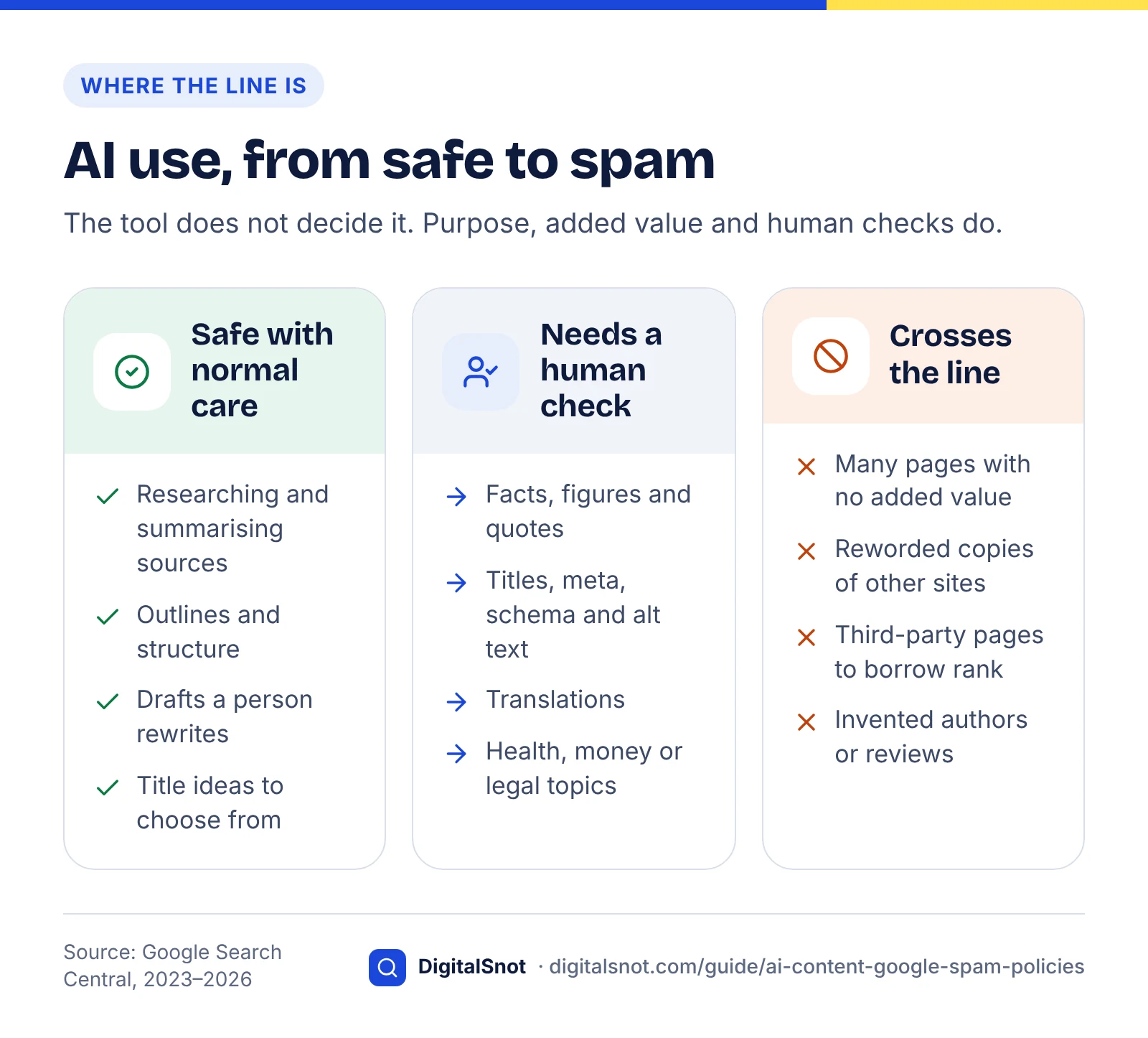
Scaled content abuse is producing many pages mainly to manipulate search rankings rather than to help people, by any method. AI makes this line cheap to cross, but the policy is about the pattern, not the tool.
Google's spam policies define it in one sentence: "Scaled content abuse is when many pages are generated for the primary purpose of manipulating search rankings and not helping users." When Google introduced the policy on 5 March 2024, its Search Central announcement said it applies whether content is produced through "automation, human efforts, or some combination of human and automated processes."
Google's own examples
The spam policies list examples of scaled content abuse, including:
- using generative AI tools or similar tools to generate many pages without adding value for users;
- scraping feeds, search results or other content and lightly rewording it to generate many pages;
- stitching or combining content from different web pages without adding value; and
- creating multiple sites with the intent of hiding the scaled nature of the content.
In May 2026 Google clarified that its spam policies apply to all of Search, including generative AI responses, and now lists attempts to manipulate those responses in its definition of spam. Its guide to optimising for generative AI features spells out one consequence: creating separate content for every variation of a query, primarily to manipulate rankings or generative AI responses, violates the scaled content abuse policy.
How it is enforced
Google says sites that violate its spam policies may rank lower or not appear in results at all. Enforcement comes from automated systems, which Google refreshes in spam updates, and from manual actions, which are reported to the site owner in Search Console. The most recent spam update ran from 24 September to 8 October 2026, a rollout of 13 days and 16 hours, and applied globally in all languages, according to the Google Search Status Dashboard. Google did not say which policies it targeted (checked October 2026).
The policies have had a measurable effect by Google's own account. When the March 2024 changes finished rolling out on 19 April 2024, Google reported 45% less low-quality, unoriginal content in search results, above the 40% it had originally expected.
Worked example: when location pages cross the line
Example: a cleaning company with one office in Leeds asks an AI tool to write 300 "office cleaning in [town]" pages, identical except for the town name. Nobody learns anything the main service page does not already say; the pages exist because they were cheap to make and might rank. That is the pattern the policy describes.
The safer version covers only towns the company genuinely serves, and each page carries something true and specific: which team covers it, typical response times, photos of local jobs, and the access or parking constraints the crew deals with there. AI can draft the shared explanations; the local facts come from the business. Our guide to building service and location pages that AI answers can quote covers what to include on each one.
Site reputation abuse and expired domains
Site reputation abuse and expired domain abuse are both about borrowing ranking strength you did not earn: hosting other people's content to ride on your site's signals, or buying an old domain to publish low-value pages under its past reputation. AI makes both cheap to fill with text.
Site reputation abuse
Site reputation abuse is publishing third-party pages on a site mainly to take advantage of the host site's ranking signals. Google's spam policies give the example of a medical site hosting third-party "best casinos" content. Third-party content is not a problem in itself: syndicated news, user-generated content, and affiliate links or ad units handled appropriately are listed as exceptions.
In November 2024 Google tightened the policy wording. Using third-party content to exploit a site's ranking signals is a violation "regardless of whether there is first-party involvement or oversight of the content." Google adds that simply moving such content into a subdirectory of the same domain does not resolve the issue.
The policy now works differently in Europe. In its August 2026 update, Google said that, following discussion with the European Commission, it was adjusting enforcement within the European Economic Area (EEA) from 30 August 2026. For users outside the EEA, a manual action under the policy still directly affects search results for the affected part of the site, and the rest of the site is not affected. For users inside the EEA, "the impact of the manual action won't apply", and the affected section may be separated in Google's systems so that it ranks independently over time (checked October 2026).
For a small business, the realistic risk is being the host. If someone offers to pay you to publish "partner" or "sponsored" articles about topics unrelated to your business, such as loans, casinos or coupon codes, that is the pattern this policy targets.
Expired domain abuse
Google's spam policies define it precisely: "Expired domain abuse is where an expired domain name is purchased and repurposed primarily to manipulate search rankings by hosting content that provides little to no value to users." Google's examples include casino-related content on a former elementary school site. Google also says it is fine to use an old domain name for a new, original site designed to serve people first.
Both policies share one test: would this content earn its rankings on a site with no history? If the honest answer is no, and the history is the reason it is on that domain, do not publish it.
Non-commodity content: what AI cannot add for you
Non-commodity content is material that offers expert or first-hand insight beyond common knowledge. It is the part of a page that an AI model cannot produce from its training data, and Google says it will likely matter more to visibility in generative AI search than any of its other suggestions.
Google's May 2026 guide explains the idea with two headlines. Its example of commodity content is a post like "7 Tips for First-Time Homebuyers", which it says "is often based on common knowledge, which could originate from anyone, and typically adds little unique insight for readers." Its non-commodity example, "Why We Waived the Inspection & Saved Money: A Look Inside the Sewer Line", "provides unique expert or experienced takes that go beyond common knowledge and the ordinary."
The guide's advice is direct: "Don't just recycle what others on the internet have already said, or could easily be produced by a generative AI model." And: "Creating content that people find unique, compelling, and useful will likely influence your website's presence in generative AI search in the long run more than any of the other suggestions in this guide."
What only you can add
- First-hand experience: what happened when you did the job, tested the product or handled the complaint, with your own photos.
- Your own numbers: typical job durations, the questions customers ask most, what drives your prices, taken from your records rather than estimated by a model.
- Judgement: when you advise against an option, and the mistakes you see again and again.
- Local and sector specifics: the rules, suppliers and conditions where you work.
- Original analysis: a comparison, checklist or calculation you built and can explain.
- Accountability: a named person who stands behind the advice.
Example: turning a commodity draft into a useful page
Example: a dental clinic in Pune asks an AI tool for "10 tips for whiter teeth". The draft is accurate but interchangeable with thousands of others. The useful version keeps two or three of the general points, then adds what the clinic sees in its own consultations: which whitening options it offers and why, which patients it turns away and for what reasons, what a first appointment involves, and before-and-after photos used with consent. AI saved time on structure; the clinic supplied everything worth citing.
Find the commodity baseline first
Before writing, look at what the pages already ranking or cited for your topic all say. That shared material is the commodity baseline: cover it briefly, then go beyond it. The free Cited Content Pattern Analyzer compares the pages an AI answer cites to show what they have in common, and the Entity Coverage Checker lists the entities your draft mentions against the ones competitors cover. Use both to find gaps you can fill from your own knowledge, not as a list of things to copy. Our guide to getting cited in AI search covers what else makes a page worth quoting.
A safe AI-assisted writing workflow
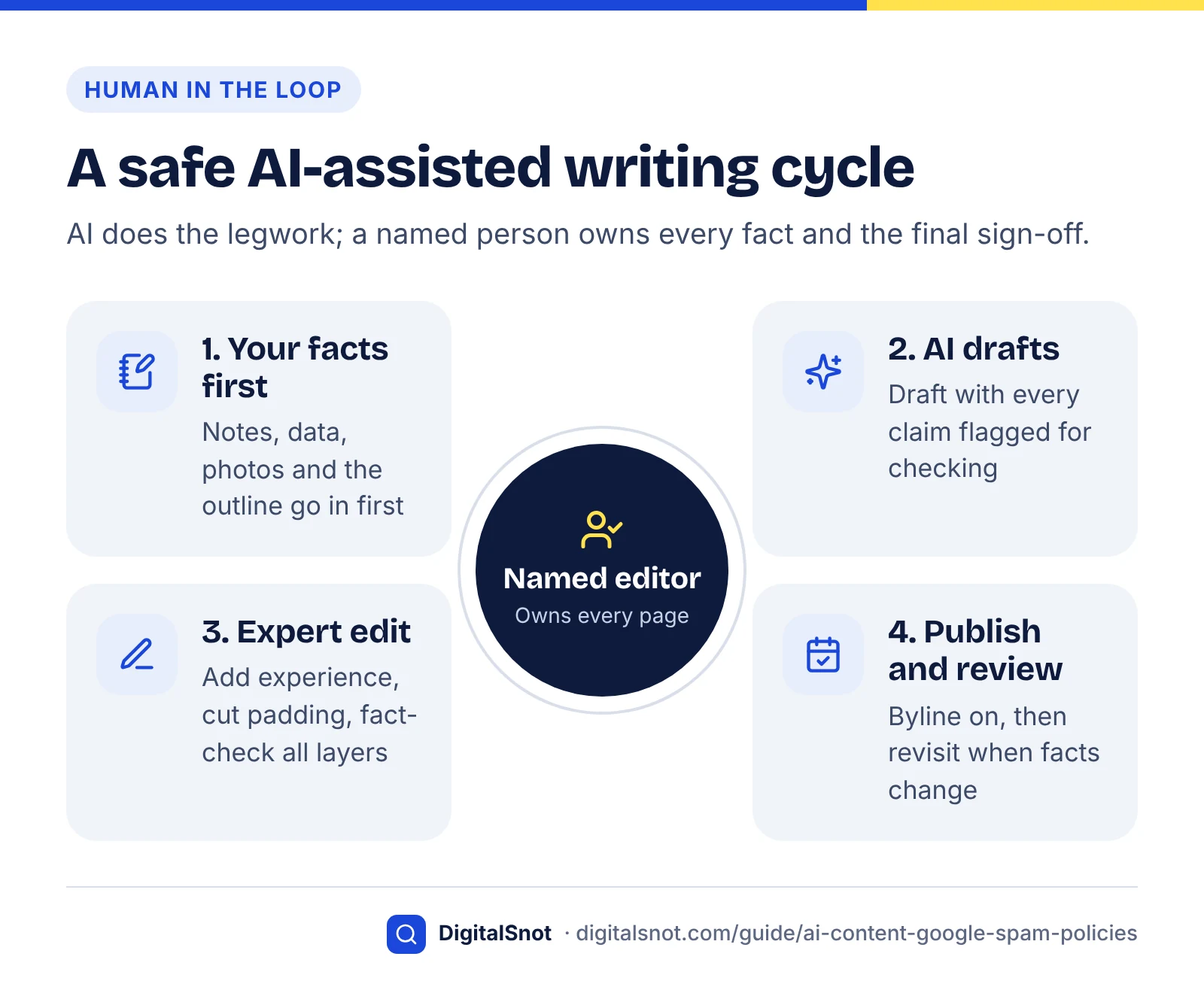
A safe workflow gives AI the repetitive work, such as research summaries, outlines and first drafts, and keeps every judgement, fact and signature with a named person. The table shows where that split falls at each stage.
Method: we mapped each stage of a typical article workflow to the Google document that governs it, then marked what AI can reasonably do and what a person must check. It is our framework, not a Google requirement, so adapt it to your team.
| Stage | Where AI helps | What a person must do | Google basis |
|---|---|---|---|
| Topic choice | Brainstorm customer questions; group related queries | Pick topics where you have real experience or data to add | Non-commodity content (AI features guide) |
| Research | Summarise sources; suggest counter-arguments | Open every source and confirm it says what the summary claims | "Useful when researching a topic"; hallucination warning |
| Outline | Propose headings and order | Add the sections only you can write: process, prices, local detail, examples | "Add structure to original content" |
| First draft | Write plain explanatory passages | Rewrite in your voice; add experience, photos and judgement; cut padding | Effort and originality (helpful content) |
| Facts, figures, quotes | Flag every claim that needs a source | Verify each against a primary source; delete what you cannot trace | Manual fact-checking is "critical" (1 October 2026) |
| Title and meta description | Suggest variants | Check each is accurate and matches the page | Metadata review (1 October 2026) |
| Structured data | Draft the JSON-LD | Validate it; confirm every value is visible on the page | Metadata review; structured data guidelines |
| Image alt text | Describe images | Check against the actual image; remove keyword stuffing | Metadata review (1 October 2026) |
| Translation | First-pass translation | A fluent reviewer checks each language before it goes live | Scaled content risk if published at volume without value |
| Byline and sign-off | None | A real, named person takes responsibility | Who created it; no fabricated authors |
The workflow step by step
- Brief from your own material. Give the AI your notes, job sheets, photos and data with the outline, so the draft is built around your facts rather than the model's guesses.
- Draft with AI and flag the claims. Ask the tool to list every statistic, date, name and quote it used.
- Expert edit. The person who knows the subject rewrites the draft, cuts padding and adds experience, judgement and examples.
- Fact-check every layer. Body, title, meta description, structured data and alt text, as the next section describes.
- Sign off and publish. A named author or editor takes responsibility, and their byline goes on the page.
- Review on a schedule. Revisit key pages when facts change, and at least every quarter.
If you publish at volume, add a weekly cap on pages that can go live without a second reviewer. Teams drift into scaled content when output grows faster than anyone can check it. If you hire writers or an agency, ask to see their AI workflow in writing; our guide to choosing an SEO agency lists other questions worth asking.
Fact-checking text, titles, metadata, schema and alt text
Fact-check AI content in five layers: the visible body text, the title element, the meta description, the structured data and the image alt text. Google's 1 October 2026 guidance names the last four explicitly because they can appear in Search results even when nobody reads them on the page.
1. Body text
- Highlight every checkable claim: numbers, dates, names, prices, laws, product specifications and quotes.
- Find the primary source for each, open it, and confirm it says exactly what the draft claims. AI tools can attach invented figures or URLs to real publishers.
- Check quotes word for word, and attribute them to the right person, publication and date.
- Delete any claim you cannot trace. A shorter, accurate page beats a longer one with a fabricated statistic.
- Check your own business facts. AI drafts can carry over an old phone number, price or address from elsewhere on your site. The free AI Answer Consistency Checker finds conflicting brand facts, such as numbers, phone and address, across your pages and listings.
Five places people forget to fact-check AI text
2. Title element
Check that the title promises only what the page delivers. Watch for years the content does not justify, statistics that are not in the body, superlatives, and "updated" claims when nothing was updated. A title that oversells is also a common reason Google rewrites it; our post on title tag mistakes covers the patterns to avoid.
3. Meta description
Read it as a searcher would. AI-written descriptions tend to add offers, guarantees or features the business does not have. Each description should summarise this page accurately. Our on-page SEO checklist explains how to write titles and descriptions that match the page.
4. Structured data
AI tools write plausible JSON-LD quickly, including properties whose values appear nowhere on the page. Google's general structured data guidelines say not to mark up content that is not visible to readers, and not to mark up irrelevant or misleading content such as fake reviews. A structured data issue can lead to a manual action that removes the page's eligibility for rich results. Validate the markup with Google's Rich Results Test, then compare every value with the visible page. Our schema markup guide lists which types still earn a Google feature in 2026.
5. Image alt text
Alt text should describe what is actually in the image for someone who cannot see it. AI tools describe images confidently and sometimes wrongly, misreading products, places or people, and they tend to add keywords that do not describe anything. Check each description against the image itself.
To see the hidden layers in one place, run the URL through the free On-Page SEO Checker. It checks a page against a target keyword, including its title, description, headings and images, so you can read the metadata the AI wrote before a searcher sees it.
Disclosure, bylines and who is responsible
Disclose AI use where readers would reasonably wonder how a page was made, put a real, accountable person's name on it, and never invent authors. Google asks for all three, and in the EU the law now requires disclosure for some content.
What Google asks
Google's guidance on helpful, reliable, people-first content asks you to think about who created the content, how and why. Its "How" questions include: "Is the use of automation, including AI-generation, self-evident to visitors through disclosures or in other ways?" The page says disclosures are most useful for content where someone might think "How was this created?" Google's 2023 post adds that giving AI an author byline is probably not the best way to make its role clear.
In early October 2026 Google added a warning to the same page. Fabricating creator profiles, for example with AI-generated headshots, made-up names or false credentials, to make content look as if human experts wrote it is a form of deception. Google says any form of deception makes a page "untrustworthy to both users and our automated quality systems", and is a signal of a low-quality page.
How to word a disclosure
Be specific. In a 2024 study of 4,976 people in the US and UK, published in PNAS Nexus, labelling headlines "AI-generated" lowered how accurate people judged them and their willingness to share them. That held whether the headlines were true or false, and whether a person or AI wrote them. The effect was 2.66 percentage points, about a third of the effect of labelling a headline false. The authors found that people assumed the label meant AI had written the headline entirely, with no human supervision.
The fix is to say what AI did and what the person did. For example: "Drafted with AI assistance from our own notes. Facts checked and edited by [Name], [role], on [date]." That corrects the assumption of full automation and tells the reader who is accountable.
The EU AI Act: a legal layer since 2 August 2026
Article 50 of the EU AI Act applies from 2 August 2026. According to the European Commission's FAQ on Article 50, deployers must disclose that text published to inform the public on matters of public interest has been artificially generated or manipulated. The duty does not apply where the content has undergone human review or editorial control and a person or organisation holds editorial responsibility for publishing it.
The Commission adds that content generated before 2 August 2026 does not need labelling retroactively, although it encourages deployers to label it where possible. Whether a particular page concerns a matter of public interest is a legal question we cannot answer for you; if you publish in the EU or for EU readers, ask a legal adviser. Either way, the workflow above, with a named editor who substantively reviews each page, matches the kind of review the exemption describes.
Who is responsible
You are. Whatever tool wrote the draft, the business that publishes a page answers for it. Make one named person responsible for signing off every page, keep a simple log of who checked what and when, and link their byline to a real profile of their experience.
Should you publish it? A decision table
Use this table before publishing any AI-assisted page. Find the row that best matches the page, and do what the last column says.
| If the page is… | Risk | Do this |
|---|---|---|
| An AI draft on a topic you know, rewritten with your experience and fact-checked | Low | Publish under a named author; add a short, specific note on AI's role if readers would wonder |
| One of many near-identical pages from a template (towns, products, keyword variants) | High: scaled content abuse | Publish only the variants with distinct, real information; merge or drop the rest |
| A reworded or summarised version of competitors' articles | High: Lowest quality rating, and scaled content if repeated | Do not publish; start again from your own knowledge, data or analysis |
| A machine translation of an existing page | Medium to high, depending on volume and review | Publish only after a fluent person has reviewed it |
| About health, money, legal or safety topics | High accuracy bar | Have a qualified person review it and name them on the page; cite primary sources |
| Third-party "partner" or "sponsored" content unrelated to your business | High: site reputation abuse | Decline it, or remove it if it is already live |
| Content for an expired domain you bought for its history | High if the content offers little value | Use the domain only for a new, original site built for people |
| AI-written reviews, testimonials or author profiles | Deception | Never publish; use real reviews and real people |
| AI content already live that nobody checked | Accuracy and quality risk | Audit it: fact-check all five layers and add a byline, or remove it |
One rule sits under every row: if a page exists mainly because it was cheap to make, rather than because a reader needs it, do not publish it.
Signs of a spam problem and what to do
The clearest sign of a spam problem is a manual action notice in Search Console. Less obvious signs are a sharp drop in a group of AI-produced pages that lines up with a spam update, or a growing set of pages that Google rarely shows to anyone.
Warning signs to check monthly
- Any message in the Manual actions report in Search Console.
- A sudden drop in one directory or template that starts inside a spam update window, such as 24 September to 8 October 2026.
- Many recently published pages with few or no impressions in the Search Console Performance report.
- Pages that differ only by a keyword, place name or product variant.
- Claims on live pages that nobody on the team can trace to a source.
- Third-party or "sponsored" sections unrelated to your business.
If you have a manual action
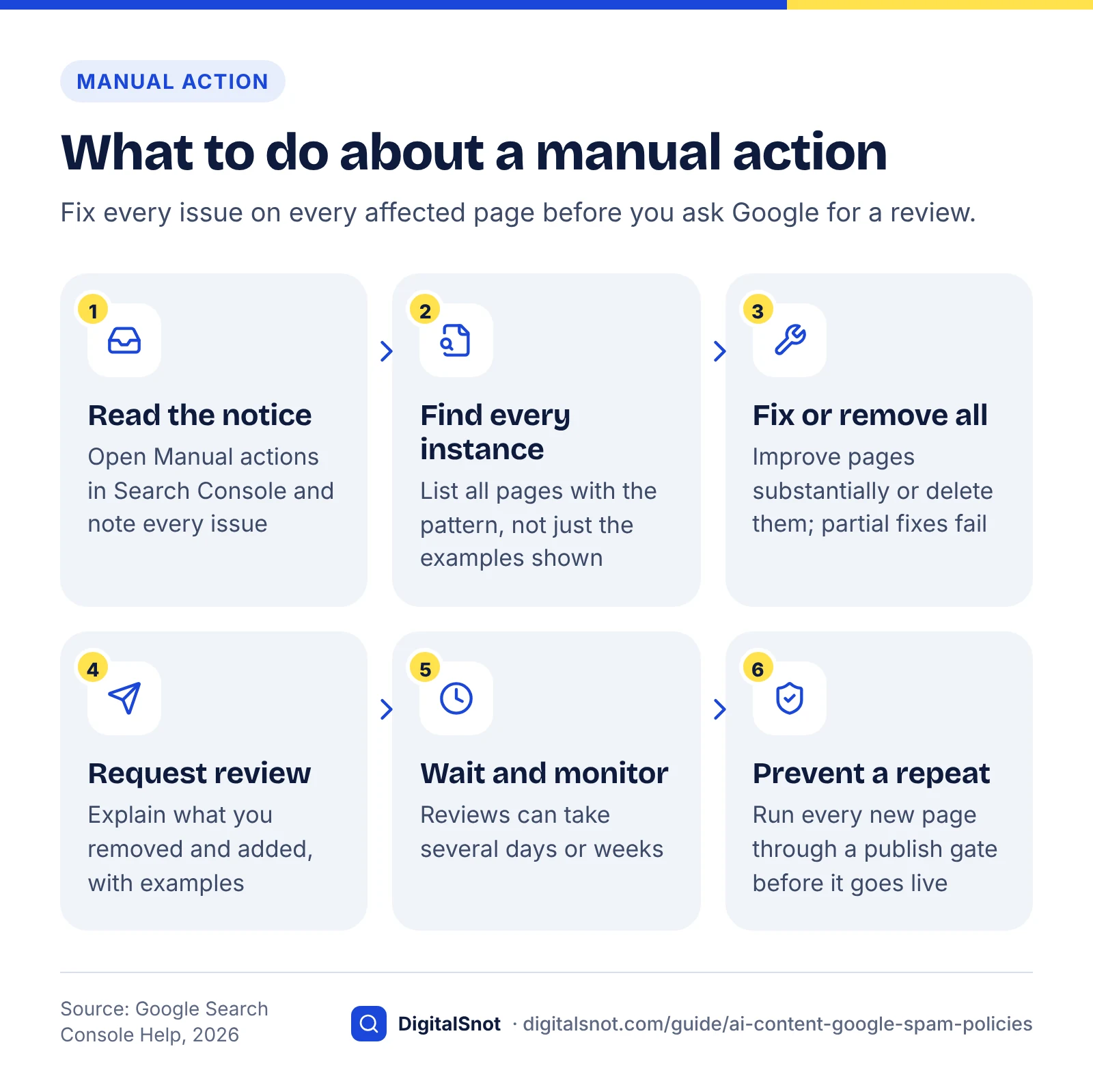
Google's Manual actions report help page is clear that you must fix every listed issue on every affected page, because a partial fix does not earn a partial return to results. Then select Request Review and explain exactly what you removed and what you improved, with examples. Google says most reviews take several days or weeks, and it notifies you by email.
If there is no message but traffic fell during a spam update
Reconsideration requests exist only for manual actions, so there is nothing to submit after an automated demotion. Remove or substantially improve the pages that break the policy, rather than changing a few words, and give Google time to recrawl them. Do not delete large parts of the site in a panic: first confirm that the update caused the drop. Our core update recovery guide shows how to rule out other causes and compare the weeks around a rollout.
Self-audit an existing AI content library
- Export every URL published since you started using AI, with clicks and impressions for the last three months.
- Group pages by template or topic, and flag any group of near-identical pages.
- Run each page through the publish gate below: keep, improve, merge or remove.
- Fact-check the pages you keep, including their metadata, and give each a real byline.
- Log what you changed and when, so you can match changes to later movement.
The publish gate: a value-add checklist
Before any AI-assisted page goes live, it should pass every check below. If it fails one, fix it or hold it back. The right-hand column shows which Google document each check comes from.
| Check | Passes when | Google basis |
|---|---|---|
| Purpose | You would publish it even if search engines did not exist, because a reader needs it | Helpful content: why the content was created |
| Non-commodity value | It contains at least one first-hand detail, real number or original analysis an AI model could not produce | Guide to generative AI features |
| Accuracy | Every figure, date, name and quote has been traced to a source; untraceable claims are gone | Generative AI guidance, 1 October 2026 |
| Metadata | Title, meta description, structured data and alt text have each been read and matched to the page | Generative AI guidance, 1 October 2026 |
| Scale | It is not one of many near-identical pages, or each variant has distinct, real information | Spam policies: scaled content abuse |
| Authorship | A real, named person signs it off, and the byline links to their actual experience | Helpful content: who created it |
| Disclosure | If readers would wonder how it was made, a specific note explains AI's role and who checked it | Helpful content: how it was created |
| Hosting | None of it is third-party content placed to borrow your site's rankings | Spam policies: site reputation abuse |
Used this way, AI makes a small team faster without making its site riskier. The work it cannot do, knowing the subject, checking the facts and standing behind the page, is exactly what Google's 2026 guidance asks you to keep.
If you would like help building this into your content process, from briefs to fact-checking and refreshes, that is part of our content SEO service. When you are ready to talk it through, get in touch.
Free tools in this guide
- Cited Content Pattern Analyzer See the formats and patterns of cited pages, and get a content plan.
- Entity Coverage Checker Find the brands, tools and concepts competitors cover and you miss.
- AI Answer Consistency Checker Find brand facts that differ between your pages and listings.
- On-Page SEO Checker Check titles, headings, images, links, schema and indexing for any page.
By the numbers
- Google's generative AI content guidance began calling manual fact-checking of all AI-generated content critical
- 1 Oct 2026
- Source: Google Search Central
- less low-quality, unoriginal content in Google results after the March 2024 core update and new spam policies, per Google
- 45%
- Source: Google
- length of the September 2026 spam update (13 days 16 hours), which ran from 24 September to 8 October 2026
- 13 days
- Source: Google Search Status Dashboard
- date the EU AI Act's Article 50 transparency rules began to apply, including disclosure of some AI-generated public-interest text
- 2 Aug 2026
- Source: European Commission
Frequently asked questions
Does Google penalise AI-generated content?
No, not for being AI-generated. Google's position since February 2023 is that appropriate use of AI or automation is not against its guidelines. What Google acts on is spam: using AI, people or both to produce many pages mainly to manipulate rankings without adding value breaks its scaled content abuse policy, and such pages can rank lower or drop out of results. Its rater guidelines also say AI use alone does not determine a page's quality rating.
What is scaled content abuse?
Scaled content abuse is Google's spam policy against generating many pages for the primary purpose of manipulating search rankings rather than helping users. It applies however the pages are made, by automation, people or a mix. Google's examples include mass AI pages that add no value, scraped and lightly reworded content, and pages stitched together from other sites. Google introduced the policy in March 2024 and enforces it through spam updates and manual actions.
What changed in Google's AI content guidance on 1 October 2026?
Google added a manual fact-checking instruction. Its generative AI content guidance now explains that models predict likely words rather than retrieve facts, so their output can contain hallucinations, and says it is critical to manually fact-check and review all AI-generated content before publishing. The review explicitly covers title elements, meta descriptions, structured data and image alt text, because all of these can appear in Search results.
Do I have to disclose that I used AI?
Google does not require a label on every page, but it recommends disclosure where readers would reasonably wonder how content was made. Be specific about what AI did and who checked it, because a 2024 PNAS Nexus study found vague "AI-generated" labels make people assume full automation. In the EU, Article 50 of the AI Act has required disclosure for some AI-generated public-interest text since 2 August 2026, unless a person reviewed it and holds editorial responsibility.
Can I list AI as the author of my content?
Google advises against it. Its 2023 guidance says giving AI an author byline is probably not the best way to show readers that AI was involved; a short disclosure note does that better. Put a real, accountable person in the byline instead. Since October 2026, Google's helpful content guidance also calls fabricated creator profiles, such as AI-generated headshots or made-up names, a form of deception that signals a low-quality page.
Can Google detect AI-written content?
We found no Google documentation describing an AI-text detector used for ranking, and Google's guidance does not judge pages by whether a machine wrote them. It judges value, effort and spam patterns. Its rater guidelines say generative AI use alone does not determine effort or quality, while mass-produced, unoriginal pages are rated Lowest however they were made. Make each page useful and accurate rather than trying to pass an AI detector.
Is it safe to use AI for location pages or product descriptions?
It is safe when each page carries real, distinct information, and risky when pages differ only by a place name or product variant. Many near-identical pages generated mainly to rank fit Google's scaled content abuse pattern. Build location pages only for areas you genuinely serve, with local details you can show, and write product copy that adds facts beyond the manufacturer's data. Fact-check every specification before publishing.
How many AI-assisted pages can I publish without risk?
Google sets no number. The scaled content abuse policy is about purpose and value, not volume, so a handful of pages made only to rank can be a problem while hundreds of genuinely useful pages are not. In practice, publish only as fast as a named person can properly edit and fact-check each page. If output starts to outpace review, slow down, because that gap is how teams drift into scaled content.
What should I do if I get a manual action for AI content?
Fix every issue on every affected page, then request a review. Google's Manual actions report help says partial fixes do not earn a partial return. Remove or substantially improve the offending pages, select Request Review in Search Console, and explain what you removed and added, with examples. Reviews can take several days or weeks. If traffic fell without a notice, there is no review to request: fix the pages and wait for recrawling.
Sources
Every figure and claim in this guide comes from the sources below. We checked each one when writing and link to the original so you can read it yourself. Credit belongs to the authors and publishers listed. How we write and check our articles.
-
1
Google Search's guidance about AI-generated content
Google Search Central Blog · February 2023: appropriate AI use is not against guidelines; disclosure; AI should not be the byline.
-
2
Google Search's guidance on using generative AI content on your website
Google Search Central · 1 October 2026 manual fact-checking text, metadata review, scaled content warning, research use.
-
3
Google Tells Sites To Fact-Check AI Content Before Publishing
Search Engine Journal · Date and scope of the 1 October 2026 change, compared with the previous version of the page.
-
4
Search Quality Rater Guidelines (General Guidelines, September 2025)
Google · Generative AI use alone does not set effort or rating; Lowest rating for low-effort copied or AI content.
-
5
Spam policies for Google web search
Google Search Central · Definitions and examples of scaled content, site reputation and expired domain abuse.
-
6
What web creators should know about our March 2024 core update and new spam policies
Google Search Central Blog · 5 March 2024 launch of scaled content abuse; applies to automation, human effort or both.
-
7
Optimizing your website for generative AI features on Google Search
Google Search Central · May 2026: commodity vs non-commodity content; query-variation pages as scaled content abuse.
-
8
Google Search Status Dashboard: history
Google · September 2026 spam update: 24 September to 8 October, 13 days 16 hours, global.
-
9
Google Search: New updates to address spam and low-quality results
Google · 45% less low-quality, unoriginal content after rollout completed 19 April 2024 (40% expected).
-
10
Updating our site reputation abuse policy
Google Search Central Blog · November 2024: violation regardless of first-party involvement or oversight.
-
11
Update to the Site Reputation Policy
Google Search Central Blog · From 30 August 2026: different effect of manual actions inside and outside the EEA.
-
12
Creating helpful, reliable, people-first content
Google Search Central · Who, How and Why; AI disclosure question; October 2026 warning on fabricated creator profiles.
-
13
General structured data guidelines
Google Search Central · Markup must reflect visible content; no misleading markup; structured data manual actions.
-
14
People are skeptical of headlines labeled as AI-generated, even if true or human-made, because they assume full AI automation
PNAS Nexus (Altay and Gilardi, 2024) · 4,976 participants; AI labels cut perceived accuracy by 2.66 points vs 9.33 for false labels.
-
15
Transparency obligations under Article 50 of the AI Act
European Commission · Applies from 2 August 2026; public-interest text disclosure and the human review exemption.
-
16
Manual actions report
Search Console Help · Fix all issues on all pages before Request Review; review timing.