Guide · Technical SEO
How to make an AI agent-ready website: a 2026 checklist
A plain-English checklist for AI agents that book, buy and fill in forms: what is live in October 2026, what is still experimental, and what to fix first.

On this page (12 sections)
- 1What AI agents can actually do for your customers in 2026
- 2How AI agents read your website
- 3Make forms, bookings and checkout usable by agents
- 4Commerce protocols explained: UCP, ACP and Copilot Checkout
- 5Product feeds and Merchant Center: the data shopping agents use
- 6Identify and manage agent traffic: Google-Agent, ChatGPT and Web Bot Auth
- 7Lighthouse's Agentic Browsing audit: what it checks
- 8India: UPI agent payments and what to do now
- 9Which agent work fits your business: a decision table
- 10The agent-readiness scorecard: now, next and watch
- 11Mistakes to avoid and how to measure progress
- 12Sources
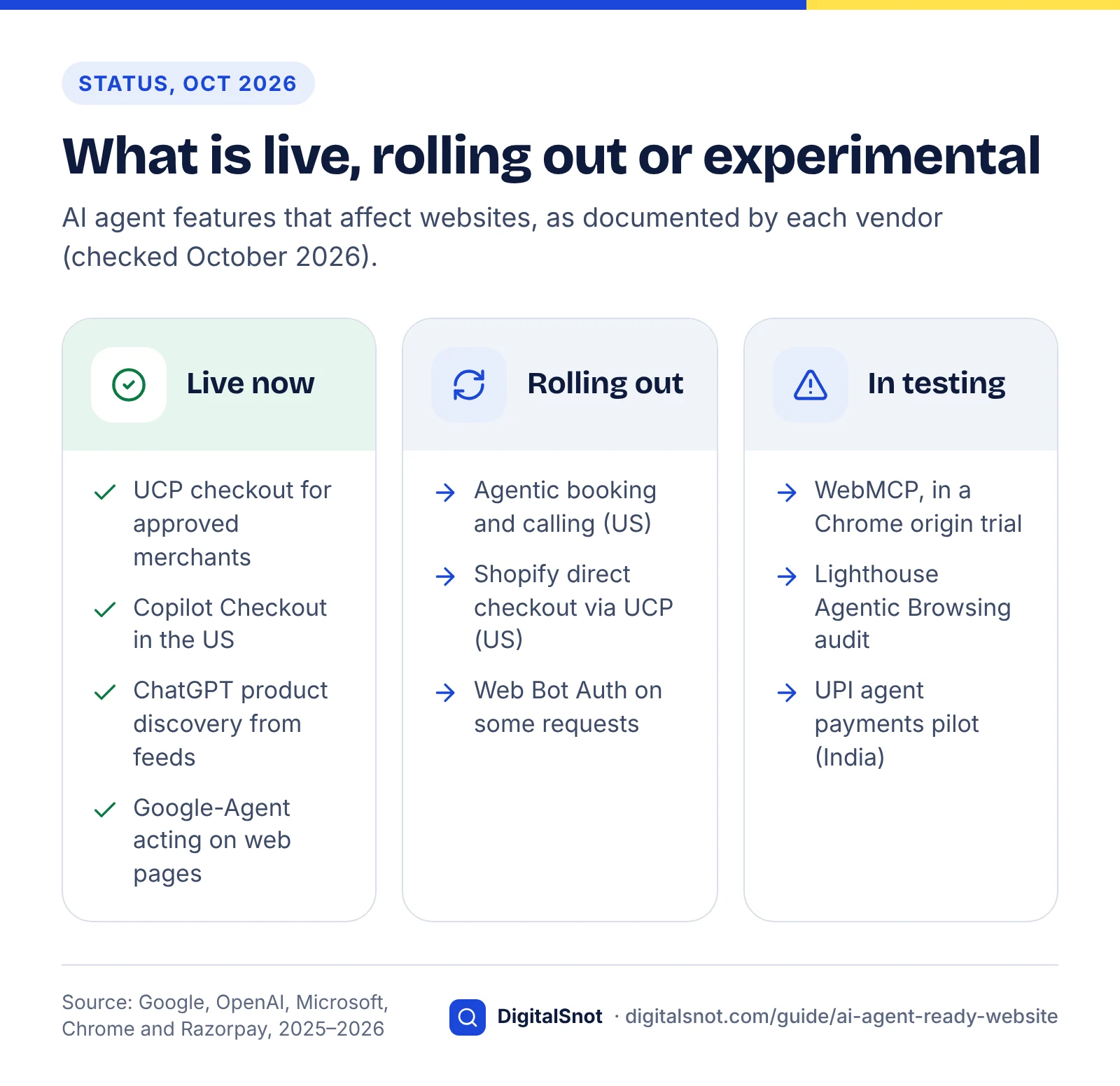
AI agents are assistants that act for a person instead of only answering: they compare products, fill in forms, phone businesses and, with some merchants, pay. In October 2026 a few of these features are live, more are rolling out in the US, and some are still experiments in Chrome. Most coverage mixes all three, which makes it hard to know what to fix first for an AI agent-ready website.
This guide separates what vendors have documented from what is announced or experimental, with a date on each claim. Who this is for: owners and marketers of service businesses and small online shops in the UK, India, the US and elsewhere. What you'll be able to do: check whether agents can reach and use your site, fix the forms and pages they struggle with, decide whether commerce protocols such as Google's UCP apply to you, and work through a now, next and watch checklist scored by effort and impact.
Agent readiness builds on being found. If AI answers never mention you, start with our guide to getting cited in AI search. This guide covers what happens after an assistant decides to act on your site.
What AI agents can actually do for your customers in 2026
Today, AI agents can check prices and availability, phone some businesses, start bookings and complete checkout with a limited set of merchants. Claims that agents will soon buy anything from anyone are, for now, announcements, regional pilots or experiments.
An AI agent is software that carries out a task for a person, such as booking a table or comparing products, rather than just returning an answer. That is close to how Google describes agents in its guide to optimising for generative AI features (May 2026), which also says its agent guidance is preliminary and still evolving.
Status board: what vendors have documented
Method: we read each vendor's own documentation or announcement, recorded the stated status and region, and rechecked every page in October 2026. Where a vendor has only announced a plan, the table says so. Each row is sourced in the section that covers it.
| Capability | Who | Status in October 2026 | Where |
|---|---|---|---|
| Checkout inside AI Mode and the Gemini app (UCP-powered) | Live for participating merchants; early access, and Google approves each integration | US, Canada and Australia named; onboarding starts in the US | |
| Direct checkout for Shopify stores through UCP | Google and Shopify | Eligible stores enrolled by default with an opt-out; rollout partial (reported September 2026) | US stores selling to US shoppers |
| AI Mode phoning businesses for prices and availability | Live; Google can call businesses for the user to check prices and availability | US | |
| Agentic booking and calling for more local services | Announced May 2026 for a US rollout over the summer | US | |
| Product discovery from merchant feeds (ACP), checkout on your own site | OpenAI | Live; Instant Checkout inside ChatGPT scaled back in March 2026 | ChatGPT, for integrated merchants |
| Copilot Checkout | Microsoft | Rolling out since January 2026 | US, on Copilot.com |
| Agents browsing and acting on web pages (Google-Agent, ChatGPT's cloud browser) | Google, OpenAI | Live; identifiable by user agent, IP ranges and some signed requests | Wherever those products are offered |
| UPI agent payments in ChatGPT | NPCI, Razorpay, OpenAI | Private beta pilot since October 2025 | India |
| WebMCP and Lighthouse's Agentic Browsing audit | Chrome | Experimental; WebMCP is in an origin trial | Developers only |
Two patterns stand out. First, checkout is moving towards either the merchant's own site or Google's protocol: OpenAI stepped back from checkout inside ChatGPT, while Google is widening checkout inside AI Mode. Second, almost every live commerce feature is US-first. If you trade in the UK or India, the agent work that pays off today is the work that also helps human visitors: clear pages, usable forms and accurate data.
How AI agents read your website
Browser agents look at your page the way a screenshot and a screen reader would, at the same time. Google says they work from screenshots, the page's DOM and the accessibility tree, so the HTML that helps disabled visitors is the same HTML that helps agents.
The accessibility tree is the browser's own summary of a page that keeps the roles, names and states of interactive elements, such as "button, Book now". The Chrome team's guide Build agent-friendly websites on web.dev explains that agents combine this tree with visual analysis of screenshots, so a page has to make sense in both. A button that is really a styled div with no role may be missing from the tree, and a field hidden behind an overlay may be skipped by the visual pass.
OpenAI gives the same advice. Its Publishers and Developers FAQ says its browser agent reads ARIA roles and labels, the attributes screen readers use, and asks developers to follow WAI-ARIA practices and add descriptive roles, labels and states to buttons, menus and forms.
Where structured data fits
Structured data is not how a browser agent clicks through your site. Google's generative AI guide says you don't need new machine-readable files, AI text files, special markup or Markdown to appear in Google Search, and it recommends semantic HTML where practical without demanding perfect markup.
Structured data still matters where systems read data instead of pages: product feeds, Merchant Center, and the Product, Offer and LocalBusiness markup that should agree with them. Our schema markup guide covers which types are still worth adding in 2026.
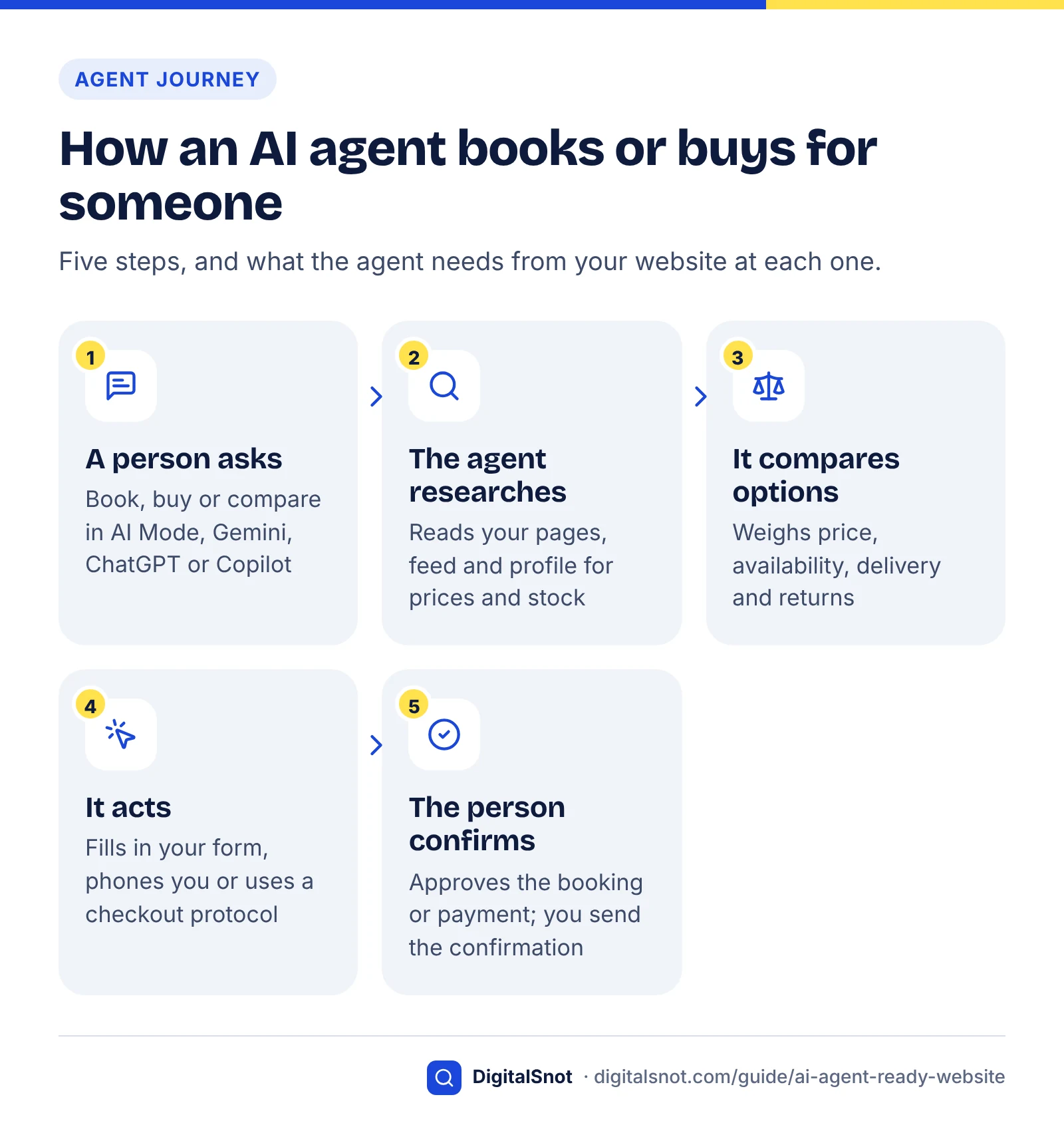
One rule follows from all of this: don't build a separate "agent version" of your pages. Agents read the page your customers see, so the fix is to make that page unambiguous. Use real controls and visible labels, put prices in text, and keep important details out of hover effects and images of text.
Make forms, bookings and checkout usable by agents
An agent can only finish a task if every step uses a real, labelled control and the information it needs is on the page. Fix the flow that earns you money first: the booking form, the quote request or the checkout.
Six fixes, in order
- Use native elements for actions. Use
<button>,<a href>,<select>and<input>. web.dev notes that agents recognise native semantic elements as interactive; if you must build a custom control, give it an appropriate role and a tabindex. - Label every field. Link each
<label>to its input with theforattribute so an agent can tell "Phone" from "Postcode". Placeholder text on its own is not a label. - Remove invisible layers. web.dev warns that an agent's visual analysis may discard elements covered by an overlay, even a transparent one. Check cookie banners, chat widgets and full-screen "tap to continue" layers on booking and checkout pages.
- Keep the layout still and the targets big. Agents act on screen positions, so a late banner that pushes a button down can make them miss it. Keep buttons and inputs large enough to survive visual analysis. Our website speed checks show how to spot layout shifts.
- Put the facts in text. State prices or price ranges, service areas, opening hours, lead times and availability on the page, not only in a PDF or an image.
- Make the finish line obvious. End with a confirmation page that repeats what was booked or bought, the reference number and the next step, and send the same details by email.
Why visible prices reduce phone calls
Google's AI Mode can now ring businesses for people. Its help page on checking local availability and pricing describes Google calling businesses on the user's behalf to gather details such as prices and availability. Google began these calls in US Search in 2025, and its help page on checking pricing with AI says businesses can opt out of AI calls (checked October 2026).
At Google I/O in May 2026, Google said it was widening agentic booking in Search. Search pulls together pricing and availability and then links people to finish the booking with the provider. For categories such as home repair, beauty and pet care, people can ask Google to call businesses for them. Google said this would roll out to everyone in the US over the summer, so check what your own customers can actually see before relying on it.
For a service business the takeaway is practical. If your prices, slots and service area are on your site and your Google Business Profile matches them, an agent may be able to answer the question without a call and hand the customer straight to your booking page. Our guide to local SEO for AI search covers the profile and review side.
What an AI agent sees on your booking page
Test it like an agent
You don't need special tools for a first check. Complete your own booking or checkout using only the keyboard (Tab, Shift+Tab, Enter and Space), then repeat it with your phone's screen reader switched on. Any step where you get stuck, or hear "button" with no name, is a step an agent is likely to fail as well.
Commerce protocols explained: UCP, ACP and Copilot Checkout
A commerce protocol is a shared format that lets AI assistants read a merchant's catalogue and complete or hand off a purchase without a custom integration for each assistant. In 2026 the names to know are Google's Universal Commerce Protocol (UCP), OpenAI's Agentic Commerce Protocol (ACP) and Microsoft's Copilot Checkout, which is a checkout feature rather than a protocol you implement yourself.
Google: Universal Commerce Protocol
Google launched UCP on 11 January 2026 as an open standard for agent-led shopping, developed with Shopify, Etsy, Wayfair, Target and Walmart, according to Search Engine Land's launch report. It is designed to work alongside other agent standards, including Agent2Agent, the Agent Payments Protocol and the Model Context Protocol.
Google's Merchant Center help page on UCP-powered checkout sets the limits. It applies to products eligible in the United States, Canada and Australia, for participating merchants. Access is by early-access invitation after you complete the technical work and submit an interest form, and only listings marked as checkout-eligible show the buy button. You remain the merchant of record. In October 2026 Google began rolling out a UCP integration hub in Merchant Center to US merchants, and said Australia and Canada would follow next year (checked October 2026).
Shopify is the shortcut for small US stores. In September 2026 Search Engine Land reported that Google was enrolling eligible Shopify merchants automatically: US-based stores selling to US customers, with a valid Merchant Center account and eligible products. Merchants can switch direct checkout off in Shopify's agentic settings. Their products still appear in AI Mode and Gemini, but shoppers are sent to the store's own site to pay.
OpenAI: Agentic Commerce Protocol
OpenAI changed course in March 2026. In Powering Product Discovery in ChatGPT it said the first version of Instant Checkout did not give the flexibility it wanted, so merchants can now use their own checkout while OpenAI concentrates on product discovery. ACP is being extended to carry product feeds and promotions. Target, Sephora, Nordstrom, Best Buy and Home Depot have integrated for discovery, and Shopify merchants are covered through Shopify Catalog with no extra work.
Microsoft: Copilot Checkout
Microsoft launched Copilot Checkout and Brand Agents in January 2026. Search Engine Land reported that shoppers can buy inside Copilot without being sent to another site, starting in the US on Copilot.com, with PayPal, Shopify and Stripe as partners. Shopify merchants are enrolled automatically after an opt-out window.
| Question | Google UCP | OpenAI ACP | Copilot Checkout |
|---|---|---|---|
| Where the purchase happens | Inside AI Mode and Gemini, or on your site if you opt out | On your own site (since March 2026) | Inside Copilot |
| Status, October 2026 | Live for participating merchants | Live for product discovery | Rolling out since January 2026 |
| Markets | US, Canada and Australia (Google's help page) | Not stated in OpenAI's post | US |
| Easiest route in | Shopify (US), or Merchant Center plus an approved integration | Shopify Catalog, or a direct integration | Shopify, PayPal or Stripe |
| Who owns the sale | You, as merchant of record | You, through your checkout | Check your payment partner's terms |
For most small shops your platform chooses the protocol. Your decisions are narrower: whether to stay opted in, how accurate your product data is, and how you measure sales. Shopify told merchants that some features, including certain checkout blocks, product bundles, custom pixels and Google Analytics client-side tracking, aren't supported in Google's direct checkout, according to the same Search Engine Land report. Orders placed in AI Mode may therefore not appear in GA4 the way site orders do.
UCP, ACP and Copilot Checkout in 15 seconds
Product feeds and Merchant Center: the data shopping agents use
Shopping agents mostly read structured product data, not your page design. For physical products, a complete and accurate Merchant Center feed, plus whatever catalogue your platform shares with OpenAI and Microsoft, is the biggest single lever for agentic shopping.
Google's Merchant API added conversational attributes in May 2026: question-and-answer pairs, document links and related products, according to its latest updates log, and Merchant Center lets you override your return policy for individual products. Fields like these let an assistant answer "does this fit my model?" or "can I send it back?" without guessing.
Feed checklist for agents
- Price and availability in the feed match the product page, including sale prices and out-of-stock variants.
- Shipping cost, delivery speed and regions are set in Merchant Center, not only described in a footer.
- Returns show the window, the cost and a link to the full policy.
- Identifiers include brand, GTIN or MPN, and clear variant attributes such as size, colour and material.
- Answers cover real customer questions as question-and-answer pairs, with manuals or size guides linked as documents.
On the product page, keep Product and Offer markup consistent with the feed. The free Schema Markup Generator builds Product JSON-LD you can paste into the page. Afterwards, compare its price and availability with the feed, because an agent cannot reliably settle a conflict between your page and your feed.
Service businesses have no Merchant Center equivalent. Your "feed" is a services and prices page with one section per service, plus your Business Profile. Treat them with the same discipline: one price per service, the same hours everywhere, and dates on anything seasonal.
Identify and manage agent traffic: Google-Agent, ChatGPT and Web Bot Auth
Agents identify themselves through user-agent strings, published IP ranges and, increasingly, cryptographic signatures. Because they act on a person's request, robots.txt usually doesn't control them, so your CDN and firewall settings decide whether they reach your forms.
Google-Agent
Google's documentation on user-triggered fetchers lists Google-Agent, which agents running on Google infrastructure use to navigate the web and take actions when a user asks. Its user-agent strings contain Google-Agent, its IP addresses come from the published user-triggered-agents.json list, and like other user-triggered fetchers it generally ignores robots.txt.
Web Bot Auth is an experimental way for bots to sign their requests cryptographically, so a site or CDN can check who really sent them. Google signs a subset of Google-Agent requests this way, authenticated as agent.bot.goog, and advises sites to keep checking IP addresses, reverse DNS and user agents as well, because not every request is signed yet (checked October 2026).
OpenAI's agents
For the cloud browser in ChatGPT Work, OpenAI's allowlisting article says requests are signed with HTTP Message Signatures (RFC 9421) and carry a Signature-Agent header naming https://chatgpt.com, and that Akamai and Cloudflare verify these signatures automatically. OpenAI's user-triggered fetcher, ChatGPT-User, and its search and training crawlers are covered in our guide to blocking or allowing AI crawlers.
Cloudflare's Agent setting
Cloudflare now sorts AI traffic into Search, Agent and Training, with controls on every plan including Free. Its July 2026 post Your site, your rules defines Agent traffic as tools acting for a person in real time. It says that from 15 September 2026, new domains have Agent and Training traffic blocked by default on pages that show ads, while Search stays allowed. If your booking or product pages carry ads and sit on a newly added domain, agents may already be turned away. Cloudflare applies the strictest matching rule, so blocking Training can also block crawlers that do more than one job, such as Googlebot.
| Signal | Example | How far to trust it |
|---|---|---|
| User-agent string | Google-Agent | Low on its own, because anyone can copy it |
| Published IP ranges | Google's user-triggered-agents.json | Good, if you keep the list current |
| Signed request | agent.bot.goog, or a Signature-Agent header naming chatgpt.com | Strongest, but only some requests are signed today |
| CDN classification | Cloudflare's Agent category | Convenient; check what the default does on your domain |
A four-step check
- Check your CDN or firewall first. In Cloudflare, look at the Agent setting and any challenge rules on booking and checkout paths. Other CDNs and security plugins have their own bot rules, so check those too.
- Check robots.txt for the crawlers that find you. Agents usually discover you through search first. Run your homepage through the free AI Crawler Checker to see, crawler by crawler, whether Google, Bing, ChatGPT search, Perplexity and Claude may fetch it. A blocked search crawler costs you more than any agent setting.
- Look in your logs. Run a sample of your Apache or Nginx access log through the AI Bot Log Analyzer to see which AI bots fetched which pages, then search the raw log for
Google-Agentto find agent sessions on your forms. - Verify before you allow or block. Match IP addresses against Google's published list, and let your CDN verify signatures rather than trusting user-agent strings.
Lighthouse's Agentic Browsing audit: what it checks
Lighthouse has an experimental Agentic Browsing category that tests whether AI agents can understand and operate a page. It is a useful free diagnostic, but it reports a pass ratio rather than a 0 to 100 score, and part of it depends on a web standard that is still in trial.
According to Chrome's Lighthouse agentic browsing scoring page, the category covers four areas and shows a fractional score: how many readiness checks the page passes. Testing it needs Chrome 150 or later, WebMCP audits need registration for the WebMCP origin trial, and results can vary with how a site registers tools or responds to agent requests (checked October 2026).
WebMCP is a proposed web standard that lets a page describe actions, such as searching products or booking a table, as structured tools an AI agent can call. Lighthouse checks both declarative tools, defined on HTML forms, and imperative tools, defined in JavaScript.
| Audit area | What it looks for | What to do |
|---|---|---|
| Accessibility for agents | A sound accessibility tree: named controls and valid roles | Fix now; these are the same fixes as in the forms section |
| Layout stability | Cumulative Layout Shift (CLS) | Fix now on booking and checkout pages |
| WebMCP integration | Registered tools, forms without declarative WebMCP, and tool schema validity | Watch; act only if your developer has joined the origin trial |
| Discoverability | An llms.txt summary at the domain root | Optional; Google Search doesn't use llms.txt |
The llms.txt check shows why the category is a diagnostic, not a target. Lighthouse looks for the file, while Google's generative AI guide says Google Search doesn't use llms.txt, though you can keep one for other services that read it. Labelled forms and accurate prices will do more for agents than a summary file.
Run the category on your main booking or product page, fix the accessibility and layout findings, and note the WebMCP findings for later. The wider technical SEO audit checklist covers the crawl, indexing and speed basics that agents depend on before any of this.
India: UPI agent payments and what to do now
India has one of the few documented agent payment pilots outside the US. NPCI, Razorpay and OpenAI announced agentic UPI payments in ChatGPT as a private beta in October 2025; it is a pilot, not a feature a merchant can switch on.
Razorpay's announcement describes the flow. A person pre-authorises an agent to buy within spending limits they set, using UPI Reserve Pay and UPI Circle. The agent checks the merchant's catalogue, presents options and places the order after a single confirmation. BigBasket was among the first merchants, Axis Bank and Airtel Payments Bank were the banking partners, and the partners said they planned to move to full production over the following months. We found no announcement of a general launch as of October 2026.
Google's UCP-powered checkout isn't offered in India either, since the Merchant Center help page names only the US, Canada and Australia. For Indian businesses the near-term work is the same as for everyone else, plus three local points:
- Keep catalogue and stock data machine-readable. The pilot's agent reads the merchant's catalogue, so a store with accurate prices, stock and delivery areas is ready for whichever protocol arrives.
- Ask your payment provider. If you use Razorpay or another UPI gateway, ask whether agentic payments are open to merchants like you and what onboarding would involve.
- Don't over-invest yet. A pilot with a handful of large merchants isn't a reason to rebuild your checkout.
Our prediction (not a sourced fact): pre-authorised UPI limits make India a likely early market for agent payments at scale, but the first wave will favour large grocery and food merchants. Small businesses gain most in the meantime by being easy to find and easy to book.
Which agent work fits your business: a decision table
Start from what you sell and where you sell it, not from protocol names. Find your row, do the first column now, and leave the last column until its status changes.
| If you are… | Do this first | Then | Skip for now |
|---|---|---|---|
| A service business taking bookings by phone or form | Publish prices, areas and availability in text; label your booking form | Check your CDN's agent setting; make your Business Profile match the site | Commerce protocols and WebMCP |
| A restaurant, salon or clinic using a booking platform | Make every "Book" link go straight to the right booking page | Show the same prices and hours on your site, profile and platform | Building your own booking integration |
| A US Shopify store | Check Shopify's agentic settings and decide whether to stay in Google's direct checkout | Clean your Merchant Center feed; track the orders GA4 may miss | A separate UCP integration |
| A retailer in the US, Canada or Australia not on Shopify | Fix your Merchant Center feed, shipping and returns data | Weigh a UCP integration and interest form against developer time | WebMCP tools |
| An online shop in the UK or India | Make checkout accessible and product data accurate | In India, ask your payment provider about agent payments | UCP, until Google lists your market |
| A B2B or lead-generation site | Make enquiry forms accessible; give pricing guidance in text | Log agent visits to your forms | Product feeds and checkout protocols |
| An ad-supported site on Cloudflare | Decide whether you want agent visits at all | Set the Agent control on purpose instead of keeping the default | Any agent work beyond that decision |
If you fit two rows, such as a clinic that also sells products online, do the first column of both before any work from the last column.
The agent-readiness scorecard: now, next and watch
Most of the value sits in a handful of low-effort tasks that also help human visitors. The scorecard below ranks 15 tasks so you can see which belong in this month's work and which only need watching.
Method (our analysis, October 2026): we listed every task recommended or implied by the vendor documents cited in this guide, then scored each one for a typical small business. Effort: 1 means under a day without a developer, 2 means a few days or some developer time, 3 means a project or a third-party approval. Impact: 1 means experimental or limited to markets you may not serve, 2 means it helps some agents today, 3 means it helps every agent and human visitor today. "Now" is impact 3 with effort up to 2, or impact 2 with effort 1. "Watch" is impact 1 with effort 2 or more, and "Optional" is impact 1 with effort 1. Everything else is "Next". Your scores may differ, so reuse the method rather than the numbers.
| Task | Effort | Impact | Bucket |
|---|---|---|---|
| Check CDN and firewall agent settings on booking and checkout paths | 1 | 3 | Now |
| Label every form field; use native buttons and links | 1 | 3 | Now |
| Publish prices, service areas, hours and availability in text | 1 | 3 | Now |
| Make your Business Profile match your website | 1 | 3 | Now |
| Remove overlays and layout shifts from booking and checkout pages | 2 | 3 | Now |
| Fix Merchant Center price, stock, shipping and returns data (shops) | 2 | 3 | Now |
| Add a clear confirmation page and email | 1 | 2 | Now |
| Review Shopify's agentic settings and tracking gaps (US Shopify stores) | 1 | 2 | Now |
| Run Lighthouse's Agentic Browsing category on key pages | 1 | 2 | Now |
| Add question-and-answer and related-product attributes to your feed | 2 | 2 | Next |
| Log and verify agent visits (Google-Agent, signed requests) | 2 | 2 | Next |
| Build a UCP integration outside Shopify (eligible markets only) | 3 | 2 | Next |
| Add an llms.txt file | 1 | 1 | Optional |
| Prepare for agentic UPI payments (India) | 2 | 1 | Watch |
| Build WebMCP tools | 3 | 1 | Watch |
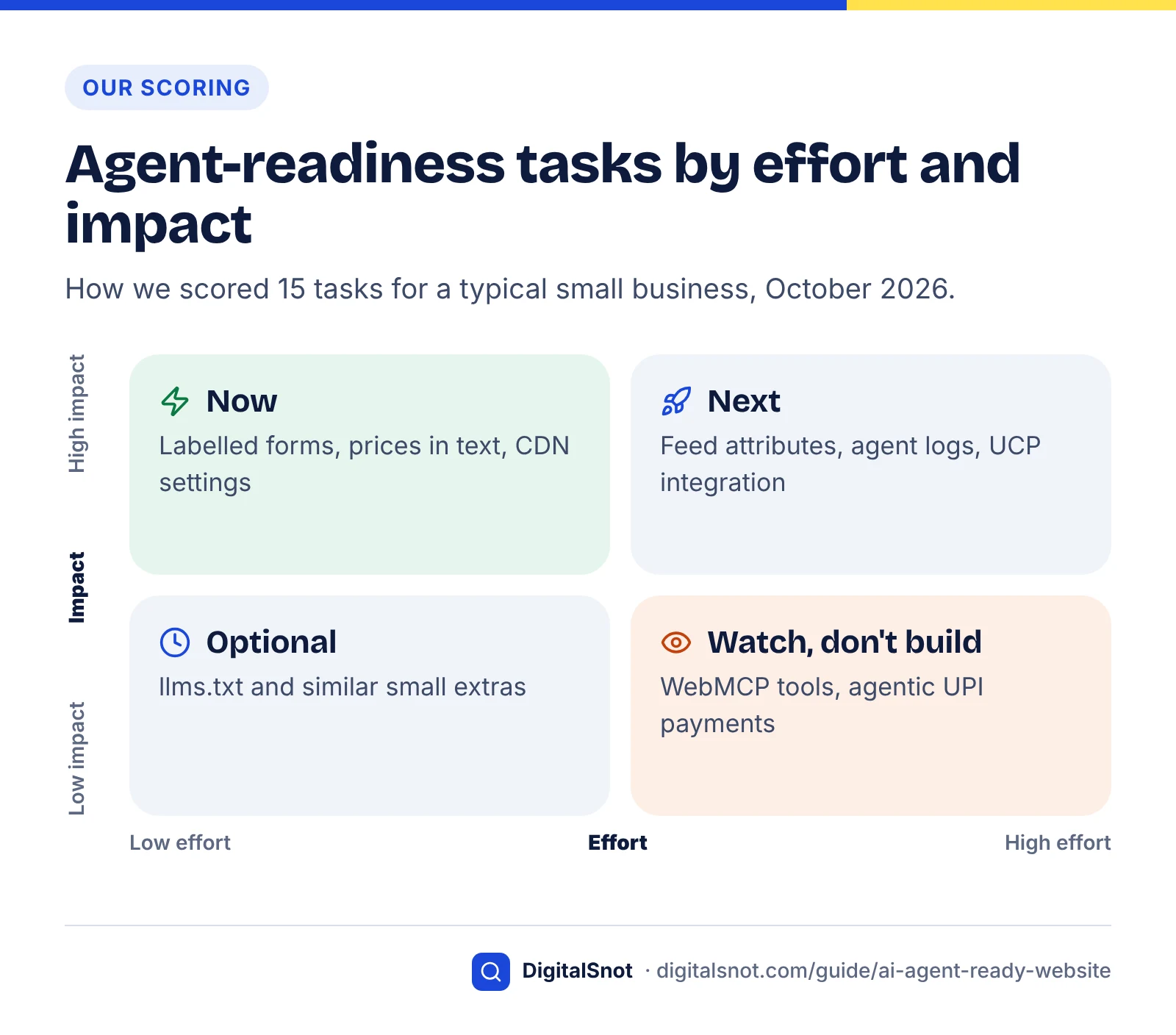
Two patterns come out of the scoring. Nine of the 15 tasks land in "Now", and seven of those nine scored effort 1, meaning no developer is needed. The "Watch" and "Optional" items score lowest because they are experimental, unused by Google Search or limited to a few markets, not because they are bad ideas; revisit them each quarter.
For a before-and-after baseline on the discovery side, the free AI Search Readiness Checker runs more than 15 checks covering crawler access, indexing, answer-first openings, structured data and authorship. It measures how findable your page is rather than whether an agent can act on it, so pair it with the keyboard test from the forms section.
Mistakes to avoid and how to measure progress
The costliest mistakes are the silent ones: an agent turned away by a security default, or orders from an AI checkout that never show in your analytics. Measure with logs and order data, not with scores.
What not to do
- Don't leave CDN defaults unchecked. Cloudflare's 15 September 2026 defaults can block Agent traffic on ad-supported pages of new domains.
- Don't build an agent-only version of your pages. Agents read the page your customers see, and two versions drift apart into conflicting facts.
- Don't chase a Lighthouse pass ratio or ship WebMCP on a whim. Both are experimental, and WebMCP's details can still change during its origin trial.
- Don't treat announcements as launches. "Rolling out this summer" is a plan; check what your customers can actually use.
- Don't block every unknown bot to stop abuse. Challenge suspicious behaviour instead, and let verified agents through.
How to measure
- Agent visits: each month, count Google-Agent and signed-agent requests to booking, quote and checkout URLs from your logs or CDN analytics.
- Completed actions: compare bookings and orders by channel in your booking system, Shopify or Merchant Center, because some AI checkouts don't pass GA4 tracking.
- Visibility before action: track impressions in AI Overviews and AI Mode with the Search Console report explained in our guide to the generative AI performance report.
- Quarterly review: recheck the status board at the top of this guide, because vendors change these features month by month.
Agent readiness sits where technical SEO and AI search optimisation meet: crawl access, clean HTML and accurate data. If you would rather have someone run these checks across your site, you can contact us.
Free tools in this guide
- Schema Markup Generator Create JSON-LD for 10 schema types, with live checks for missing fields.
- AI Crawler Checker See which AI crawlers can read your page, and what they see without JavaScript.
- AI Bot Log Analyzer See how AI crawlers crawl your site from your server access log.
- AI Search Readiness Checker Score a page on what helps ChatGPT, Gemini and AI Overviews cite it.
By the numbers
- Google launched the Universal Commerce Protocol, an open standard for agent-led shopping built with Shopify, Etsy, Wayfair, Target and Walmart
- 11 Jan 2026
- Source: Search Engine Land
- UCP-powered checkout on Google applies to products eligible in the US, Canada and Australia, for participating merchants only
- 3 countries
- Source: Google Merchant Center Help
- From this date Cloudflare's defaults block Agent and Training traffic on pages with ads for new domains; search-only traffic stays allowed
- 15 Sep 2026
- Source: Cloudflare Blog
- minimum Chrome version for testing Lighthouse's experimental Agentic Browsing category; WebMCP audits also need an origin trial
- Chrome 150
- Source: Chrome for Developers
Frequently asked questions
What is an AI agent on a website?
An AI agent is software that completes a task for a person, such as comparing products, filling in a booking form or paying, instead of only answering a question. Google describes browser agents as working from screenshots, the page's DOM and the accessibility tree. In practice an agent uses your site much as a visitor with a screen reader would, so clear labels and real buttons matter most.
Do small service businesses need to prepare for AI agents?
Yes, but the work is mostly basic website hygiene. Put prices or price ranges, service areas, hours and availability on your site in text, label every field on your booking or quote form, and check that your CDN does not block agent traffic. Google says AI Mode may phone a business when information online is limited, so clear pages can also save you calls. Commerce protocols can wait.
Is Google's Universal Commerce Protocol available in the UK or India?
Not as of October 2026. Google's Merchant Center help page says UCP-powered checkout applies to products eligible in the United States, Canada and Australia, for participating merchants, with onboarding starting in the US. UK and Indian shops should focus on accurate product data and an accessible checkout on their own site, which every assistant and every human visitor can use.
Does robots.txt stop AI agents from using my site?
Usually not. Google says user-triggered fetchers, including Google-Agent, generally ignore robots.txt because a person asked for the visit. To allow or block agents, use your CDN or firewall; Cloudflare, for example, has a separate Agent control. robots.txt still matters for the search crawlers that help agents find you in the first place, such as Googlebot, Bingbot and OAI-SearchBot.
What is Web Bot Auth?
Web Bot Auth is an experimental way for bots to sign their HTTP requests cryptographically, so a site or CDN can check who really sent them instead of trusting a user-agent string. Google signs a subset of Google-Agent requests this way as agent.bot.goog. OpenAI's ChatGPT Work cloud browser signs requests with HTTP Message Signatures, which Cloudflare and Akamai verify automatically.
Do I need an llms.txt file for AI agents?
No. Google's generative AI guide says Google Search does not use llms.txt, so the file will not help you there. Lighthouse's experimental Agentic Browsing category does check for one, and some other services may read it, so it is optional at best. Time spent labelling forms and publishing accurate prices will help agents much more than a summary file.
Should I add WebMCP to my website now?
Only if a developer wants to experiment. WebMCP is a proposed web standard that lets a page expose actions as structured tools an AI agent can call, and Chrome's Lighthouse documentation says its WebMCP audits require registering for the origin trial. Standards in trial can change, so most small businesses should wait and focus on accessible forms, which help every agent today.
Can ChatGPT buy products from my online shop?
In most cases ChatGPT now helps people discover products and sends them to your site to buy. In March 2026 OpenAI said merchants can use their own checkout while it focuses on product discovery, with its Agentic Commerce Protocol extended to product feeds. Shopify merchants are covered through Shopify Catalog, and some large retailers have integrated directly. In India, a separate UPI payments pilot runs in ChatGPT.
How can I tell if AI agents are visiting my website?
Check your server or CDN logs. Google-Agent includes "Google-Agent" in its user-agent string and uses IP ranges that Google publishes in a user-triggered-agents.json file. Some agent requests are also signed, which CDNs such as Cloudflare can verify. Filter your logs for these signals on booking, quote and checkout pages, and compare IP addresses with the published lists before trusting a user-agent string.
Will making my site agent-ready hurt human visitors?
No. The main fixes are the same ones that help disabled visitors and anyone on a slow phone: real buttons, labelled fields, stable layouts, visible prices and a clear confirmation step. The only trade-off is security. Blocking every unknown bot stops some abuse but also stops legitimate agents, so challenge suspicious behaviour and allow verified agents instead.
Sources
Every figure and claim in this guide comes from the sources below. We checked each one when writing and link to the original so you can read it yourself. Credit belongs to the authors and publishers listed. How we write and check our articles.
-
1
Optimizing your website for generative AI features on Google Search
Google Search Central · Agents section (screenshots, DOM, accessibility tree); no new files or markup needed; Search does not use llms.txt.
-
2
Build agent-friendly websites
web.dev (Google Chrome) · Accessibility tree, native elements, labels, transparent overlays, target size and layout stability for agents.
-
3
Publishers and Developers - FAQ
OpenAI Help Center · OpenAI's browser agent reads ARIA roles and labels; follow WAI-ARIA practices for buttons, menus and forms.
-
4
Use AI Mode to check local availability and pricing
Google Search Help · AI Mode calls businesses on the user's behalf to check availability and pricing.
-
5
How to check pricing for local businesses with AI in Google Search
Google Search Help · Google can call businesses to check prices and availability in the US; businesses can opt out of AI calls.
-
6
Google Search's I/O 2026 updates: AI agents and more
Google (The Keyword) · Agentic booking widened to local services; calling for home repair, beauty, pet care; US rollout over summer 2026.
-
7
Google launches Universal Commerce Protocol for agent-led shopping
Search Engine Land · UCP launch on 11 January 2026, co-developers, and compatibility with A2A, AP2 and MCP.
-
8
About the Universal Commerce Protocol (UCP) and UCP-powered checkout feature on Google
Google Merchant Center Help · Eligibility (US, Canada, Australia), early access, checkout-eligible listings, merchant of record.
-
9
How to onboard to the Universal Commerce Protocol in Merchant Center
Google Merchant Center Help · UCP integration hub: technical work, interest form and selection; rolling out gradually, US first (October 2026).
-
10
Google opens native AI checkout to eligible Shopify merchants
Search Engine Land · Automatic enrolment, eligibility, opt-out and unsupported features such as GA client-side tracking (Sept 2026).
-
11
Powering Product Discovery in ChatGPT
OpenAI · March 2026 shift from Instant Checkout to discovery; ACP feeds; retailers integrated; Shopify Catalog.
-
12
Microsoft launches Copilot Checkout and Brand Agents
Search Engine Land · Copilot Checkout launch (January 2026), US rollout, partners and Shopify auto-enrolment.
-
13
Latest updates
Google for Developers (Merchant API) · Conversational attributes such as question-and-answer pairs, document links and related products (May 2026).
-
14
Google User-Triggered Fetchers
Google for Developers · Google-Agent purpose, user-agent strings, IP list, robots.txt behaviour and experimental Web Bot Auth signing.
-
15
ChatGPT Work's Cloud browser allowlisting
OpenAI Help Center · RFC 9421 request signing, Signature-Agent header and automatic verification by Akamai and Cloudflare.
-
16
Your site, your rules: new AI traffic options for all customers
Cloudflare Blog · Search, Agent and Training controls on all plans; 15 September 2026 defaults for pages with ads; strictest rule applies to multi-purpose crawlers.
-
17
Lighthouse agentic browsing scoring
Chrome for Developers · Four audit areas, fractional pass score, Chrome 150 requirement, WebMCP origin trial and tool types.
-
18
Razorpay, NPCI, and OpenAI Come Together to Launch Agentic Payments, Ushering in AI-Driven Commerce at National Scale
Razorpay Newsroom · October 2025 agentic UPI pilot in ChatGPT: UPI Reserve Pay, spending limits, BigBasket, banking partners.