Break-even and cash flow: how many sales before you make a profit
Work out your break-even point from fixed and variable costs, then plan three months of cash, because a business can show a profit and still run short of money.

On this page (9 sections)
Two questions decide whether a small business survives its first years. How many sales do you need each month before you stop losing money? And will there be cash in the bank on the day the rent, salaries and suppliers are due? The first is break-even; the second is cash flow. This post shows you how to work out break-even and cash flow, with a worked example for a made-up cafe. It is general information, not tax or accounting advice: ask your accountant how to treat loans, GST and equipment in your own books.
Fixed costs and variable costs
Start by sorting your monthly costs into two groups.
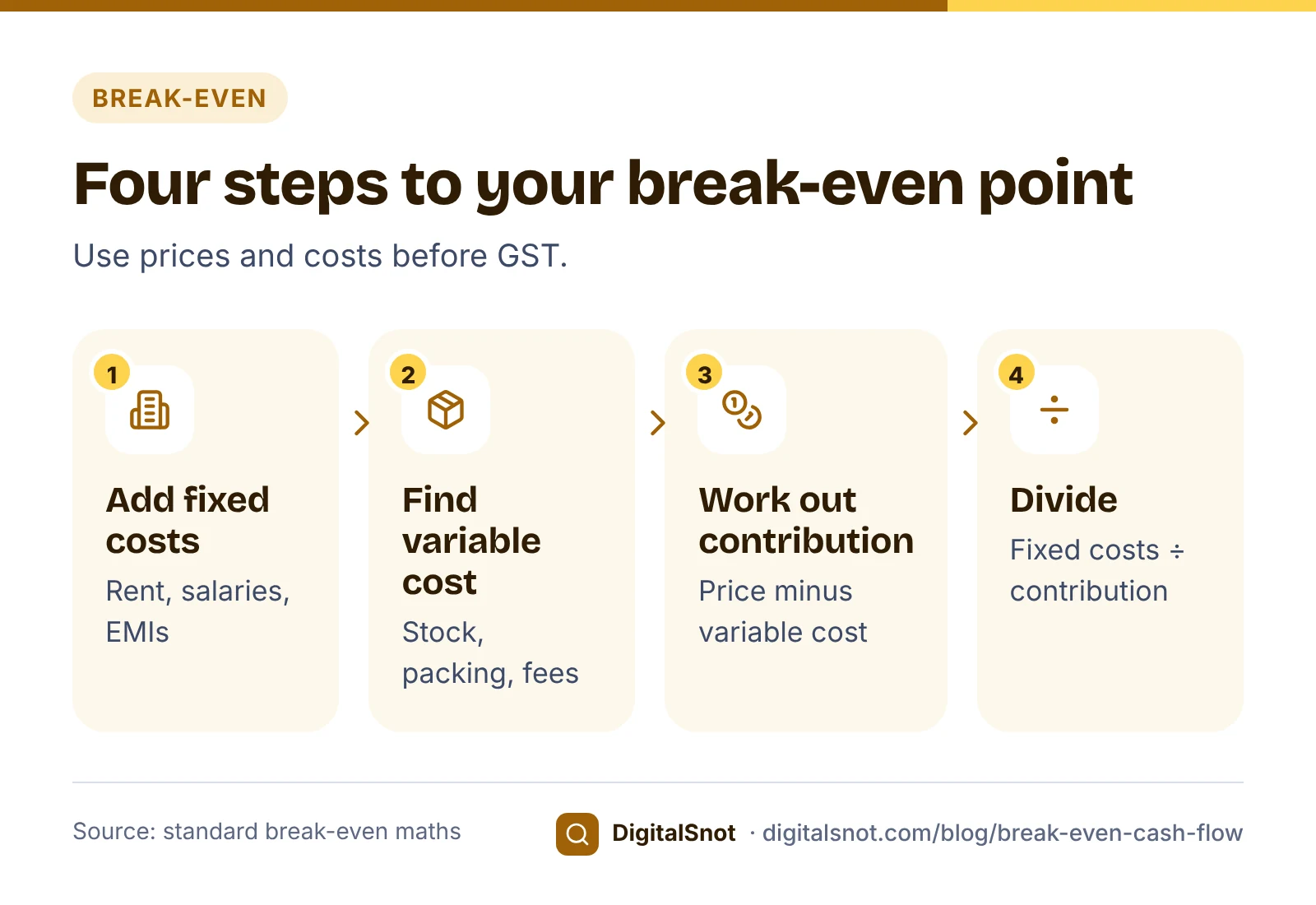
- Fixed costs stay the same whether you sell a lot or nothing: rent, salaries, software, internet, insurance and loan EMIs.
- Variable costs rise with each sale: stock or ingredients, packing, delivery, card or UPI payment fees and marketplace commission.
Some costs rise in steps, such as a second staff member or a bigger shop. Treat them as fixed, and try the bigger figure as a separate scenario. If you work in the business, our suggestion is to count a salary for yourself as a fixed cost too, or the break-even point hides your own pay.
Use prices and costs before GST. The GST you collect goes to the government and is not your income. If you claim input tax credit on what you buy, use your costs before GST as well; if you cannot claim it, include the GST you pay in your costs. Our post on GST-inclusive and exclusive prices shows how to take GST out of a price.
Contribution: what each sale leaves over
Each sale first pays for itself. The price before GST minus the variable cost of that sale is its contribution: the part that goes towards your fixed costs, and then to profit.
- Contribution per unit = price − variable cost per unit.
- Contribution margin = contribution per unit ÷ price.
A product that sells for ₹500 before GST and costs ₹300 in stock, packing and fees contributes ₹200, a contribution margin of 40%. This is close to, but not the same as, the gross margin on a product. Our post on margin and markup explains why pricing by markup can leave you with less than you think, and the Profit Margin & Markup Calculator works out the margin, markup and profit on each unit from any two of cost, price, margin or markup.
Break-even units and break-even sales
Once you know your fixed costs and contribution, the maths is short:
- Break-even units = monthly fixed costs ÷ contribution per unit. With ₹1,00,000 of fixed costs and ₹200 of contribution, that is 500 units a month.
- Break-even sales = monthly fixed costs ÷ contribution margin. ₹1,00,000 ÷ 0.40 = ₹2,50,000 of sales a month.
- Units for a target profit = (fixed costs + the profit you want) ÷ contribution per unit.
- Margin of safety = (current sales − break-even sales) ÷ current sales: how far sales can fall before you make a loss.
If you sell many products at different prices, count orders instead of products. Use your average order before GST as the price, and your variable cost as a share of it.
Put your own numbers into our Break-even Calculator. List your fixed costs a month, then your price per unit or average order and the variable cost in rupees or as a percentage. Add a target profit and your current sales if you like. It shows the break-even units and sales, the units for your target, your margin of safety, a chart of sales against costs and scenarios side by side, with every formula shown. It treats every sale and every month as the same, so seasons and a changing product mix are not modelled, and it counts profit, not cash in the bank.
Worked example: Kesariya Cafe, Jaipur
Kesariya Cafe is a made-up cafe in C-Scheme, Jaipur. Its monthly fixed costs:
- Rent ₹60,000, salaries ₹1,10,000, electricity and gas ₹18,000, software, internet and phone ₹4,000, and a loan EMI of ₹23,000.
- Total: ₹2,15,000 a month.
Its average order is ₹250 before GST, and ingredients, cups, packing and payment fees come to ₹100 an order. So each order contributes ₹150, a contribution margin of 60%.
- Break-even orders: ₹2,15,000 ÷ ₹150 = 1,433.3, so 1,434 orders a month, about 48 a day over 30 days.
- Break-even sales: ₹2,15,000 ÷ 0.60 = about ₹3,58,333 a month.
- In October it served about 1,650 orders, or ₹4,12,500 of sales. That leaves ₹32,500 of profit and a margin of safety of about 13%: a slow fortnight would wipe it out.
- For a profit of ₹60,000 a month it needs (₹2,15,000 + ₹60,000) ÷ ₹150 = 1,834 orders.
The scenarios show which lever moves the break-even point most. Each changes one thing and keeps everything else the same, so they show the arithmetic, not what customers will do.
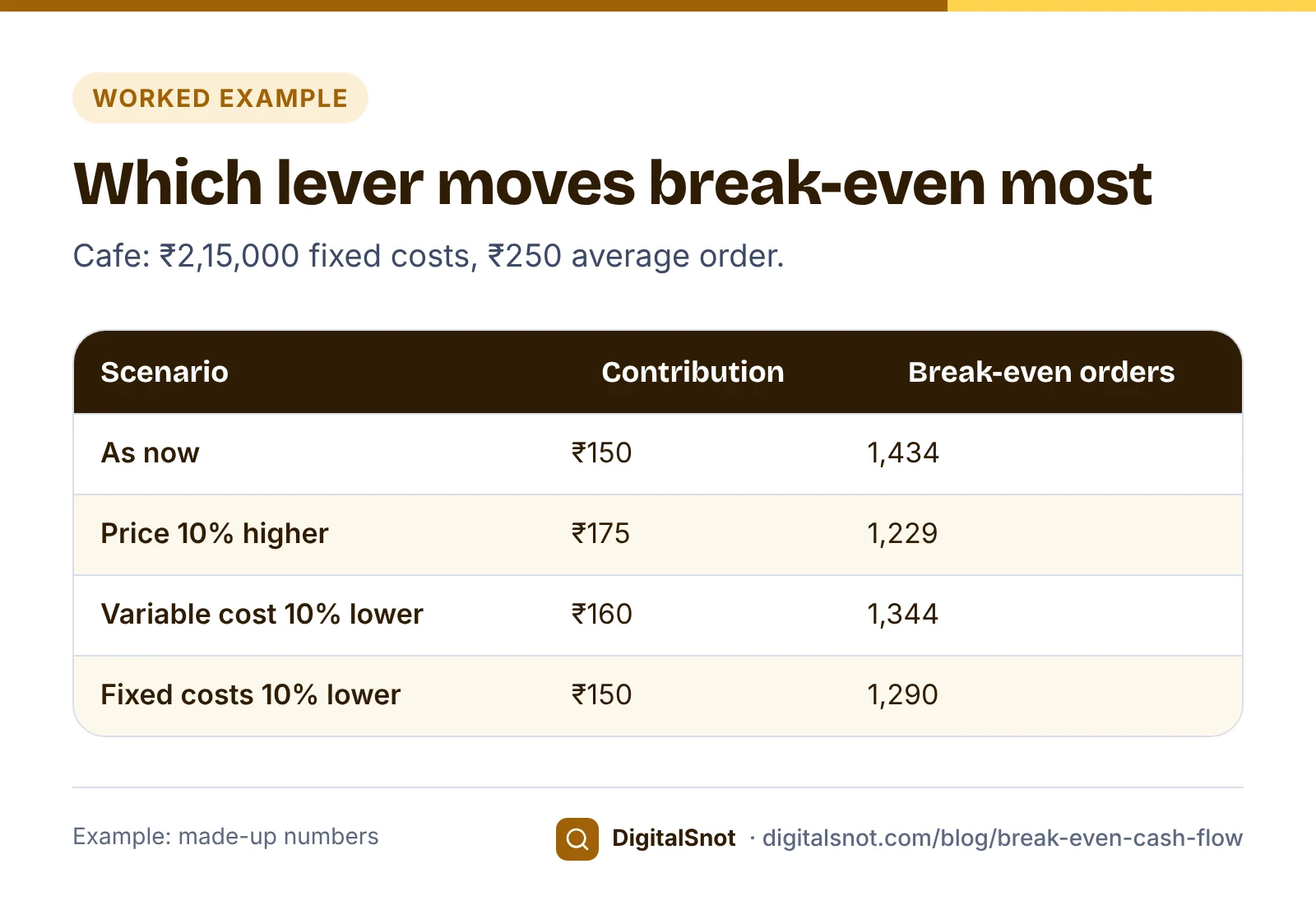
The EMI is in the fixed costs because the cash goes out every month. In the cafe's accounts, only the interest part of the EMI is an expense; the rest repays the loan. For a break-even that matches the profit and loss statement, the owner would use only the interest, and the accountant can say which to use.
Why profit is not cash
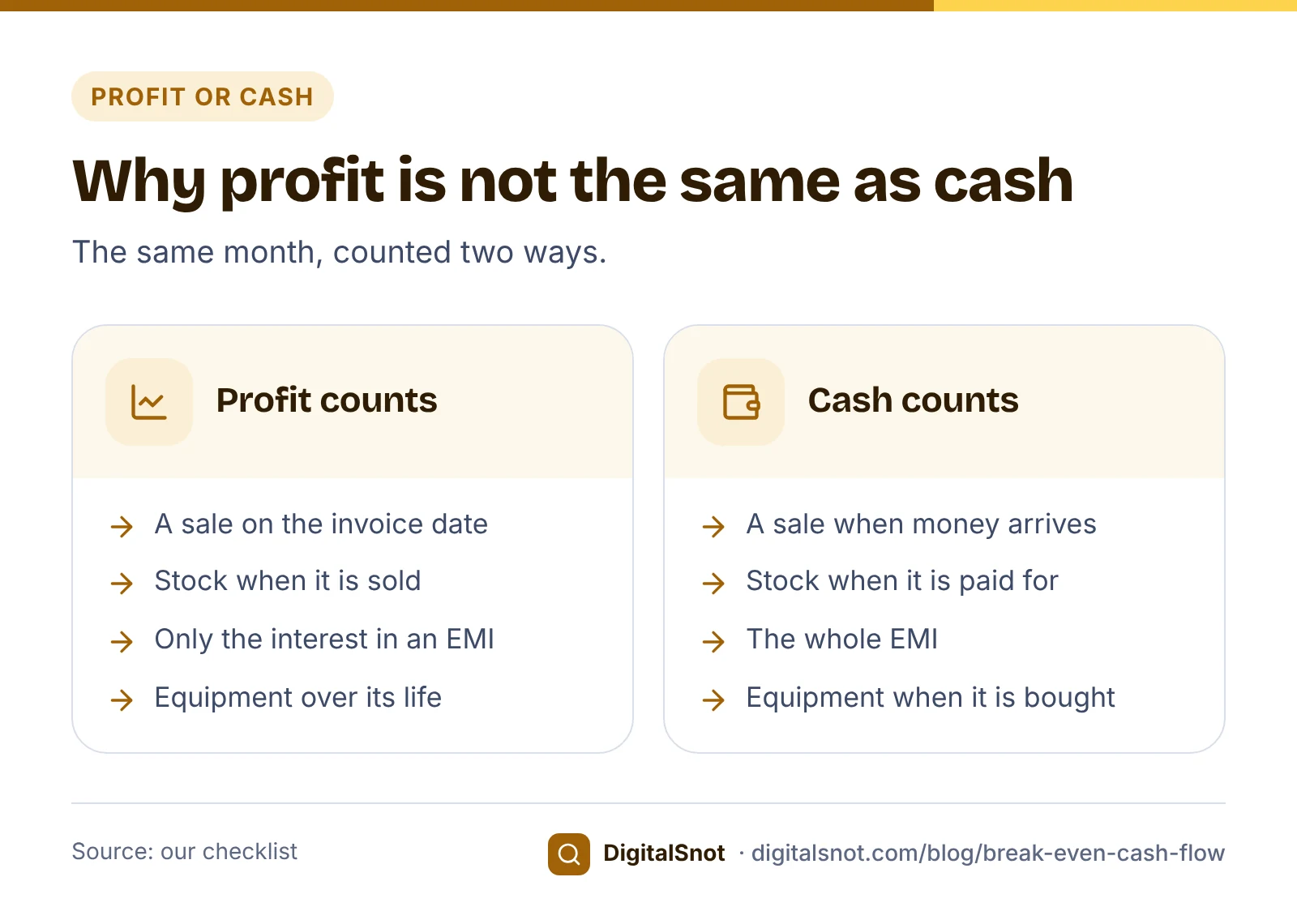
Break-even tells you whether the business makes money over a month. It does not tell you whether the money is in the bank when bills fall due. Four things open the gap:
- Sales on credit. Profit counts a sale on the invoice date; cash arrives when the customer pays, perhaps 30 to 90 days later. If you are a micro or small enterprise with Udyam Registration, the MSMED Act limits the credit period you can agree with a business buyer to 45 days from acceptance, and a late payer owes interest. Our posts on MSME categories and delayed payment interest explain both.
- GST before the customer pays. Under sections 12 and 13 of the CGST Act, the time of supply is generally the earlier of the invoice and the payment. So GST on a credit sale is due with the return for the month of the invoice, even if the customer has not paid. On the buying side, you can claim credit only on invoices that show in your GSTR-2B, as our post on GSTR-2B reconciliation explains.
- Stock and equipment. Stock is paid for before it sells, and a new machine or a deposit goes out in one month even though it serves many.
- Loan repayments. The principal part of an EMI is not an expense, but it is still cash going out.
Paying your own suppliers late is not a safe way to close the gap. Under section 16 of the CGST Act, input tax credit on a bill you have not paid within 180 days of the invoice date has to be reversed with interest. And if a supplier is a micro or small enterprise, paying after the MSMED Act limit means the expense is allowed for income tax only in the year you actually pay, under section 43B(h) of the Income-tax Act, 1961, a rule the Income-tax Act, 2025 keeps in its section 37.
A three-month cash flow plan
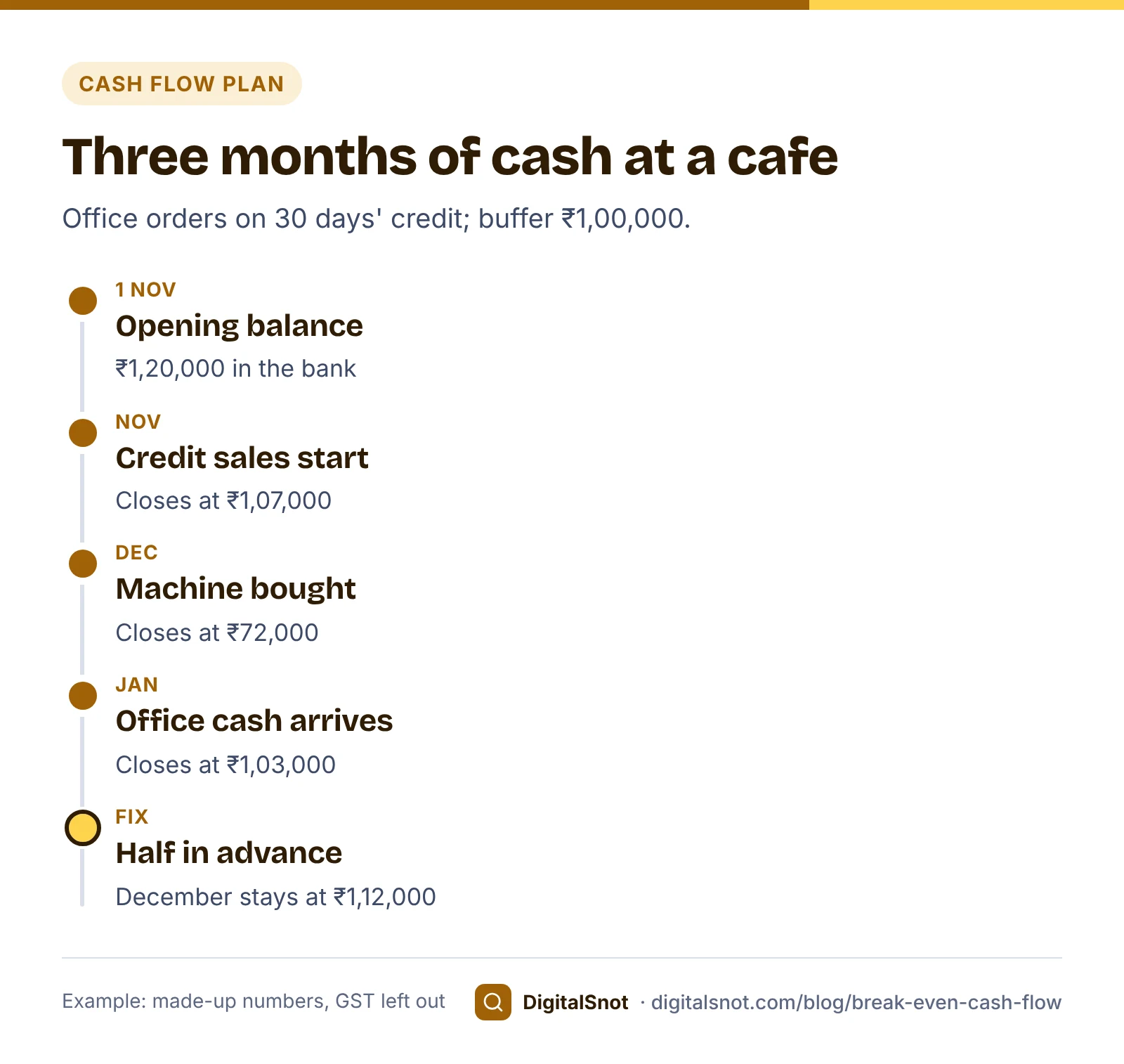
From November 2026, Kesariya Cafe starts supplying tea and snacks to two offices nearby, ₹80,000 a month, billed monthly and paid 30 days later. It also plans to buy a ₹1,20,000 coffee machine in December. It starts November with ₹1,20,000 in the bank and wants to keep at least ₹1,00,000, its own safety buffer. Counter sales are paid on the spot, and stock and packing cost 40% of sales, paid in the same month. To keep the example short, GST is left out; in your own plan, add GST collected to cash in and GST paid to cash out.
| November | December | January | |
|---|---|---|---|
| Opening balance | ₹1,20,000 | ₹1,07,000 | ₹72,000 |
| Counter sales collected | ₹3,90,000 | ₹4,20,000 | ₹3,30,000 |
| Office orders collected | ₹0 | ₹80,000 | ₹80,000 |
| Stock and packing paid | ₹1,88,000 | ₹2,00,000 | ₹1,64,000 |
| Fixed costs and EMI | ₹2,15,000 | ₹2,15,000 | ₹2,15,000 |
| Coffee machine | ₹0 | ₹1,20,000 | ₹0 |
| Closing balance | ₹1,07,000 | ₹72,000 | ₹1,03,000 |
Over the three months, sales cover the costs by ₹67,000, ₹85,000 and ₹31,000: ₹1,83,000 in all, counting the EMI as a cost and the machine as equipment. Yet the bank balance ends ₹17,000 lower than it started, and in December it falls to ₹72,000, below the buffer. The ₹2,00,000 difference is the machine and January's office bill, which will be paid only in February.
The plan shows the problem two months early, while there is time to act:
- Move the cost. Buying the machine in January instead keeps December at ₹1,92,000 and January at ₹1,03,000.
- Collect sooner. Asking the offices for half of each month's bill in advance keeps December at ₹1,12,000.
- Borrow the gap. If neither works, a small loan covers it, and the EMI goes into the next months' costs.
Our Cash Flow Planner does this for 12 months. Type your bank balance, safety buffer, monthly sales, how much is paid straight away and the credit days for the rest, your stock and GST rates, regular and one-off costs and any other money coming in. It pays GST in the month after the sale, finds the first month the balance falls below your buffer, compares your plan with slow sales and late collections, and shows what would cover the gap, including a loan sized with the maths of our Loan EMI Calculator. It works in whole months, so the balance can dip lower within a month; the buffer is there for that.
Mistakes to avoid
- Prices with GST in them. They make every sale look larger than it is. Use prices before GST.
- Leaving out your own pay. A business that breaks even only because the owner takes nothing has not broken even.
- Average months for a seasonal business. Plan the slow months and the festival months separately.
- Counting invoices as cash. A sale on credit pays the bills only when the money arrives.
- No buffer. There is no rule for its size; our suggestion is about one month of regular costs, such as rent, salaries and EMIs.
- Discounting without the maths. A discount cuts contribution, so the break-even point rises. Try the lower price in the calculator before you announce a sale.
Your next step
List last month's costs, sort them into fixed and variable, and put them into the Break-even Calculator. Then plan the next three months in the Cash Flow Planner, and look for the first month that drops below your buffer. If you would like help with the marketing side of reaching your break-even number, talk to us.
Free tools in this article
- Profit Margin & Markup Calculator Any two of cost, price, margin and markup give the rest, with GST and many products at once.
- Break-even Calculator Break-even units and sales from your monthly costs, with target profit, a chart and what-if scenarios.
- Cash Flow Planner Plan 12 months of cash in and out, see the month cash runs short and what would cover the gap.
- Loan EMI Calculator Work out a loan EMI and total interest, see the monthly schedule, test extra payments and compare offers.
Frequently asked questions
How do I calculate my break-even point?
Add up your fixed costs for a month, take your variable cost per unit from your price before GST to get the contribution per unit, and divide the fixed costs by the contribution. With ₹1,00,000 of fixed costs and ₹200 of contribution, you break even at 500 units a month.
What is the difference between fixed and variable costs?
Fixed costs stay the same whether you sell a lot or nothing in a month, such as rent, salaries, software and loan EMIs. Variable costs rise with each sale, such as stock, packing, delivery, payment fees and commission.
Should I include GST in my break-even calculation?
No. Use your price before GST, because the GST you collect goes to the government. If you claim input tax credit on purchases, use your costs before GST too; if you cannot claim it, include the GST you pay in your costs.
Why can a profitable business run out of cash?
Profit counts a sale when it is made, but cash arrives only when the customer pays. Credit sales, GST due for the month of the invoice, stock bought before it sells, equipment and loan repayments can all take cash out before the profit comes in.
How big should my cash buffer be?
There is no rule. Our suggestion is about one month of regular costs, such as rent, salaries and EMIs, so that a slow month or a late payment does not stop you paying them. A seasonal business may want more.
Is it safe to delay paying my suppliers to save cash?
It has costs. Under section 16 of the CGST Act, input tax credit on a bill not paid within 180 days of the invoice date must be reversed with interest, and paying a micro or small supplier late brings interest under the MSMED Act and can delay your income tax deduction.
Sources
Every figure and claim in this article comes from the sources below. We checked each one when writing and link to the original so you can read it yourself. Credit belongs to the authors and publishers listed. How we write and check our articles.
-
1
CGST Act, 2017: section 12 (time of supply of goods)
CBIC · Time of supply of goods: the earlier of the invoice date and the payment
-
2
CGST Act, 2017: section 13 (time of supply of services)
CBIC · Time of supply of services, tied to the invoice date and the payment
-
3
CGST Act, 2017: section 16
CBIC · Input tax credit conditions, including reversal with interest when a supplier is not paid within 180 days
-
4
Circular 193/05/2023-GST
CBIC · Credit limited to the invoices shown in GSTR-2B
-
5
The Micro, Small and Medium Enterprises Development Act, 2006
India Code · Section 15: payment within the agreed period, never more than 45 days from acceptance
-
6
Section 43B
Income Tax Department · Clause (h): sums owed to micro and small enterprises beyond the MSMED Act limit are deductible only when paid
Want a second pair of eyes?
Tell us about your site. We reply within one business day.
Talk to us Try our free tools