Editing AI drafts so they read like a person wrote them
A five-step edit for chatbot drafts: clear out leftovers, fact-check every claim, add what only you know, cut filler and hype, and disclose AI use where readers expect it.

On this page (10 sections)
- 1What Google says about AI drafts
- 2Step 1: clear out what the chatbot left behind
- 3Step 2: fact-check every claim
- 4Step 3: add what only you know
- 5Step 4: cut filler and hype, write plain English
- 6Step 5: disclose AI use where readers would expect it
- 7A worked example: Nest Interiors, Hyderabad
- 8Mistakes to avoid
- 9Your next step
- 10Sources
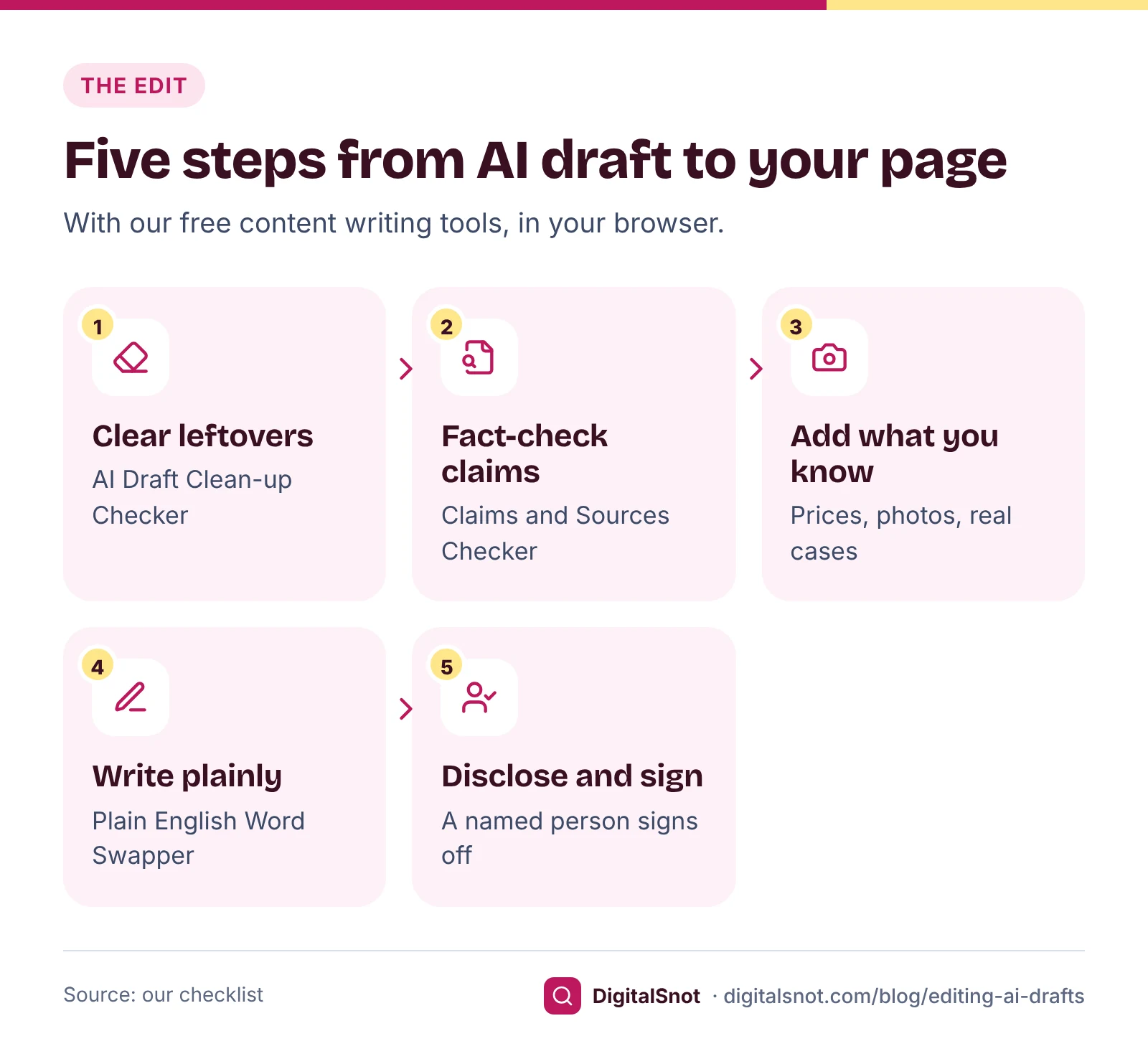
A chatbot can give you a tidy first draft in a minute. Publishing it as it is takes longer to fix later: a placeholder left in, a figure nobody can trace, a "best in the city" claim you cannot prove and a tone that sounds like every other page on the topic. This post gives you five steps for editing AI drafts into pages you can stand behind: clear out the leftovers, fact-check every claim, add what only you know, cut filler for plain English, and disclose AI use where readers would expect it. A made-up interior design firm in Hyderabad shows each step.
What Google says about AI drafts
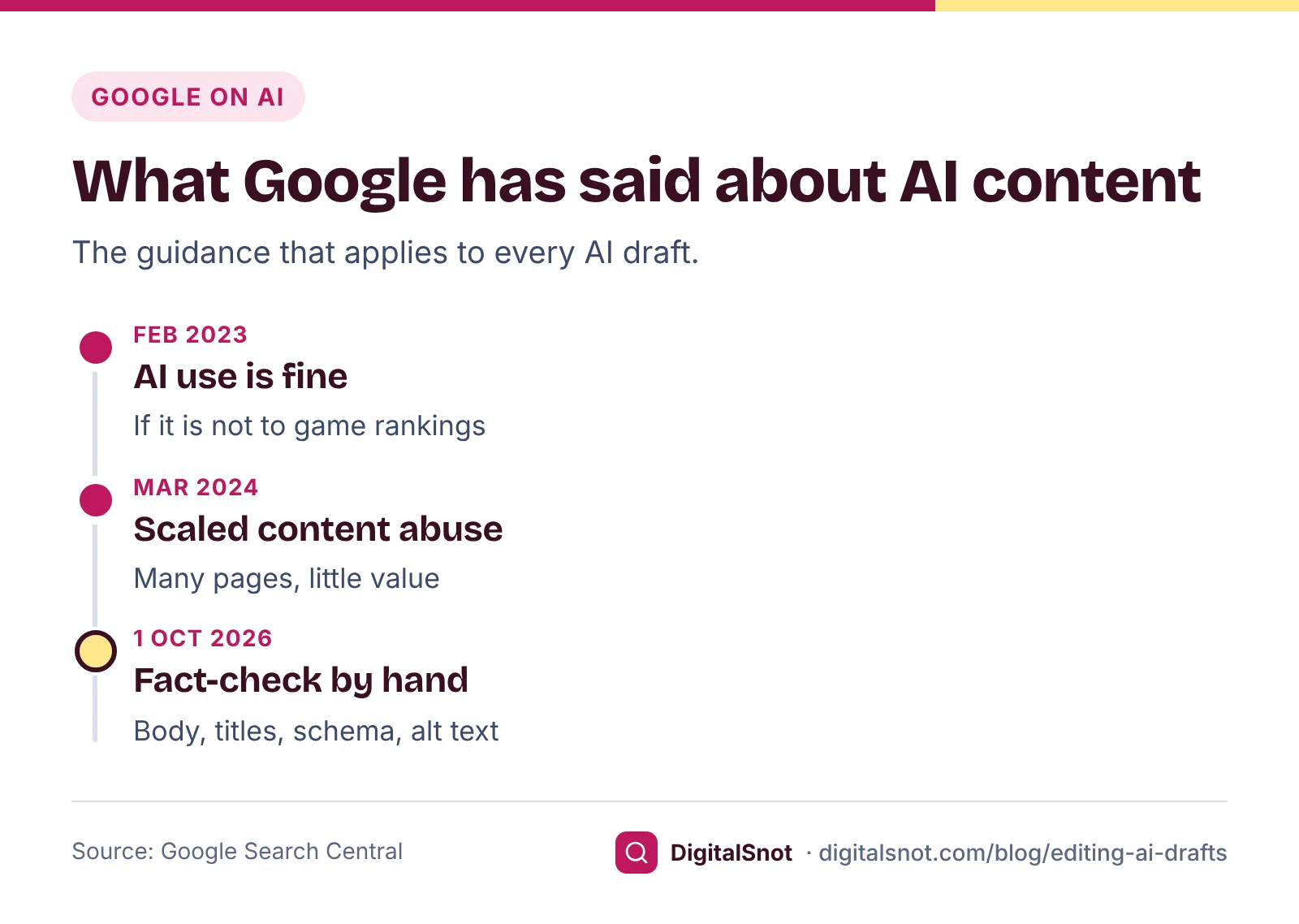
Google does not penalise a page because AI helped write it. Its February 2023 post on AI-generated content says: "Appropriate use of AI or automation is not against our guidelines." The same post draws the line at using automation, including AI, mainly to manipulate search rankings, which breaks Google's spam policies.
Google's guidance on using generative AI content says AI can be particularly useful when researching a topic and to add structure to original content. It also warns that generating many pages without adding value for users may break its spam policy on scaled content abuse.
On 1 October 2026 Google added a clear instruction to that page. It explains that generative models do not retrieve facts but predict a likely sequence of words, so their output can contain mistakes, and says it is critical to manually fact-check and review all AI-generated content for accuracy and trustworthiness before publishing. That includes title elements, meta descriptions, structured data and image alt text, not just the article body. Our guide on using AI without breaking Google's spam policies covers the policies in detail; this post is about the edit itself.
Step 1: clear out what the chatbot left behind
Start with the mechanical clean-up, because it is quick and the mistakes are embarrassing when they go live. Paste the draft, including any lines the chatbot added before or after it, into our AI Draft Clean-up Checker. It marks:
- chatbot lines such as "I hope this helps" or "Let me know if you would like";
- placeholders such as [Your name] or ₹X,XXX;
- Markdown marks such as ** and ##;
- figures and "studies show" claims with no link or named source nearby;
- relative words such as "this year" and recent years that may now be out of date;
- filler phrases, sentences that start the same way, phrases repeated across paragraphs and sentences over 25 words;
- exclamation marks, emoji and a mix of British and American spelling.
It gives you a cleaned copy without the chatbot lines and Markdown marks, and leaves the rest for you to fix. It is not an AI detector, and it cannot tell whether a fact is true, only whether a source is nearby. It works with Hindi and Hinglish drafts too, and your text is not uploaded.
Step 2: fact-check every claim
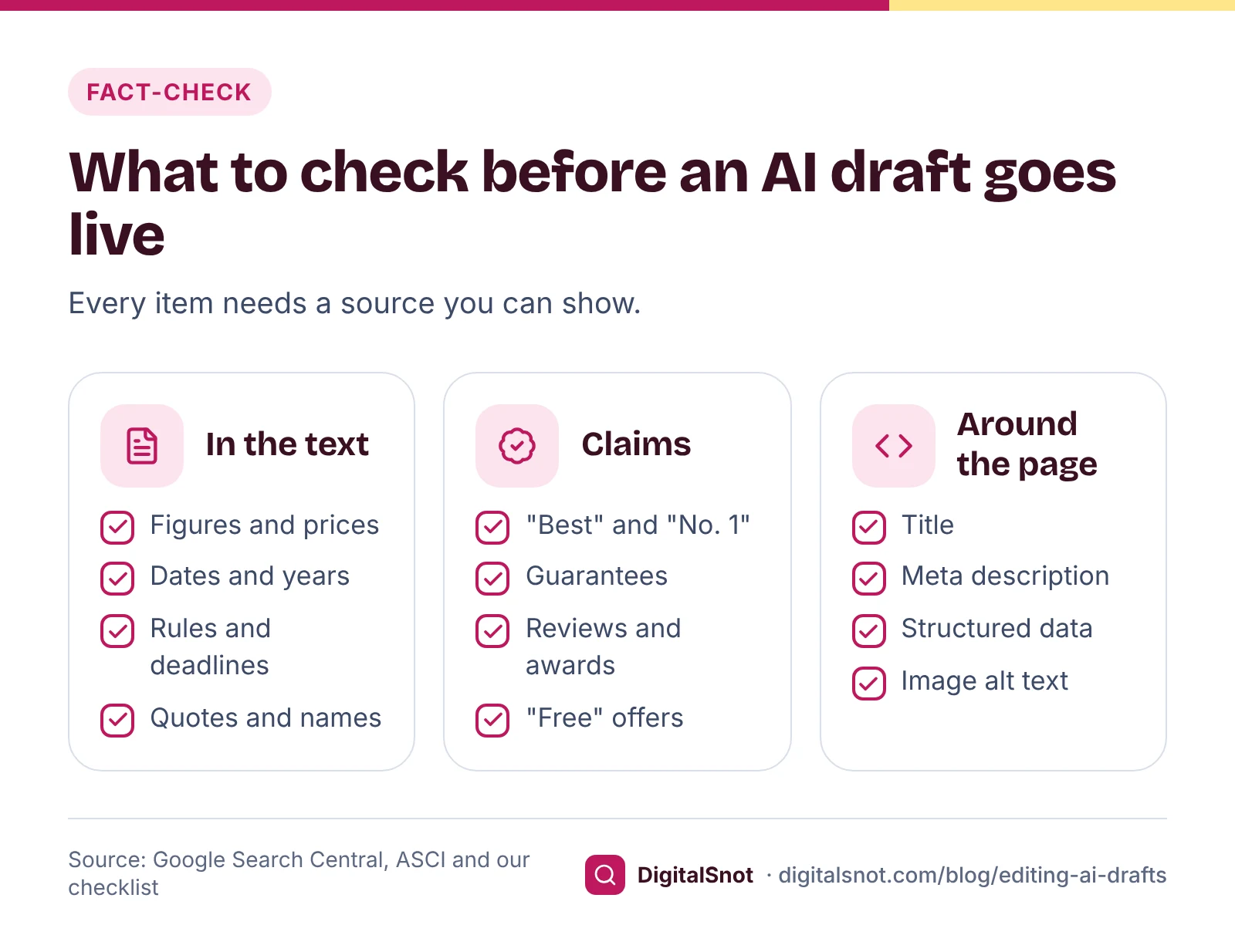
This is the step that matters most and the one most often skipped. Make a list of every figure, price, date, rule, name, quote and comparison in the draft. For each one, find the original source: an official page, your own records, the maker's instructions or the study itself, not a blog that repeats it. If you cannot find a source, take the claim out, however plausible it sounds.
Claims about your own business need the same care. A chatbot will happily write "the most trusted clinic in Pune" or "over 500 happy clients". Paste the draft into our Claims and Sources Checker. It finds sentences that make a claim, such as numbers, "best" and "No. 1", guarantees, comparisons, health and money claims, awards, testimonials and "free" offers, shows whether a source is nearby and explains why each needs proof. The ASCI Code says advertisements must be truthful and that claims about matters of fact should be capable of substantiation, and the Consumer Protection Act, 2019 treats an advertisement that falsely describes a product or service as misleading. The checker reads words, not facts, and is not legal advice.
Then check the parts readers see before they open the page: the title, the meta description, any structured data and every image's alt text. Google names all four in its fact-checking instruction.
Step 3: add what only you know
An AI draft is built from what is already common knowledge, so on its own it reads like every other page on the topic. Google's page on helpful, people-first content asks whether content provides original information, reporting, research or analysis, and whether it clearly demonstrates first-hand expertise, for example from having actually used a product or service or visited a place.
That is where your edit earns its time. Add:
- your own prices, with the month they apply to;
- photos of your own work, and real cases told with the customer's permission;
- the questions customers actually ask you, in their words;
- your judgement: when you advise against an option, and the mistakes you see again and again;
- local details: suppliers, rules and conditions where you work.
Cut the general points the top pages all repeat down to a line or two, and give the space to this. If you brief writers, put these items in the brief, as our post on content briefs suggests, and our post on case studies shows how to present a real result with proof.
Step 4: cut filler and hype, write plain English
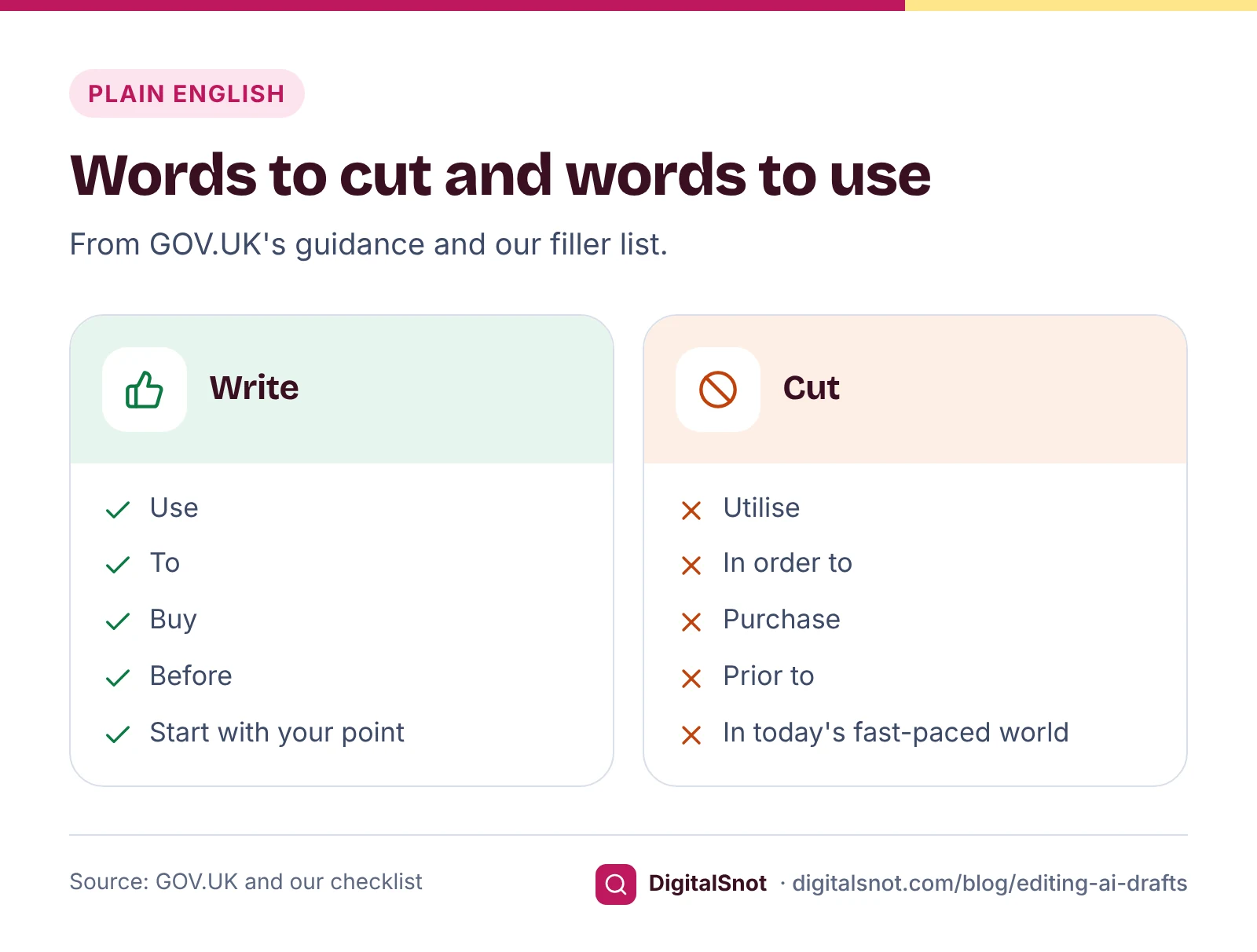
AI drafts lean on the same phrases: "in today's fast-paced world", "it is important to note that", "when it comes to", "plays a crucial role in". They take up space and say nothing. Cut them and start each paragraph with its point.
Then swap formal words for plain ones. GOV.UK's clear language guidance says not to use formal or long words when easy or short ones will do. Our Plain English Word Swapper marks formal, wordy and vague words and suggests plain ones: "use" for "utilise", "to" for "in order to", "buy" for "purchase" and "before" for "prior to". It also marks Indian business English, such as "do the needful" and "prepone", that readers outside India may not understand; untick that list if all your readers are in India. Quotes, links and code are left alone, and it never rewrites sentences with AI.
A few more edits make a draft sound like a person:
- Split long sentences where a new idea starts.
- Replace generic examples ("a business owner") with your own ("a family in Kondapur redoing a 10-foot kitchen").
- Delete the closing paragraph that repeats the introduction.
- Read it aloud. Anything you would not say to a customer, rewrite.
Step 5: disclose AI use where readers would expect it
Google's helpful content page asks you to think about who created the content, how and why. It says AI or automation disclosures are useful for content where someone might think, "How was this created?", and the February 2023 post adds that giving AI an author byline is probably not the best way to do it. Keep a real, named person in the byline: the person who checked the facts and stands behind the advice.
Our suggestion: if a chatbot wrote most of an article, add a short line at the end, such as "Drafted with AI help; facts checked and edited by Ravi Menon, 18 October 2026." If AI only suggested headings, no note is needed. Either way, never invent an author or credentials.
A worked example: Nest Interiors, Hyderabad
Nest Interiors is a made-up interior design firm in Gachibowli, Hyderabad. The owner asks a chatbot for a post on modular kitchen costs and gets a draft that starts "Certainly, here is a blog post about modular kitchens" and contains:
- "In today's fast-paced world, a modular kitchen is a must."
- "Studies show modular kitchens cost ₹1.5 to 3 lakh on average."
- "Nest Interiors is the best interior designer in [City]."
- "Prices have risen sharply in 2023."
- "I hope this helps."
The edit, step by step:
- The AI Draft Clean-up Checker removes the opening line and "I hope this helps", flags the placeholder, the old year, the unsourced figure and the filler phrase.
- The "studies show" figure has no study behind it, so it goes. The owner replaces it with a price range from the firm's own recent kitchens, with the month, and says what moves the price: size, materials and fittings.
- "The best interior designer" has no proof, so the Claims and Sources Checker's "Needs proof" note leads the owner to replace it with something they can show: the number of Google reviews and the rating, with the date.
- The owner adds photos of three finished kitchens (with the clients' permission) and the five questions customers ask at the first visit.
- The Plain English Word Swapper changes "utilise the available space" to "use the space".
- The title and meta description are checked against the page, a disclosure line is added, and the owner signs it off.
Mistakes to avoid
- Publishing straight from the chat window, with its opening and closing lines.
- Checking the body but not the title, meta description, structured data or alt text.
- Keeping a figure because it "sounds right" when nobody can find its source.
- Running a draft through an AI detector instead of editing it; the fixes are the same whoever wrote it.
- Making dozens of near-identical pages because AI makes them cheap.
- Putting a made-up name, or the AI tool, in the byline.
Your next step
Take one draft you have waiting and run it through the three tools in this order: the AI Draft Clean-up Checker, the Claims and Sources Checker and the Plain English Word Swapper. All run in your browser and none of them uses AI. If you would rather have a team write and check your pages, see our content SEO service or get in touch.
Free tools in this article
- AI Draft Clean-up Checker Find chatbot lines, placeholders, unsourced figures and filler in a draft, and get a cleaned copy.
- Claims and Sources Checker Find the numbers, "best" claims, guarantees and testimonials in your copy that need a source.
- Plain English Word Swapper Find formal, wordy and vague words in a draft and swap in plain ones with one press.
By the numbers
- date from which Google's guidance on generative AI content calls manual fact-checking of all AI-generated content critical
- 1 Oct 2026
- Source: Google Search Central
Frequently asked questions
Is it against Google's rules to publish AI-written content?
Not in itself. Google says appropriate use of AI or automation is not against its guidelines. Using it mainly to manipulate search rankings breaks its spam policies, and making many pages with generative AI without adding value for users may count as scaled content abuse.
What changed in Google's AI content guidance in October 2026?
Since 1 October 2026, Google's guidance on using generative AI content says it is critical to manually fact-check and review all AI-generated content for accuracy and trustworthiness before publishing, including title elements, meta descriptions, structured data and image alt text.
How do I make an AI draft sound less robotic?
Remove chatbot lines and filler phrases, swap formal words for plain ones, split long sentences, and replace generic examples with your own prices, photos, cases and customers' questions. Then read it aloud and rewrite anything you would not say to a customer.
Do I have to tell readers that I used AI?
Google says disclosures are useful where readers might reasonably wonder how content was made. Our suggestion: if AI wrote most of an article, add a line saying so and who checked it. Keep a real, named person in the byline, never the AI tool or an invented author.
Can an AI detector tell me if my content is safe to publish?
No. Our view is that detectors are not reliable enough to judge a text by, and Google judges the page, not the tool. Check for leftovers, unsourced claims, missing first-hand detail and filler instead; those fixes are the same whoever wrote the draft.
Which claims in an AI draft need a source?
Every figure, price, date, rule, quote and comparison, and every claim such as "best", "No. 1", a promise of results or "trusted by thousands". The ASCI Code asks that factual claims be capable of substantiation. If you cannot find the original source, take the claim out.
Sources
Every figure and claim in this article comes from the sources below. We checked each one when writing and link to the original so you can read it yourself. Credit belongs to the authors and publishers listed. How we write and check our articles.
-
1
Google Search's guidance about AI-generated content
Google Search Central · Appropriate use of AI is not against Google's guidelines; automation to manipulate rankings is spam; AI as author byline is probably not the best way.
-
2
Google Search's guidance on using generative AI content on your website
Google Search Central · Useful for research and structure; scaled content warning; from 1 October 2026, critical to fact-check all AI output by hand, including titles, meta descriptions, structured data and alt text.
-
3
What web creators should know about our March 2024 core update and new spam policies
Google Search Central · March 2024 launch of the scaled content abuse policy, whether content is made by automation, people or both.
-
4
Spam policies for Google web search
Google Search Central · Scaled content abuse: many pages generated mainly to manipulate rankings.
-
5
Creating helpful, reliable, people-first content
Google Search Central · Original information; first-hand expertise; Who, How and Why; disclosures where readers might wonder how content was made.
-
6
Clear language
GOV.UK · Do not use formal or long words when easy or short ones will do.
-
7
The ASCI Code
Advertising Standards Council of India · Advertisements must be truthful; factual claims should be capable of substantiation.
-
8
The Consumer Protection Act, 2019
India Code · Section 2(28): what counts as a misleading advertisement.
Want a second pair of eyes?
Tell us about your site. We reply within one business day.
Talk to us Try our free tools