Salary slip format for a small business: what it should show
What a monthly salary slip should show: earnings, loss-of-pay days, EPF and ESI at the current limits, professional tax, TDS and the records to keep, with a worked example.
On this page (11 sections)
- 1Is a salary slip compulsory?
- 2What a salary slip should show
- 3Earnings and the labour codes' 50% rule
- 4Loss-of-pay days and working days
- 5EPF and ESI: the current figures
- 6Professional tax and TDS
- 7Worked example: Smile Studio Dental, Pune
- 8Records to keep, and what the slip does not show
- 9Mistakes to avoid
- 10Your next step
- 11Sources
If you employ even a few people, a clear salary slip each month saves arguments, helps your staff when a bank or landlord asks for proof of income, and keeps your own records straight. This post explains the salary slip format: what a slip should show, how loss-of-pay days, EPF, ESI, professional tax and TDS fit on it, and what has changed recently, with a worked example you can copy. It is general information, not tax, legal or payroll advice: check your pay structure and deductions with your CA.
Is a salary slip compulsory?
The four labour codes came into force on 21 November 2025, replacing 29 older labour laws. One of them, the Code on Wages, 2019, says in section 50(3) that every employer shall issue wage slips to employees in the form and manner the rules prescribe. The same section asks employers to keep registers of their employees and wages. The labour codes also require appointment letters for all workers.
The exact form comes from the rules that apply to your establishment, central or State, so ask your CA which form you must follow. A clear, complete slip in the layout below covers the details most forms ask for, but it is not a prescribed form in itself.
What a salary slip should show
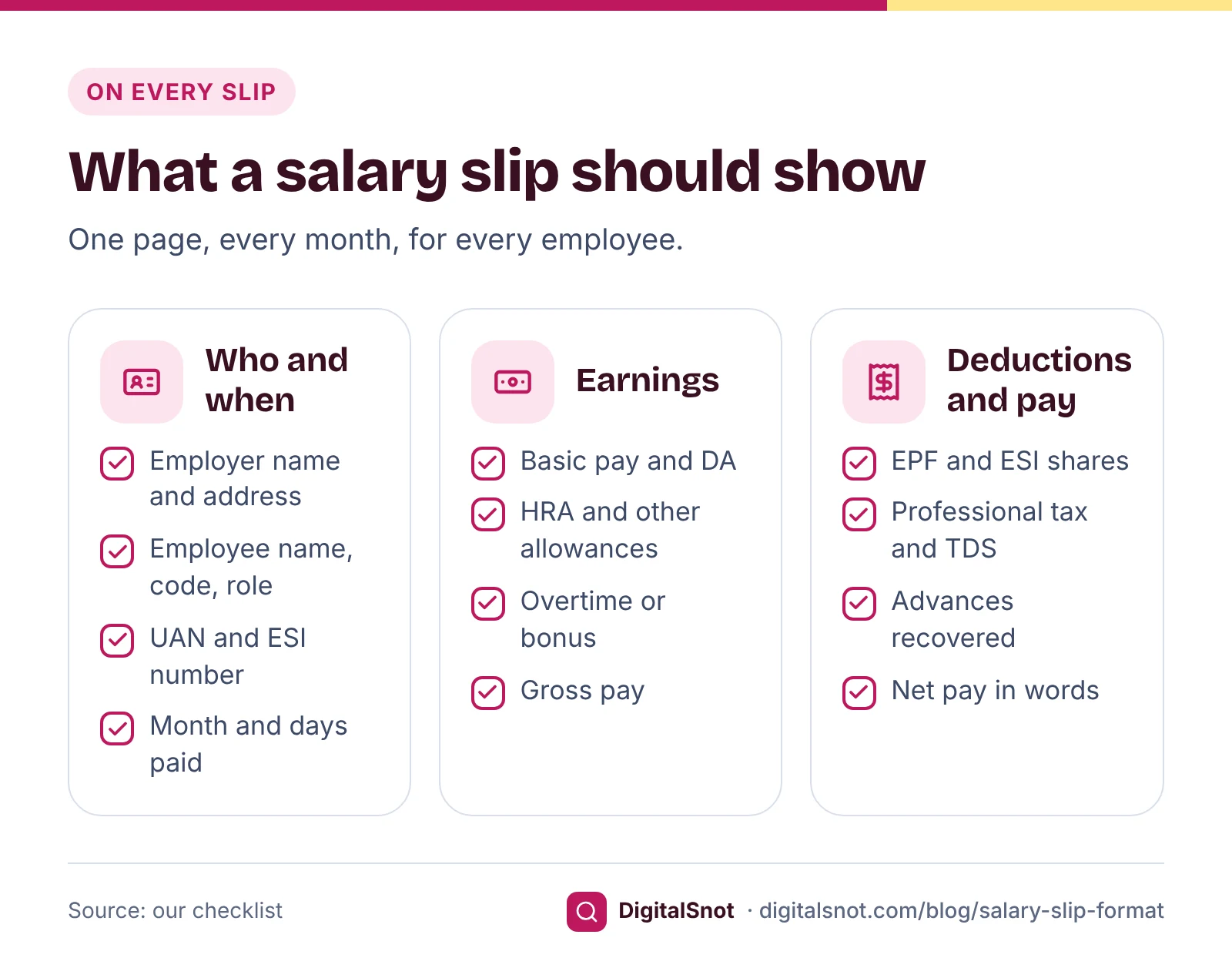
- The employer: the business name and address.
- The employee: name, employee code, designation, department and date of joining, plus PAN, the UAN for EPF and the ESI number where they apply. Our suggestion: show only the last four digits of a bank account.
- The period: the month, the days in it, the days paid and any loss-of-pay days.
- Earnings: each one on its own line, such as basic pay, dearness allowance (DA), house rent allowance (HRA), other allowances, overtime and bonus, with the gross total.
- Deductions: the employee's EPF and ESI shares, professional tax, TDS and any advance or loan recovered, with the total.
- Net pay: in figures and in words, with the payment date and how it was paid.
The employer's own EPF and ESI shares are not taken from the employee's pay, so they do not belong in the deductions column.
Earnings and the labour codes' 50% rule
From 21 November 2025, the labour codes use one definition of wages: basic pay, DA and retaining allowance. The Labour Ministry's FAQs on the labour codes explain that when the other allowances come to more than half of total pay, the part above half is added back to wages. That wage figure is the base for EPF, ESI and gratuity.
A quick example. Total pay is ₹30,000: ₹12,000 of basic pay and DA, and ₹18,000 of allowances. Half of total pay is ₹15,000, so ₹3,000 of the allowances is above half. Wages for EPF become ₹12,000 + ₹3,000 = ₹15,000. If your pay structure keeps basic pay low and allowances high, check it with your CA, because some items are left out of wages altogether.
Loss-of-pay days and working days
When an employee takes unpaid leave, the monthly amounts are cut for those days. A common method, and the one our tool uses, is the monthly amount × paid days ÷ days in the month. Some employers use 30 days for every month instead. Neither is the only right answer; follow your appointment letters or pay policy, and use the same method every month.
Overtime, bonus and other one-off amounts are not cut. Keep the leave record behind every loss-of-pay day, signed or emailed, so the slip can be explained later.
If you need to count working days, for example for a notice period or a delivery promise, use our Working Days Calculator (India). Pick your weekly off (Saturday and Sunday, Sunday only, or Sundays with the second and fourth Saturdays), keep the central government's gazetted holidays for 2026 and 2027 or leave them out, and add your State's holidays and your own closures. It counts the days between two dates, or finds the date a number of working days away.
EPF and ESI: the current figures
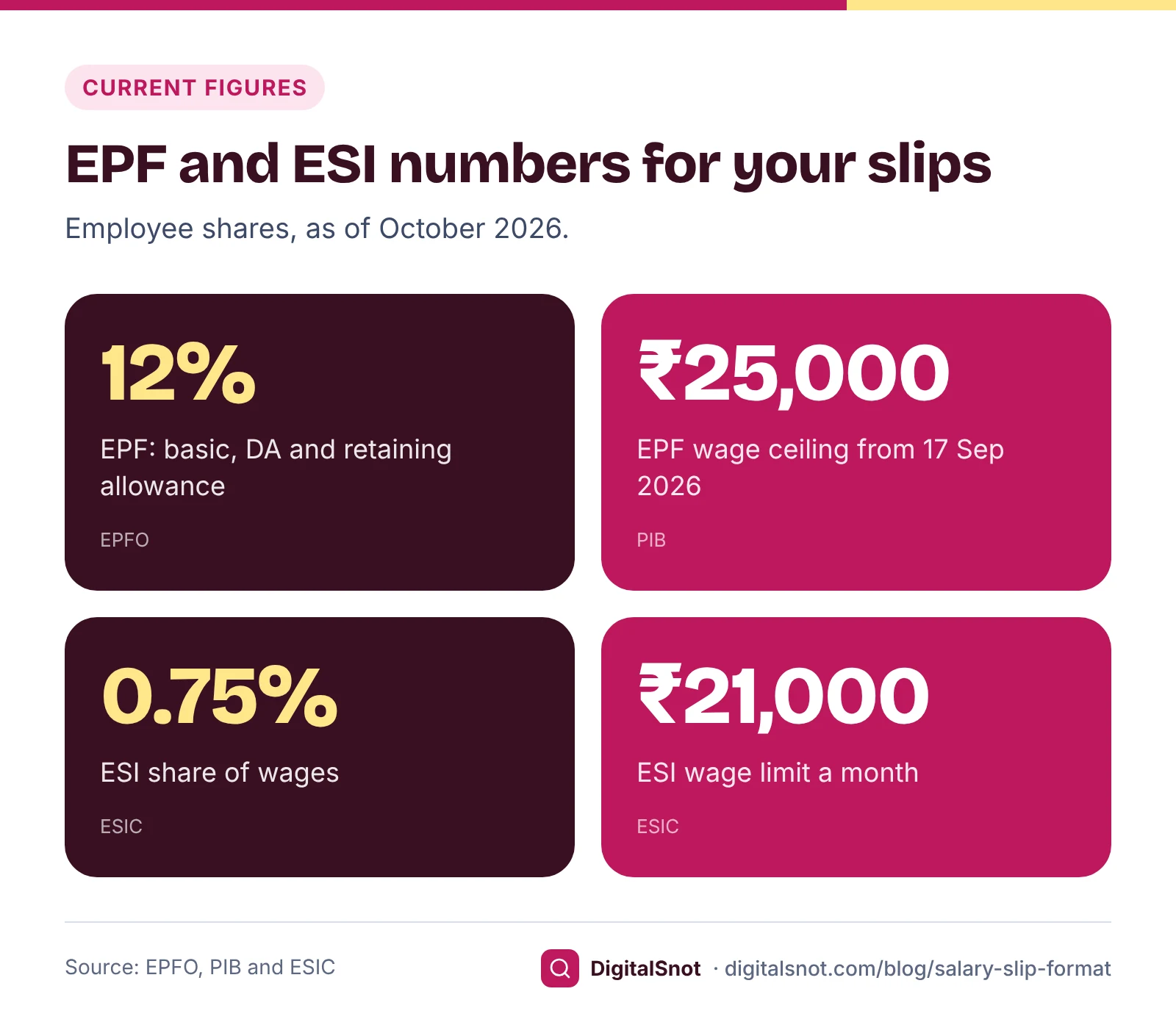
EPF. The EPFO's FAQs give the employee's share as 12% of basic wages, DA and retaining allowance; the employer pays its own share on top. The wage ceiling went up from ₹15,000 to ₹25,000 a month on 17 September 2026, by notification S.O. 5109(E). On wages at the ceiling, the employee's share is ₹3,000 a month. Contributing on wages above the ceiling needs a joint request by the employee and the employer under paragraph 26(6) of the EPF Scheme. According to PIB, employees who were left out only because their wages were above ₹15,000 are now eligible where their wages are not above ₹25,000. Ask your CA how to treat September 2026, the month the change took effect.
ESI. According to ESIC, the employee pays 0.75% of wages and the employer 3.25%, for employees earning up to ₹21,000 a month, or ₹25,000 for a person with disability. An employee whose average daily wage is up to ₹176 pays no share, but the employer still pays its own. If wages go above the limit during a contribution period, ESI continues until that period ends.
Whether your business must register for EPF or ESI depends on rules about the number of employees and the type of establishment. Your CA can confirm it.
Professional tax and TDS
Professional tax is levied by States, and the slabs and rates differ from one State to the next. Under Article 276(2) of the Constitution, the professional tax one person pays to a State, or to any one local body in it, cannot be more than ₹2,500 a year. Take the monthly figure from your State's rules for each employee's pay, and type it on the slip.
TDS on salary. The Income-tax Act, 2025 applies from 1 April 2026. Under section 392, an employer deducts tax when it pays salary, at the average rate of income tax worked out on the employee's estimated salary for the tax year. The yearly certificate is now Form No. 130, which replaces Form 16. Work out each employee's estimated tax with your CA at the start of the year and revisit it when pay changes.
Worked example: Smile Studio Dental, Pune
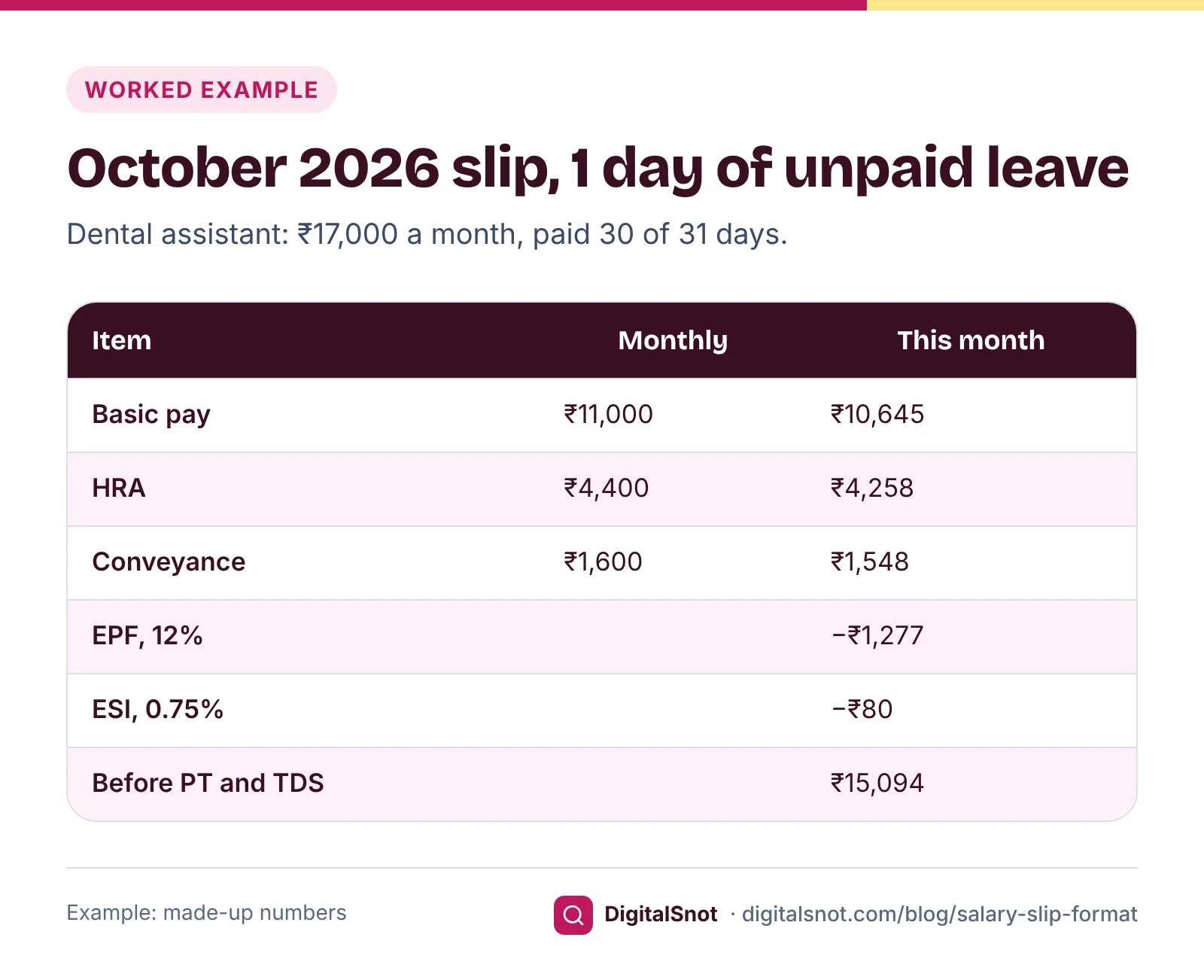
Smile Studio Dental is a made-up clinic in Kothrud, Pune, covered by EPF and ESI. Its dental assistant earns ₹11,000 basic pay, ₹4,400 HRA and ₹1,600 conveyance allowance: ₹17,000 a month. In October 2026, a 31-day month, she took 1 day of unpaid leave, so she is paid for 30 days.
- Basic pay: ₹11,000 × 30 ÷ 31 = ₹10,645.
- HRA: ₹4,400 × 30 ÷ 31 = ₹4,258.
- Conveyance: ₹1,600 × 30 ÷ 31 = ₹1,548.
- Gross pay: ₹16,451.
Her allowances (₹5,806) are less than half of her pay, so her wages are her basic pay of ₹10,645. EPF is 12% of that: ₹1,277. Her wages are within ₹21,000, so ESI applies: 0.75% of ₹10,645 is ₹80. Our helper works out ESI on the same wage figure as EPF, following the labour codes' single definition of wages; if your CA uses a different figure, type theirs. Net pay before professional tax is ₹16,451 − ₹1,277 − ₹80 = ₹15,094. The clinic then takes off the professional tax Maharashtra's rules set for her pay, and TDS if her estimated income for the year is taxable.
Had the clinic used a 30-day month, her basic pay would be ₹11,000 × 29 ÷ 30 = ₹10,633, a little less. Pick one method and keep to it.
Our Salary Slip Generator lays this out on an A4 page. It cuts monthly amounts for loss-of-pay days, fills the employee's EPF and ESI shares from the current rates and limits (you can change them), writes the net pay in words in lakh and crore, and prints or saves a PDF. Professional tax and TDS are what you type: it has no State rates and does not work out income tax. It runs in your browser, and employee details and pay are not saved.
Records to keep, and what the slip does not show
- A copy of every slip, with the attendance and leave record behind it.
- Proof of payment: the bank transfer or UPI reference for each month's net pay.
- EPF, ESI and TDS filings, matched to the deductions on the slips.
- Appointment letters that set out the pay structure the slips follow.
Gratuity does not appear on a monthly slip. It is paid when a job ends, under the Code on Social Security, 2020. When someone leaves, put the joining date, last working day and last wages into our Gratuity Calculator to see whether gratuity is due, the amount and the date it should be paid by.
Mistakes to avoid
- The old EPF ceiling. Slips made from a template set up before 17 September 2026 may still cap EPF at ₹15,000.
- Basic pay set very low. Under the 50% rule, allowances above half of total pay count as wages anyway.
- The employer's share in the deductions. Only the employee's EPF and ESI shares come off the employee's pay.
- A guessed professional tax. Use your State's own slabs, and stay within the ₹2,500 yearly limit per person.
- Changing the loss-of-pay method month to month. It makes slips hard to check and easy to dispute.
- Slips that never arrive. If you email slips, make sure your domain is set up so mail is delivered; our post on why business emails land in spam explains the checks.
Your next step
Open the Salary Slip Generator, enter your business details once, and make this month's slips. Check the EPF ceiling it uses, type professional tax and TDS from your CA's figures, then print or save them. More tools for invoices, receipts and payroll are on our free tools page.
Free tools in this article
- Working Days Calculator (India) Count working days between two dates or add working days to a date, skipping weekly offs and holidays.
- Salary Slip Generator Make a monthly salary slip with loss-of-pay days, EPF and ESI helpers and net pay in words, then print it.
- Gratuity Calculator Check whether gratuity is due, work out the amount and the pay-by date, and get a letter to send.
By the numbers
- a month: the EPF wage ceiling from 17 September 2026, up from ₹15,000
- ₹25,000
- Source: Press Information Bureau (Ministry of Labour and Employment)
- of wages: the employee's ESI share, with the employer paying 3.25%
- 0.75%
- Source: Employees' State Insurance Corporation
Frequently asked questions
Is it compulsory to give employees a salary slip?
Yes. Section 50(3) of the Code on Wages, 2019, in force since 21 November 2025, says every employer shall issue wage slips to employees in the form and manner the rules prescribe. Ask your CA which form applies to your establishment.
How much EPF is deducted from salary?
The EPFO gives the employee's share as 12% of basic wages, DA and retaining allowance. Since 17 September 2026 the wage ceiling is ₹25,000 a month, so the share on the ceiling is ₹3,000, unless the employee and employer jointly choose to contribute on higher wages.
When is ESI deducted from salary?
For employees earning up to ₹21,000 a month, or ₹25,000 for a person with disability, in an establishment covered by ESI. The employee pays 0.75% of wages and the employer 3.25%; an employee earning up to ₹176 a day pays no share.
How is salary worked out for loss-of-pay days?
A common method is the monthly amount × paid days ÷ days in the month; some employers use 30 days for every month. For example, ₹11,000 basic pay with 1 unpaid day in a 31-day month gives ₹10,645. Follow your own pay policy and use one method consistently.
How much professional tax can be deducted?
It depends on your State's rules, which set the slabs and rates. Under Article 276(2) of the Constitution, the professional tax one person pays to a State, or to any one local body in it, cannot be more than ₹2,500 a year.
What replaced Form 16 for salary TDS?
Under the Income-tax Act, 2025, which applies from 1 April 2026, TDS on salary falls under section 392 and the employer's certificate is Form No. 130, which replaces Form 16.
Sources
Every figure and claim in this article comes from the sources below. We checked each one when writing and link to the original so you can read it yourself. Credit belongs to the authors and publishers listed. How we write and check our articles.
-
1
Government makes the four labour codes effective
Press Information Bureau · Labour codes in force from 21 November 2025; appointment letters for all workers
-
2
The Code on Wages, 2019
India Code · Section 50: registers, and wage slips in the form and manner prescribed
-
3
FAQs on the labour codes
Ministry of Labour and Employment · The definition of wages and the 50% rule for allowances
-
4
EPFO FAQs
Employees' Provident Fund Organisation · Employee share of 12% of basic wages, DA and retaining allowance
-
5
EPFO wage ceiling enhanced from ₹15,000 to ₹25,000 per month
Press Information Bureau · New ceiling from 17 September 2026 (S.O. 5109(E))
-
6
ESIC contribution rates
Employees' State Insurance Corporation · 0.75% employee and 3.25% employer shares; ₹21,000 wage limit (₹25,000 for persons with disability); no employee share up to ₹176 a day
-
7
The Constitution of India
India Code · Article 276(2): professional tax on one person capped at ₹2,500 a year
-
8
Section 392: TDS on salary
Income Tax Department · Tax deducted at the average rate on estimated salary for the tax year
-
9
Form No. 130
Income Tax Department · Certificate of tax deducted on salary, replacing Form 16
Want a second pair of eyes?
Tell us about your site. We reply within one business day.
Talk to us Try our free tools