Gratuity calculation: who gets it and how it is worked out
Who is eligible for gratuity under the Code on Social Security, 2020, how the amount is worked out, the ₹20 lakh ceiling, the 30-day deadline and a worked example.

On this page (10 sections)
Gratuity is a lump sum an employer pays when a job ends after long service. Since the labour codes came into force, the rules on who gets it and how wages are counted have changed, and both employers and employees are asking the same questions. This post explains who is eligible, how the gratuity calculation works, when it must be paid and what to keep on record, with a worked example you can check. It is general information, not legal, tax or payroll advice: check your own case with your CA or a lawyer.
Which law applies now
The four labour codes came into force on 21 November 2025. Gratuity now falls under Chapter V of the Code on Social Security, 2020, which replaced the Payment of Gratuity Act, 1972.
The Code's First Schedule says the gratuity chapter applies to every factory, mine, oilfield, plantation, port and railway company, and to every shop or establishment in which ten or more employees are employed, or were employed on any day of the preceding twelve months. The government can notify others. If your business has fewer than ten people, check with your CA whether you are covered. Some employers also have their own gratuity scheme in the appointment letter; this post covers the Code's rules.
The Labour Ministry's additional FAQs of 16 March 2026 also deal with service before 21 November 2025. If part of the service falls before that date, ask your CA how they want it counted.
Who gets gratuity
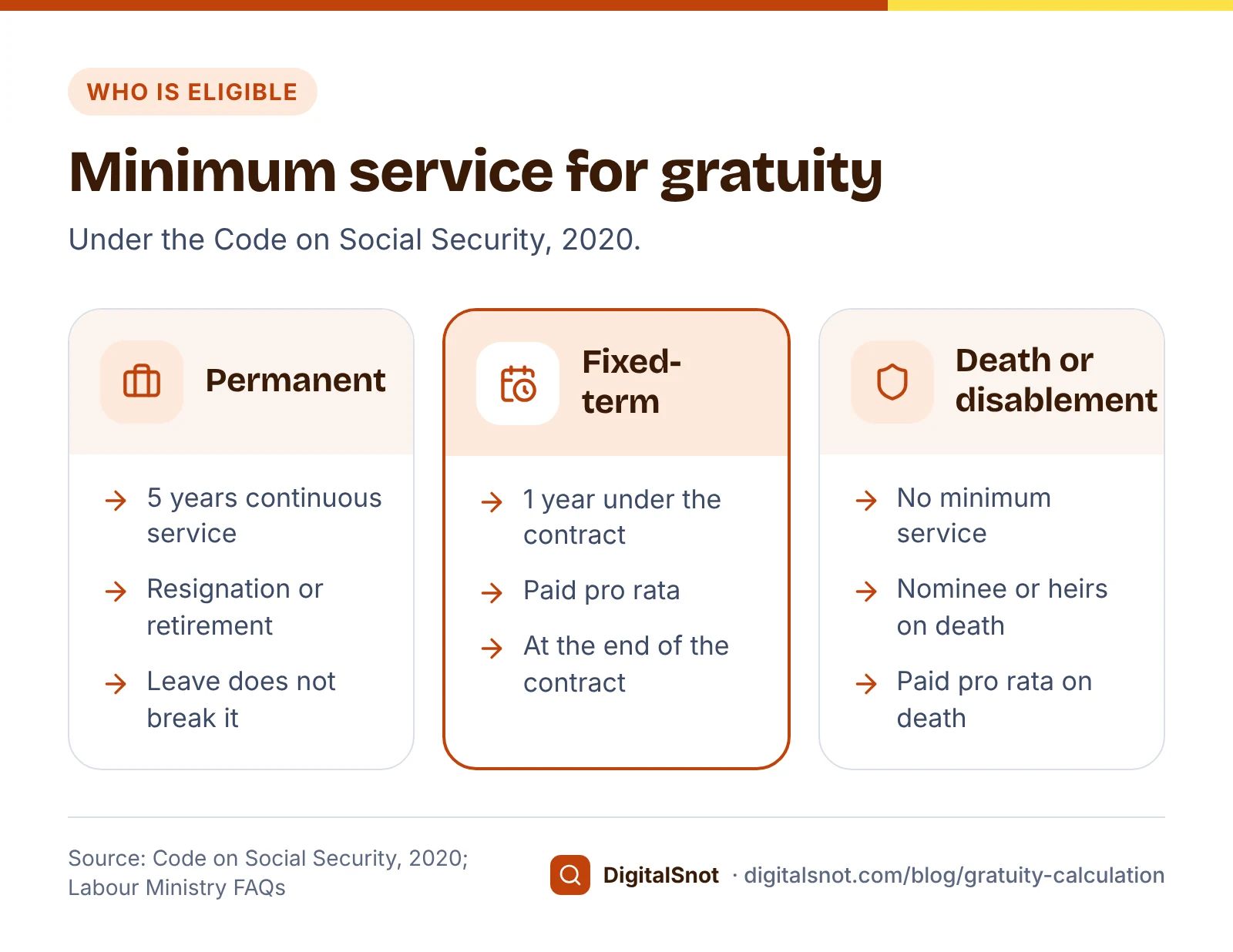
Under section 53 of the Code, gratuity is payable when employment ends after at least five years of continuous service, on:
- retirement or superannuation;
- resignation;
- death, or disablement due to accident or disease;
- the end of a fixed-term contract.
Two groups do not need five years. On death or disablement, no minimum service applies, and on death the gratuity goes to the nominee, or to the heirs if no one was nominated. A fixed-term employee becomes eligible after one year of service under the contract, as the Labour Ministry's FAQs and its factsheet on the Code say. The Code pays fixed-term and deceased employees on a pro rata basis.
Continuous service includes time off for sickness, accident or leave, so a few weeks of leave do not break it. For a permanent employee close to five years, check the joining date and the last working day carefully, because they decide whether gratuity is due at all.
The formula
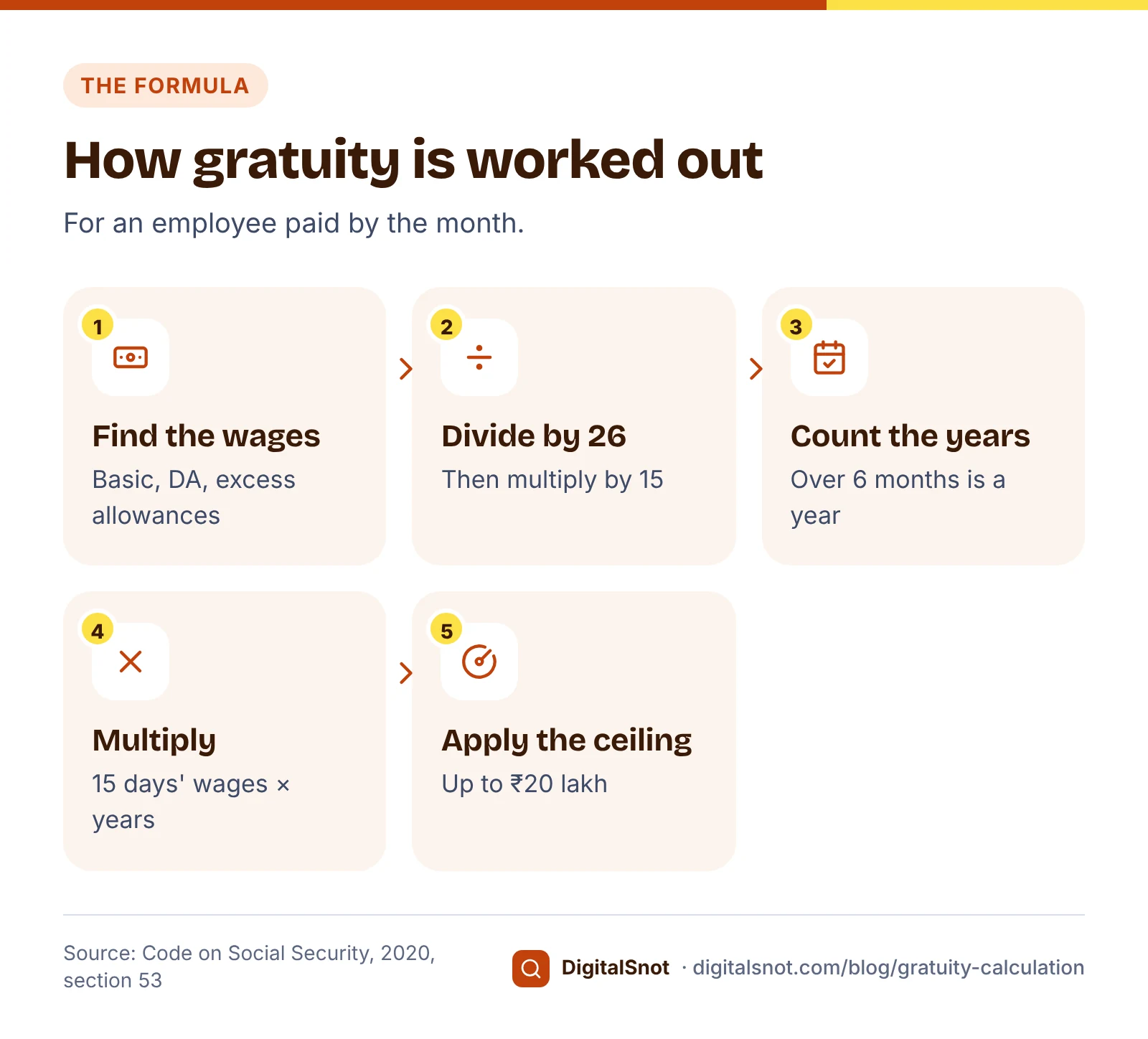
Section 53 gives 15 days' wages for each completed year of service, and a part year of more than six months counts as a full year. For an employee paid by the month, 15 days' wages are the last monthly wages ÷ 26 × 15. So:
Gratuity = last monthly wages ÷ 26 × 15 × years counted.
- Years counted: 6 years and 7 months count as 7; 6 years and 5 months count as 6.
- Seasonal work: in a seasonal establishment, an employee who was not employed all year gets seven days' wages for each season.
- Ceiling: the total cannot go above the amount the Central Government notifies, which the Labour Ministry's FAQs on the labour codes give as ₹20 lakh.
Most long-serving staff stay below the ceiling. A manager on ₹1,30,000 of wages with 27 years counted would work out at ₹20,25,000, so the payment stops at ₹20,00,000.
The Code does not spell out how "pro rata" is counted for fixed-term and deceased employees. Our calculator shows the section 53 formula and, beside it, an exact count of the service as our reading; ask the employer which count they use. For example, a fixed-term employee on ₹24,000 of wages with 1 year and 3 months of service gets ₹13,846 under the formula, which counts 1 year, or ₹17,308 on an exact count of 1.25 years.
Which wages count
From 21 November 2025, gratuity uses the labour codes' definition of wages: basic pay, dearness allowance (DA) and retaining allowance. The Labour Ministry's FAQs explain that when the other allowances come to more than half of total pay, the part above half is added to wages. Some pay items are left out of wages altogether, so check unusual items with your CA.
This matters most where basic pay is set low. Take total pay of ₹36,000: ₹14,000 basic pay, ₹2,000 DA and ₹20,000 of allowances. Half of total pay is ₹18,000, so ₹2,000 of the allowances is above half. Wages for gratuity become ₹16,000 + ₹2,000 = ₹18,000, not ₹16,000. The same wage figure is used for EPF, as our post on what a salary slip should show explains.
Worked example: Nimbus Print Works, Chennai
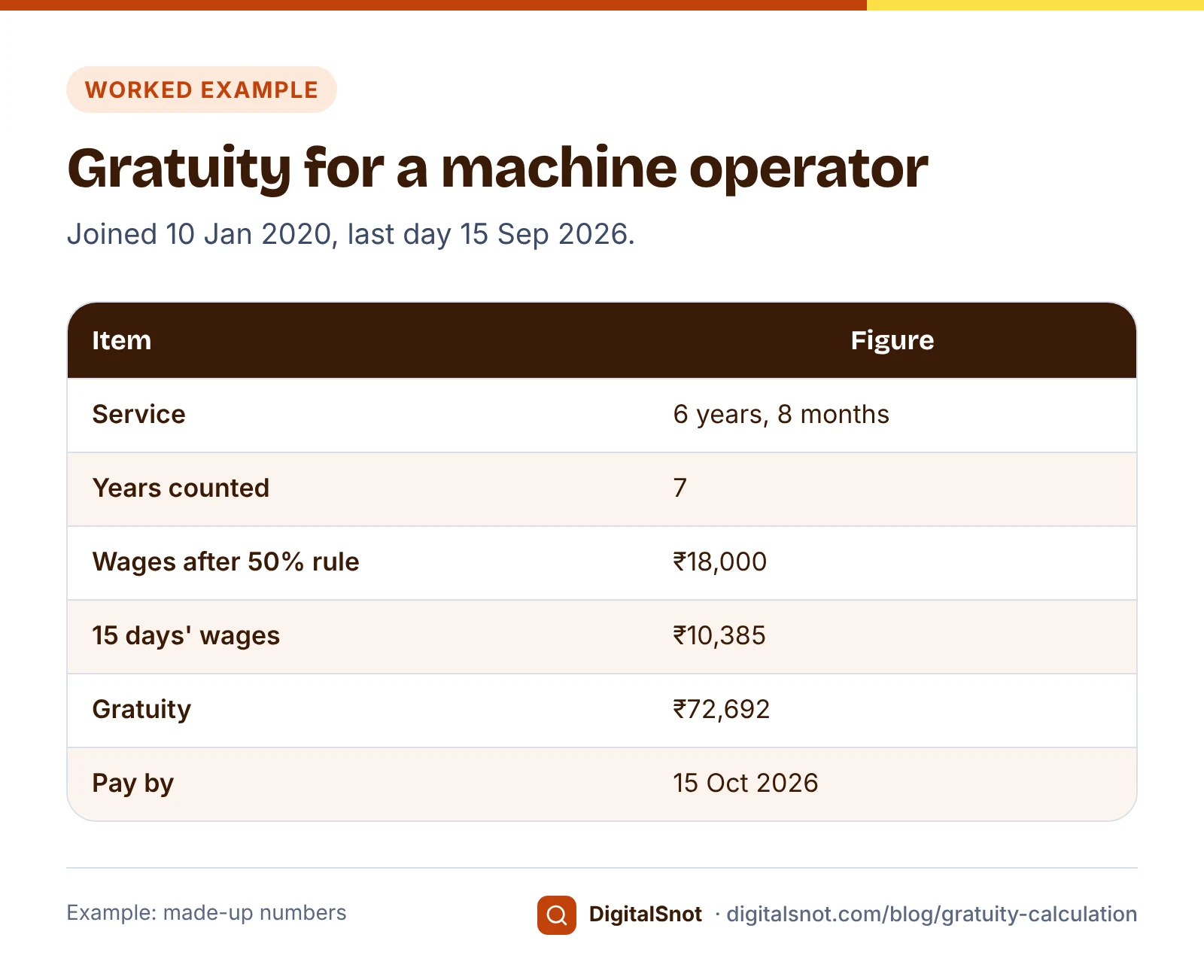
Nimbus Print Works is a made-up printing press in Ambattur, Chennai, with 14 employees. Its machine operator joined on 10 January 2020 and resigned; her last working day was 15 September 2026. Her last monthly pay was the ₹36,000 above.
- Service: 6 years, 8 months and 6 days, counting both the first and last day. The part year is more than six months, so 7 years are counted.
- Wages: ₹18,000, after the 50% rule.
- 15 days' wages: ₹18,000 ÷ 26 × 15 = ₹10,385.
- Gratuity: ₹18,000 ÷ 26 × 15 × 7 = ₹72,692.
- Pay by: 15 October 2026, 30 days after her last working day.
Had the press used basic pay and DA only (₹16,000), it would have worked out ₹64,615, about ₹8,000 less than the Code's wages give. Had she left with only 6 years and 5 months of service, 6 years would count and the gratuity would be ₹62,308.
Put your own dates and pay into our Gratuity Calculator. Choose employee or employer, permanent or fixed-term and why the job ended, then type the joining date, the last working day and the last basic pay, DA and other pay. It tells you whether gratuity is due, the years counted, the amount with the formula shown, the ceiling if it applies, the pay-by date and interest if it is paid late, and writes a letter: a request from the employee or the employer's notice of the amount. It runs in your browser and does not work out income tax.
When it must be paid, and the paperwork
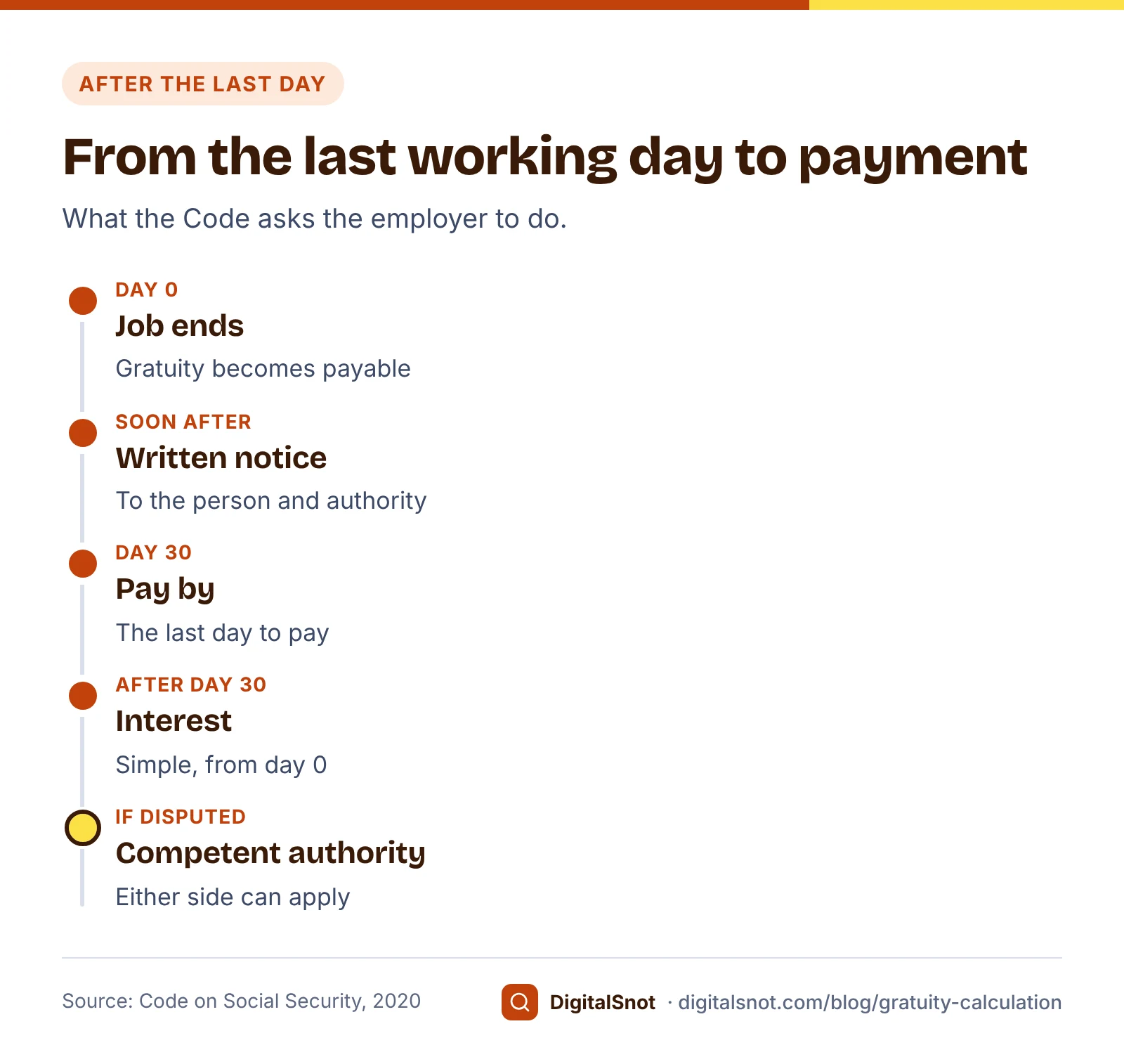
The Code asks the employer to pay gratuity within 30 days of the date it becomes payable. If the employer pays later, it owes simple interest from that date until it pays, at a rate no higher than the one the Central Government notifies for repaying long-term deposits.
The employer must also work out the amount and give written notice of it to the person and to the competent authority, even if no one has applied. If the amount is disputed, either side can go to the competent authority under the Code. For employers, our suggestion is to keep these together for every person who leaves:
- the appointment letter and the joining date;
- the last working day and the reason the job ended;
- the last month's salary slip, showing basic pay, DA and allowances;
- the nomination form;
- the written notice of the amount, and proof of payment.
If you are the employee, ask for the written notice of the amount and compare it with your own working. If it has not been paid by the 30th day, write to the employer and ask for the interest as well. If the employer refuses or disputes the amount, you can apply to the competent authority under the Code. Keep your appointment letter, your last salary slips and any emails about your last working day, because the dates and wages decide the amount.
Our Salary Slip Generator makes monthly slips with basic pay, DA and allowances on separate lines, which makes the last wages easy to show when someone leaves.
Is gratuity taxed?
Part or all of it can be tax free. Under the Income-tax Act, 2025, which applies from 1 April 2026, section 19 deals with the tax-free part, which depends on the kind of employer and on a limit the government notifies. Our calculator does not work out tax, so ask your CA how much of the amount is tax free before you file.
Mistakes to avoid
- Using basic pay alone. From 21 November 2025, DA and any allowances above half of total pay count as wages.
- Dropping the part year. More than six months counts as a full year.
- Dividing by 30. The Code's formula for monthly pay divides by 26.
- Telling a fixed-term employee to wait five years. One year under the contract is enough.
- Paying late without interest. After 30 days, simple interest is due from the date gratuity became payable.
- No written notice. The Code asks for it whether or not the employee applies.
Your next step
If someone is leaving this month, open the Gratuity Calculator, check whether gratuity is due and the date it must be paid by, and copy the letter. Then take the figures to your CA for the tax side. More payroll, receipt and invoice tools are on our free tools page, and you can contact us with a question about the tools.
Free tools in this article
By the numbers
- the most gratuity one employee can receive, the ceiling notified under the Code
- ₹20 lakh
- Source: Ministry of Labour and Employment (FAQs on the labour codes)
- of service under the contract: when a fixed-term employee becomes eligible for gratuity
- 1 year
- Source: Ministry of Labour and Employment (additional FAQs, 16 March 2026)
Frequently asked questions
How is gratuity calculated under the new labour code?
Gratuity is 15 days' wages for each completed year of service, with a part year of more than six months counted as a full year. For monthly pay: last monthly wages ÷ 26 × 15 × years counted. For example, ₹18,000 of wages and 6 years and 8 months of service give ₹18,000 ÷ 26 × 15 × 7 = ₹72,692.
Can I get gratuity before five years?
In some cases. A fixed-term employee becomes eligible after one year of service under the contract, according to the Labour Ministry's FAQs, and no minimum service applies when the job ends because of death or disablement due to accident or disease. A permanent employee who resigns or retires needs five years of continuous service.
Which businesses have to pay gratuity?
Under the First Schedule of the Code on Social Security, 2020, the gratuity chapter applies to every factory, mine, oilfield, plantation, port and railway company, and to every shop or establishment with ten or more employees on any day of the preceding twelve months, plus any others the government notifies.
Which wages are used for gratuity?
The last wages drawn, under the labour codes' definition: basic pay, DA and retaining allowance. When other allowances come to more than half of total pay, the part above half is added to wages.
What is the maximum gratuity?
The Code caps gratuity at an amount the Central Government notifies, which the Labour Ministry's FAQs give as ₹20 lakh. Check your appointment letter for any company scheme as well.
How soon must gratuity be paid?
Within 30 days of the date it becomes payable. If the employer pays later, it owes simple interest from that date. The employer must also give written notice of the amount to the person and to the competent authority.
Sources
Every figure and claim in this article comes from the sources below. We checked each one when writing and link to the original so you can read it yourself. Credit belongs to the authors and publishers listed. How we write and check our articles.
-
1
Government makes the four labour codes effective
Press Information Bureau · Labour codes in force from 21 November 2025
-
2
The Code on Social Security, 2020
India Code · Section 53: eligibility, 15 days' wages a year, the ÷ 26 rule, the ceiling; First Schedule: establishments covered
-
3
FAQs on the labour codes
Ministry of Labour and Employment · Gratuity ceiling of ₹20 lakh; the definition of wages and the 50% rule
-
4
Additional FAQs on the labour codes (as on 16 March 2026)
Ministry of Labour and Employment · Fixed-term employees eligible after one year of service under the contract; service before 21 November 2025
-
5
Code on Social Security, 2020: towards universal and inclusive social protection
Press Information Bureau · Gratuity for fixed-term employees after one year, on a proportionate basis
-
6
Section 19, Income-tax Act, 2025
Income Tax Department · Deductions from salary, including the tax-free part of gratuity
Want a second pair of eyes?
Tell us about your site. We reply within one business day.
Talk to us Try our free tools