Late GST return: how the GST late fee and interest are worked out
How the late fee and interest on a late GSTR-3B or GSTR-1 are worked out: the daily fee, the caps by turnover, 18% interest on tax paid in cash, and a worked example.

On this page (10 sections)
- 1When a return counts as late
- 2The late fee: a fixed amount a day, with a cap
- 3Interest: 18% a year on tax paid late in cash
- 4Worked example: Green Leaf Caterers, Kolkata
- 5The 57th GST Council recommendation: not law yet
- 6Returns more than three years late
- 7What to do now
- 8Mistakes to avoid
- 9Your next step
- 10Sources
If you missed a GST return date, two costs start adding up, the GST late fee and interest: a fee for each day, and interest on the tax you pay late. This post shows how each is worked out for GSTR-3B and GSTR-1, the caps that stop the fee growing, what the GST Council recommended in October 2026, and a worked example you can repeat with your own figures. It is general information, not tax advice: the GST portal works out the amount you actually pay, so check yours with your CA.
When a return counts as late
A return is late from the day after its due date. The usual dates are:
- GSTR-3B, monthly: the 20th of the next month.
- GSTR-3B, quarterly (QRMP): the 22nd or the 24th of the month after the quarter, depending on the State of your principal place of business.
- GSTR-1: the 11th of the next month for monthly filers, and the 13th of the month after the quarter for quarterly filers.
The government sometimes extends a date for a period, so check the date for your period on the GST portal, and its GSTR-3B FAQs, before you count. The days late are the filing date minus the due date: a GSTR-3B due on 20 September and filed on 15 October is 25 days late.
The late fee: a fixed amount a day, with a cap
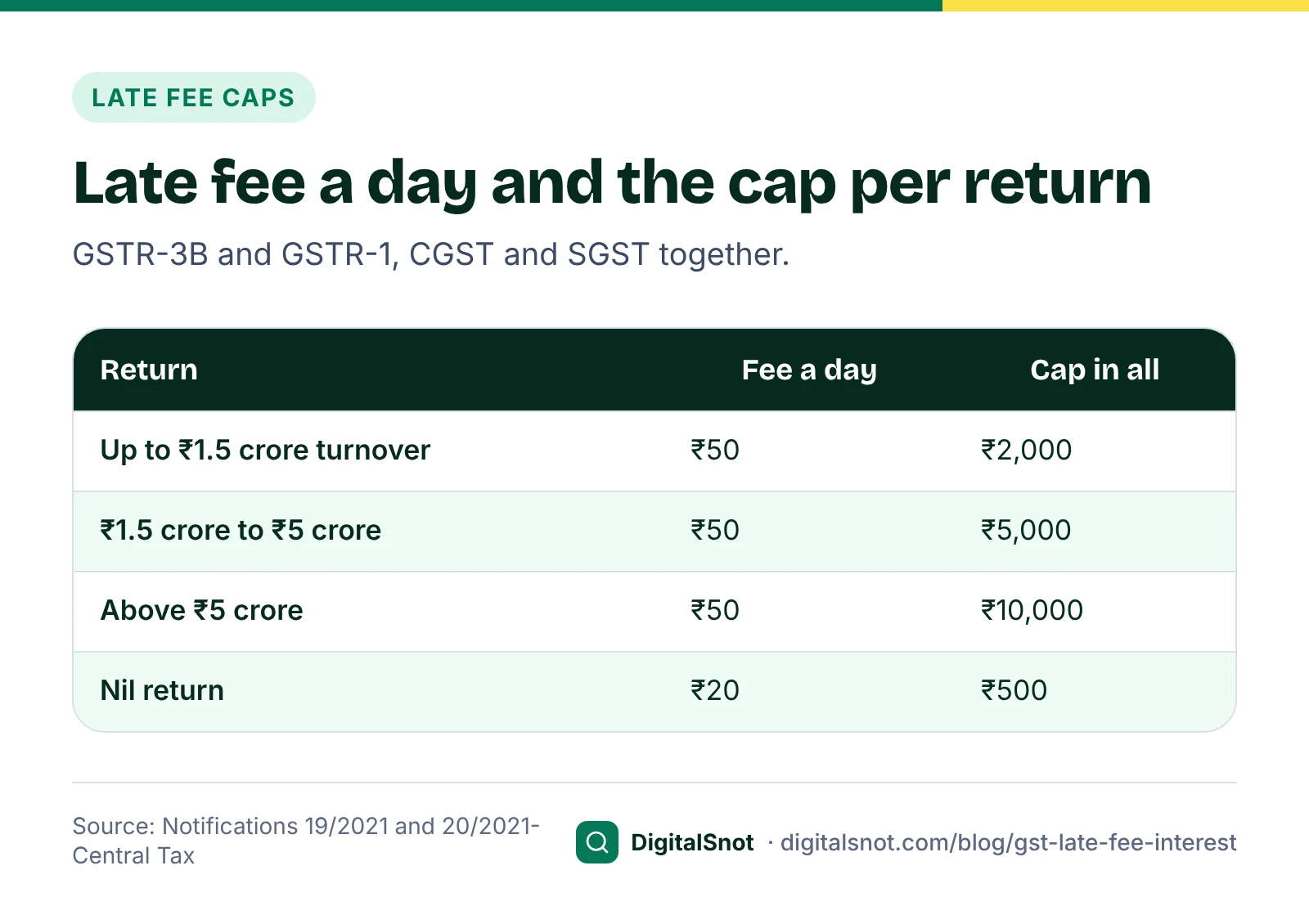
Section 47 of the CGST Act charges a late fee for every day a return is late. On the GST portal it comes to ₹25 a day under CGST plus ₹25 under SGST (or UTGST) for a GSTR-3B or GSTR-1, or ₹10 plus ₹10 for a nil return. Since the June 2021 tax period, the fee per return is capped by turnover: Notification 19/2021-Central Tax sets the caps for GSTR-3B and Notification 20/2021-Central Tax those for GSTR-1. Each amount below is split half and half between the two Acts. There is no late fee on IGST or cess.
| Return | Fee a day (CGST + SGST) | Cap per return, in all |
|---|---|---|
| Turnover up to ₹1.5 crore | ₹25 + ₹25 | ₹2,000 |
| Turnover ₹1.5 crore to ₹5 crore | ₹25 + ₹25 | ₹5,000 |
| Turnover above ₹5 crore | ₹25 + ₹25 | ₹10,000 |
| Nil return, any turnover | ₹10 + ₹10 | ₹500 |
Turnover here means your aggregate turnover in the previous financial year. A nil GSTR-3B is one with no tax to pay; a nil GSTR-1 has no outward supplies. At ₹50 a day, the fee reaches the ₹2,000 cap on day 40; a nil return reaches its ₹500 cap on day 25.
The GSTR-1 late fee is not paid with GSTR-1. The portal adds it to your next GSTR-3B, and you pay it there.
Interest: 18% a year on tax paid late in cash
Interest is a separate charge. Under section 50 of the CGST Act, tax paid after its due date carries interest from the day after it was due, at a rate the government notifies of up to 18% a year; CBIC gives 18% as the normal rate.
When a GSTR-3B is filed late and no proceedings have started for that period, section 50 charges interest only on the part of the tax paid from the electronic cash ledger, not on the part set off with input tax credit. Rule 88B also leaves out cash that sat in your cash ledger from the due date until you paid. So the working is:
Interest = tax paid in cash × 18% × days late ÷ 365.
Interest has no cap. The late fee stops at its limit, but interest keeps growing every day until you pay. The GST portal works out the interest and fills it into Table 5.1 of your next GSTR-3B, as GSTN's advisory on interest in GSTR-3B explains. A GSTR-1 carries a late fee but no interest of its own, because the tax is paid through GSTR-3B.
If a notice has been issued or proceedings have started for the period, interest is not limited to the cash part. Ask your CA in that case.
Worked example: Green Leaf Caterers, Kolkata
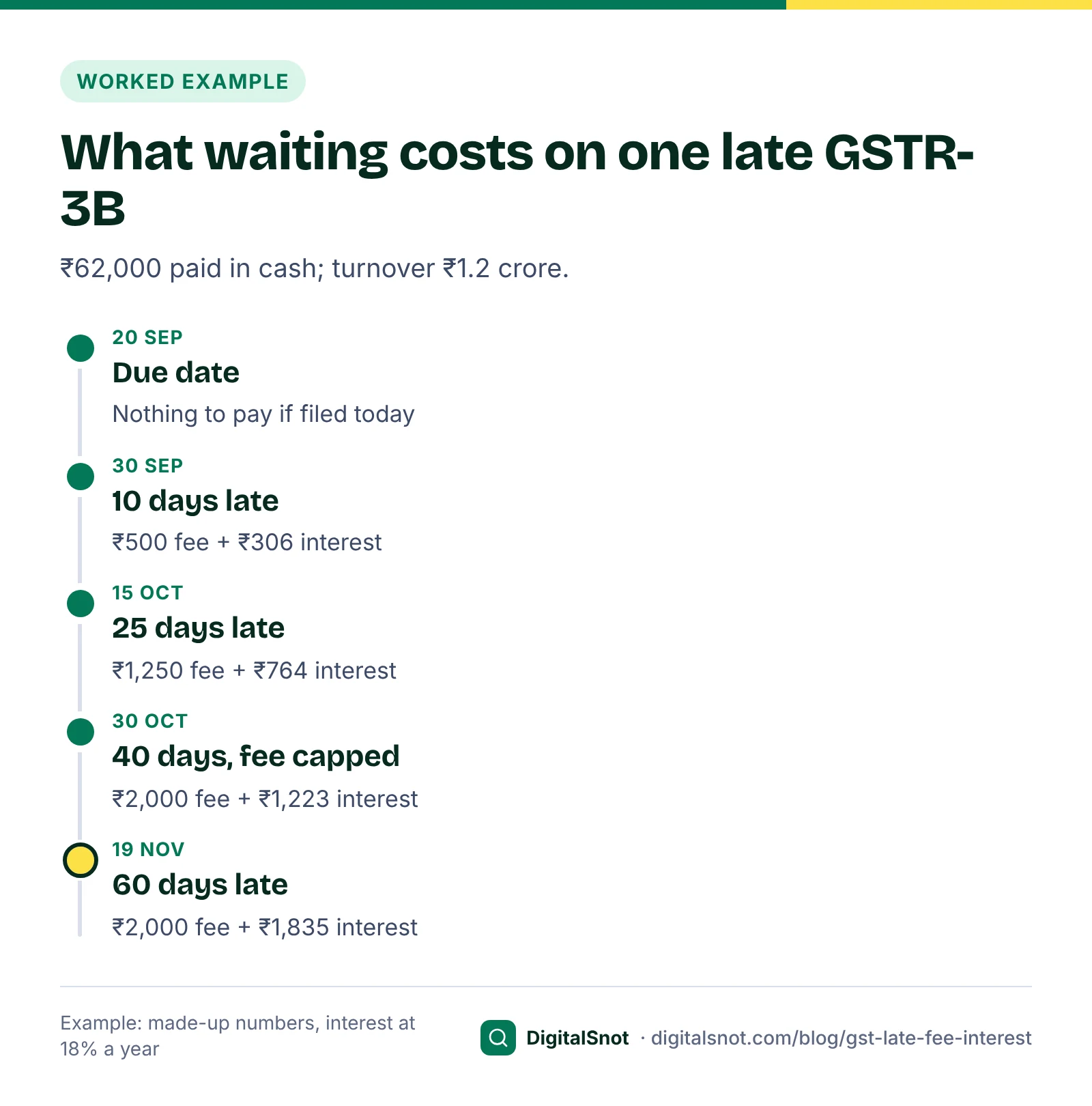
Green Leaf Caterers is a made-up catering business in Salt Lake, Kolkata. Its aggregate turnover last year was ₹1.2 crore, and it files GSTR-3B every month. Its return for August 2026 was due on 20 September 2026. It files on 15 October 2026, 25 days late, and pays ₹62,000 of tax in cash; the rest is set off with input tax credit.
- Late fee: 25 days × ₹25 = ₹625 under CGST, and ₹625 under SGST: ₹1,250 in all, below the ₹1,000 cap per Act.
- Interest: ₹62,000 × 18% × 25 ÷ 365 = ₹764.
- Total: ₹2,014.
Each extra day adds ₹50 of late fee until day 40, when the fee reaches ₹2,000 in all, and about ₹31 of interest, which carries on after that. Had it filed on 30 September, 10 days late, the cost would have been ₹500 of late fee and ₹306 of interest: ₹806.
Put your own figures into our GST Late Fee and Interest Calculator. Pick GSTR-3B or GSTR-1, monthly or quarterly filing and the tax period, and it fills in the usual due date, which you can change if the date was extended. Add the filing date, your turnover band, whether it is a nil return and the tax you pay in cash. It shows the days late, the late fee split into CGST and SGST with your cap, the interest, what each extra day adds and the steps to take. It runs in your browser, and the portal's figure is the one you pay.
The 57th GST Council recommendation: not law yet
On 8 October 2026, at its 57th meeting, the GST Council recommended waiving the late fee on a return under section 39(1) of the CGST Act, which is GSTR-3B, for taxpayers with aggregate turnover of up to ₹5 crore in the previous financial year, when the return is filed by the end of the month in which it was due. It covers the late fee, not interest.
A recommendation becomes law only when the government notifies it, and the final wording can differ. When we checked in October 2026 we found no notification, so the figures in this post and in our calculator follow the rules in force. In the example, filing by 30 September would fall inside the recommended window; filing on 15 October would not. Do not hold back a return waiting for the waiver: filing sooner costs less either way. Check gst.gov.in for the notification before you rely on it.
Returns more than three years late
The Finance Act 2023 added a time limit: a return cannot be filed once three years have passed from its due date (section 37(5) for GSTR-1 and section 39(11) for GSTR-3B). GSTN's advisory on barring of returns explains that the portal applies this limit. If a return is close to that date, file it now; if it is already past it, talk to your CA.
What to do now
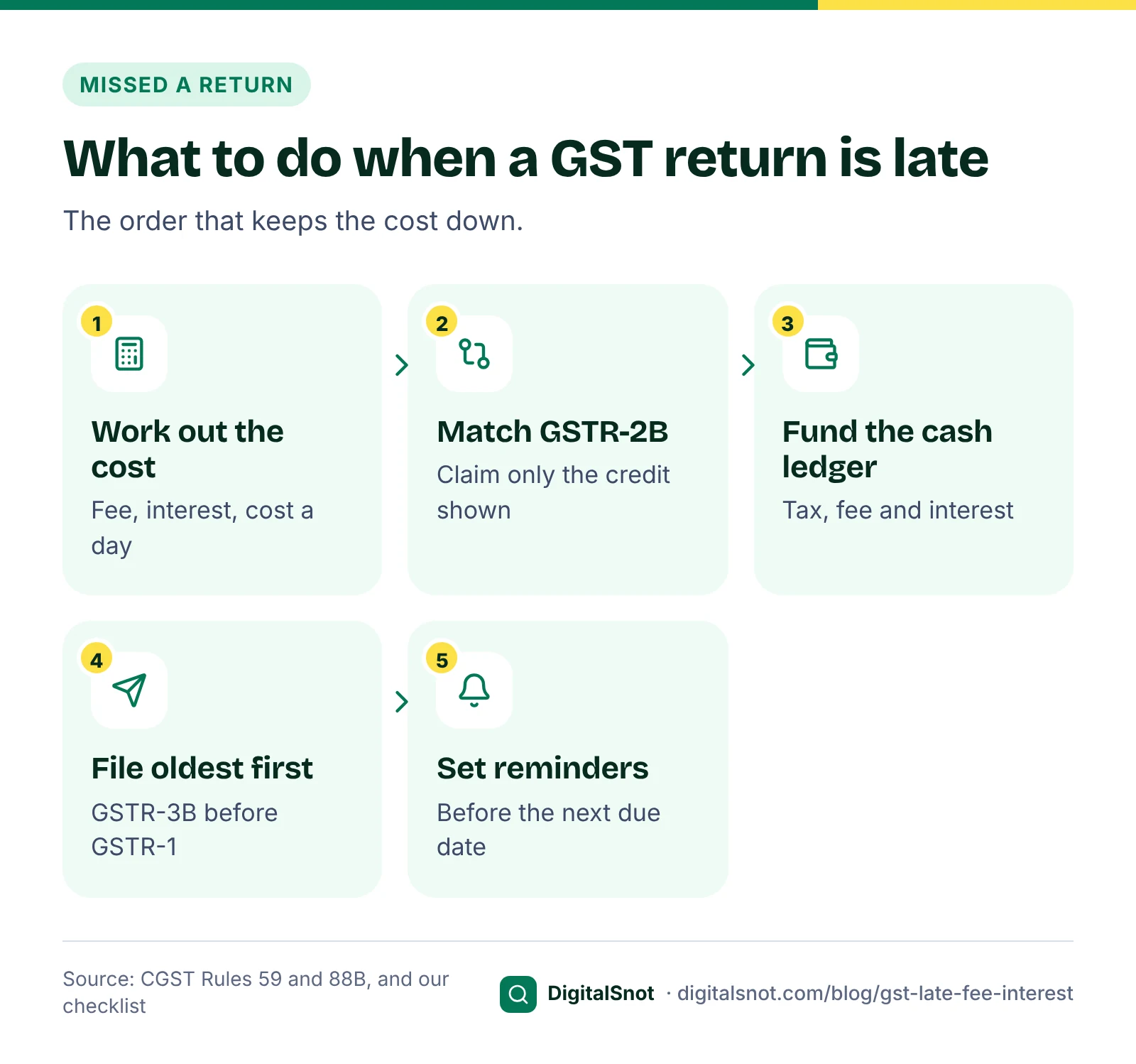
- Work out the cost. Use the calculator so you know the fee, the interest and what each day adds.
- File the oldest pending GSTR-3B first. Under rule 59(6), the portal does not take GSTR-1 while the previous period's GSTR-3B is pending.
- Check your input tax credit. Match your purchase register with GSTR-2B in our GSTR-2B Reconciliation Tool, so the return claims only the credit GSTR-2B shows. Our post on GSTR-2B reconciliation explains the steps.
- Put the money in the cash ledger. Late fee and interest are paid from the electronic cash ledger, not from input tax credit.
- Check Table 5.1 of the next GSTR-3B. The portal fills in the interest it worked out; compare it with your figure.
- Set reminders. Our suggestion: two or three days before each due date.
If you need the tax on a bill first, the GST Calculator adds or takes out GST and splits it into CGST and SGST or IGST.
Mistakes to avoid
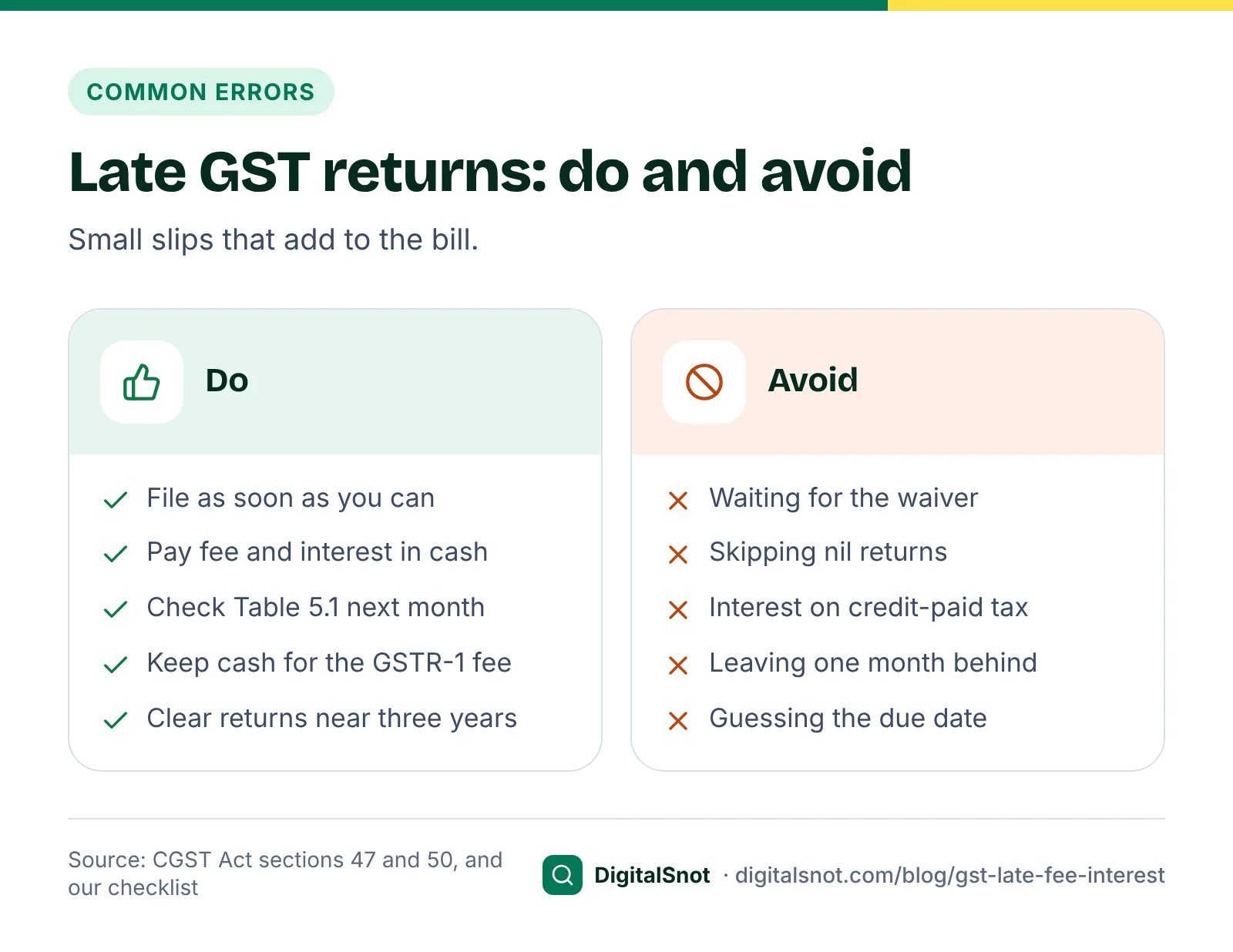
- Assuming a nil return has no fee. It costs ₹20 a day, up to ₹500.
- Forgetting the GSTR-1 fee. It turns up in your next GSTR-3B, so keep the cash ready.
- Working interest on all the tax. For a late return with no proceedings, only the cash part counts.
- Waiting for the waiver. Interest keeps growing, and the waiver may never apply in the form recommended.
- Leaving one month behind. Every pending return builds its own fee, and the next period's return soon becomes late too.
- Late invoices from suppliers. Credit depends on what they report; our post on what a GST invoice must show helps you check the bills you receive.
Your next step
Open the GST Late Fee and Interest Calculator, type the return you missed and the date you can file it, and file it as soon as you can. If several returns are pending or a notice has arrived, take the figures to your CA. More invoice, GST and payment tools are on our free tools page, and you can contact us if you have a question about the tools.
Free tools in this article
- GST Late Fee and Interest Calculator Late fee and interest on a late GSTR-3B or GSTR-1, with the cap for your turnover and the cost of each day.
- GSTR-2B Reconciliation Tool Match GSTR-2B with your purchase register: credit at risk, missing invoices and supplier follow-up messages.
- GST Calculator Add GST to a price or take it out, split into CGST and SGST or IGST, for one item or a whole bill.
By the numbers
- in all: the most late fee on one late GSTR-3B for turnover up to ₹1.5 crore, ₹1,000 each under CGST and SGST
- ₹2,000
- Source: GST Council (Notification 19/2021-Central Tax)
- a year: the most interest section 50(1) allows on tax paid late
- 18%
- Source: CBIC (CGST Act, section 50)
Frequently asked questions
What is the late fee for filing GSTR-3B late?
For a return with tax to pay, ₹50 a day: ₹25 under CGST and ₹25 under SGST. The fee per return stops at ₹2,000 in all if your turnover in the previous financial year was up to ₹1.5 crore, ₹5,000 up to ₹5 crore and ₹10,000 above that.
Is there a late fee on a nil return?
Yes. A nil GSTR-3B or nil GSTR-1 costs ₹10 a day under CGST and ₹10 under SGST, capped at ₹500 in all per return, whatever your turnover.
How is interest on late GST worked out?
Interest = tax paid in cash × 18% × days late ÷ 365, from the day after the due date. For example, ₹62,000 paid in cash 25 days late carries ₹764 of interest. The portal fills its own figure into Table 5.1 of your next GSTR-3B.
Is interest charged on tax paid with input tax credit?
Not for a return filed late when no proceedings have started for that period: section 50 then charges interest only on the tax paid from the electronic cash ledger. If a notice or proceedings have started, ask your CA.
Has the late fee waiver from the 57th GST Council come into force?
On 8 October 2026 the Council recommended waiving the late fee on a GSTR-3B filed late by taxpayers with turnover up to ₹5 crore, when it is filed by the end of the month it was due. A recommendation is law only once notified, and we found no notification when we checked in October 2026, so check gst.gov.in.
Can I pay the late fee from my input tax credit?
No. The late fee and interest are paid from the electronic cash ledger. Add the money to the cash ledger before you file the late return.
Sources
Every figure and claim in this article comes from the sources below. We checked each one when writing and link to the original so you can read it yourself. Credit belongs to the authors and publishers listed. How we write and check our articles.
-
1
CGST Act, 2017: section 47 (levy of late fee)
Central Board of Indirect Taxes and Customs · Late fee for every day a return is late
-
2
Notification 19/2021-Central Tax
GST Council · GSTR-3B late fee per day and the cap per return by turnover, and for nil returns
-
3
Notification 20/2021-Central Tax
GST Council · GSTR-1 late fee per day and the cap per return
-
4
CGST Act, 2017: section 50 (interest on delayed payment of tax)
Central Board of Indirect Taxes and Customs · Interest of up to 18% a year; only on the cash part for a late return with no proceedings
-
5
CGST Rules, 2017: rule 88B
Central Board of Indirect Taxes and Customs · How interest is worked out, leaving out cash already in the cash ledger
-
6
Advisory on interest collection and related enhancements in GSTR-3B
GSTN · The portal works out interest and fills it into Table 5.1 of the next GSTR-3B
-
7
Recommendations of the 57th meeting of the GST Council
Press Information Bureau · 8 October 2026: late fee waiver recommended for turnover up to ₹5 crore when filed by the end of the due month
-
8
Barring of GST returns on expiry of three years
GSTN · Returns cannot be filed three years after their due date
-
9
CGST Rules, 2017: rule 59
Central Board of Indirect Taxes and Customs · Rule 59(6): GSTR-1 is not taken while the previous GSTR-3B is pending
-
10
FAQs: Form GSTR-3B
GST portal · Filing GSTR-3B, due dates and late fee on the portal
Want a second pair of eyes?
Tell us about your site. We reply within one business day.
Talk to us Try our free tools