Micro, small or medium: which MSME category is your business?
The investment and turnover limits in force from 1 April 2025, how free Udyam Registration works, where traders and informal units fit, and what each category gets you.
On this page (10 sections)
- 1The two tests: investment and turnover
- 2How investment and turnover are counted
- 3Worked example: Shree Ganesh Engineering Works, Bengaluru
- 4Moving up or down a category
- 5How Udyam Registration works
- 6Traders and informal micro units
- 7What your category gets you
- 8Mistakes to avoid
- 9Your next step
- 10Sources
Your MSME category, whether micro, small or medium, decides which government protections and schemes you can use, from the rules on late payment to public tenders. The category is not a choice: it follows from two figures in your own returns. This post explains the current limits, how the figures are counted, how Udyam Registration works and what each category gets you, with a worked example. It is general information, not legal or tax advice: check your own case with a CA.
The two tests: investment and turnover
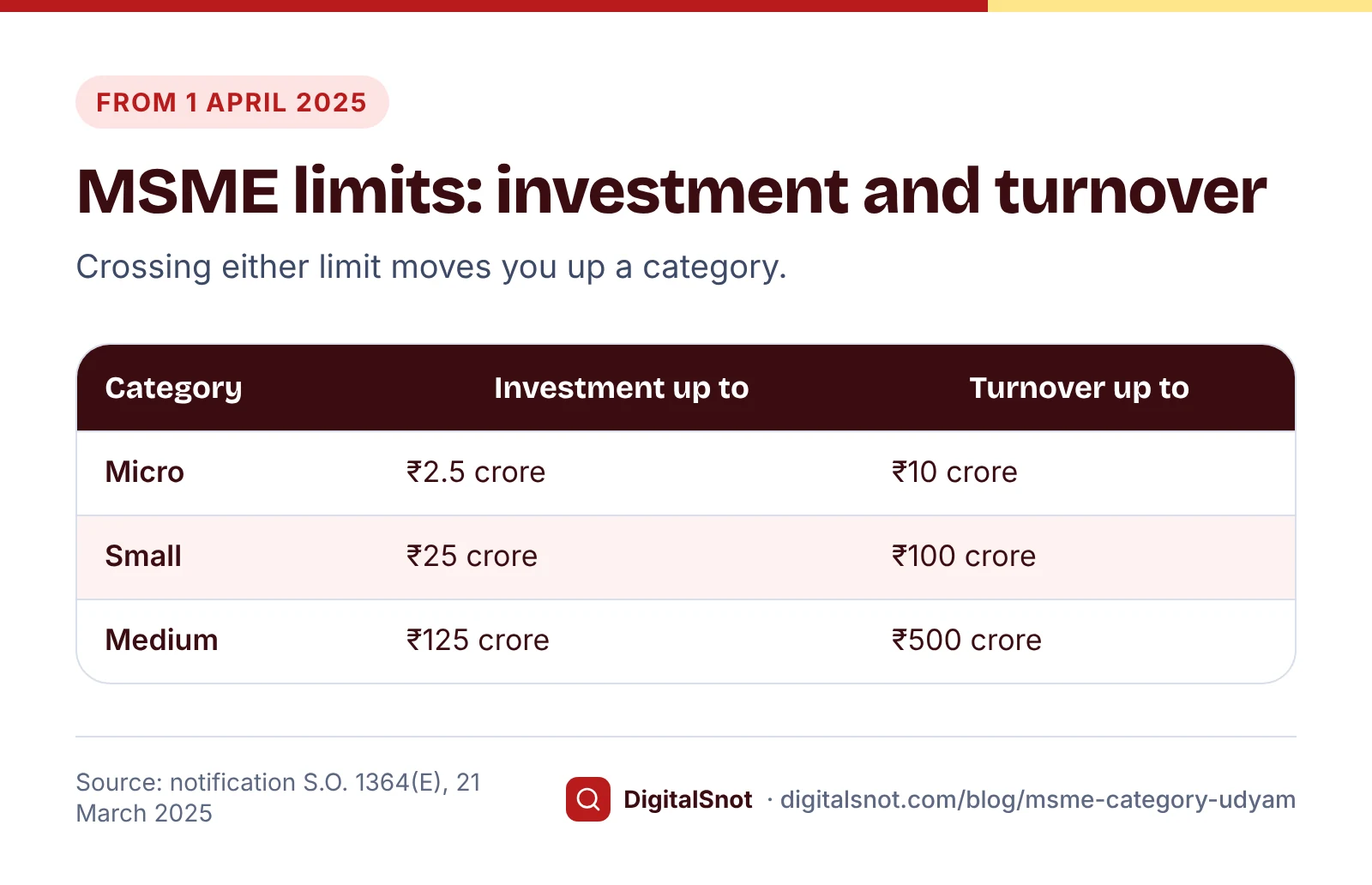
The MSMED Act, 2006 lets the central government set the limits by notification. The limits in force now come from notification S.O. 1364(E) of 21 March 2025, listed in the Udyam portal's circulars and orders. They apply from 1 April 2025, and they are the same for manufacturing and services:
| Category | Investment in plant and machinery or equipment, up to | Turnover, up to |
|---|---|---|
| Micro | ₹2.5 crore | ₹10 crore |
| Small | ₹25 crore | ₹100 crore |
| Medium | ₹125 crore | ₹500 crore |
Before that, from 1 July 2020 to 31 March 2025, the limits were ₹1 crore and ₹5 crore for micro, ₹10 crore and ₹50 crore for small, and ₹50 crore and ₹250 crore for medium. So a business that was small last year may be micro now, without any change in its figures.
Both tests count. If either figure crosses a category's limit, the enterprise moves up to the next category. It moves down only when both figures fit the lower category.
How investment and turnover are counted
The figures are not what you might guess from your bank balance or your sales ledger:
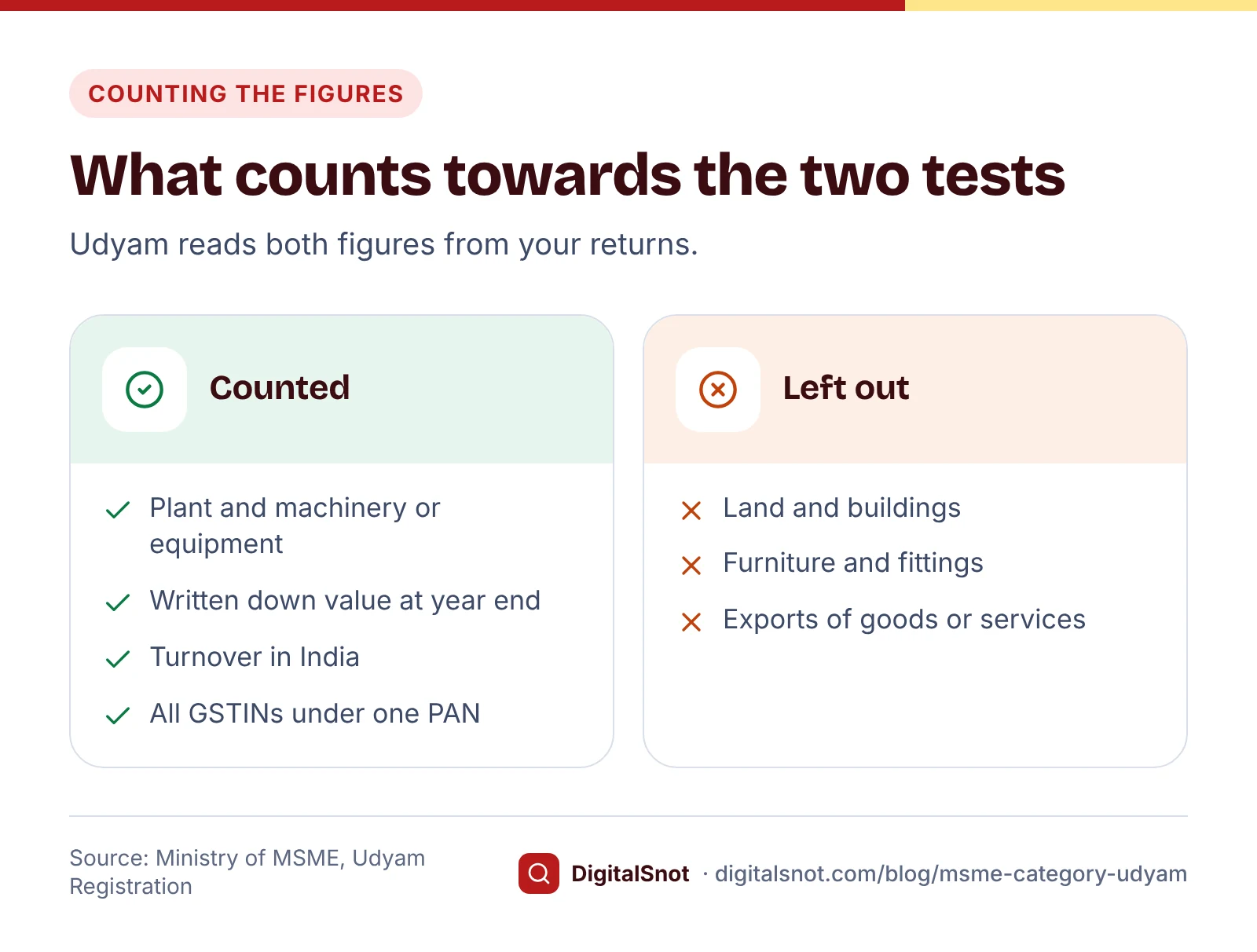
- Investment means plant and machinery or equipment. Land, buildings, furniture and fittings are left out. A Ministry of MSME clarification says to use the written down value at the end of the financial year, not the original cost.
- Turnover leaves out exports of goods or services.
- One PAN, one enterprise. All the GST registrations under one PAN count as one enterprise, so their figures are added together.
- Where the figures come from. Udyam takes investment and turnover from the income tax return and GST returns linked to your PAN. A new enterprise that has not filed a return yet declares its own figures.
To check where you stand, type your investment, turnover and export turnover into our MSME (Udyam) Category Checker. Amounts such as 85 lakh or 2.4 crore work. It shows the investment test and the turnover test side by side, the category that results, how much room is left before the next one and what happens if your Udyam certificate shows a different category. It runs in your browser. It cannot read your returns or work out the written down value of your machinery, and the figures the portal takes from your returns decide your category.
Worked example: Shree Ganesh Engineering Works, Bengaluru
Shree Ganesh Engineering Works is a made-up partnership firm in Peenya, Bengaluru, that makes machined parts. Its figures for financial year 2025-26:
- Plant and machinery at written down value on 31 March 2026: ₹2.1 crore. Its factory shed is not counted.
- Total turnover: ₹13.4 crore, of which ₹4.1 crore is exports.
The investment test gives micro, because ₹2.1 crore is within ₹2.5 crore. For the turnover test, exports come out first: ₹13.4 crore minus ₹4.1 crore leaves ₹9.3 crore, within the ₹10 crore micro limit. So the firm is a micro enterprise.
Two lessons sit in those numbers. If its exports did not show as exports in its GST returns and income tax return, its turnover would read ₹13.4 crore, and it would be small. And its investment is already at 84% of the micro limit: a new machine that takes the written down value past ₹2.5 crore would move it to small, even with no change in turnover. That would not cost it the delayed payment or procurement benefits, which cover small enterprises too.
Moving up or down a category
Growth moves you up. Crossing either limit puts you in the next category. Under the 2020 notification (S.O. 2119(E)), an enterprise keeps its present status until one year after the close of the year of registration. And under S.O. 4926(E) of 18 October 2022, it keeps the non-tax benefits of its earlier category, such as public procurement and delayed payment protection, for three years from the date of the upward change.
Moving down is slower. Both figures must fit the lower category, the enterprise stays in its present category until the end of the financial year, and it gets the new status from 1 April of the next financial year. The Udyam portal updates the category from your returns and tells you when it changes.
How Udyam Registration works
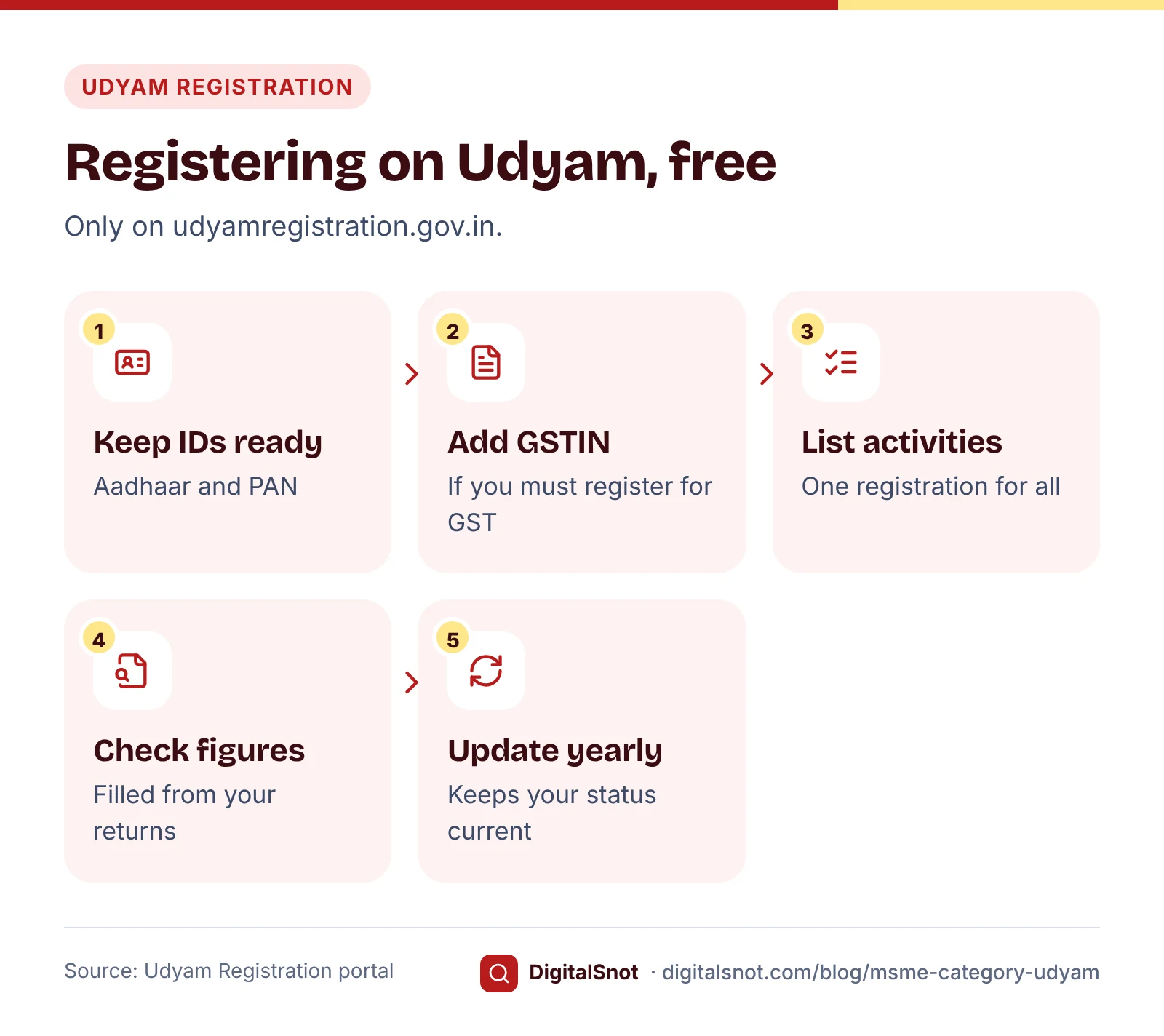
Udyam Registration replaced the older memorandum on 1 July 2020. It is online, free and based on self-declaration, with no documents to upload. The Udyam Registration portal says it is the only official website for MSME registration, so do not pay a website or agent that looks like it.
- Keep the identity numbers ready. A proprietor gives their Aadhaar number and PAN; a partnership firm the managing partner's Aadhaar; an HUF the karta's. A company, LLP, co-operative society or trust gives its PAN and GSTIN, with the Aadhaar number of the person signing for it.
- Add PAN and GSTIN. Both have been required since 1 April 2021; GSTIN where the business has to be registered under GST.
- List every activity. One enterprise has only one Udyam Registration, and all its activities, making goods, services or both, go in it.
- Check the figures the portal fills in. Keep your last income tax return, GST returns and asset register at hand (our suggestion).
- Update every year. Update your details each year with the last year's return details; missing the update can get your status suspended.
The law itself is changing. Parliament passed the MSMED (Amendment) Bill, 2026 in August 2026. According to PIB, it writes the investment and turnover test into the Act and gives Udyam Registration a footing in law as a free portal. Its parts start from dates the government notifies, so check the Udyam portal for new notifications before you rely on a category.
Traders and informal micro units
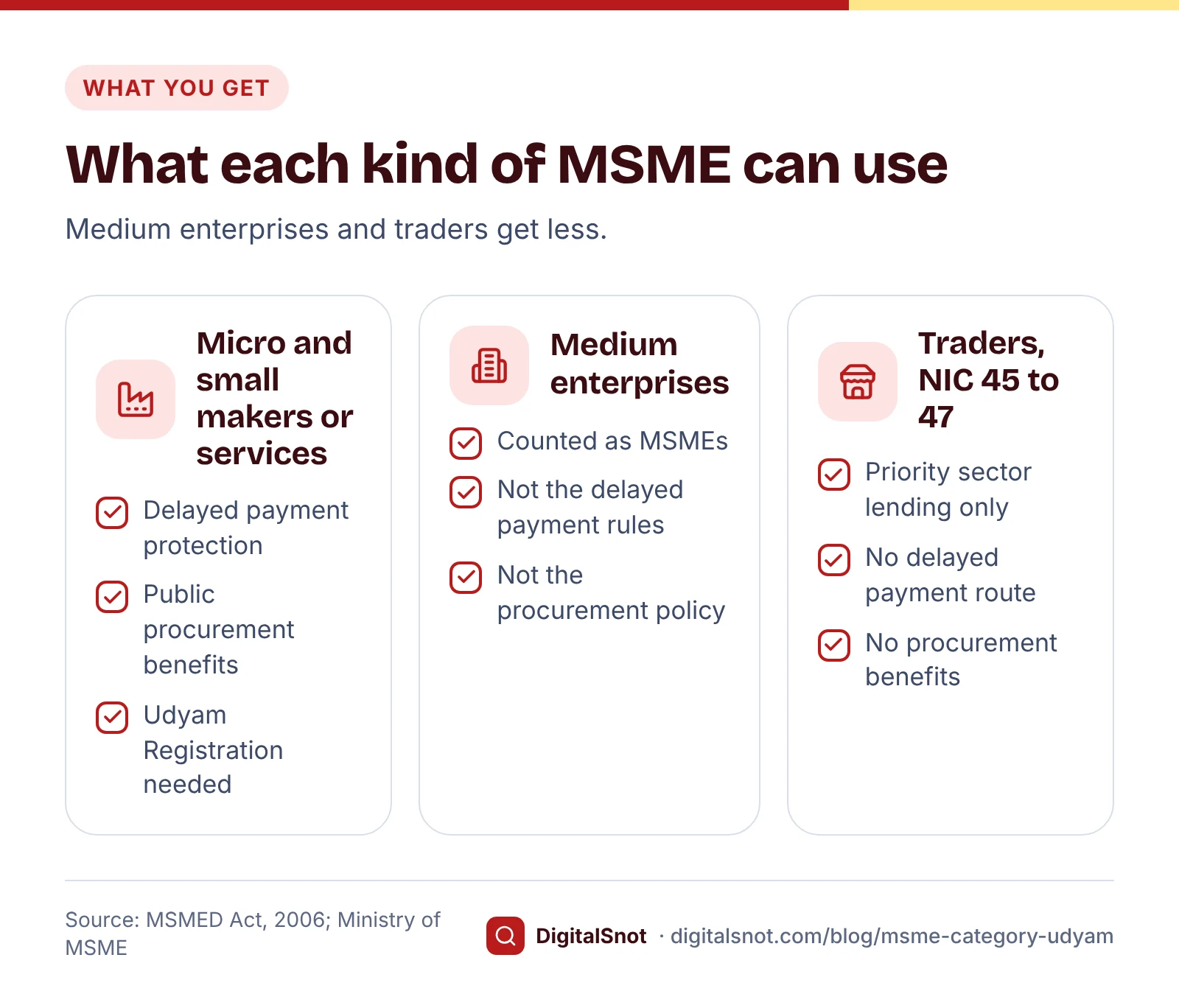
Retail and wholesale traders (NIC codes 45, 46 and 47) can register on Udyam since a Ministry of MSME memorandum of 2 July 2021, but their benefit is limited to priority sector lending from banks. They cannot use the MSMED Act delayed payment route, and they are not covered by the Public Procurement Policy for micro and small enterprises. If you trade and also make goods or provide services, add those activities to the same registration.
Very small units without a GSTIN have another door. The Ministry of MSME and SIDBI launched the Udyam Assist Platform on 11 January 2023 to bring informal micro enterprises into the formal system. They get an Udyam Assist Certificate, which a notification of 20 March 2023 treats as an Udyam Registration Certificate for priority sector lending, and an RBI circular of 9 May 2023 counts them as micro enterprises for that purpose. Ask your bank how it applies to your loan.
What your category gets you
- Protection against late payment. A buyer must pay a registered micro or small manufacturer or service provider within the period agreed in writing, never more than 45 days from acceptance, or within 15 days if nothing was agreed. After that, the buyer owes compound interest at three times the RBI Bank Rate. Our post on MSME delayed payment interest explains the rules, and the MSME Delayed Payment Interest Calculator works out what a late payer owes and drafts the reminder. Cases go online through MSME Samadhaan.
- Public procurement. The Public Procurement Policy sets a yearly target of 25% of purchases by central ministries, departments and public sector enterprises from micro and small enterprises, including 4% from those owned by SC/ST entrepreneurs and 3% from women-owned ones. Registered micro and small enterprises get tender sets free and do not pay earnest money.
- Priority sector lending. The one benefit open to traders on Udyam, and to holders of an Udyam Assist Certificate.
- Medium enterprises are inside the MSME definition, but the delayed payment rules and the procurement policy cover only micro and small ones.
Other schemes, subsidies and loans have their own rules, so read each scheme's terms before you apply.
Mistakes to avoid
- Paying for registration. Udyam is free. A site that charges a fee is not the official portal.
- Counting the wrong investment. Use the written down value of plant and machinery or equipment, not the original cost, and leave out land, buildings and furniture.
- Exports filed as domestic sales. Udyam reads export turnover from your returns. If exports are not reported as exports, your turnover looks larger than it is.
- Splitting by GSTIN. Two GST registrations under one PAN are still one enterprise for the limits.
- Trading as your only activity when you also make goods. A registration that lists only trading closes the delayed payment route. Add every activity you do.
- Skipping the yearly update. It keeps your category and status current.
Your next step
Take your last income tax return and GST returns, and put the figures into the MSME (Udyam) Category Checker. If you are micro or small and not registered, register free on the Udyam portal. Our suggestion: print your Udyam number on your invoices, so buyers know the payment rules apply. Our guide to what a GST invoice must show covers the rest of the bill, and more tools for GST and invoices are on our free tools page.
Free tools in this article
By the numbers
- of yearly purchases by central ministries, departments and public sector enterprises: the target from micro and small enterprises
- 25%
- Source: Ministry of MSME (PIB)
Frequently asked questions
What are the MSME limits for micro, small and medium enterprises now?
From 1 April 2025, under notification S.O. 1364(E): micro, investment up to ₹2.5 crore and turnover up to ₹10 crore; small, up to ₹25 crore and ₹100 crore; medium, up to ₹125 crore and ₹500 crore. The same limits apply to manufacturing and services.
Is Udyam Registration free?
Yes. Registration on udyamregistration.gov.in is free, online and based on self-declaration, with no documents to upload. The portal says it is the only official website for MSME registration, so do not pay a website or agent that looks like it.
Are exports counted in MSME turnover?
No. Exports of goods or services are left out of turnover for the MSME limits. Udyam reads export turnover from your GST returns and income tax return, so make sure your exports are reported as exports there.
Can traders register on Udyam?
Yes. Since an Office Memorandum of 2 July 2021, retail and wholesale traders can register, but their benefit is limited to priority sector lending. They cannot use the MSMED Act delayed payment route and are not covered by the Public Procurement Policy for micro and small enterprises.
What happens when my business grows into the next category?
Crossing either limit moves you up. Under a notification of 18 October 2022, you keep the non-tax benefits of your earlier category, such as public procurement and delayed payment protection, for three years from the date of the upward change.
What is the Udyam Assist Platform?
A platform launched by the Ministry of MSME and SIDBI on 11 January 2023 for informal micro enterprises without a GSTIN. They get an Udyam Assist Certificate, which is treated as an Udyam Registration Certificate for priority sector lending.
Sources
Every figure and claim in this article comes from the sources below. We checked each one when writing and link to the original so you can read it yourself. Credit belongs to the authors and publishers listed. How we write and check our articles.
-
1
Udyam Registration portal
Ministry of MSME · Free, online registration based on self-declaration; the only official website for MSME registration
-
2
Udyam Registration circulars and orders
Ministry of MSME · S.O. 1364(E) of 21 March 2025 (limits from 1 April 2025), S.O. 2119(E) of 2020 and S.O. 4926(E) of 18 October 2022
-
3
The Micro, Small and Medium Enterprises Development Act, 2006
India Code · Classification of enterprises and the delayed payment rules in sections 15 and 16
-
4
Inclusion of retail and wholesale trade as MSMEs (Office Memorandum, 2 July 2021)
Ministry of MSME · Traders with NIC codes 45, 46 and 47 get priority sector lending only
-
5
Registrations of informal micro enterprises on the Udyam Assist Platform
Press Information Bureau · Platform launched on 11 January 2023 with SIDBI; certificate treated as Udyam for priority sector lending (S.O. 1296(E), 20 March 2023; RBI circular, 9 May 2023)
-
6
The MSMED (Amendment) Bill, 2026 passed by Parliament
Press Information Bureau · Passed in August 2026; writes the investment and turnover test into the Act and gives Udyam a statutory footing
-
7
About the Public Procurement Policy
Ministry of MSME (MSME Sambandh) · 25% target from micro and small enterprises, with 4% from SC/ST-owned and 3% from women-owned ones
-
8
Public Procurement Policy for Micro and Small Enterprises
Press Information Bureau · The policy's targets and benefits, including free tender sets and exemption from earnest money
-
9
MSME Samadhaan
Ministry of MSME · Filing delayed payment applications online
Want a second pair of eyes?
Tell us about your site. We reply within one business day.
Talk to us Try our free tools