Volumetric weight: why your shipping bill is higher than your parcel weighs
How couriers and marketplaces work out volumetric and chargeable weight, where to find your divisor, how to pack so you pay less, and how to avoid weight disputes.

On this page (9 sections)
You weigh a parcel at under a kilogram and the courier charges you for five and a half. That is volumetric weight: couriers price the space a parcel takes as well as its weight. This post shows you how volumetric and chargeable weight are worked out, where to find the divisor for your courier or marketplace, how to pack so you pay less, and how to avoid weight disputes.
The divisor, slabs and prices in the worked example are made up, not any courier's rates: use the ones on your own rate card. This post is not legal or tax advice.
Actual, volumetric and chargeable weight
Three weights decide what a parcel costs:
- Actual weight is what the packed parcel weighs on a scale, with the box and padding.
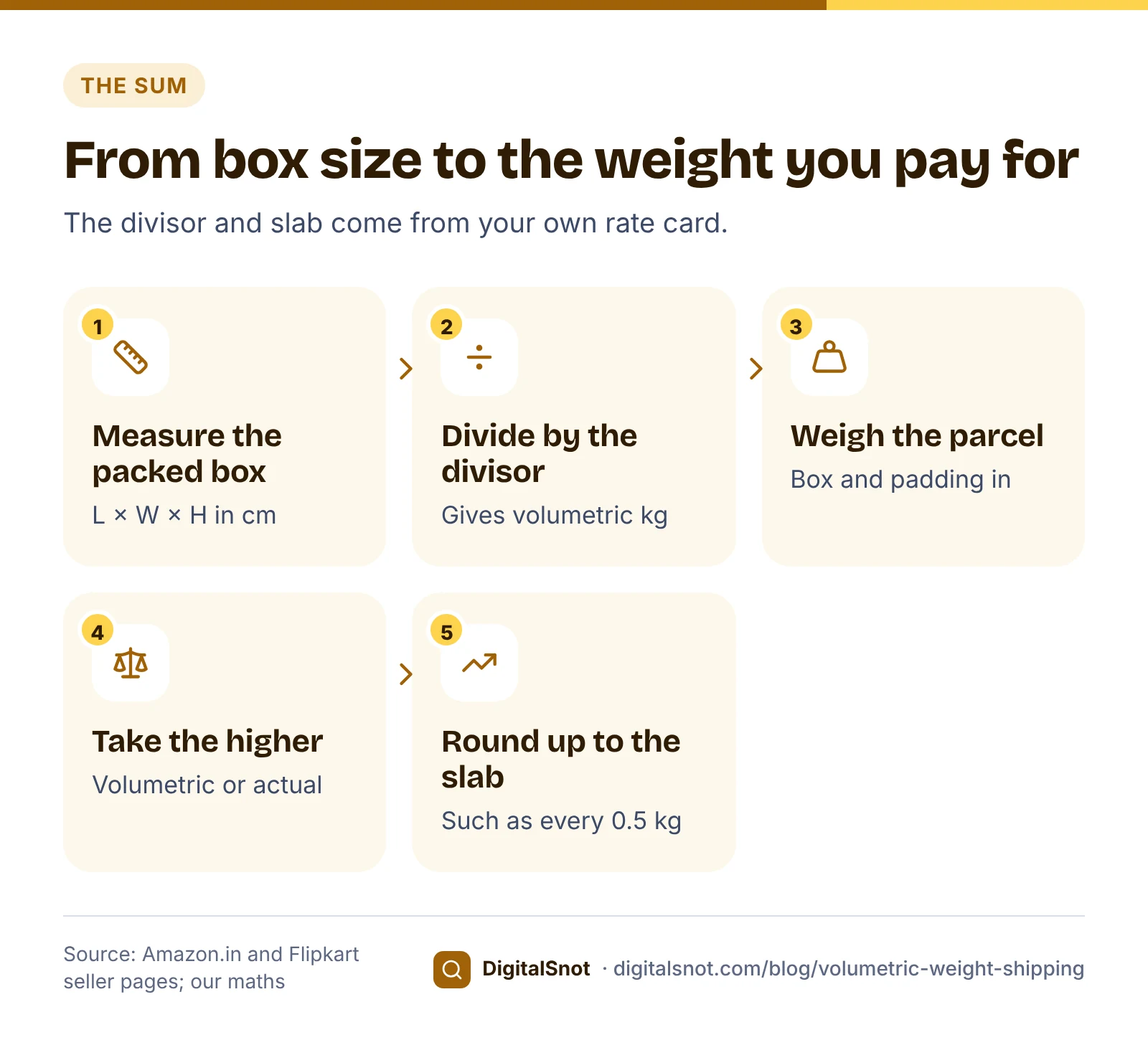
- Volumetric weight is worked out from the size of the packed parcel: length × width × height, divided by a number called the divisor. With measurements in centimetres, the answer is in kilograms.
- Chargeable weight is the one you pay for: the higher of the two, usually rounded up to the courier's weight slab, such as every 0.5 kg.
A light but bulky parcel takes as much room in a van as a heavy one, which is why size counts. Amazon.in's introduction to Easy Ship says Easy Ship fees use the volumetric or the actual weight of the package, whichever is higher, and gives the volumetric formula as length × breadth × height in centimetres divided by 5,000. Flipkart's fees and commission page says its shipping fee depends on the higher of the actual and volumetric weight of the packed product, and on whether the buyer is local, zonal or national.
Other couriers and shipping apps set their own divisor, slabs and prices, and these can differ by service and change over time. Do not borrow a number from another seller: find it on your own rate card or in your seller account, and check that it measures in centimetres and kilograms. If your rate card gives a weight per cubic metre instead, the divisor is 1,000,000 divided by that number.
A worked example: one soft toy, four boxes
Gudiya Soft Toys in Kolkata is a made-up shop that sells a 30 cm teddy bear weighing 0.85 kg packed. It sends about 120 a month. Its made-up rate card uses a divisor of 5,000 and 0.5 kg slabs, at ₹45 for the first slab and ₹35 for each slab after that.
The owner had been using a 35 × 30 × 25 cm carton. That is 26,250 cubic centimetres, and 26,250 ÷ 5,000 = 5.25 kg. Rounded up to the slab, she pays for 5.5 kg, more than six times what the parcel weighs: ₹395 a parcel, or ₹47,400 a month. Then she tried smaller packs:
- A 30 × 25 × 12 cm box: 9,000 cm³, or 1.8 kg, charged as 2 kg at ₹150.
- A padded mailer that packs to 30 × 25 × 8 cm: 6,000 cm³, or 1.2 kg, charged as 1.5 kg at ₹115.
- A 25 × 20 × 10 cm box, with the teddy in a vacuum bag: 5,000 cm³, or exactly 1 kg. That matches the parcel's own weight rounded up to the slab, so it is charged on weight: ₹80 a parcel, or ₹9,600 a month.
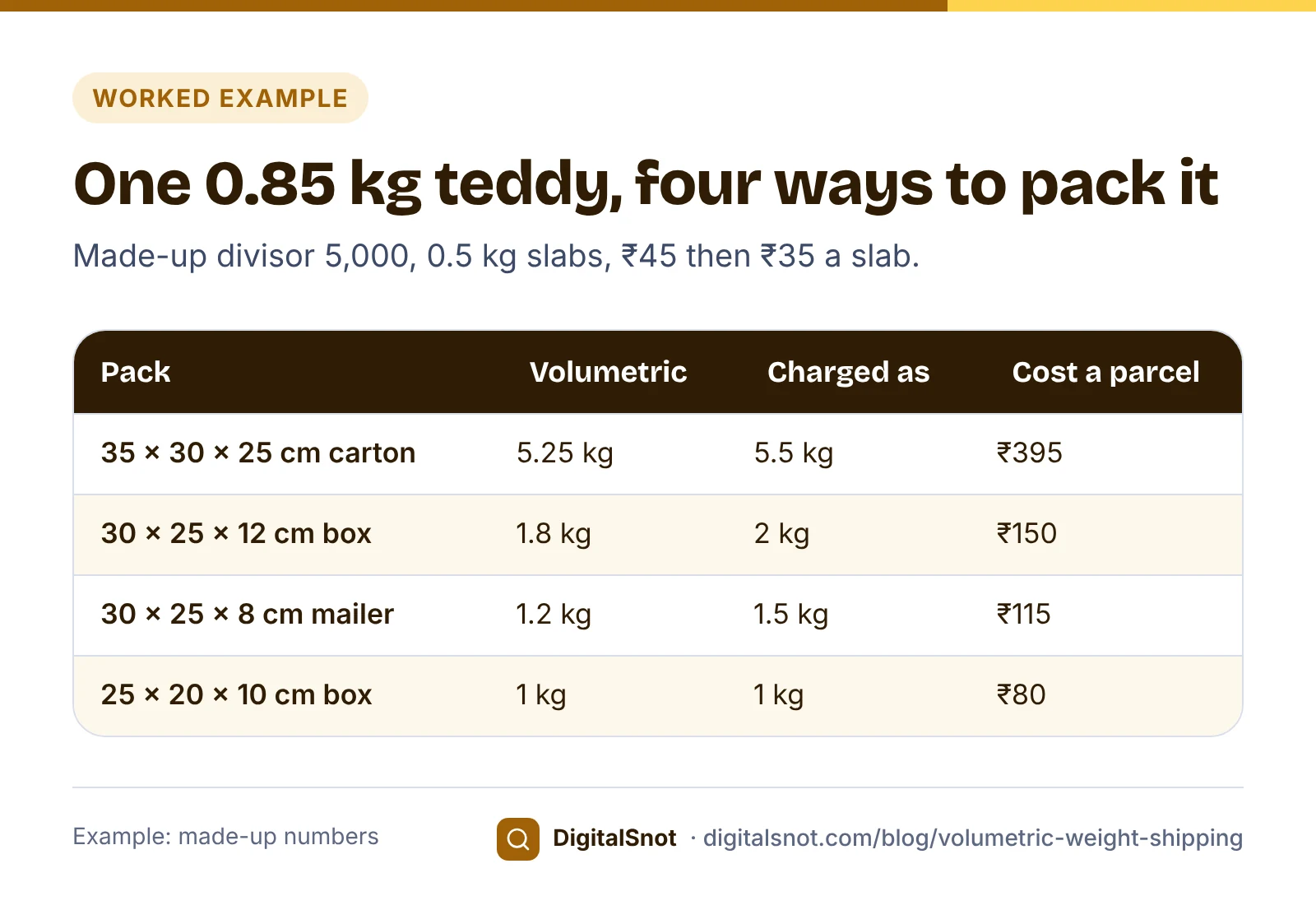
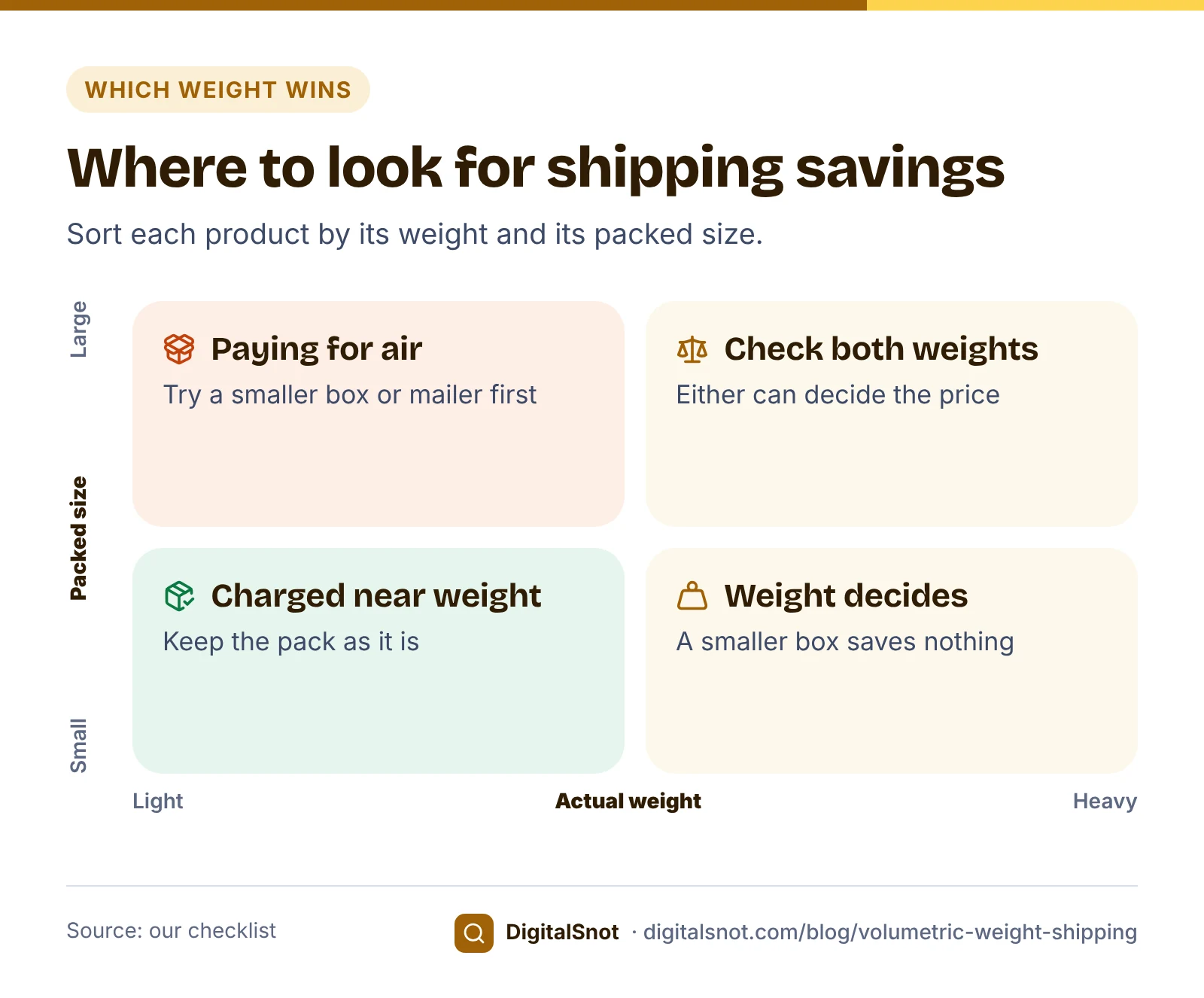
The last step shows a limit. No box can make a parcel cheaper than its own weight rounded up to the slab. Once the volumetric weight is at or below that, a smaller box saves nothing more, so stop shrinking and protect the product.
If you measure in inches, convert first: one inch is 2.54 cm. A 12 × 10 × 8 inch box is 30.48 × 25.4 × 20.32 cm, about 15,732 cm³, or 3.15 kg at a divisor of 5,000.
Work it out for every product
Put your own numbers into the Shipping Weight and Box Size Calculator. Enter the divisor and slab from your rate card, and your slab prices if you want rupee figures. Then add a row for each product or box: its packed length, width and height in centimetres or inches, its weight on a scale and how many you send a month. For each row it shows which weight decides the price, the chargeable weight and the cost. When the box size decides, it shows the height that would get the same length and width charged on weight instead, and a table shows the largest box for each slab. You can download the result as a CSV.
The tool does not fill in a divisor, because divisors differ between companies and services; its example uses 5,000 only to show how it works. It runs in your browser and never signs in to your seller or courier account. Couriers may round measurements, weigh parcels again or add charges it does not count, so check its figures against your fee reports.
Pack to cut volume, not protection
The aim is the smallest pack that still gets the product there in one piece. A damaged parcel costs you a return, a replacement and perhaps a poor review, which is far more than a slab. These are our suggestions:
- Keep a few standard box sizes that fit your best-sellers closely, instead of one large carton for everything.
- Use padded mailers or poly bags for soft goods such as clothes, cushion covers and soft toys.
- Fold, roll or vacuum-pack products that can take it without damage.
- Cut the empty space, not the padding around fragile items such as glass, pottery or electronics.
- Test multi-item orders. Two items in one box can cost less than two parcels, or more if the box grows a lot. Work out both.
- Measure again whenever your supplier, product or packaging changes.
Measure like the courier, and avoid weight disputes
Many weight disputes start with a gap between what the seller declared and what the courier measured. Close the gap before the parcel leaves. Our suggestions:
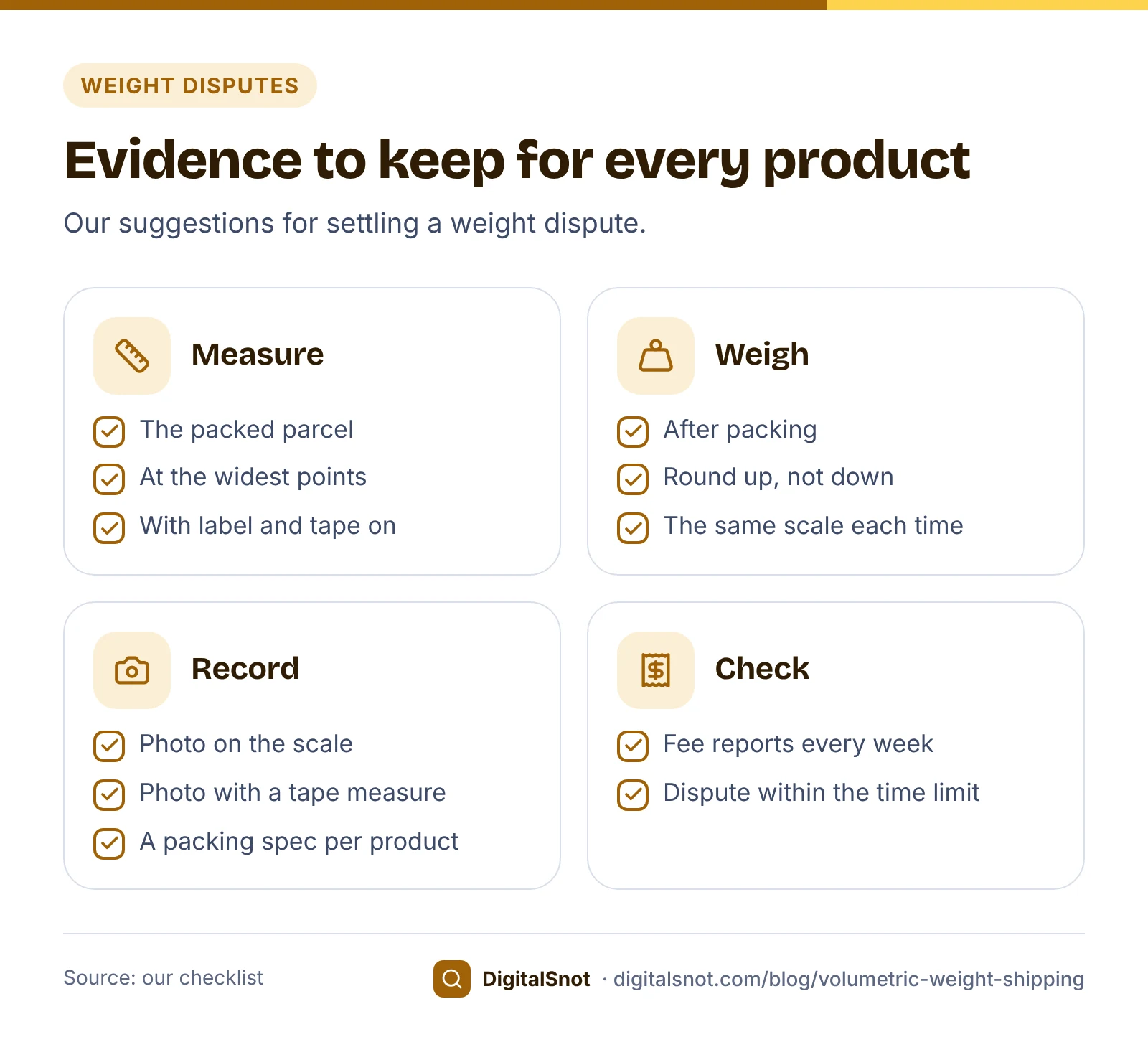
- Measure the packed parcel, outside the box, at its widest points, once the label and tape are on. A soft bag that bulges in the middle measures at the bulge.
- Weigh it after packing, on a scale you trust, and round up to the next 10 grams rather than down.
- Write a packing spec for each product: the box or mailer, its packed size and its weight. Whoever packs uses the same one every time.
- Keep evidence: for each product, a dated photo of a packed parcel on the scale and one with a tape measure along each side.
- Check your fee reports every week for weights that do not match your spec, and raise a dispute through your marketplace's or courier's own process, within its time limit. The process and the limits differ, so read them in your seller help or courier agreement.
Print the weight on what goes in the box. The Packing Slip and Shipping Label Maker prints packing slips and address labels, on A4 sheets or 4 × 6 inch thermal labels, with the order value and weight, a QR code for the order number and a pick list of everything to pack. Before you print, it checks PIN codes, phone numbers and cash on delivery amounts, and flags orders worth over ₹50,000 so you can check whether you need an e-way bill under rule 138 of the CGST Rules. It does not book a courier or create tracking numbers: if you book through a courier or aggregator, the label with the AWB number comes from them.
Chargeable weight and your profit
A smaller box lowers the cost of every order you send, and of every parcel that comes back. A cash on delivery parcel the buyer refuses travels both ways. The COD and RTO Cost Calculator takes your shipping both ways, packaging, cash on delivery share and RTO rates, and shows what returned parcels cost you each month. Our post on cutting COD returns shows how to bring them down.
On a marketplace, use the shipping or weight handling fee for the chargeable weight, not the scale weight, when you work out your profit. Amazon.in's fees and pricing page lists a weight handling fee among its seller fees, and our post on your real profit per order goes through every fee line.
If you charge buyers for delivery, show it with the first price they see. The Consumer Protection (E-Commerce) Rules, 2020 ask for the total price with a breakup of the charges, and the CCPA's dark patterns guidelines list drip pricing, where parts of the price appear only at the end. Our post on a return and refund policy customers trust covers who pays to send items back.
Mistakes to avoid
- Using someone else's divisor. Take it from your own rate card, for the service you use.
- Measuring the product, not the parcel. The courier measures the packed box, bulges included.
- Weighing before packing. The box, padding and tape all count.
- One big carton for everything. Small, light products end up paying for air.
- Cutting padding to save a slab. A broken product costs more than the slab you saved.
- Not reading the fee report. A wrong weight you never dispute is a cost you pay on every order.
Your next step
This week, measure and weigh your five best-selling products as you pack them. Put them into the Shipping Weight and Box Size Calculator with your rate card's divisor and slab, and see which ones you are paying for by size. Start with the product that sends the most parcels. All our free tools for online sellers work in your browser and never sign in to your seller or courier accounts. If you want help with your shipping costs and margins, get in touch.
Free tools in this article
- Shipping Weight and Box Size Calculator Work out volumetric and chargeable weight for each box, and how many slabs a smaller box would save.
- Packing Slip and Shipping Label Maker Print packing slips and address labels with QR codes, on A4 sheets or thermal labels, from your orders.
- COD and RTO Cost Calculator See what COD and returned parcels cost you each month, and the largest prepaid discount you can give.
Frequently asked questions
What is volumetric weight?
It is a weight worked out from the size of a packed parcel instead of a scale: length × width × height divided by a number called the divisor. With measurements in centimetres the answer is in kilograms. Couriers use it so that light but bulky parcels pay for the space they take.
How do I calculate volumetric weight?
Measure the packed parcel in centimetres, multiply length × width × height, and divide by the divisor on your rate card. With a divisor of 5,000, a 35 × 30 × 25 cm box is 26,250 ÷ 5,000 = 5.25 kg. Convert inches to centimetres first: one inch is 2.54 cm.
What divisor do Amazon and Flipkart use?
Amazon.in's introduction to Easy Ship gives the volumetric formula as length × breadth × height in centimetres divided by 5,000, and says Easy Ship fees use the higher of volumetric and actual weight. Flipkart's fees page says its shipping fee depends on the higher of the actual and volumetric weight. Check your current rate card, because fees and formulas can change.
What is chargeable weight?
It is the weight you pay for: usually the higher of the actual and volumetric weight, rounded up to the courier's slab. With 0.5 kg slabs, a parcel of 1.1 kg is charged as 1.5 kg. Check how your own rate card rounds.
Why was I charged for more weight than I declared?
The courier may have measured or weighed the packed parcel differently, for example at a bulge or with the packaging included. Keep a packing spec per product and dated photos of parcels on the scale and against a tape measure, and raise a dispute through your marketplace's or courier's own process, within its time limit.
Does a smaller box always save money?
No. A smaller box saves money only while the volumetric weight is higher than the actual weight. No box can make a parcel cheaper than its own weight rounded up to the slab, so once the box size no longer decides the price, spend the space on protection instead.
Sources
Every figure and claim in this article comes from the sources below. We checked each one when writing and link to the original so you can read it yourself. Credit belongs to the authors and publishers listed. How we write and check our articles.
-
1
A quick introduction to Amazon Easy Ship
Amazon.in (sell.amazon.in) · Easy Ship fees use the higher of volumetric and actual weight; volumetric weight = (length × breadth × height in cm) ÷ 5,000.
-
2
Amazon pricing and seller fees
Amazon.in (sell.amazon.in) · The weight handling fee among Amazon.in's seller fees.
-
3
Fees and commission
Flipkart Seller Hub · Shipping fee by the higher of actual and volumetric weight, and by local, zonal or national delivery.
-
4
Rule 138: Information to be furnished prior to commencement of movement of goods and generation of e-way bill
CBIC · E-way bills for consignments worth over ₹50,000, with some goods left out.
-
5
Consumer Protection (E-Commerce) Rules, 2020 (Gazette)
Department of Consumer Affairs · The total price with a breakup of compulsory and voluntary charges, such as delivery.
-
6
CCPA issues Guidelines for Prevention and Regulation of Dark Patterns, 2023
PIB: Central Consumer Protection Authority · Drip pricing is one of the 13 specified dark patterns.
Want a second pair of eyes?
Tell us about your site. We reply within one business day.
Talk to us Try our free tools