A return and refund policy your customers can trust
What India's E-Commerce Rules ask your return and refund policy to show, the returns you cannot refuse, fair cancellation and refund times, and the dark patterns to keep out.

On this page (10 sections)
- 1What the E-Commerce Rules ask you to show
- 2Defective goods: the returns you cannot refuse
- 3Cancellations and cancellation charges
- 4Refund times you set and keep
- 5Dark patterns to keep out of returns and cancellations
- 6A worked example: one small shop's policy
- 7Put the policy where buyers look
- 8Mistakes to avoid
- 9Your next step
- 10Sources
A clear return and refund policy answers a buyer's first worry before they pay: what if it arrives damaged, or does not suit me? This post shows you what the Consumer Protection (E-Commerce) Rules, 2020 ask your policy and shop pages to show, which returns you cannot refuse, how to handle cancellations, how to set refund times you can keep, and which dark patterns to keep out. A worked example takes one small shop from a blank page to a finished policy.
This post is for your own online shop. For orders on Amazon.in, Flipkart or Meesho, check the return policy for your category in your seller account. It is not legal advice: ask a lawyer to read your final policy.
What the E-Commerce Rules ask you to show
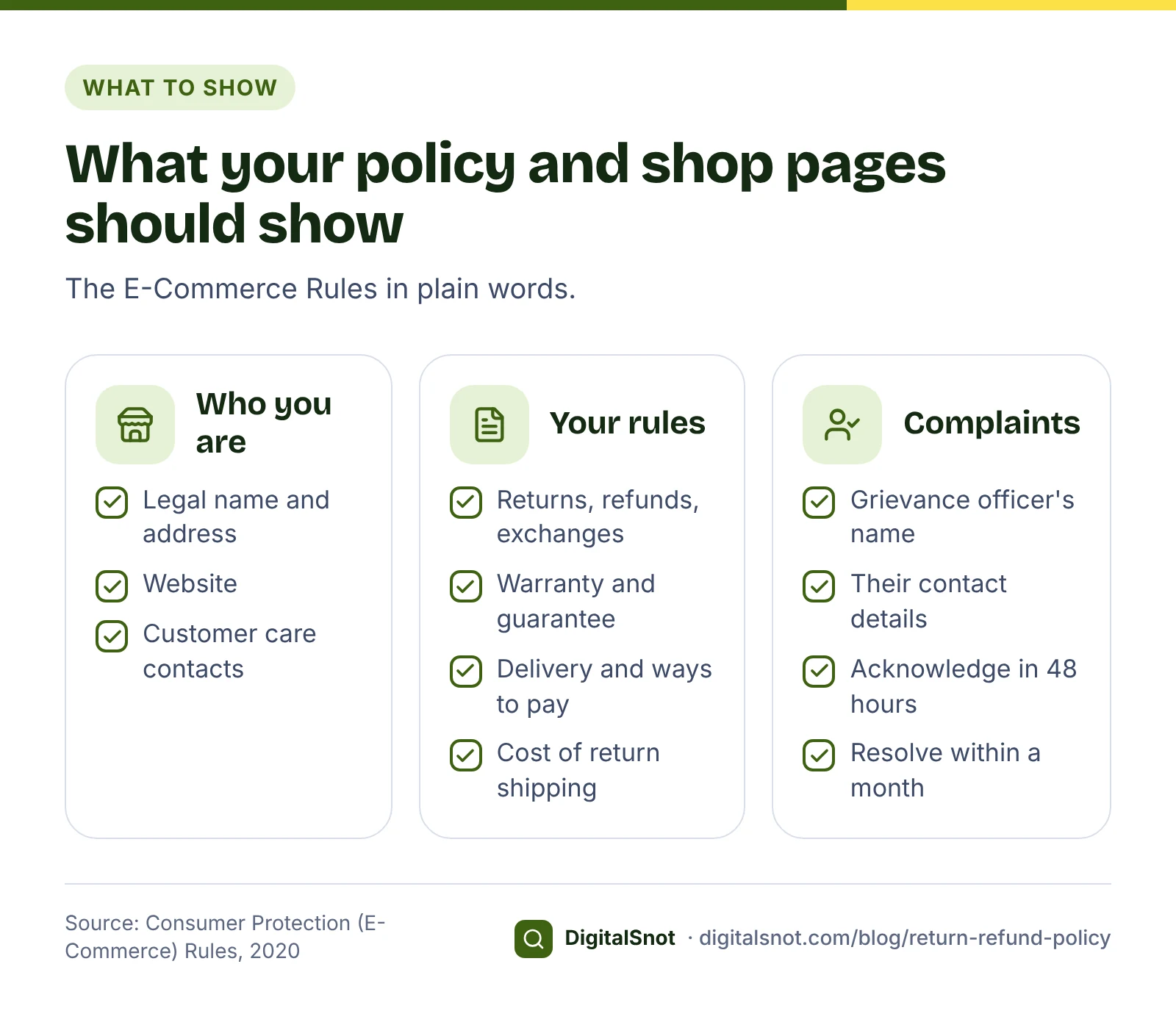
The Consumer Protection (E-Commerce) Rules, 2020 set duties for e-commerce entities, and our reading of their definition is that a business running its own online shop is one. They ask for the information buyers need before they decide, and a way to complain. In plain words, show:
- Who you are. Your legal name, address, website and customer care contact details (rule 4(2)).
- Returns, refunds and exchanges. What can come back, how, and how the money goes back.
- Warranty and guarantee. Whether there is one, who gives it and for how long.
- Delivery and shipment. Where you deliver and how long it takes.
- Ways to pay, including cash on delivery if you offer it.
- The cost of return shipping, if you sell your own stock.
- A grievance officer. Rule 4(4) asks you to appoint one and show their name and contact details. Under rule 4(5), they acknowledge a complaint within 48 hours and resolve it within one month of receiving it.
The government amended the Rules in September 2026. From 1 January 2027 they also ask for the buyer to get a copy of the complaint as recorded. If you run the shop alone, the grievance officer can be you. Put the same details in the policy, in your footer and on your contact page.
Defective goods: the returns you cannot refuse
You can decide whether to take back items when a buyer simply changes their mind. You cannot refuse the other kind. The E-Commerce Rules say a shop selling its own stock, and a seller on a marketplace, shall not refuse to take back goods, or refuse a refund, if the goods are defective, deficient or spurious.
So a fair policy has two routes:
- Change of mind: your choice. Give the window in days, the condition items must be in, such as unused with tags, and the items that cannot come back, such as made-to-order, perishable or hygiene products. Say who pays return shipping and how much.
- Damaged, wrong or defective: always covered. Say how many days the buyer has to report it, what proof you need, and what you do: replace, refund or let the buyer choose. Our suggestion: you pay the return shipping, because the fault is not the buyer's.
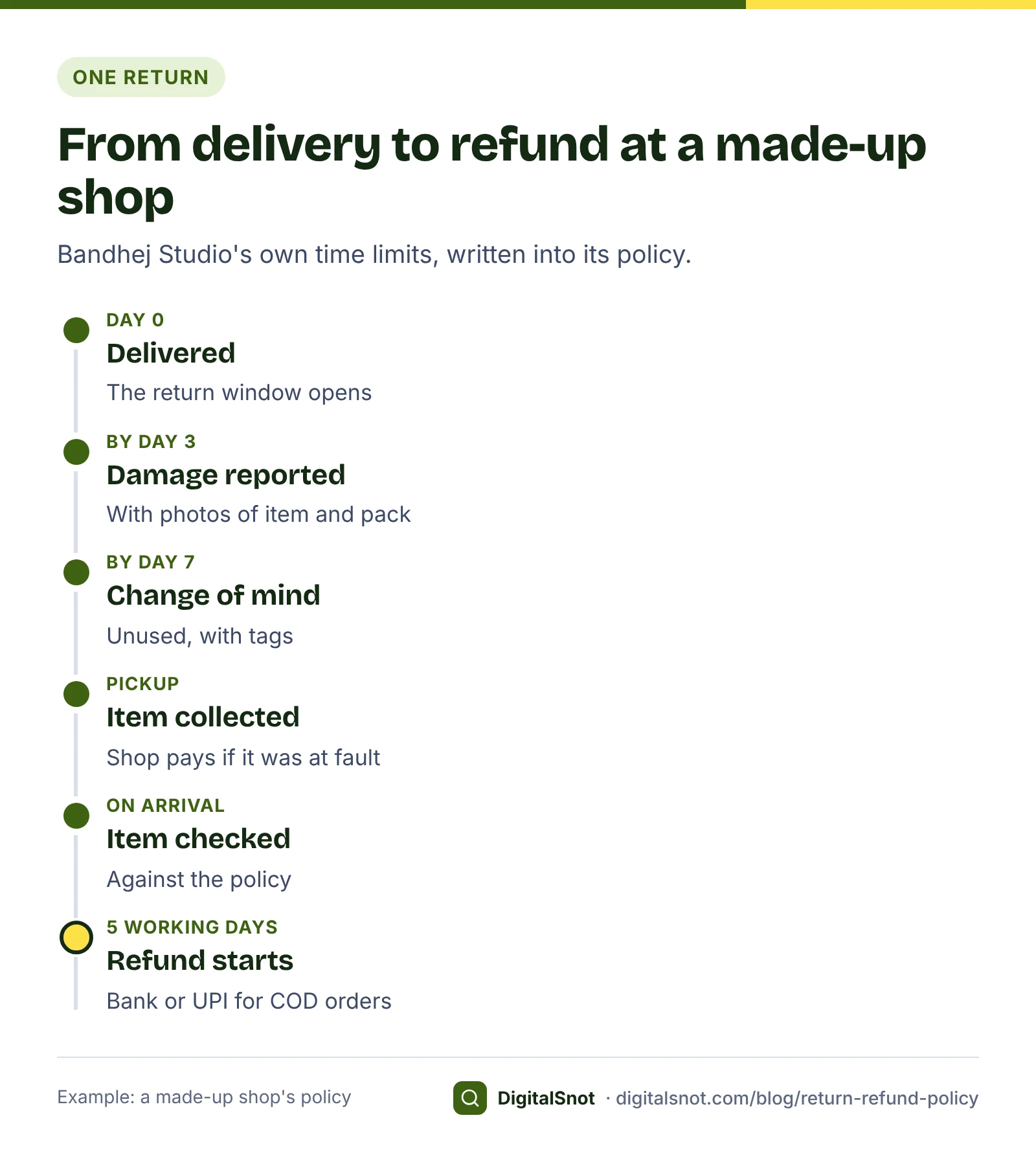
Blanket lines sit badly with this rule and can mislead a buyer whose item arrives broken: "no refunds under any circumstances", "all sales are final", "goods once sold will not be taken back". Replace each with the specific rule, for example "Sale items cannot be returned for a change of mind; damaged, wrong or defective items are covered below."
Be careful with proof. If you insist on an unboxing video, a buyer who did not film the parcel loses a fair claim on that rule alone. Our suggestion: accept clear photos of the item and the packaging too. If you do need a video, say so on the product page and at checkout, before the buyer pays.
Cancellations and cancellation charges
Rule 4(8) says an e-commerce entity shall not charge consumers who cancel after confirming a purchase, unless it also bears similar charges when it cancels the order on its own. When you cancel an order yourself, for example because an item is out of stock, refund the full amount.
The simplest fair rule is free cancellation until dispatch. It costs you little and saves a return. If you want to keep a charge, ask your lawyer how to meet rule 4(8), and show the charge at checkout and in the order confirmation, not only in the policy.
Refund times you set and keep
Rule 4(10) asks e-commerce entities to pay accepted refunds within a reasonable period of time, as the Reserve Bank of India or another competent authority prescribes, or as the law says. It does not give one number for every shop, so set your own and keep it:
- Say when the clock starts, for example when the returned item reaches you and passes your check, or when you accept a damage claim from photos.
- Give a number of days, not "soon" or "as early as possible".
- Say where the money goes. Refund to the original payment method. Cash on delivery orders have no online payment to reverse, so refund to a bank account or UPI ID the buyer gives you, and ask for it in your first reply.
- Say what you keep back, if anything. A cash on delivery fee or a pickup charge must be clear before the buyer pays, not a surprise at refund time.
- Keep a log of the date of each request, check and refund, so you can see whether you keep your own promise.
Store credit as the only refund is a poor fit for damaged items and cancelled orders, where buyers usually want their money back. Offer credit as a choice, not the only route.
Dark patterns to keep out of returns and cancellations
The Central Consumer Protection Authority's Guidelines for Prevention and Regulation of Dark Patterns, 2023 list 13 dark patterns. Four turn up around returns and cancellations:
- Drip pricing. A restocking or cash on delivery fee that appears only when the refund is paid.
- Basket sneaking. A paid "return protection" add-on already ticked at checkout. Rule 4(9) of the E-Commerce Rules also says consent to a purchase must come from an explicit and affirmative action, never a pre-ticked box.
- Confirm shaming. A cancel button that reads "No, I like wasting money".
- Interface interference. A return or cancel link in small, faded text next to a bright "Keep my order" button.
Paste the text of your cart, checkout and order pages into the Dark Pattern Checker for Online Shops. It marks phrases that point to 12 of the 13 patterns, finds boxes ticked in advance, and lets you tick what the flow does, such as a fee that appears only at the last step. It uses fixed word lists, not AI, so a match is a reason to look, not proof. Our post on dark patterns your online shop must avoid covers all 13, with the official definitions in the guidelines.
A worked example: one small shop's policy
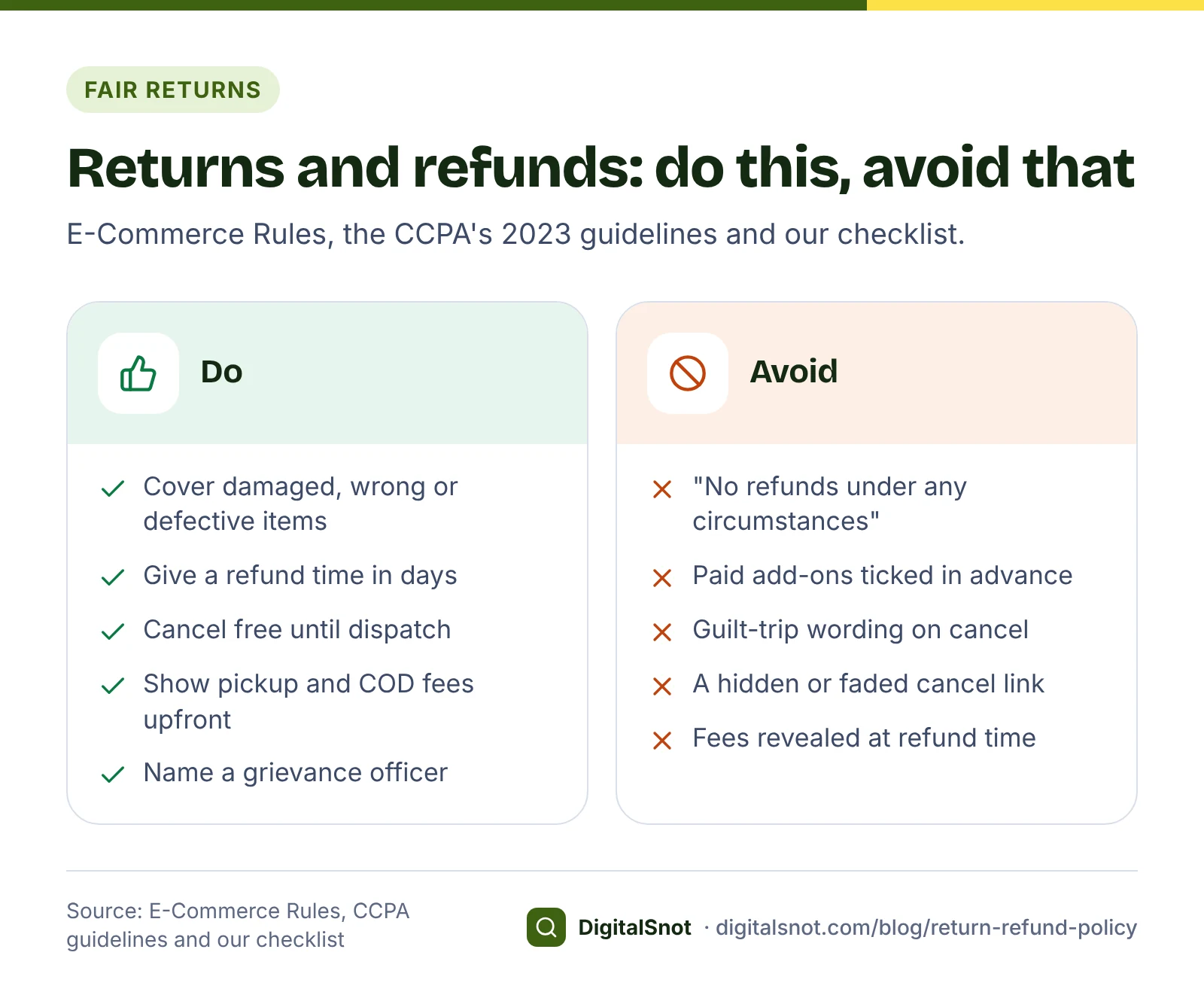
Bandhej Studio in Jaipur is a made-up shop selling tie-dyed dupattas and sarees on its own website. Its owner opened the Return and Refund Policy Builder and answered its questions with her real rules:
- Change-of-mind returns within 7 days of delivery, unused with tags. Pieces dyed to order cannot be returned.
- Damaged, wrong or defective items reported within 3 days with photos: a replacement or a full refund, as the buyer prefers, and the shop pays for the pickup.
- Other returns pay an ₹80 pickup charge, shown at checkout.
- Refunds start within 5 working days of the item reaching the shop and passing the check. Cash on delivery refunds go to a bank account or UPI ID.
- Free cancellation until dispatch.
- Complaints acknowledged within 24 hours and resolved within 15 days by a named grievance officer, well inside the Rules' limits.
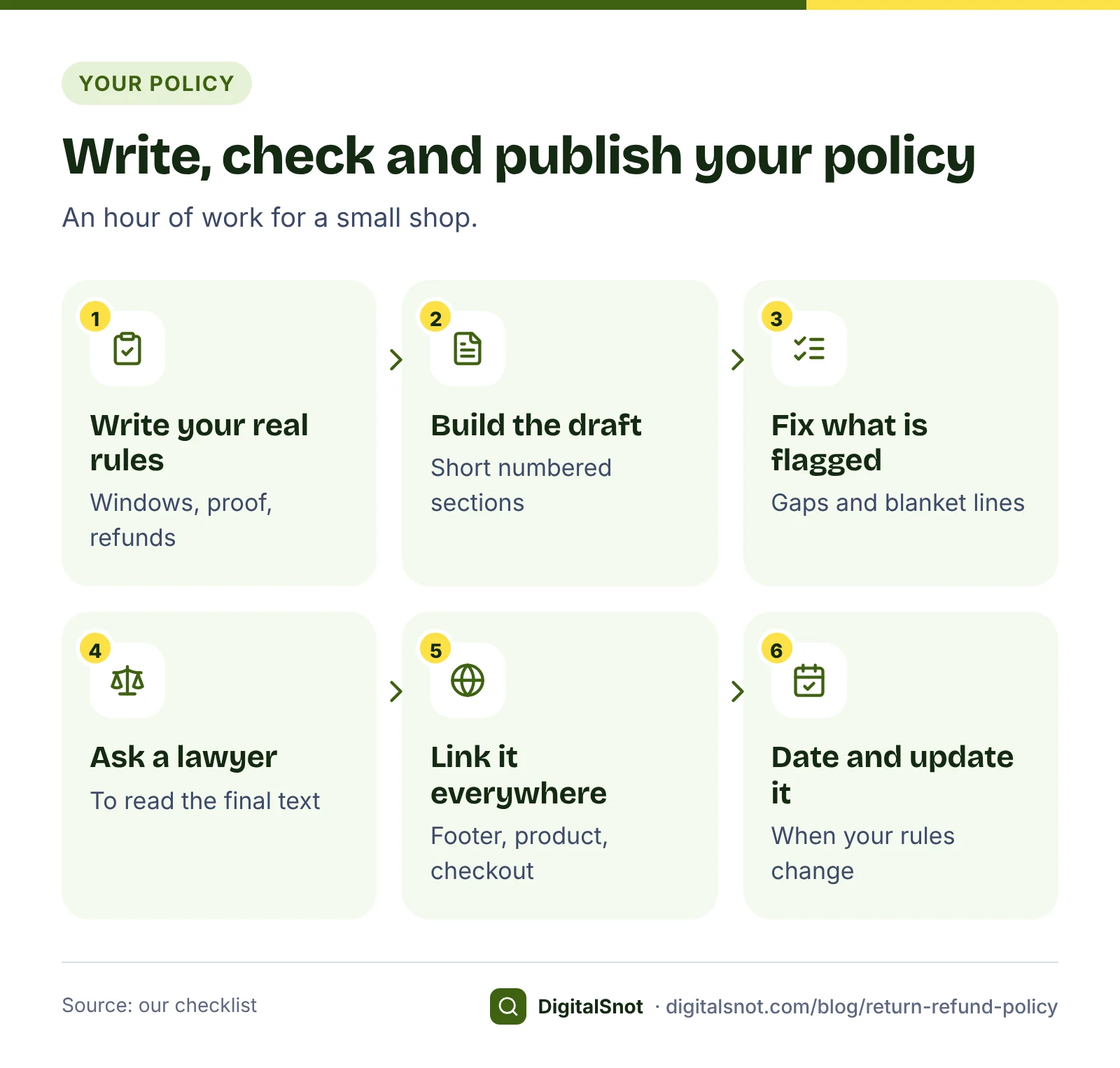
The builder turned her answers into a policy in short numbered sections, ready to copy as text, HTML or Markdown. Anything still missing showed as a marked gap. Its checks then flagged two things: the line "All sales are final", which she had typed under items that cannot be returned, and the box asking for an unboxing video. She replaced the line with the specific rule and added photos as proof.
Each check says whether it comes from the E-Commerce Rules, Google or our checklist. The tool uses fixed templates, not AI, saves her answers only in her browser, and is not legal advice.
Put the policy where buyers look
A policy helps only if buyers find it before they pay. Link it in your footer, near the buy button and at checkout, and send it with the order confirmation. Then:
- Write your delivery rules and terms of sale with the Shipping Policy and Terms of Sale Builder. It covers delivery areas and times, cash on delivery, failed deliveries and returns to origin, damage in transit, payment and cancellations, with the same grievance officer and complaint times, and checks for boxes ticked in advance and lines such as "not responsible for delays".
- Keep Google in step. If you list products on Google, Merchant Center lets you add your return policy and set a different one for individual products. Since November 2025 you can also set shop-wide shipping and return policies in Search Console. Google's misrepresentation policy asks sellers to check their contact details and their shipping, returns and privacy policies.
- Tell your team. If the policy says 5 working days, whoever handles returns needs to know it.
Cash on delivery parcels that come back undelivered are not returns, but they cost you shipping both ways. Our post on cutting COD returns shows how to reduce them.
Mistakes to avoid
- Copying another shop's policy. Its windows and couriers are not yours, and it may carry the same blanket lines.
- Promising what you cannot do. A 2-day refund you miss every week is worse than a 5-day refund you keep.
- Hiding fees in the policy. Show pickup and cash on delivery charges before payment.
- No named grievance officer. Give a name and an email or phone number someone checks every day.
- Never updating it. Change the policy when you change couriers, windows or charges, and put the date at the top.
Your next step
Set aside an hour this week. Write down the rules you really follow, build the policy with the Return and Refund Policy Builder, fix what its checks flag, and link it from your footer and checkout. Then run your checkout text through the Dark Pattern Checker. All our free tools for online sellers work in your browser and never sign in to your shop. If you want a second pair of eyes on your pages, get in touch.
Free tools in this article
- Dark Pattern Checker for Online Shops Paste your checkout text to spot false urgency, hidden fees, pre-ticked add-ons and other dark patterns.
- Return and Refund Policy Builder Turn your return, refund, cancellation and delivery rules into a clear policy, with checks for gaps.
- Shipping Policy and Terms of Sale Builder Turn your delivery, payment and cancellation rules into a shipping policy and terms of sale, with checks.
By the numbers
- for a grievance officer to acknowledge a consumer complaint, which must then be resolved within one month (rule 4(5) of the Consumer Protection (E-Commerce) Rules, 2020)
- 48 hours
- Source: Department of Consumer Affairs: Consumer Protection (E-Commerce) Rules, 2020
- the date from which the amended E-Commerce Rules also ask for the buyer to get a copy of the complaint as recorded
- 1 Jan 2027
- Source: PIB: Department of Consumer Affairs
Frequently asked questions
Do I need a return and refund policy for my online shop?
The Consumer Protection (E-Commerce) Rules, 2020 ask e-commerce entities to give buyers information on returns, refunds, exchanges, warranty and guarantee, delivery, payment and complaints, and a shop selling its own stock must also give the cost of return shipping. A clear policy page is the simplest way to do that. Ask a lawyer what else applies to your shop.
Can I say "no returns, no refunds"?
You can choose not to take back items when a buyer changes their mind, and say so plainly. But the E-Commerce Rules say a seller shall not refuse to take back goods, or refund them, if they are defective, deficient or spurious. Keep a route for damaged, wrong or defective items and avoid blanket lines such as "no refunds under any circumstances".
Can I charge a buyer for cancelling an order?
Rule 4(8) of the E-Commerce Rules says an e-commerce entity shall not charge consumers who cancel after confirming a purchase unless it also bears similar charges when it cancels an order on its own. Free cancellation until dispatch is the simple route; if you want a charge, ask your lawyer first.
How quickly must I refund a buyer?
Rule 4(10) asks for accepted refunds to be paid within a reasonable period of time, as the RBI or another competent authority prescribes, or as the law says. It does not set one number for every shop, so state a number of days in your policy, say when it starts and keep to it.
How do I refund a cash on delivery order?
There is no online payment to reverse, so ask the buyer for a bank account or UPI ID and refund there. If you keep back a cash on delivery fee, say so in your policy and show the fee before the buyer pays, because the CCPA's 2023 guidelines list drip pricing as a dark pattern.
Who can be the grievance officer for a small shop?
The person who handles complaints, which can be you if you run the shop alone. Rule 4(4) of the E-Commerce Rules asks you to appoint one and show their name and contact details, and rule 4(5) asks them to acknowledge a complaint within 48 hours and resolve it within one month.
Sources
Every figure and claim in this article comes from the sources below. We checked each one when writing and link to the original so you can read it yourself. Credit belongs to the authors and publishers listed. How we write and check our articles.
-
1
Consumer Protection (E-Commerce) Rules, 2020 (Gazette)
Department of Consumer Affairs · Rules 4(2), 4(4), 4(5), 4(8), 4(9) and 4(10); information on returns, refunds, warranty, delivery and payment; no refusing defective, deficient or spurious goods.
-
2
Government amends E-Commerce Rules to strengthen consumer protection
PIB: Department of Consumer Affairs · The 2026 amendment, in force from 1 January 2027.
-
3
CCPA issues Guidelines for Prevention and Regulation of Dark Patterns, 2023
PIB: Central Consumer Protection Authority · 13 specified dark patterns, including drip pricing, basket sneaking, confirm shaming and interface interference.
-
4
The Guidelines for Prevention and Regulation of Dark Patterns, 2023 (Gazette)
Department of Consumer Affairs · Official definitions of each dark pattern.
-
5
Return policies for individual products
Google Merchant Center Help · Adding a return policy and setting a different one for individual products.
-
6
Misrepresentation policy
Google Merchant Center Help · Check contact details and shipping, returns and privacy policies.
-
7
More ways to share your shipping and return policies with Google
Google Search Central blog · Shop-wide shipping and return policies in Search Console from November 2025.
Want a second pair of eyes?
Tell us about your site. We reply within one business day.
Talk to us Try our free tools