LTV and CAC: how much can you spend to win one customer?
Work out what a customer is worth in gross profit, what it costs to win one, the LTV:CAC ratio and the payback period, with worked examples for a clinic and a shop.
On this page (11 sections)
- 1LTV, CAC and the ratio: our definitions
- 2Use gross margin, not revenue
- 3How long do customers stay?
- 4CAC: count everything you spent to win new customers
- 5Reading the ratio and the payback period
- 6Worked example 1: Smile Studio Dental, Pune
- 7Worked example 2: Kurti Corner, Jaipur
- 8Using lifetime value in Google Ads
- 9Mistakes to avoid
- 10Your next step
- 11Sources
"How much should I pay for a new customer?" is the question behind every ad budget, discount and agency fee. Two numbers answer it, LTV and CAC: what a customer is worth to you over the time they keep buying (LTV), and what it costs you to win one (CAC). This post shows how to work out both from your own records, how to read the LTV:CAC ratio and the payback period, and how to turn them into a spending limit. A made-up dental clinic in Pune and a made-up online kurti shop in Jaipur run the numbers with you.
LTV, CAC and the ratio: our definitions
People work these out in different ways, so here are the definitions our tools use. They are our measures:
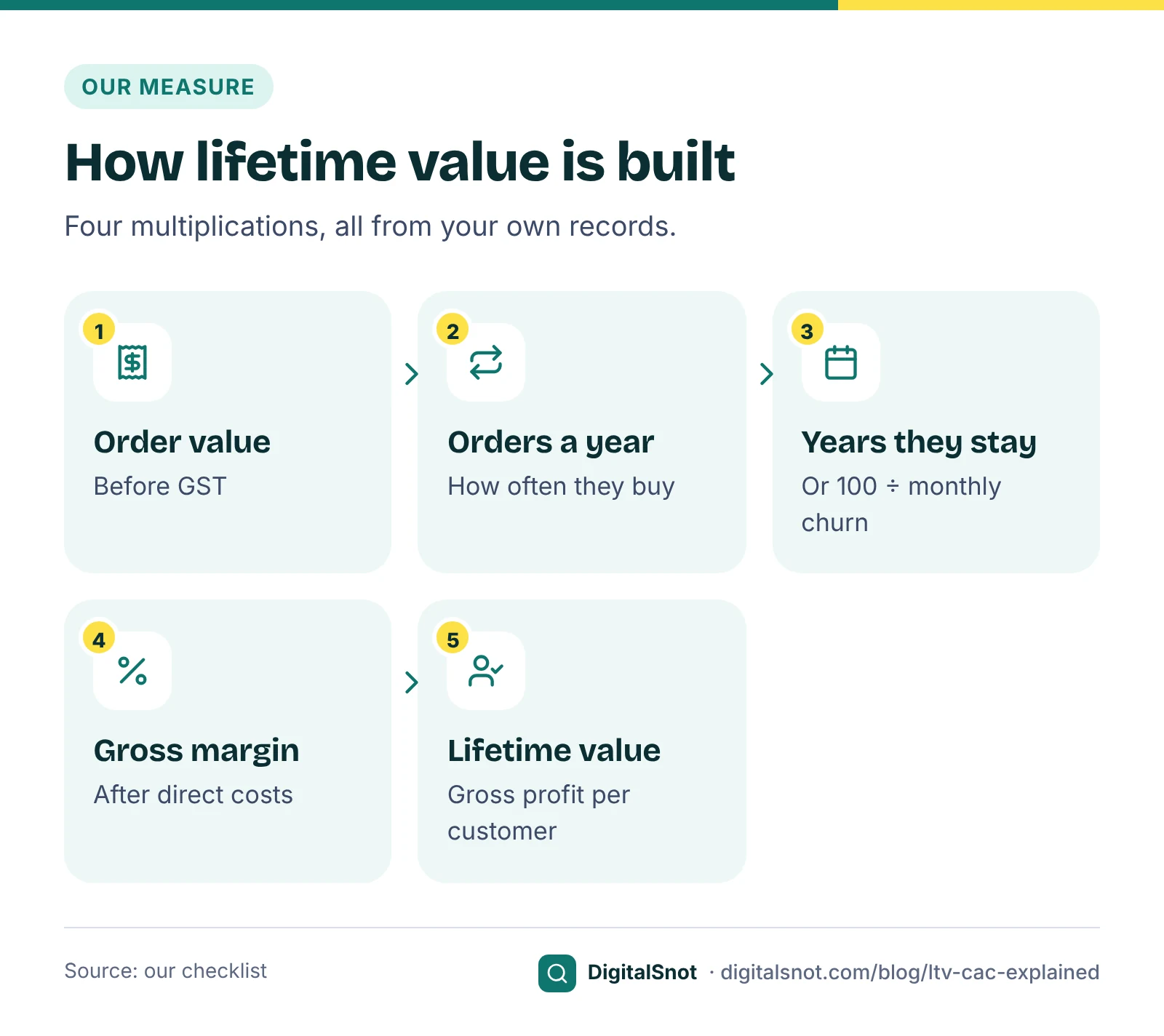
- Customer lifetime value (LTV): the gross profit a customer brings while they keep buying. Order value before GST × orders a year × years they stay × gross margin.
- Customer acquisition cost (CAC): what you spent to win new customers in a period ÷ the new customers won in that same period.
- LTV:CAC ratio: LTV ÷ CAC, the gross profit that comes back for each rupee spent winning a customer.
- Payback period: CAC ÷ the gross profit a customer brings each month, in months.
Our LTV & CAC Calculator works out all four from your numbers, adds a what-if table (customers staying longer, a higher order value, a lower CAC) and compares channels side by side. It runs in your browser.
Use gross margin, not revenue
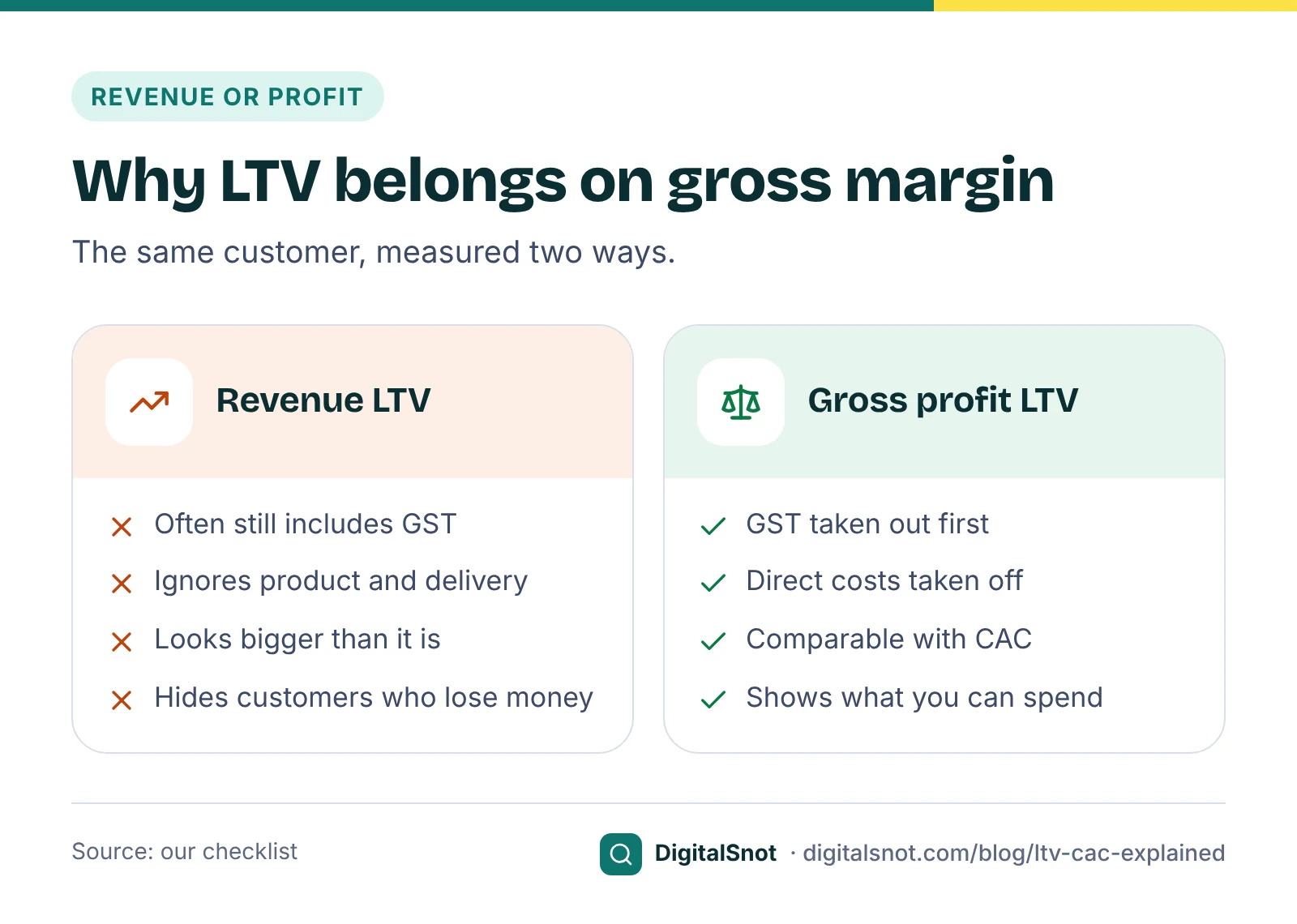
A lifetime value in revenue looks bigger and misleads you. You never keep the GST, and out of the rest you pay for the product, materials, delivery, payment fees and returns. If you compare a revenue LTV with your CAC, a customer who loses you money can look profitable.
So take GST out first. A price that includes 18% GST holds price ÷ 1.18 of value: ₹1,180 including 18% GST is ₹1,000 of sales. Then multiply by your gross margin, the share of each sale left after its direct costs. Our post on margin and markup shows how to work out a margin that is really a margin.
Google uses the same logic for ads. Google Ads Help suggests you estimate the value of a lead as your average sale × your profit margin × the share of leads that become customers, and notes that repeat business can raise that value. LTV is the repeat-business version of that sum.
How long do customers stay?
This is the number most people guess, and it changes the answer most. Three ways to work it out, best first:
- Your records. Look at customers who started a few years ago. How long did they keep buying?
- Monthly churn. If a share of customers stops buying each month, the average stay in months is 100 ÷ churn %. At 5% monthly churn, customers stay 20 months on average.
- Repeat rate. If you know the share of customers who buy again each year, the expected years are 1 ÷ (1 − that share). If two in three buy again, that is 1 ÷ (1 − 0.67), about 3 years.
For an online shop, our Customer Lifetime Value Calculator can read your orders export from Shopify, WooCommerce or a spreadsheet and work out your repeat purchase rate, orders per customer, average order value and a monthly cohort table. Your file is read in your browser and not uploaded. A short export makes the repeat rate look low, because recent customers have had little time to come back, so use at least a year of orders where you can, and leave out cash on delivery orders that were refused at the door.
CAC: count everything you spent to win new customers
CAC is only useful if it counts the full cost. Add up, for one period:
- ad spend on Google, Meta and marketplaces;
- agency and freelancer fees, content and design;
- offers for first-time buyers;
- the cost of anyone whose job is winning new customers.
Leave out spending on existing customers, such as loyalty offers, and divide by the new customers won in the same period. Then do the same for each channel, so you can see which one wins customers cheaply.
Add the GST on ad invoices if you cannot claim it back. Google's page on taxes in your country lists 18% GST when Google India bills you, and Meta's page on ads bought in India says they are billed with GST. Whether you can claim it as input tax credit depends on the conditions in section 16 of the CGST Act; ask your accountant, as this post is not tax advice.
Reading the ratio and the payback period
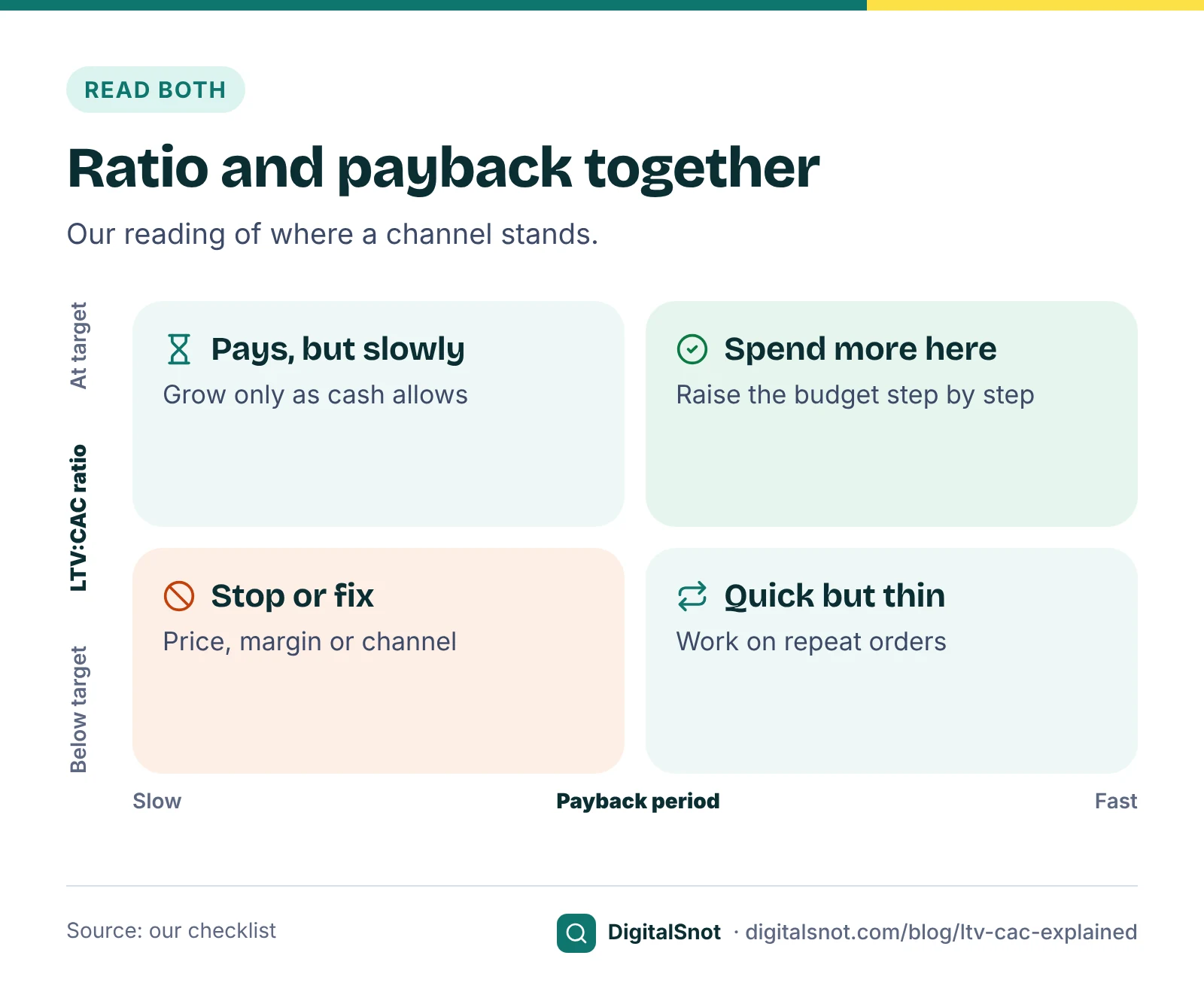
The ratio tells you whether winning customers pays at all:
- Below 1: each new customer costs more than the gross profit they will ever bring. Stop or fix the channel.
- Between 1 and your target: customers pay back what they cost, but leave little for rent, salaries and profit.
- At or above your target: there is room, and possibly room to spend more.
There is no universal right ratio. Choose a target from your own margins, fixed costs and how long you can wait for the money; the calculator starts at 3 as our suggestion. The most you can spend to win a customer is then LTV ÷ your target.
The payback period tells you something the ratio hides: how long your cash is out of your pocket. A customer worth a lot over four years still costs you the full CAC on day one. If you are short of cash, a long payback can hurt even when the ratio looks healthy. Our post on break-even and cash flow covers planning for that gap.
Worked example 1: Smile Studio Dental, Pune
Smile Studio Dental is a made-up clinic in Kothrud, Pune. All numbers are made up.
- Average bill per visit: ₹1,200, before any GST.
- Visits a year per patient: 3. Patients stay 4 years. Gross margin after materials and lab fees: 55%.
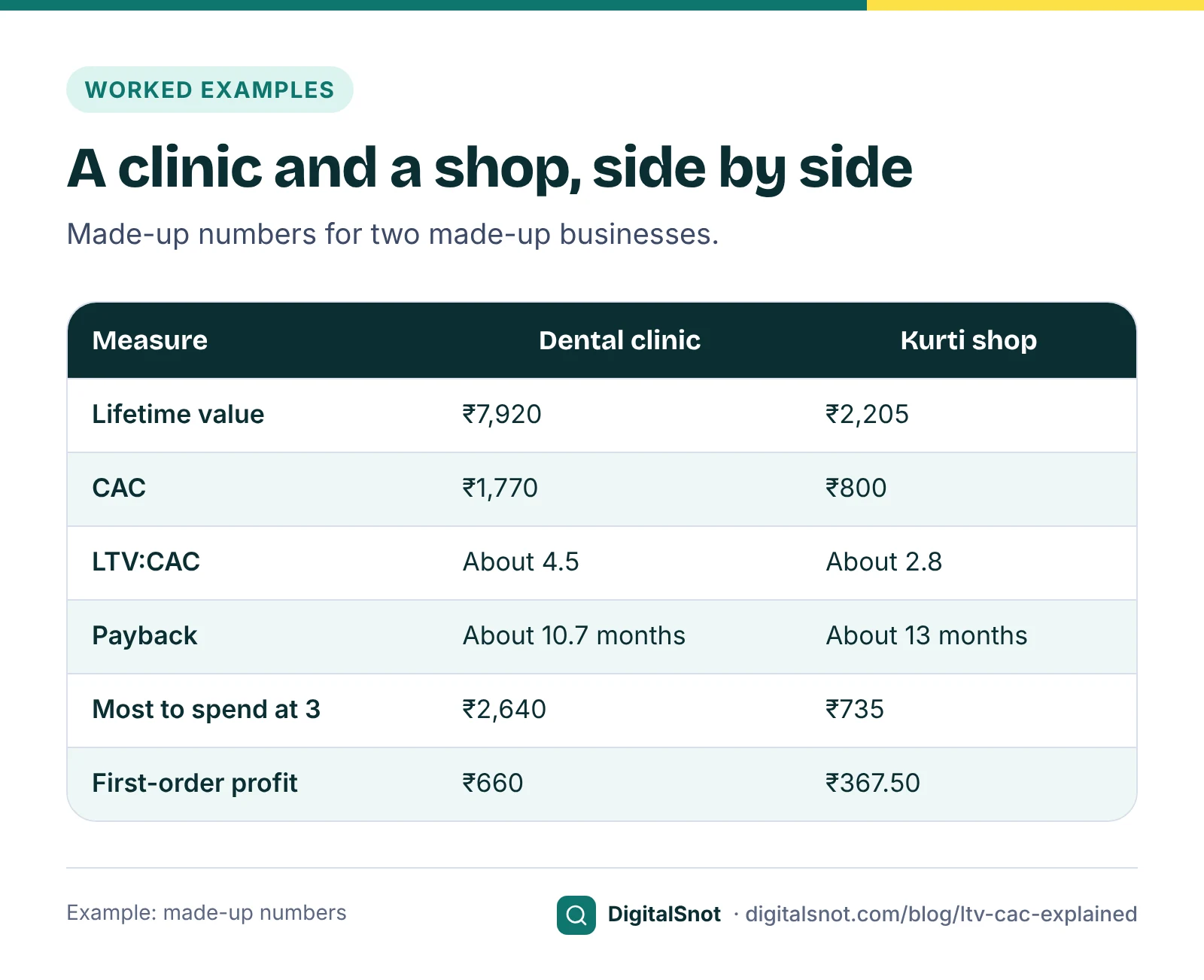
- LTV: ₹1,200 × 3 × 4 × 55% = ₹7,920.
- CAC: ₹30,000 of Google Ads plus 18% GST, which the clinic cannot claim back in this example, is ₹35,400. It brought 20 new patients, so CAC is ₹1,770.
- Ratio: ₹7,920 ÷ ₹1,770 = about 4.5. Payback: a patient brings ₹1,200 × 3 × 55% ÷ 12 = ₹165 of gross profit a month, so ₹1,770 ÷ ₹165 = about 10.7 months.
The ratio is comfortable and, at a target of 3, the clinic could pay up to ₹2,640 for a patient. But it takes nearly 11 months to earn back each patient's cost, so raising the budget sharply would tie up a lot of cash before it comes back.
Worked example 2: Kurti Corner, Jaipur
Kurti Corner is a made-up online shop. Again, all numbers are made up.
- Average order: ₹1,050 before GST. Orders a year: 2. Two in three customers buy again each year, so they stay about 3 years. Gross margin after product, packaging, shipping, payment fees and returns: 35%.
- LTV: ₹1,050 × 2 × 3 × 35% = ₹2,205.
- CAC: ₹40,000 of Meta ads in a month brought 50 new customers. The shop is GST-registered and claims the GST back, so CAC is ₹800.
- Ratio: about 2.8. Payback: ₹61.25 of gross profit a month, so about 13 months.
The first order makes only ₹1,050 × 35% = ₹367.50 of gross profit, less than half the ₹800 it cost to win the customer. The shop depends on repeat orders. One more order a year would lift LTV to ₹3,307.50, the ratio to about 4.1 and cut the payback to under 9 months, which is why a follow-up message after delivery may be worth more than a bigger ad budget. The Customer Lifetime Value Calculator shows that one-more-order line for your own numbers.
Using lifetime value in Google Ads
If you sell online, Google Ads can use what you know about lifetime value. Google's page on customer lifecycle goals describes bidding higher for new customers (New Customer Value) or bidding only for new customers (New Customer Only), in Search, Performance Max, Shopping and Demand Gen campaigns. For the extra value, Google suggests thinking about a customer's expected lifetime value and choosing a fraction of it you are comfortable with. Google's page on how it detects customers says it can use up to 540 days of purchases, or your own customer lists or purchase tag.
Our New Customer Value Calculator works out the extra value from your first order, gross margin and repeat orders, shows what it does to your reported ROAS, and gives the target ROAS to use. That last step matters: Google adds the extra value to each new customer's purchase, so reported ROAS rises although sales do not. Google's page on Target ROAS defines it as conversion value ÷ ad spend, so raise your target to match, or you count future orders twice. Our post on true ROAS explains what Google's ROAS leaves out.
Mistakes to avoid
- Working out LTV on revenue, or with GST still in the price.
- Leaving agency fees, offers or your own time out of CAC, so it looks cheaper than it is.
- Mixing periods: spend from one month and new customers from another.
- Using an optimistic lifespan with no records behind it. When unsure, use a cautious figure and look at the what-if table.
- Judging only the ratio and ignoring the payback period and your cash.
- Treating a target ratio from someone else's business as a rule.
Your next step
Put your own numbers into the LTV & CAC Calculator, then use the most you can spend per customer to plan your channels, as our post on a small business marketing budget shows. If you want a second pair of eyes on the numbers before you raise a budget, get in touch.
Free tools in this article
- LTV & CAC Calculator Customer lifetime value, the cost to win a customer, the LTV:CAC ratio and payback in months.
- Customer Lifetime Value Calculator Work out what a customer is worth from your averages or your orders file, with repeat rate and cohorts.
- New Customer Value Calculator Work out the extra value for new customers in Google Ads, its effect on ROAS and the target to use.
By the numbers
- of purchases Google Ads can look back on to tell new customers from existing ones
- 540 days
- Source: Google Ads Help
Frequently asked questions
What is LTV in marketing?
Customer lifetime value is what a customer brings you over the time they keep buying. We work it out as gross profit: order value before GST × orders a year × years they stay × gross margin. It is our measure, a simple estimate from averages, useful for deciding how much you can spend to win a customer.
How do I calculate CAC?
Add up everything you spent to win new customers in a period, such as ad spend, agency fees, content, first-time offers and sales costs, and divide by the new customers won in the same period. Include GST on ad invoices if you cannot claim it back, and leave out spending on existing customers.
What is a good LTV to CAC ratio?
There is no universal number. Below 1, each new customer costs more than the gross profit they bring. Above 1, what is left pays for rent, salaries and profit. Set your own target from your margins, fixed costs and cash; our calculator starts at 3 as a suggestion you can change.
What is the CAC payback period?
The months of a customer's gross profit it takes to earn back what you spent to win them: CAC ÷ gross profit per customer per month. If a customer brings ₹500 of gross profit a month and cost ₹2,000 to win, the payback is 4 months. It matters for cash flow.
Should I use revenue or profit for lifetime value?
Gross profit. Revenue includes GST, which is not yours to keep, and the cost of the product, delivery and fees. A revenue LTV can make a customer who loses you money look profitable, so take GST out and multiply by your gross margin.
How do I work out how long customers stay?
Use your records: how long did customers who started a few years ago keep buying? Or use monthly churn: the average stay in months is 100 ÷ churn %. Or, from the share who buy again each year, the expected years are 1 ÷ (1 − that share).
Sources
Every figure and claim in this article comes from the sources below. We checked each one when writing and link to the original so you can read it yourself. Credit belongs to the authors and publishers listed. How we write and check our articles.
-
1
How to estimate conversion value
Google Ads Help · Lead value as average sale × profit margin × share of leads that become customers; repeat business can raise it.
-
2
Taxes in your country
Google Ads Help · 18% GST when Google India bills you.
-
3
Ads bought in India
Meta Business Help Centre · Ads bought in India are billed in rupees and subject to GST.
-
4
Section 16: eligibility and conditions for taking input tax credit
CBIC · A registered person can claim input tax credit only when the conditions are met.
-
5
About customer lifecycle goals
Google Ads Help · New Customer Value and New Customer Only, the campaign types, and choosing a fraction of expected lifetime value.
-
6
How customer lifecycle goals detect customers
Google Ads Help · Google's own detection from up to 540 days of purchases, customer lists or the purchase tag.
-
7
About Target ROAS bidding
Google Ads Help · Target ROAS as conversion value ÷ ad spend.
Want a second pair of eyes?
Tell us about your site. We reply within one business day.
Talk to us Try our free tools