Paid posts and influencers: how to follow ASCI influencer disclosure rules
When a creator's post needs an ad label, which labels ASCI accepts, where the label goes in captions, stories, reels and live streams, and who is responsible.

On this page (11 sections)
- 1When a post needs a label
- 2The labels ASCI accepts
- 3Where the label goes
- 4Reels, videos and live streams
- 5Instagram's paid partnership label is an extra
- 6Virtual influencers, health and finance
- 7Who is responsible, and what can happen
- 8Worked example: Chai Tapri Co., Ahmedabad
- 9Mistakes to avoid
- 10Next step
- 11Sources
If your business sends products to creators or pays them for posts, the post is an advertisement, and India has clear disclosure rules on how to say so. The Advertising Standards Council of India (ASCI) sets guidelines for influencer advertising, the basis of ASCI influencer disclosure, and the Department of Consumer Affairs has published its own guide for celebrities and influencers.
This post explains when a label is needed, which labels to use, where to put them in captions, stories, reels and live streams, and what a brand should write into a creator's brief. It covers the published guidelines and is not legal advice.
When a post needs a label
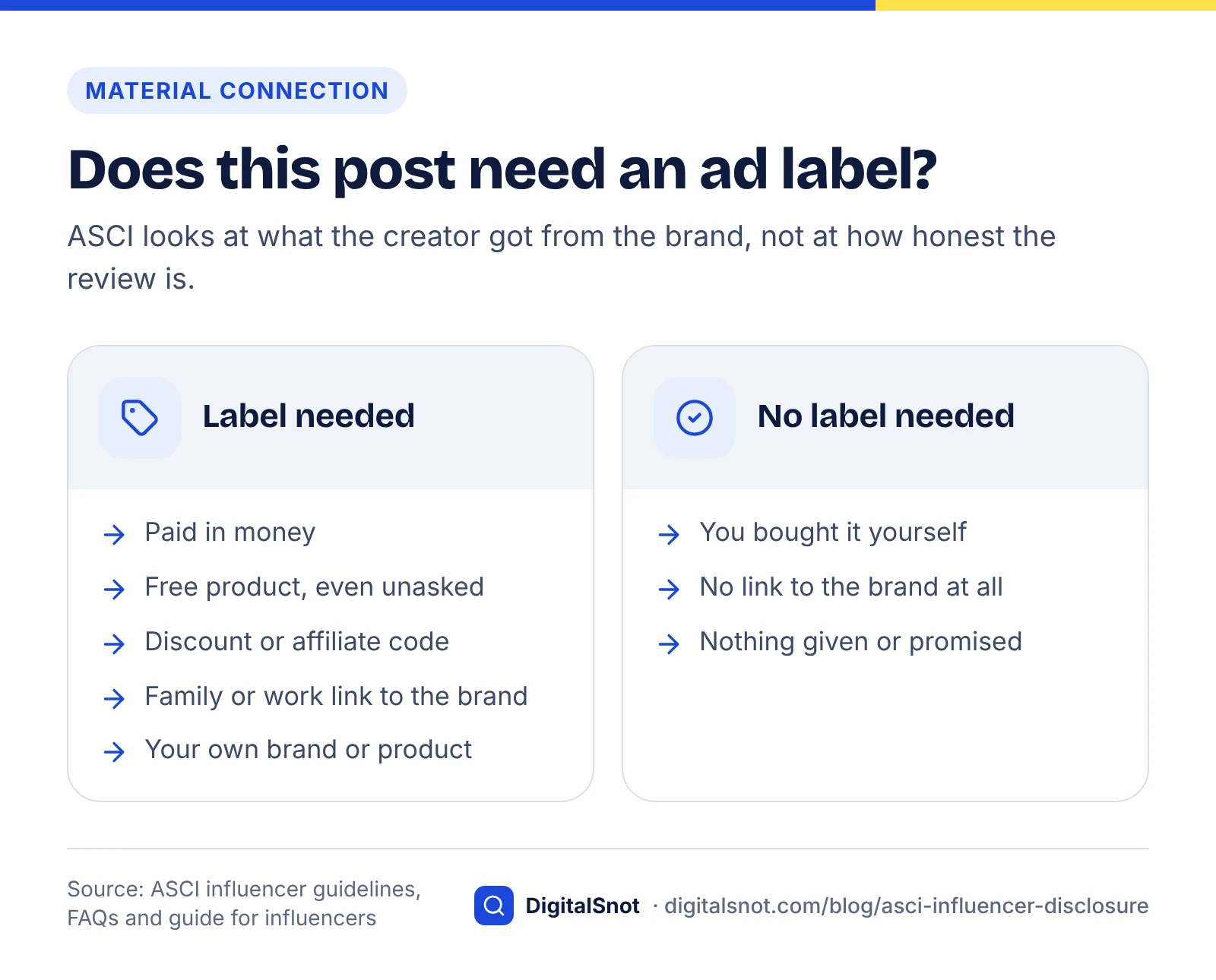
ASCI asks for a label whenever there is a material connection between the brand and the creator. Its guidelines for influencer advertising in digital media define it as any connection that may affect the weight or credibility of what the creator says. It is not limited to money. It includes:
- payment of any kind;
- free products, with or without conditions, including ones the creator did not ask for;
- discounts, gifts, contest entries, trips and hotel stays;
- a family or employment relationship with the brand.
The label is needed even when the review is honest and the opinions are the creator's own. ASCI's guide for influencers adds two common cases: a link or code that pays the creator for clicks or sales (affiliate marketing), and a post about the creator's own product or a relative's business.
When does a post not need one? ASCI's FAQs say that if someone buys a product and talks about it with no connection to the brand, it is not an advertisement.
The labels ASCI accepts
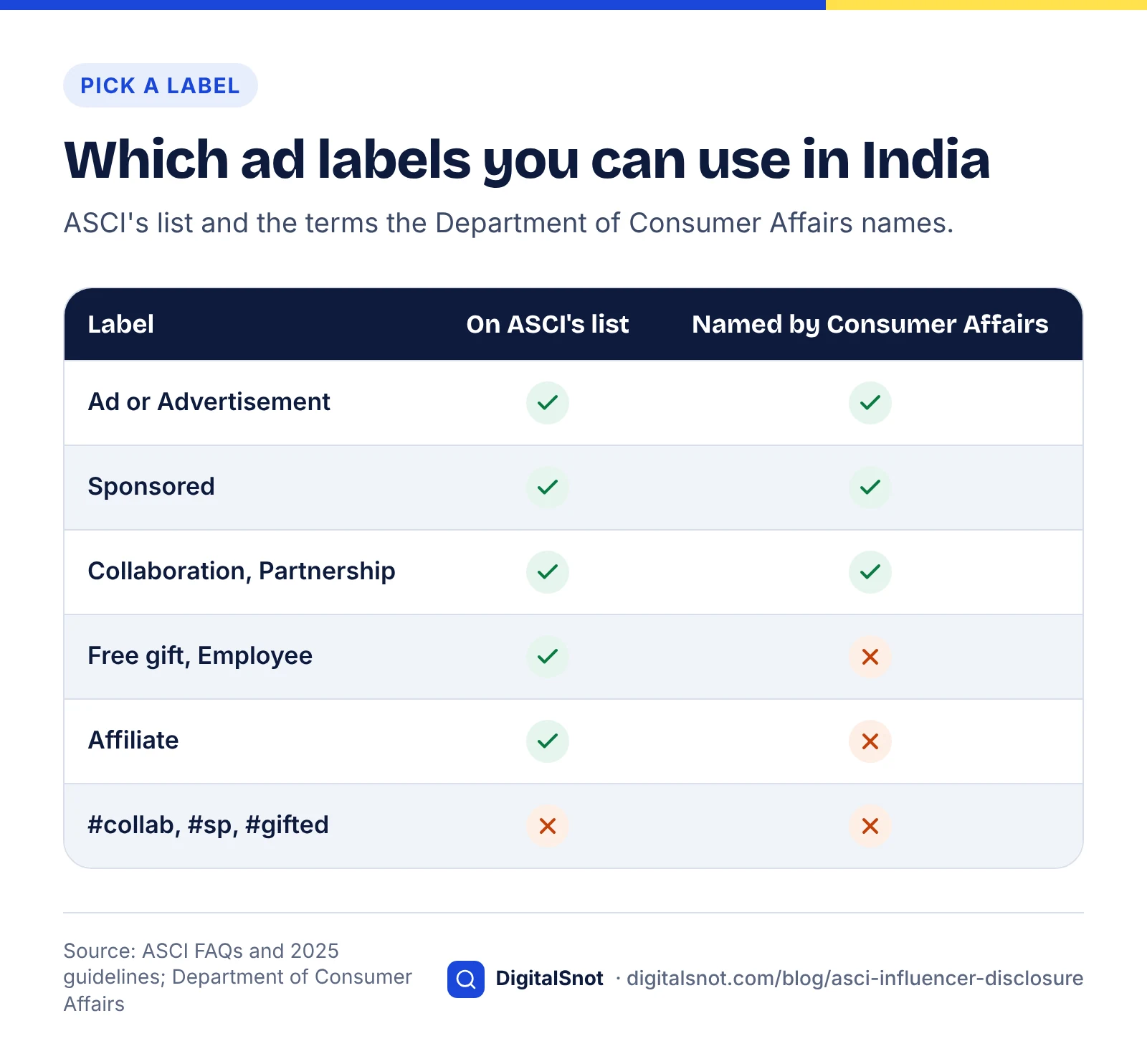
ASCI's FAQs list the labels that can be used: Advertisement, Ad, Sponsored, Collaboration, Partnership, Employee and Free gift, and say no other labels can be used. The 2025 guidelines add Affiliate, and platform disclosure tools such as Instagram's paid partnership label and YouTube's "Includes paid promotion".
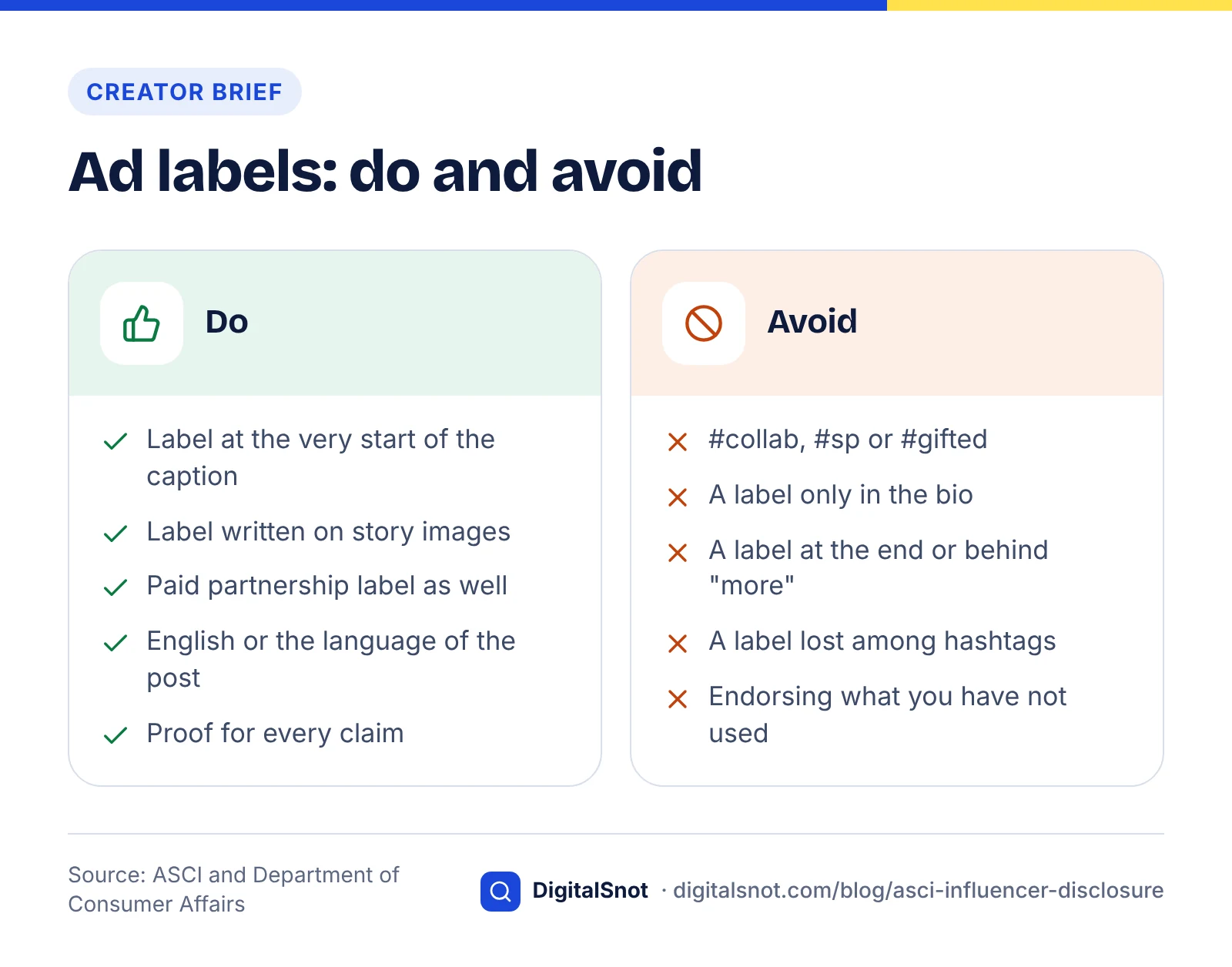
Short forms are not on the list. #collab, #sp and #gifted are common, but none of them is an accepted label; write #Collaboration, #Sponsored or "Free gift" instead.
The label can be in English or in the language of the advertisement, as long as an average consumer can understand it. So a Hindi reel can carry "Ad" or विज्ञापन (our reading of that rule).
The Department of Consumer Affairs' guide, Endorsements Know-hows, names five terms for paid or barter endorsements: advertisement, ad, sponsored, collaboration and partnership, shown as a hashtag or headline text. "Ad" is on both lists and can be read at a glance, which is why our tools suggest it.
Where the label goes
ASCI's rule is that the disclosure must be upfront and prominent, so an average consumer does not miss it. Its guidelines say a label is likely to be missed if it appears:
- only in the bio or an "about me" page;
- at the end of a post or video;
- anywhere a reader has to tap "more" to see;
- buried in a group of hashtags or links.
The Department of Consumer Affairs, in its January 2023 release, says the same: the disclosure must be clear, prominent and extremely hard to miss, and not mixed with a group of hashtags or links.
In practice, start the caption with the label: "Ad | Free gift: ..." rather than ending it with "#ad" after twenty other hashtags.
Stories and pictures without text. ASCI says the label is superimposed on the picture or video so viewers can see it clearly, and the Department's guide also asks for it on the image. A caption alone is not enough for a story.
To check a caption before it goes live, paste it into our Influencer Post Disclosure Checker. Tick what the brand gave and the type of post, and it finds the label, checks it against ASCI's list, flags look-alikes such as #collab, shows whether the label is upfront or lost among hashtags, and gives you a fixed caption with the label at the start. Instagram does not publish where it cuts a caption, so "upfront" there is our measure: the first 90 characters and the first two lines. It reads only the caption, so it gives you a list of the things to check by hand, such as the label on the image.
Reels, videos and live streams
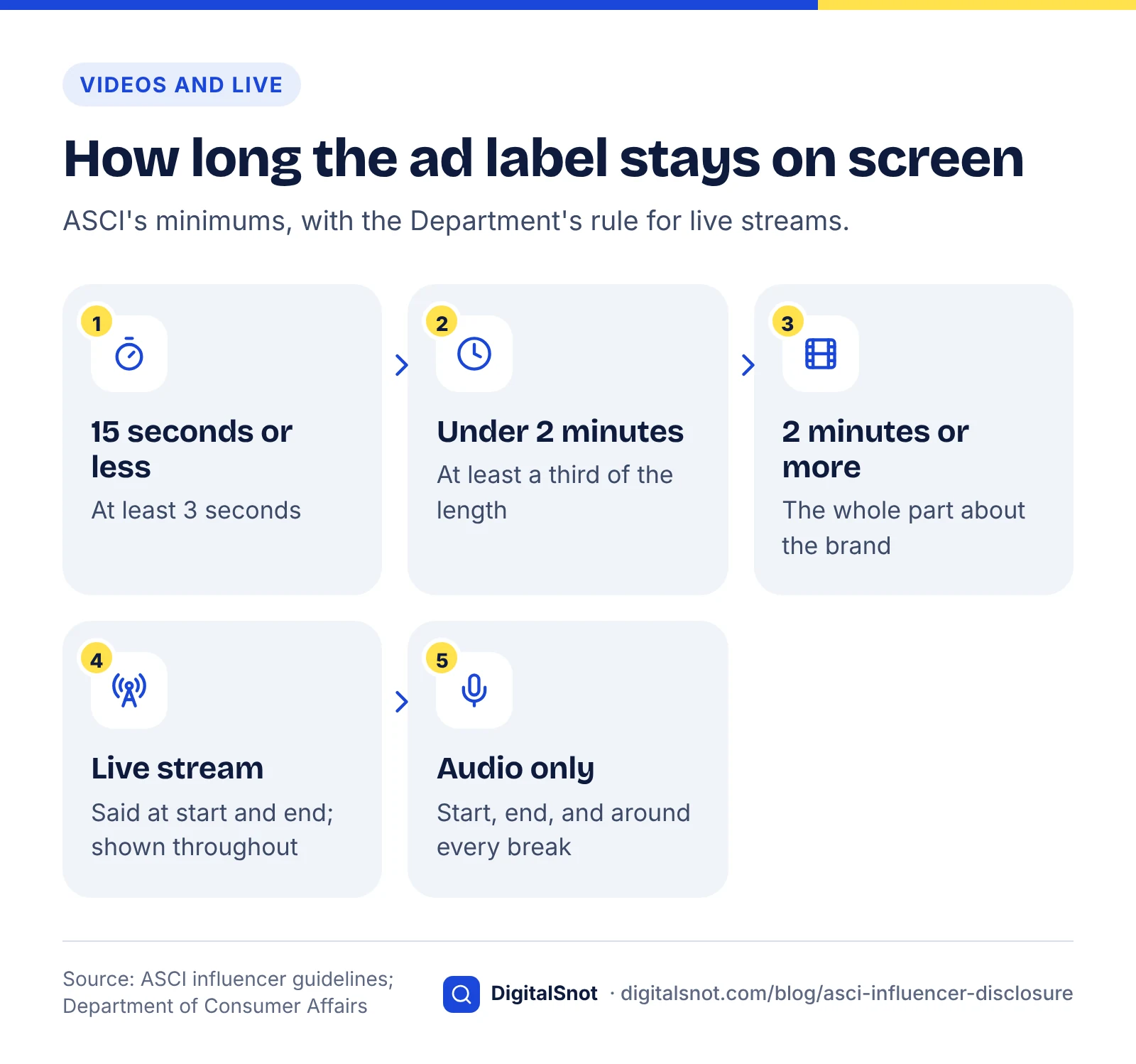
For a video, the label goes on screen as well as in the caption. ASCI's guidelines set the minimum time it stays there:
- 15 seconds or less: at least 3 seconds;
- more than 15 seconds and under 2 minutes: at least a third of the length;
- 2 minutes or more: the whole section in which the brand or its features or benefits are mentioned.
For a live stream, ASCI asks for the label to be announced at the beginning and the end, and added to the caption if the recording stays up afterwards. For audio, it is announced at the start, at the end and before and after every break. The Department of Consumer Affairs goes further for video and live streams: its March 2023 release says disclosures should be made in both audio and video and displayed continuously and prominently during the entire stream. Following the stricter rule meets both.
On YouTube there is one more step. YouTube's paid product placements policy asks creators to tick the paid promotion setting in YouTube Studio for content made in return for something of value, including free products. Our YouTube Paid Promotion and ASCI Disclosure Helper takes what the brand gave, the video type and its length, and tells you whether to tick that box, which label to use, how long it stays on screen, and gives you a line to say at the start and a line for the description in English, Hinglish or Hindi.
Instagram's paid partnership label is an extra
Meta's branded content policies ask creators to tag the brand with the branded content tool, which on Instagram is the paid partnership label, when a brand has given money or something of value such as a free gift. The brand must approve the tag. Instagram Help explains how to add the paid partnership label: turn on branded content tools, then switch on the label under Advanced settings when you post.
Use it, but not on its own. ASCI's guidelines say a platform's disclosure tool is in addition to the creator's own disclosure, and Meta says tagging the brand does not remove your legal responsibility to disclose. Keep "Ad" at the start of the caption and on the image as well.
Virtual influencers, health and finance
A virtual influencer, a computer-made character, also needs ad labels, and ASCI asks that it tells people they are not dealing with a real human.
Creators who give health, nutrition or financial advice have extra duties. ASCI's 2023 update for health and finance influencers asks for the relevant qualification or registration, such as SEBI registration for investment advice, shown upfront. The Department of Consumer Affairs has also issued additional guidelines for health and wellness influencers. If your brand is in these fields, check the current text with your lawyer before a campaign.
Who is responsible, and what can happen
Under ASCI's guidelines, the responsibility for disclosure and for the content of the ad lies with both the brand and the creator, and ASCI notifies both when a post breaks the rules. Creators are also expected to check that the brand can back up its claims. The Department of Consumer Affairs says creators must not endorse anything they have not personally used or experienced, or where they have not done due diligence.
The law adds teeth. Under the Central Consumer Protection Authority's 2022 guidelines on misleading advertisements, the CCPA can fine manufacturers, advertisers and endorsers up to ₹10 lakh for a misleading advertisement, and up to ₹50 lakh for later ones, and can bar an endorser from endorsing for up to one year, or up to three years for later contraventions.
Worked example: Chai Tapri Co., Ahmedabad
Chai Tapri Co. is a made-up packaged tea brand planning one reel with a Surat food creator. Before choosing, it compares two creators in our Influencer Campaign Calculator, using numbers from their recent posts:
- Creator A: ₹8,000 fee plus a tea hamper worth ₹1,200, about 12,000 views a reel: ₹9,200, or about ₹0.77 a view.
- Creator B: ₹15,000 fee plus the same hamper, about 30,000 views a reel: ₹16,200, or about ₹0.54 a view.
Any GST on the creator's invoice comes on top; the rate is for your CA to confirm. TDS can also apply to free products a creator keeps once their value to one person crosses ₹20,000 in a financial year, and the calculator reminds you of this.
The brand picks creator B and writes these points into the brief:
- Caption starts with "Ad | Free gift:" before the first line.
- "Ad" on screen for at least 15 seconds of the 45-second reel, a third of its length; our suggestion is to keep it there for the whole reel.
- "Ad" written on both story frames that show the hamper.
- The paid partnership label switched on, with Chai Tapri Co. tagged and approved.
- No claim the brand cannot prove, such as health benefits; the creator tastes the tea before filming.
- The brand sees the post before it goes live (our suggestion), and both keep a copy of the brief.
Mistakes to avoid
- "#collab" or "#gifted" as the only label. Neither is on ASCI's list.
- The label at the end of a long caption. Readers who never tap "more" never see it.
- Relying on the paid partnership label alone. ASCI treats it as an addition.
- Stories with no label on the image. Stories have no caption to save them.
- Skipping the label for "only a free sample". Free products count, even unsolicited ones.
- Letting the creator make claims the brand cannot prove. Both of you are responsible.
Next step
Add a disclosure section to every creator brief, and check each caption before it goes live. All three tools in this post are free on our social media tools page; they work in your browser and never sign in to anyone's account. For the Instagram side of a small business's plan, read our 30-day Instagram plan for a local shop. If you are planning a creator campaign and want a second pair of eyes on it, talk to us.
Free tools in this article
- Influencer Post Disclosure Checker Check an influencer caption's ad label against ASCI's list and placement rules, and copy a fixed caption.
- YouTube Paid Promotion and ASCI Disclosure Helper Get the paid promotion setting, the ASCI label and its time on screen, and ready lines in three languages.
- Influencer Campaign Calculator Compare creators by cost per view and engagement, find the best mix for your budget and track cost per sale.
By the numbers
- the most the CCPA can fine an endorser of a misleading advertisement, rising to ₹50 lakh for later contraventions
- ₹10 lakh
- Source: Press Information Bureau, Department of Consumer Affairs
- the shortest time an ad label stays on screen in a video of 15 seconds or less, under ASCI's guidelines
- 3 seconds
- Source: ASCI
Frequently asked questions
Is #ad at the end of my caption enough?
No. ASCI says a label is likely to be missed at the end of a post, anywhere that needs a tap on "more", or in a group of hashtags. Put it at the very start of the caption, for example "Ad | Free gift:" before your first line.
Is #collab an accepted ASCI label?
No. ASCI's FAQs list Advertisement, Ad, Sponsored, Collaboration, Partnership, Employee and Free gift, and its 2025 guidelines add Affiliate and platform tools. Short forms such as #collab, #sp or #gifted are not on the list, so write #Collaboration or simply "Ad".
Does a free product with no payment need a label?
Yes. ASCI counts free products, even ones the creator did not ask for, as a material connection, and the label is needed even if the review is honest. "Ad | Free gift" at the start of the caption covers it.
Is Instagram's paid partnership label enough on its own?
No. ASCI's guidelines say a platform's disclosure tool is in addition to the creator's own label, and Meta says tagging the brand does not remove the legal responsibility to disclose. Use both.
How long must the ad label stay on screen in a reel?
Under ASCI's guidelines, at least 3 seconds for a video of 15 seconds or less, at least a third of the length for one under 2 minutes, and the whole brand section for longer videos. Keeping it on for the whole reel is simpler.
Who is responsible if an influencer post is not labelled?
ASCI holds both the brand and the creator responsible and notifies both. Under the CCPA's 2022 guidelines, an endorser of a misleading advertisement can be fined up to ₹10 lakh, up to ₹50 lakh for later ones, and barred from endorsing for up to 1 year, or 3 years for later ones.
Sources
Every figure and claim in this article comes from the sources below. We checked each one when writing and link to the original so you can read it yourself. Credit belongs to the authors and publishers listed. How we write and check our articles.
-
1
Guidelines for Influencer Advertising in Digital Media (2025)
Advertising Standards Council of India (ASCI) · Material connection, accepted labels including Affiliate and platform tools, placement, on-screen times, live and audio rules, shared responsibility.
-
2
Influencer guidelines FAQs
ASCI · The list of accepted labels; a product bought with no connection is not an ad; disclosure in video captions.
-
3
ASCI's guide for influencers
ASCI · Affiliate links and codes, own products and relatives' businesses need a label.
-
4
Health and finance influencer guidelines update (2023)
ASCI · Qualifications and registration shown upfront for health and financial advice.
-
5
Endorsements Know-hows! For celebrities, influencers and virtual influencers
Department of Consumer Affairs · The Department's guide for influencers on disclosing endorsements.
-
6
Centre releases endorsement guidelines for celebs and social media influencers
Press Information Bureau · 20 January 2023: disclosures clear, prominent and extremely hard to miss, not mixed with hashtags; do not endorse what you have not used.
-
7
Centre releases guidelines for celebrities, influencers and virtual influencers on social media platforms
Press Information Bureau · The five terms as hashtag or headline text; on the image for pictures; audio and video, throughout live streams.
-
8
Additional guidelines for health and wellness celebrities, influencers and virtual influencers
Press Information Bureau · Extra rules for health and wellness endorsements.
-
9
Guidelines on Prevention of Misleading Advertisements and Endorsements for Misleading Advertisements, 2022
Press Information Bureau · CCPA penalties up to ₹10 lakh and ₹50 lakh, and endorser bans of up to 1 and 3 years.
-
10
Branded content policies
Instagram Help Centre · Use the branded content tool for content made for an exchange of value; tagging does not remove legal responsibility.
-
11
Add a paid partnership label on Instagram
Instagram Help Centre · Turning on branded content tools and the label under Advanced settings; brand approval.
-
12
Paid product placements, sponsorships and endorsements
YouTube Help · Tick the paid promotion setting in YouTube Studio for content made in return for something of value.